Hood design-Week 2
HOOD DESIGN
Objective:
Design Outer Panel with the Hem.
Develop the Inner Panel.
Develop all the Necessary Reinforcements.
Mirror and position the Hinge & Striker.
Provide Mastic Data.
Provide the required Emboss definition.
Develop a detailed Report for the Mastic position and Embossed you have placed.
Introduction:-
The hood or bonnet is a hinged cover over the engine of motor vehicles that allows access to the engine compartment, or trunk for maintenance and repair. The inner panel provides strength while the outer panel functions as the metal cover. Hood comes from the Old English word hod which means a hood, a soft covering for the head. Interestingly, hood is used by British English speakers to refer to the waterproof cloth top covering the passenger-compartment of a car.
Concerns regarding the severity of a potential pedestrian head injury during a collision with a motor vehicle have led to advanced hood designs on many models. Such designs may include a multi-cone inner hood panel design. An active structure capable of pushing the surface of the hood away from the vehicle's hard motor components in the event of a pedestrian crash is also in use. Pyrotechnic or spring force designs are often used in active-hood design.
Hood
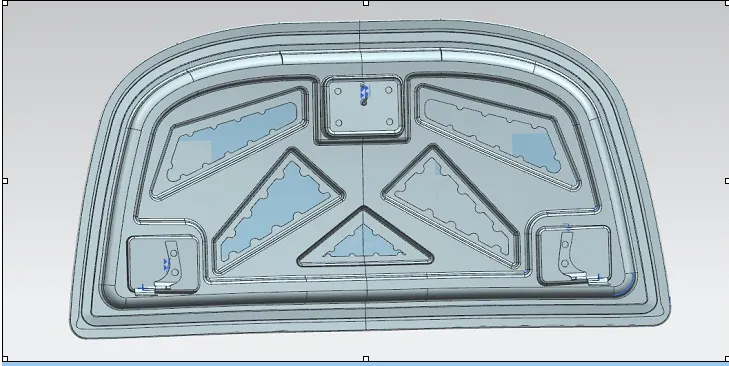
The Hood assembly consists of inner and outer panels, latch and Hinge Reinforcement. Here the Outer and inner panels are joined with the help of hemming process and application of Mastic sealant.
Hood Thickness Information
Outer Panel Thickness = 0.75mm
Inner Panel Thickness = 0.75mm
Reinforcement Thickness = 1.5mm
Outer Panel with the Hem
Hemming and Edge Relief:-
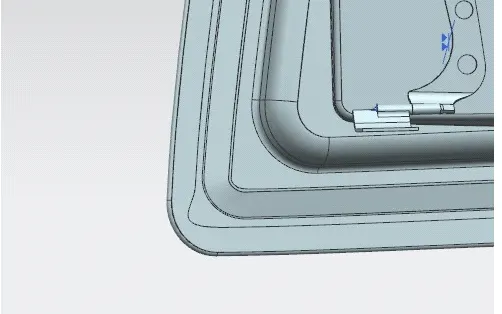
Hemming is a forming operation in which the edges of the sheet are folded or folded over another part in order to achieve a tight fit. Normally hemming operations are used to connect parts together to improve the appearance of a part and to reinforce part edges. The accuracy of the hemming operation is very important since it affects the appearance of the surface and surface quality. Material deformations, which occur during the hemming process, can lead to dimensional variations and other defects in parts. Typical hemming defects are split or wrinkles in the flange, material overlaps in the corner areas or material roll-in.
Hemming:-
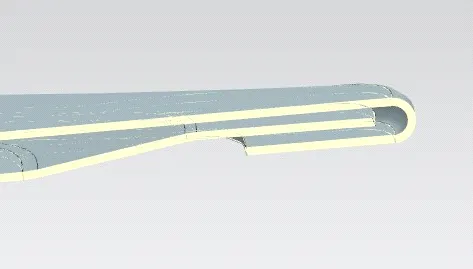
some materials are removed from the corners of outer panel to give relief.
Latch Placement:-
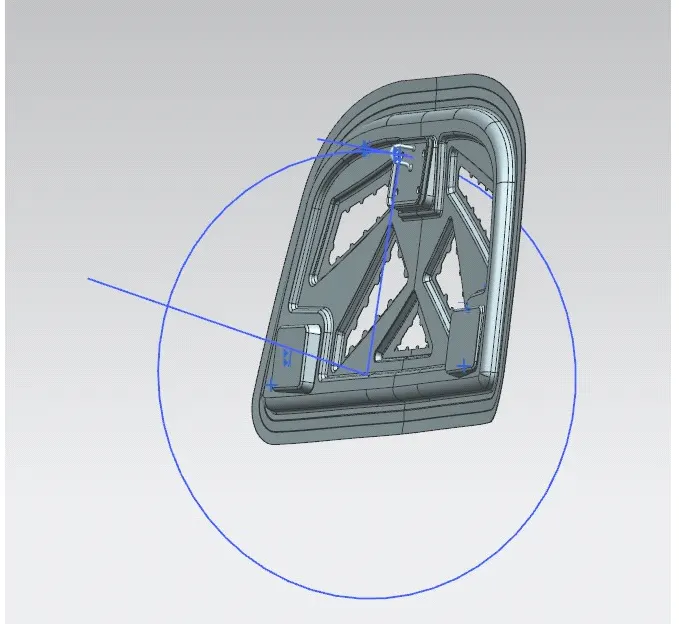
Using the axis of the hinge, a circle is drawn at the middle of the hood and the latch is placed perpendicular to that circle.
Mastic Seal:-
In hood, Mastic are used in between inner and outer panels. It is a type of liquid sealant that occurs in an elastic state, thus making it flexible yet still keeps the bond of the surface that is attached together.
Embossing:-
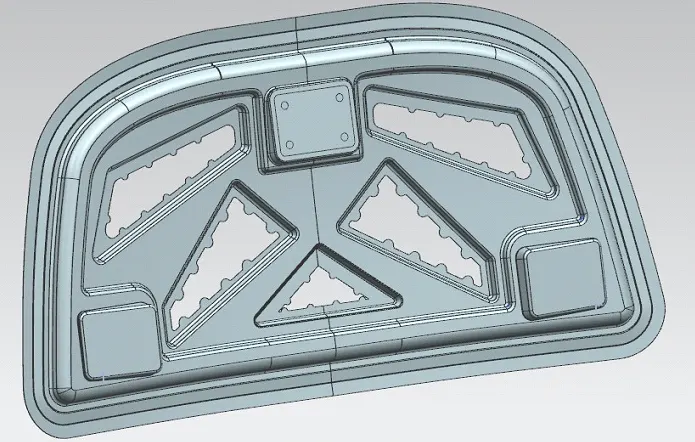
To reduce the weight of Hood, some materials are removed and embosses are created to give stiffness to the panel. Sheet metal embossing is a stamping process for producing raised or sunken designs or relief in sheet metal. In this project the Embosses are created to divide the force towards the hinge joints during collision.
Deep Drawing:-
Deep drawing is a widely used process in sheet metal forming. Here, a sheet metal blank is radially drawn into a forming die by the mechanical action of a punch. This is also known as the shape transformation process. The process is considered "deep" drawing when the depth of the drawn part exceeds its diameter. The part is redrawn with the help of series of dies. The flange region experiences a radial drawing stress and tangential compressive stress due to the material retention property. These compressive stresses result in flange wrinkles. Wrinkles can be prevented by using a blank holder, the function of which is to facilitate controlled material flow into the die radius.
Deep drawing processes are divided into three types:
1. Deep drawing with a tool
2. Deep drawing with active means
3. Deep drawing with active energy.
Important factors
Opening angle:-
It is the angle between the hood surface and the hinge axis (parallel to road).It may vary with countries based on the average height of their citizens.
Hood Support rod and strut:-
Support rods are ordinary roads with some bends to make it more rigid and most cars have heavy steel torsion springs and brackets to hold the hood up. Struts were introduced to save weight. Upon lifting the hood, the hood struts extend, assisting you with raising the hood. Also called hood lift support, the hood struts acting as a prop rod to hold the hood up when fully extended.