Full Hydro simulation of PFI engine in ConvergeCFD
Aim- To run a full hydro simulation of a PFI engine.
Description- In this project, we are going to continue with the full hydro simulation of PFI engine by using the combustion model and SAGE model has been incorporated into CONVERGE which helps in including detailed chemistry in combustion applications with a set of chem.in format input files the fuel used is IC8H18 which has close characteristics and chemical similarity with the gasoline.
Geometry
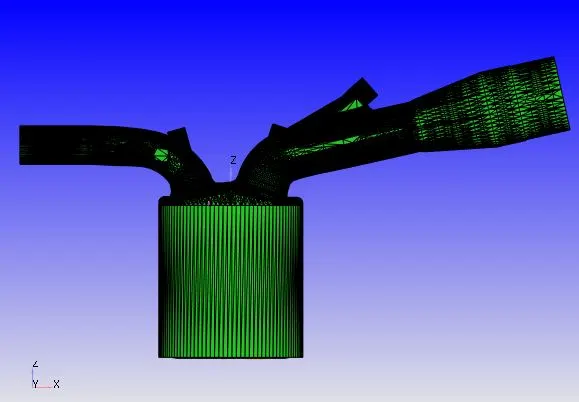
Models used:
|
Turbulence models |
RNG k-ε |
|
Injection drop distribution |
Χ2 distribution |
|
Drop drag |
Dynamic drag model |
|
Droplet collision model |
NTC model |
|
Drop turbulent dispersion |
O’Rourke model |
|
Drop/wall interaction |
Rebound slide model |
|
Evaporation model |
Chiang model |
|
Spray breakup |
KH-RT |
|
Combustion model |
SAGE |
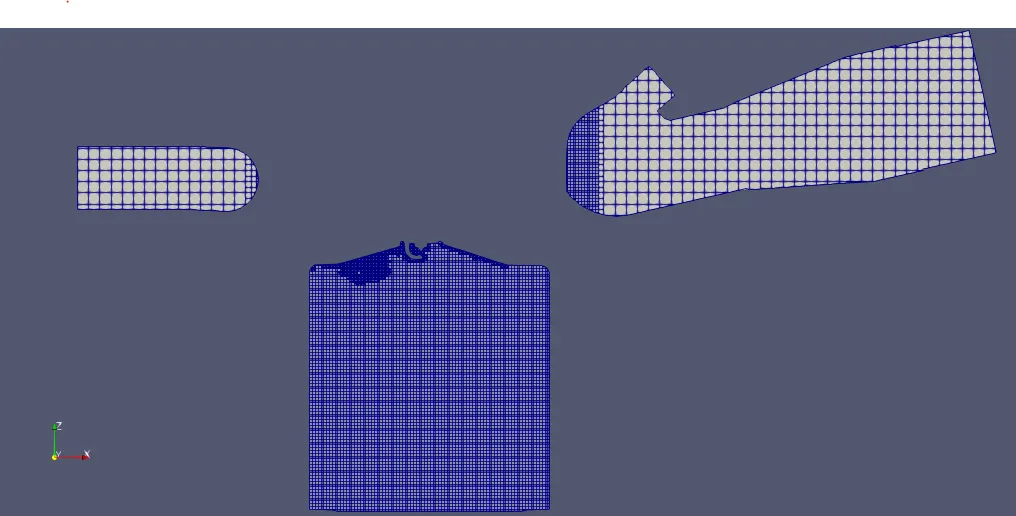
Mesh:
Results:
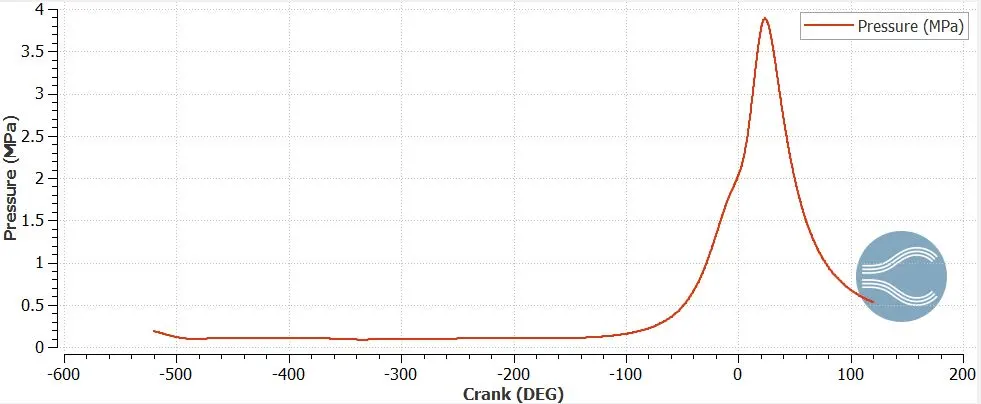
The peak pressure for the engine is 3.88 Mpa which is obtained at 25ᵒ at this point the engine undergoes compression stroke which is an isochoric process this leads to such a huge pressure rise in the engine. The engine components should be designed in such a way that it can withstand high pressure.
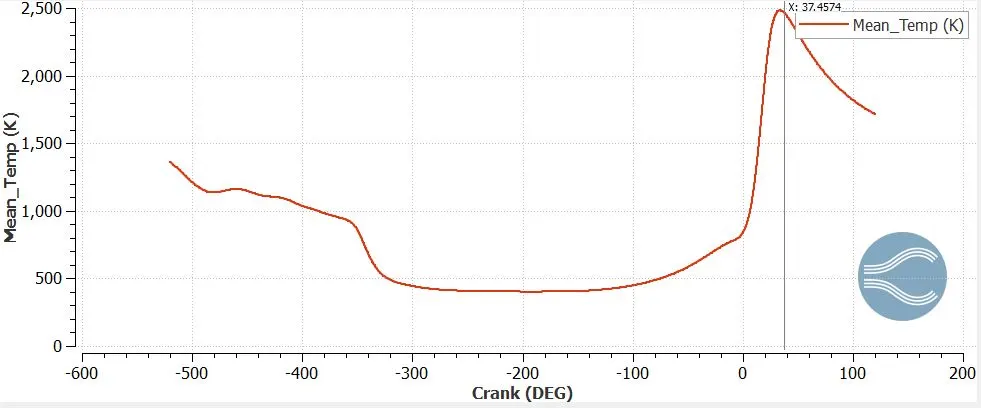
The peak temperature is at 2480K which is at 33ᵒ crank angle when the piston reaches the top dead center the pressure it rises to a maximum at 25ᵒ at this point the temperature is around 2335 K by close supervision of the graph at 0ᵒ after this point there is a drastic increase in the temperature this is due to the spark produced and it's maintained at 600K temperature which is sufficient to ignite the gasoline whose SIT(self-ignition temperature ) is 210 ᵒ also the temperature rise is due to the high pressure caused by the piston motion.
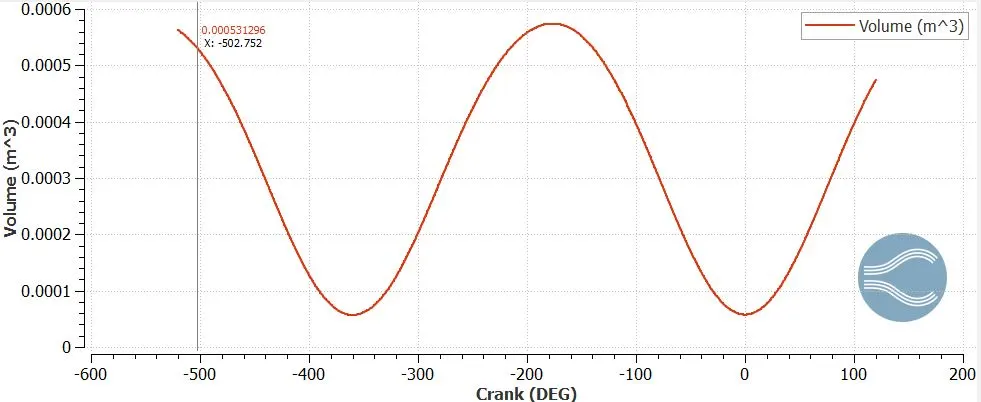
The clearance volume of the cylinder is 5.737*10-5 m3 so the volume plot is necessary to calculate the compression ratio of the PFI engine and the maximum volume of the engine which is the swept volume of the piston is 0.00057412 m3.
Clearance volume (Vc) = 5.737 *10-05 m3
Maximum volume i.e (Vc+Vs) =.00057412 m3 Compression ratio (r) = 10.07
For an SI (spark ignition engine ) the compression ratio is between 8 – 12.
The mass of the fuel-injected per cycle in the engine is 3*10-5 and the calorific value of the gasoline is 44.6 MJ/kg.
Where m is the mass of the fuel trapped =2.102*10-5 kg
=∆H (N2) + ∆H(O2) + ∆H(IC8H18) - ∆H(CO2) - ∆H(H2O) + ∆H(N2);
∆H(O2)= Enthalpy of formation of oxygen is 0 KJ/mol
∆H (N2) =433 KJ/mol =433*1000/28= 15464.28 KJ/kg
∆H(IC8H18) = -259.3KJ/mol=-2271.93 KJ/kg
∆H(CO2) =-393.5 KJ/mol=-8943.18 KJ/kg
∆H(H2O) = -241.820KJ/mol=-13434.4 KJ/kg
Hence the combustion efficiency is =79.81%
Torque as per the formula is given in the challenge the torque can be found out.
Indicated work from the engine is 468.646 Nm
RPM =3000 rpm
Time = 5.55*10-5 sec/degree
Total duration is 639.82 hence the total Time (seconds) =639.82 * 5.55*10-5 = 0.0355 Power = 468.646/0.03551 = 13.197 KW
N=3000 rpm
Torque =0.0446 KNm
Significance of ca10, ca50, and ca90 is the percentage of the combustion taking place in the cylinder it's specified along with the crank angle degree from the engine performance calculator the following values for the ca10, ca50,ca90 was obtained;
CA10 deg: 6.83717
CA50 deg: 18.4623
CA90 deg: 31.701
The physical significance of CA10 is that it is used to identify the start of ignition in an Sl engine, whereas the CA50 indicates the end of premixed combustion and the start of diffusion combustion of fuel used in the engine and CA90 specifies the end of the combustion in an SI engine. The higher the difference between CA10 and CA90 (CA90-CA10), the higher will be the combustion duration and vice versa.
Conclusion
The PFI engine was simulated using converge and some parameters like compression ratio, combustion efficiency power, and torque were calculated.