Frequency Analysis of a rotating shaft
Aim: To run the simulation of frequency analysis in solidwork for the rotating shaft by applying bearing fixture on the stepped face of the two ends and find out five mode shaped and resonant frequencies.
Introduction:
The number of cycles completed in a unit time is called Frequency.Frequency is measured in hertz (Hz) which is equal to one event per second.Time taken to complete one cycle is called periodic time. It is represented in seconds/cycle `F=1/T`.
Amplitude - The maximum displacement of a vibrating system or body from the mean equilibrium position is called amplitude.
Free Vibrations - When a system is disturbed, it starts vibrating and keeps on vibrating thereafter without the action of external force. Such vibrations are called free vibrations.
Natural Frequency - When a system executes free vibrations which are undamped, the frequency of such a system is called natural frequency. F=`w /2*π`
Forced Vibrations- The vibrations of the system under the influence of an external force are called forced vibrations. The frequency of forced vibrations is equal to the forcing frequency.
Resonance- When frequency of the exciting force is equal to the natural frequency of the system it is called resonance. Under such conditions the amplitude of vibration builds up dangerously.
Degree of Freedom- The degree of freedom of a vibrating body or system implies the number of independent coordinates which are required to define the motion of the body or system at given instant.
Natural Frequency Of Shaft
In solid mechanics, in the field of rotordynamics, the critical speed is the theoretical angular velocity that excites the natural frequency of a rotating object, such as a shaft, propeller, leadscrew, or gear. As the speed of rotation approaches the object's natural frequency, the object begins to resonate, which dramatically increases system vibration. The resulting resonance occurs regardless of orientation. When the rotational speed is equal to the numerical value of the natural vibration, then that speed is referred to as critical speed.
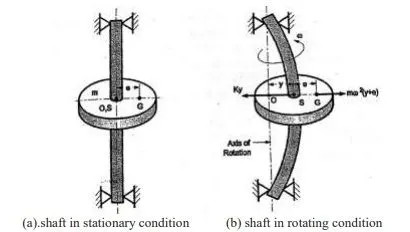
All rotating shafts, even in the absence of external load, will deflect during rotation. The unbalanced mass of the rotating object causes deflection that will create resonant vibration at certain speeds, known as the critical speeds. The magnitude of deflection depends upon the following:
- Stiffness of the shaft and its support
- Total mass of shaft and attached parts
- Unbalance of the mass with respect to the axis of rotation
- The amount of damping in the system
The critical speed is the theoretical angular velocity which excites the natural frequency of a rotating object, such as a shaft. As the speed of rotation approaches the objects natural frequency, the object begins to resonate which dramatically increases systemic vibration. The resulting resonance occurs regardless of orientation. When the rotational speed is equal to the numerical value of the natural vibration then that speed is called critical speed.
For a rotating shaft there is a speed at which, for any small initial deflection, the centrifugal force is equal to the elastic restoring force. At this point the deflection increases greatly and the shaft is said to "whirl". Below and above this speed this effect is very much reduced. This critical (whirling speed) is dependent on the shaft dimensions, the shaft material and the shaft loads.
All rotating shafts, even in the absence of external load, deflect during rotation. No shaft is perfectly straight and no shaft with attached masses is perfectly statically balanced such that the centre of gravity coincides with the axis of rotation.
Case setup:
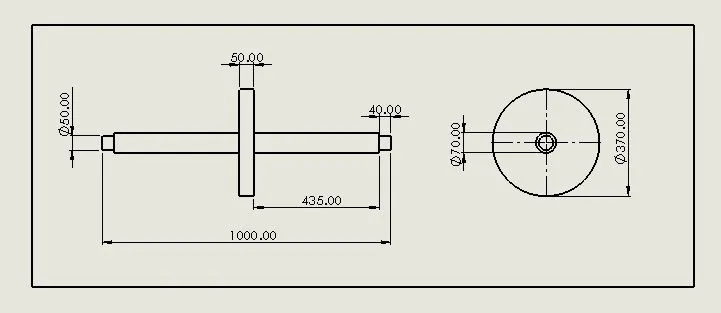
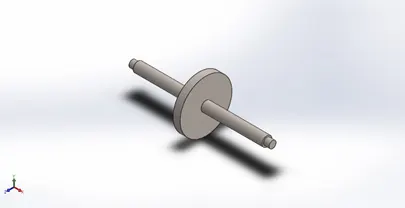
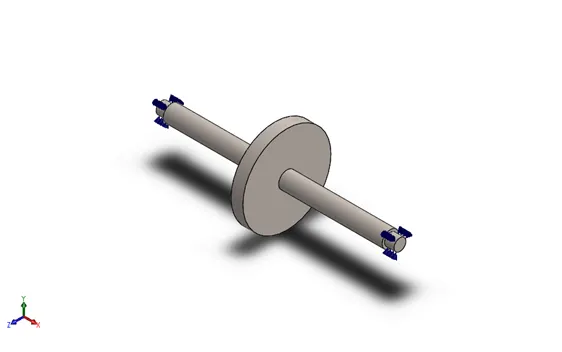
The shaft is drawn in solid work according to the shape model given in question all dimensions are assumed and a shaft having length of 1 metre is made with larger dia of 370mm .
Material Poperties:
|
Name: |
Alloy Steel |
|
Model type: |
Linear Elastic Isotropic |
|
Default failure criterion: |
Max von Mises Stress |
|
Yield strength: |
6.20422e+08 N/m^2 |
|
Tensile strength: |
7.23826e+08 N/m^2 |
|
Mass density: |
7,700 kg/m^3 |
|
Elastic modulus: |
2.1e+11 N/m^2 |
|
Poisson's ratio: |
0.28 |
|
Thermal expansion coefficient: |
1.3e-05 /Kelvin |
Mass:68.3859 kg
Volume:0.00888128 m^3
Density:7,700 kg/m^3
Weight:670.182 N
The Bearing fixture is applied at the step face of the shaft on bothe the ends sicnce this simmlation is to find out the natural frequency of the shaft hence no external load hs been applied.
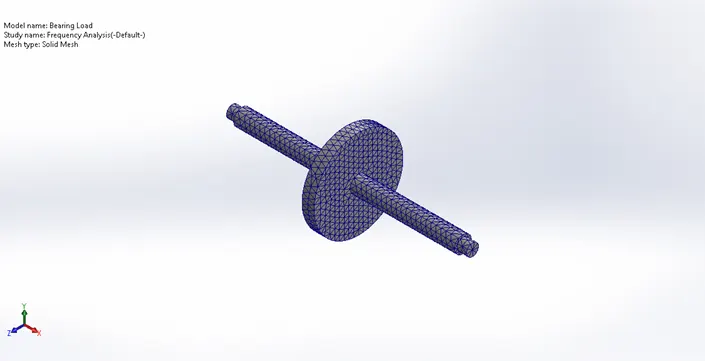
Mesh diagrame
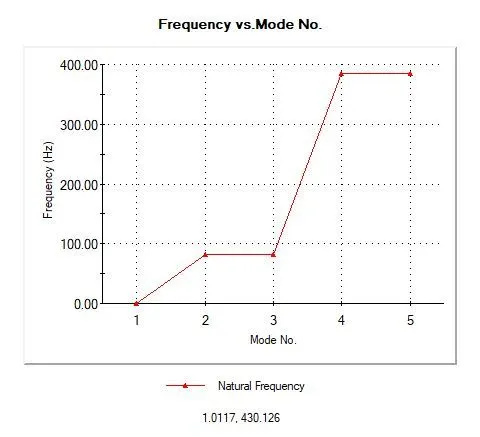
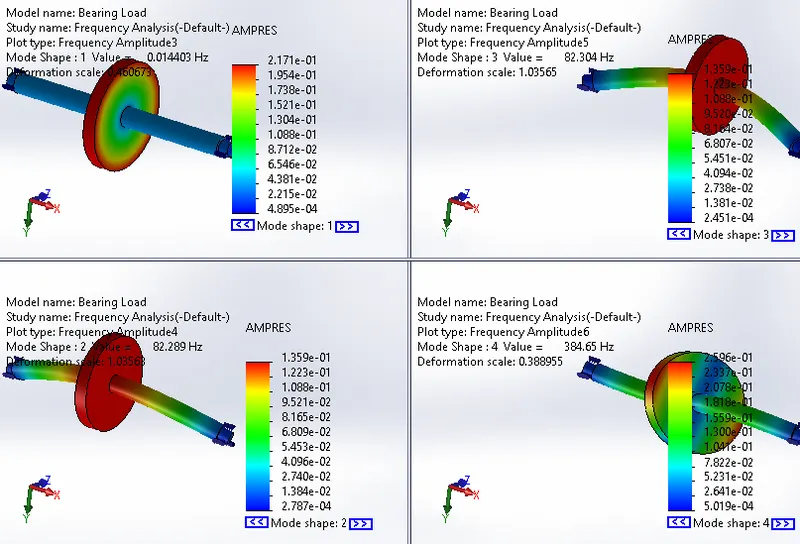
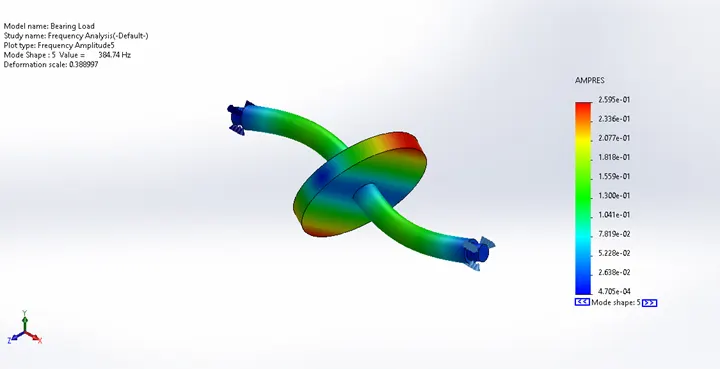
after running frequency analysis five different mode shape obtained and five different frequency obtained from the result.
Mass Participation (Normalized)
|
Mode Number |
Frequency(Hertz) |
X direction |
Y direction |
Z direction |
|
1 |
0.014403 |
1.1037e-40 |
5.0178e-11 |
7.3165e-12 |
|
2 |
82.289 |
1.7337e-10 |
0.45791 |
0.44912 |
|
3 |
82.304 |
9.7833e-11 |
0.44912 |
0.45792 |
|
4 |
384.65 |
2.6777e-09 |
1.8293e-09 |
2.8082e-10 |
|
5 |
384.74 |
1.0218e-08 |
4.3272e-10 |
3.8758e-09 |
|
|
|
Sum X = 1.3166e-08 |
Sum Y = 0.90703 |
Sum Z = 0.90703 |
Conclusion:
| Mode No. | Frequency(Rad/sec) | Frequency(Hertz) | Period(Seconds) |
| 1 | 0.090497 | 0.014403 | 69.43 |
| 2 | 517.04 | 82.289 | 0.012152 |
| 3 | 517.13 | 82.304 | 0.01215 |
| 4 | 2416.8 | 384.65 | 0.0025998 |
| 5 | 2417.4 | 384.74 | 0.0025991 |
Mode No 2 and 3 have almost same natural frequency similarly Mode No 4 and 5 have the same frquency of around 384 Hz. if the body reaches these critical frequencies it could cause the failure.