AIM: We will have to find out the critical frequencies of a rotating shaft in Solidworks. We will have to create the model in Solidworks according to dimensions that you see fit.
INTRODUCTION:
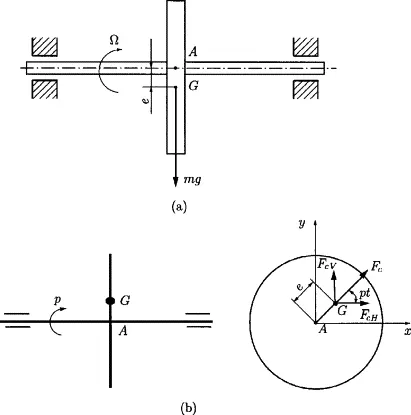
Rotating shafts: Rotating shafts tend to bow out at certain speeds and whirl in a complicated manner. Whirling is defined as the rotation of the plane made by the bent shaft and the line of centers of the bearings. The phenomenon results from such various causes as mass unbalance, hysteresis damping in the shaft, gyroscopic forces, and fluid friction in bearings. Figure 2.36a shows a shaft with a wheel of mass m. The center of mass, G, of the wheel is at the distance e (eccentricity) from the center of the wheel, A. The shaft rotates with a constant (angular) speed Ω = p = const. The centrifugal force is Fc = mep2 and acts at the center of mass, G. By projecting the centrifugal force on the horizontal (Ox) and the vertical axis (Oy) (radial and tangential directions, Fig. 2.36b), the following relations are obtained:
Natural frequency: The natural freequency is the rate at which an object vibrates when it's not disturbed by an outside force. These frequency are dependent on the way mass and stiffness are disturbed inside the body. Frequency (omega) is equai to the speed of the vibration divided by the wavelength (lambda).
Resonance: Resonance is a phenomenon that only occurs when the frequency at which a force is periodically applied is equal or nearly equal to one of the natural frequencies of the system on which it acts. This causes the system to oscillate with larger amplitude than when the force is applied at other frequencies.
Need to calculate natural frequency: To avoid failure at these larger amplitude we should make sure that the operating range of frequency of applied external load isn't near the natural frequency of body. This is the purpose of the project to identify the natural frequency of the body.
It can have a drastic effect, for example collapse of Tacoma Bridge where vibration were caused sue to aeroelastic fluttering
Modes of the vibration: Any complex body (ie more complicated than a single mass on a simple spring) can vibrate in many different ways. ie, there is no one "simple harmonic oscillator". These different ways of vibrating will each have their own frequency, that frequency determined by moving mass in that mode, and the restoring force which tries to return that specific distortion of the body back to its equilibrium position. It can be somewhat difficult to determine the shape of these modes
For example one cannot simply strike the object or displace it from equilibrium, since not only the one mode liable to be excited in this way. Many modes will tend to excited, and all to vibrate together. The shape of the vibration will thus be very complicated and will change from one instant to the next.
However one can use resonance to discover both the frequency and shape of the mode. If the frequencies of the modes are different from each other, then we know that if we jiggle the body very near the resonant frequency of one of the modes, that mode will respond a lot. The other modes, with different resonant frequencies will not respond very much. Thus the resonant motion of the body at the resonant frequency of one of the modes will be dominated by that single mode
Mode 1:
Mode 2:
Mode 3:
Mode 4:
Mode 5:
Results Table :
List of resonance frequency :
Mode No.
Frequency (Rad/sec)
Frequency (Hertz)
Period(Seconds)
1
4335
689.93
0.0014494
2
4338.8
690.54
0.0014481
3
9007.8
1433.6
0.00069753
4
13674
2176.3
0.00045949
5
13682
2177.6
0.00045922
CONCLUSION :
The resonance frequency has different value for different mode.
Thus shaft should not be operated indicated frequency since it can result in resonance which can have drastic effect on lifeof the shaft.