Forces Acting on a Vehicle
AIM: To calculate the forces acting on a vehicle based on the following questions.
What should be the maximum speed of the motor used in an electric Rikshaw capable to run at 25 kmph, if the fixed gear ratio is 9 and tire size is 3.75-12"?
Solution –
Here, the tire size is given as 3.75/12",
To proceed with the calculations we need to determine the tire diameter from the given tire size.
To determine tire/wheel diameter :
First Number 3.75" – The number 3.75" represents the section width of the tire in millimeters. This is the measurement of the tire at its thickest point.
The Second Number 100 – The number 100 represents the sidewall aspect ratio. This will help in finding the height of the sidewall, from rim to tread. This is also called section height.
Section Height = 100 percent of 90 mm
= (90 x 100)/100
= 90 mm
Section Height = 90 mm
The Third Number 12 – The number 12 represents the diameter, in inches, of the wheel on which the tire is mounted.
Rim Diameter = 12 inch = 304 mm
∴">∴∴ Tyre Diameter = 304 + 95 + 95 = 494 mm
∴">∴∴ Tyre Radius (r) = 494/2 = 247 mm = 247 x 10-3 m
Linear Velocity is given as;
v = 25 kmph = (90 x 5)/18 = 7 m/s
Angular Velocity (`w`) is given as;
Angular Velocity = (Linear Velocity) / (Wheel Radius)
`w = v/r`
`w=7/(247*10^-3)` rad/s
`w =28.34 (rad)/sec`
Speed of the motor (N);
N =`(w * 60)/(2*π)` = `(28.34*60)/(2π)` rpm
N =270.62rpm
Speed of the motor with fixed gear ratio 7;
N = 9 x 270.6
∴">∴∴ N = 2435.4 rpm
2. Prepare a simple excel calculator to identify vehicle propulsion power based on given inputs and outputs.
Inputs: Kerb Weight (kg), Payload (kg), Coefficient of rolling resistance, Air density (kg/m3), Width (m), Height (m), Drag coefficient, Speed
Output: Total power in kW
What are the limitations of this calculation?
Solution –
Given -
ρ = 1.25 `(kg)/m^3`;
g = 9.81;
A = HxW
=1.5 x 0.91
`Cd` = 0.3
Formulas used :
Aerodynamic Drag
`Fad =0.5* (ρ * A * Cd*(V^2))`
`Fad = 0.5 * 1.25*(1.5*0.91)*0.3*(7)^2`
`Fad = 12.54 N`
Rolling Resistance
`Frr = μrr * M* g`
`Frr = 0.0167 * 800 `
`Frr = 136 N`
Hiil Climbing Force
`Fhc = M*g*Sin(θ)`
`Fhc = 800*sin(10)`
`Fhc = 138.91`
`F = 12.54+136+139`
Also power is given as;
Power = Force x Velocity
Power = 288 x 7
Power = 2016 watt
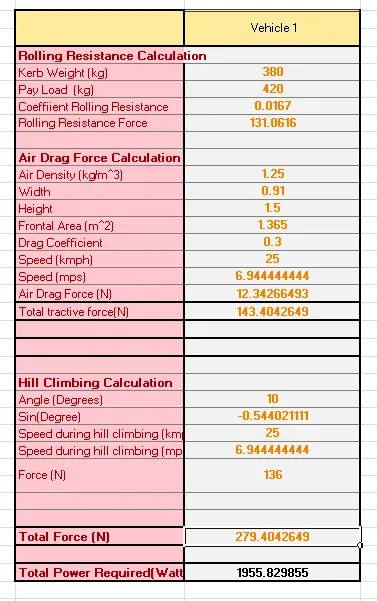
3, Now, We know that Required Power to Drive the vehicle and Motor Speed in RPM. Hence, We can able to calculate Required torque as per following formula
`P = (2π*N*T)/60`
`T = (P * 60)/(2π*N)`
T = `(2016*60)/(2*π*2440`
`T = 7.88 n.m`
Calculations for Battery Power requirements:
Now, we calculate the required capacity of the energy sources. To design an electric Rikshaw with a gross vehicle weight 800 kg ( 380 curb weight and 420 payloads) and at a top speed 25 kmph.
To turn an electric rikshaw 48v 1200 watts BLDC motor, how much ampere-hour of lithium-ion battery is needed.
Step-1: Find out the current (in Amps) consumed by the motor to run.
we know that Power = Voltage x Current
Current, I = Power/Volt
1200/48
I = 25 Amps
Step-2: Find out the watt-hour of the battery. To run the 1200 watts for 1 hour, Simply Multiply (1200 x 1 hour) = 1200 watts/ hour
Take efficiency of 80 % for the battery i.e (1200/0.8)= 1500 watt/hour
Step 3: Convert watt-hour of the battery into Ampere hour of battery,
Ampere hour = (1200/48) = 32 Amps / hour
Therefore, To run 1200 watts/hour for 1 hour 48v and 35 Ah lithium-ion battery is needed. If the electric bike is running at an average speed of 25 kmph, 48V and 35Ah Provide 25 km/hr Mileage.
close all
clear all
clc

%Wide Open Throttle

% REFERENCES
  %[WEBSITE:  https://avt.inl.gov/sites/default/files/pdf/fsev/genmot.pdf]
  %[BOOK:ELECTRIC VEHICLE TECHNOLOGY EXPLAINED, IInd EDITION 2012]

% Inputs
Mass=1546.75 %kg
Air_Density=1.25 %kg/m^3
% Linear_Velocity=19.8 %m/s
Tyre_Width=175 %mm
Aspect_Ratio=65 %
Height_Tyre=113.75 %mm
Rim_Size=355.6 %mm
r=((2*Height_Tyre+Rim_Size)/2)/1000 %mm Radius Of Tyre
% Angular_Velocity=(Linear_Velocity)/(2*3.14*r) %rpm
Drag_Coeff=0.19
Length=4.310 %m
Width=1.765 %m
Frontal_Area=1.8 %m^2
Rolling_Resistance_Coeff=0.0048
G=11 %11:1, Gear Ratio
T_max = 140 %N-m
Wc = 733 %rad/s
Gear_Eff=0.95
P=102000 %W

% Formula,
% I*(G^2/(Gear_Eff*r^2))= 5% of Mass since we are not involving rotating part inetia forces in the calculation
% (G/r)*T_max=((Rolling_Resistance_Coeff*Mass*9.81))+(0.625*Frontal_Area*Drag_Coeff*v^2)+((Mass+I*(G^2/(Gear_Eff*r^2))*(dv/dt)
% (G/r)*T_max=((Rolling_Resistance_Coeff*Mass*9.81))+(0.625*Frontal_Area*Drag_Coeff*v^2)+((Mass+77.3375)*(dv/dt)

% d=(G/r)*T_max*Gear_Eff
% a=(Rolling_Resistance_Coeff*Mass*9.81)=72.83
% b=(0.625*Frontal_Area*Drag_Coeff*1)=0.213V^2
% c=(Mass+77.3375)

% (4971.99=0.213V^2+1624*(dv/dt))
% (4971.99/1624)=0.00013V^2+(dv/dt))
% (dv/dt)=3.06-0.00013V^2

% (G/r)*T_max=((Rolling_Resistance_Coeff*Mass*9.81))+(0.625*Frontal_Area*Drag_Coeff*v^2)+((Mass+I*(G^2/(Gear_Eff*r^2))*(dv/dt)
%  T=P/v
%  T=102000/(37.93*v)= 2756.75/V
%  T=2756.75/V

% Gear_Eff*(G/r)*(T)=((Rolling_Resistance_Coeff*Mass*9.81))+(0.625*Frontal_Area*Drag_Coeff*v^2)+((Mass+I*(G^2/(Gear_Eff*r^2))*(dv/dt)
% 0.95*37.93*/(2756.75/v)=72.83+0.213V^2+1624.08*(dv/dt)
% (1624.08*(dv/dt))*v=((36.03*2756.75/V)-(72.83-0.213V^2))
% 1624.08*(dv/dt)=((96899.76/v)-(72.83-0.213V^2))
% (dv/dt)=((58.08/v)-0.04-0.00013V^2)

% Matlab conversion of formula,
% (dv/dt)=3.06-0.0.00013V^2
% (V(n+1)-Vn)/dt)=3.06-0.00013*(Vn)^2
% V(n+1)=V(n)+dt*(3.06-(0.00013*(V(n))^2))


% (dv/dt)=((58.08/v)-0.04-0.00013V^2)
% (V(n+1)-Vn)/dt)=((58.08/v)-0.04-0.00013*(Vn)^2)
% V(n+1)=V(n)+dt*((58.08/V(n))-0.04-(0.00013*(V(n)^2)))


% To Find

Time=linspace(0,25,501)
V(1)=0
dt=0.05;
for n=1:500
if V(n)<19.8
V(n+1)=V(n)+dt*(3.06-(0.00013*(V(n))^2))
elseif V(n)<35.8
V(n+1)=V(n)+dt*((58.08/V(n))-0.04-(0.00013*(V(n)^2)))
else
V(n+1)=V(n)
end
end
V=(V*3.6);
figure(1)
plot(Time,V)
hold on
% REDUCING MASS BY 5% TO ACHIEVE FASTER WIDE OPEN THROTTLE

Mass=1469.4125 %kg

% Formula,
% I*(G^2/(Gear_Eff*r^2))= 5% of Mass since we are not involving rotating part inetia forces in the calculation
% (G/r)*T_max=((Rolling_Resistance_Coeff*Mass*9.81))+(0.625*Frontal_Area*Drag_Coeff*v^2)+((Mass+I*(G^2/(Gear_Eff*r^2))*(dv/dt)
% (G/r)*T_max=((Rolling_Resistance_Coeff*Mass*9.81))+(0.625*Frontal_Area*Drag_Coeff*v^2)+((Mass+77.3375)*(dv/dt)

% d=(G/r)*T_max*Gear_Eff=5016.76
% a=(Rolling_Resistance_Coeff*Mass*9.81)=69.1916
% b=(0.625*Frontal_Area*Drag_Coeff*1)=0.213V^2
% c=(Mass+77.3375)=1546.75

% (5016.76-69.1916)=0.213V^2+1546.75*(dv/dt))
% 4947.5684=0.213V^2+1546.75*(dv/dt))
% (4947.5684/1546.75)=0.00013V^2+(dv/dt))
% (dv/dt)=3.19-0.00013V^2

% (G/r)*T_max=((Rolling_Resistance_Coeff*Mass*9.81))+(0.625*Frontal_Area*Drag_Coeff*v^2)+((Mass+I*(G^2/(Gear_Eff*r^2))*(dv/dt)
%  T=P/v
%  T=102000/(37.72*v)= 2704.1357/V
%  T=2704.1357/V

% Gear_Eff*(G/r)*(T)=((Rolling_Resistance_Coeff*Mass*9.81))+(0.625*Frontal_Area*Drag_Coeff*v^2)+((Mass+I*(G^2/(Gear_Eff*r^2))*(dv/dt)
% 0.95*37.72*/(2704.1357/v)=69.1916+0.0.213V^2+1546.75*(dv/dt)
% (1546.75*(dv/dt))*v=((35.83*2704.1357/V)-(69.1916-0.213V^2))
% 1546.75*(dv/dt)=((96889.1821/v)-(69.1916-0.213V^2))
% (dv/dt)=((62.64/v)-0.04-0.00013V^2)

% Matlab conversion of formula,
% (dv/dt)=3.19-0.0.00013V^2
% (V(n+1)-Vn)/dt)=3.19-0.00013*(Vn)^2
% V(n+1)=V(n)+dt*(3.19-(0.00013*(V(n))^2))


% (dv/dt)=((62.64/v)-0.04-0.00013V^2)
% (V(n+1)-Vn)/dt)=((62.64/v)-0.04-0.00013*(Vn)^2)
% V(n+1)=V(n)+dt*((62.64/V(n))-0.04-(0.00013*(V(n)^2)))

Time=linspace(0,25,501)
V(1)=0
dt=0.05;
for n=1:500
if V(n)<19.8
V(n+1)=V(n)+dt*(3.19-(0.00013*(V(n))^2))
elseif V(n)<35.8
V(n+1)=V(n)+dt*((62.64/V(n))-0.04-(0.00013*(V(n)^2)))
else
V(n+1)=V(n)
end
end
V=(V*3.6);
plot(Time,V)
legend({'Original Data','5% Mass Reduced Data'},'Location','southeast')