Forces acting on a moving vehicle
Aim: To understand different types of forces acting on a moving vehicle
Objectives:
- Instantaneous gross vehicle propulsion power calculation for a given set of input conditions
Governing equations:
The wheel of a car undergoes rolling motion which is the combination of rotation and translation and assuming rolling without slipping motion,
VCM = R*Ꙍ
Where VCM is the velocity of centre of mass of the wheel,
R is the radius of the wheel and
Ꙍ is the angular velocity of the wheel.
1) To find the maximum speed of the motor for the given inputs:
- Vehicle speed= 90 kmph
- Gear ratio-(motor to wheel) =7
- Tyre specification= 90/100 R10 53J
- Where 90 is the tyre width in mm, 100 is the aspect ratio (Height of the tyre sidewall as a percentage of section width), R(Radial-Type of construction), 10 is the diameter of tyre’s inner rim in inches, 53 is the load capacity of the tyre and j is the speed symbol.
Radius of the tyre(R)= tire height+(rim-radius/2)= 90 mm + (10*2.54*10)/2 = 217 mm, VCM= 90 kmph
using VCM = R*Ꙍ equation,
90 *(5/18)=(217*10^-3)* Ꙍ
Ꙍ=115.207 rad/sec or 1100 rpm, then Motor speed(N)= 1100 *7= 7700 rpm.
If the tyre code is 90/90 R18 51P, then
Radius of the tyre=tire height+(rim-radius/2)= (0.9*90) mm + (18*2.54*10)/2 = 309.6 mm, VCM= 90 kmph
using VCM = R*Ꙍ equation,
90 *(5/18)=(309.6*10^-3)* Ꙍ
Ꙍ=80.75 rad/sec or 771 rpm, then Motor speed(N)= 771 *7= 5397 rpm.
2) To prepare an excel calculator to find the instantaneous propulsion power of the vehicle
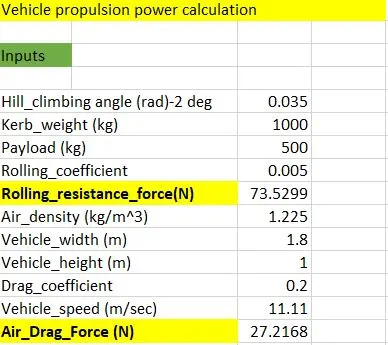
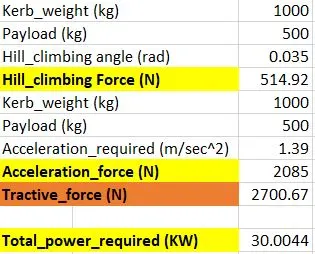
3) When the rolling resistance increased twice, the percentage change in the total power required is as follows:
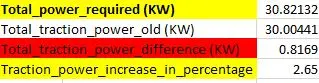
When the rolling resistance increases twice, traction power required increased by around 3 percent which is around 1 KW.
The percentage change in the required power is very small because the acceleration force and hill climbing force demands more power compared to the rolling and drag forces.
Limitations of the above excel calculation:
- The frontal area to calculate the drag force is approximated
- The rotational inertia is not included while calculating the acceleration force
- A constant slope value is taken to calculate the hill climbing force
- The change in air-density with altitude is not included
4) The Gradeability of the dragon challenge is 1 as the hill climbing angle is 45 degree that is the rise and run are the same. The vehicle travels 99 turns and 999 steps in 22 minutes & 41 seconds, the average speed(Assuming distance values) can be beween 30 to 40 kmph.
The forces acting on the car includes:
1) Hill climbing force
2) Drag force
3) Acceleration force
4) Rolling resistance force