Flow Simulation Project 3 : Flow over an airfoil
AIM :
Model the flow over a NACA0017 airfoil. For the angle of attacks 0,2,4,6,8,10 compare the lift and drag forces.
Theory :
The NACA airfoils are airfoil shapes for aircraft wings developed by the National Advisory Committee for Aeronautics (NACA). The shape of the NACA airfoils is described using a series of digits following the word "NACA".
The NACA four-digit wing sections define the profile by
1. First digit describing maximum camber as percentage of the chord.
2. Second digit describing the distance of maximum camber from the airfoil leading edge in lenths of the chord.
3. Last two digits describing maximum thickness of the airfoil as percent of the chord.
The NACA 0017 airfoil is symmetrical, the 00 indicating that it has no camber. The 17 indicates that the airfoil has a 17% thickness to chord length ratio: it is 17% as thick as it is long. Angle of attack is the angle between the line of chord of the airfoil and the relative airflow
Design and Analysis in SolidWorks:
1. Airfoil model
2. Wizard Setup
3. Global Mesh Creation
4. Data file Used :
https://drive.google.com/file/d/1V2LQhDf4ci4t4caYAxBN2-eaXH1QQ9Y-/view?usp=sharing
Result:
Case 1: Angle of attack = 0 Deg.
Pressure contours
Velocity contours
Drag and Lift Force Results
SG Force(X)1 Denotes Drag Force.
SG Force(X)2 Denotes Lift Force.
Case 2: Angle of attack = 2 Deg.
Pressure contours
Velocity contours
Drag and Lift Force Results
Case 3: Angle of attack = 4 Deg.
Pressure contours
Velocity contours
Drag and Lift Force Results
Case 4: Angle of attack = 6 Deg.
Pressure contours
Velocity contours
Drag and Lift Force Results
Case 5: Angle of attack = 8 Deg.
Pressure contours
Velocity contours
Drag and Lift Force Results
Case 6: Angle of attack = 10 Deg.
Pressure contours
Velocity contours
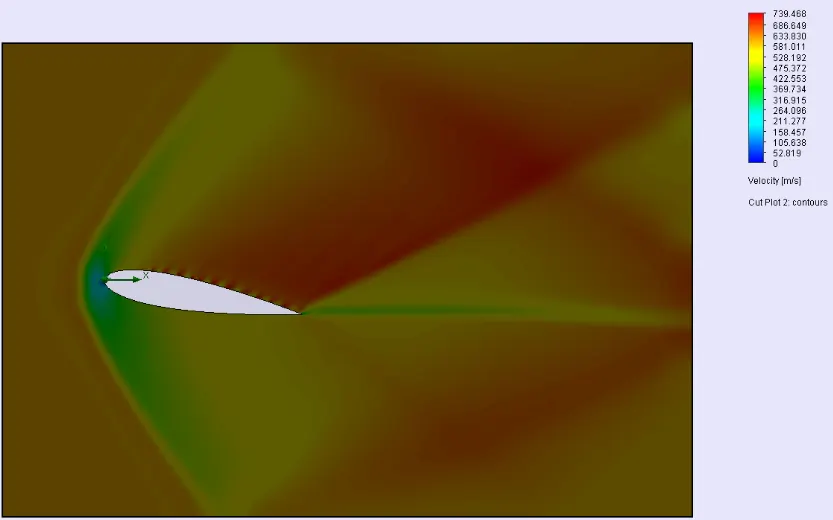
Drag and Lift Force Results
Drag Force v/s Angle of Attack
Lift Force v/s Angle of Attack
Conclusions:
1. From above graph it is seen that with with increament of angle of attack the drag force increase polynomially,
2.From lift force v/s angle of attack graph it is seen that the lift force increase linearly with the increament in the angle of attack.