Flow simulation for flow over a cylinder with different inlet velocity
AIM: Perform flow simulation on a cylinder with different inlet velocity and corresponding to their Reynolds number.
OBJECTIVE:
- Calculate the Reynolds number for different inlet velocity.
- Perform flow simulation on cylinder with different inlet velocity corresponding to their different Reynolds number.
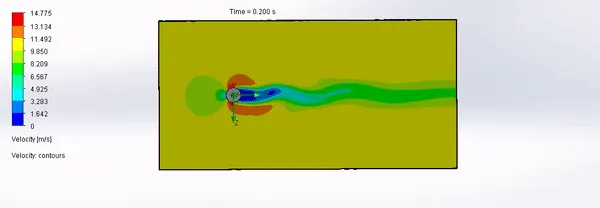
- Obtain velocity and pressure contour. Obtain pressure - velocity animation.
- Compare the result and draw a conclusion.
THEORY:
Computational fluid dynamics (CFD) is a branch of fluid mechanics that uses numerical analysis and data structures to analyze and solve problems that involve fluid flows. Computers are used to perform the calculations required to simulate the free-stream flow of the fluid, and the interaction of the fluid (liquids and gases) with surfaces defined by boundary conditions. With high-speed supercomputers, better solutions can be achieved, and are often required to solve the largest and most complex problems. Ongoing research yields software that improves the accuracy and speed of complex simulation scenarios such as transonic or turbulent flows. Initial validation of such software is typically performed using experimental apparatus such as wind tunnels. In addition, previously performed analytical or empirical analysis of a particular problem can be used for comparison. A final validation is often performed using full-scale testing, such as flight tests.
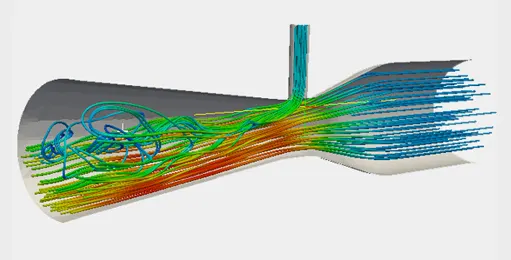
Whenever an object moves in any kind of environment, it changes the conditions of the surroundings and is therefore subject to a force generated as a result of this change. Consider for example a swimmer moving across a water stream; as he makes his way through the water, he displaces the water molecules from their position and the water molecules, in turn, try to re-acquire their initial position by exerting a force (or resistance) against the swimmer’s motion. When such objects flow across any such fluid, the resistance to their flow and thus their flow patterns are predicted by a dimensionless quantity called the Reynolds Number. The concept is applicable in the movement of every object across any environment except for a vacuum, which has no molecules of its own. The Reynolds number in a sensor is used to predict the aerodynamics and flow patterns of a fluid.
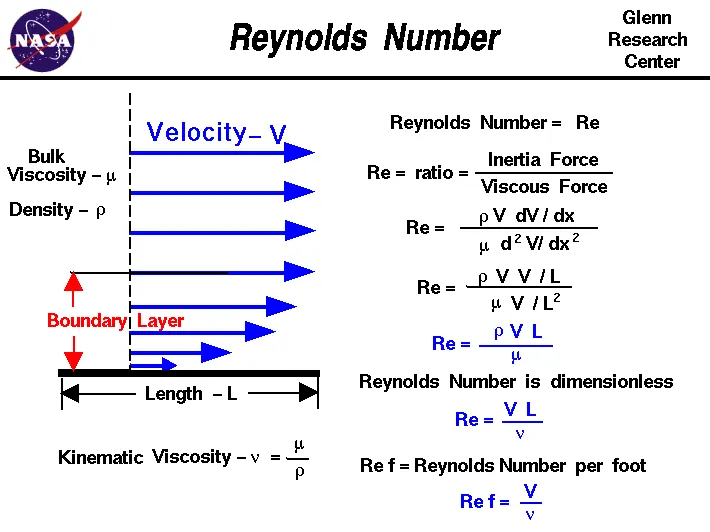
GOVERNING EQUATION:
The Reynolds number (Re) is an important dimensionless quantity in fluid mechanics used to help predict flow patterns in different fluid flow situations.
The Reynolds number is defined as
`"Reynolds number "(Re)= (ρuD)/μ=(uD)/v`
where:
- ρ is the densityof the fluid (SI units: kg/m3)
- u is the flow speed(m/s)
- D is the diameter of the tube (m)
- μ is the dynamic viscosityof the fluid (Pa·s or N·s/m2 or kg/(m·s))
- ν is the kinematic viscosityof the fluid (m2/s).
`Time=("Distance")/(Speed)`
CALCULATIONS:
From the above formula, velocity at a particular Reynold Number can be calculated by putting the values for air as ρ = 1.225 kg/m3, D = 0.05 m, μ = 1.81 * 10-5 kg/(m-s) & ν = 1.48 * 10-5 m2/s
For case 1, Flow Speed (u) = 10 m/s Reynold Number (Re) = 33,840
For case 2, Flow Speed (u) = 12 m/s Reynold Number (Re) = 40,607.73
For case 3, Flow Speed (u) = 14 m/s Reynold Number (Re) = 47,375.7
For case 4, Flow Speed (u) = 20 m/s Reynold Number (Re) = 67,679.5
Calculation of simulation time from inlet velocity and computational domain length
For case 1,
Time = 10/1 = 0.1s
Simulation time = 2*Time = 0.1*2 = 0.2s
Step time = Simulation time/10 = 0.2/10 = 0.02s
Similarly, we can do calculation for other cases
|
Case No |
Inlet Velocity (m/s) |
Computational Domain length (m) |
Time (s) |
Simulation Time (s) |
Step Time (s) |
|
1 |
10 |
1 |
0.1 |
0.2 |
0.02 |
|
2 |
12 |
1 |
0.08 |
0.16 |
0.001 |
|
3 |
14 |
1 |
0.07 |
0.14 |
0.001 |
|
4 |
20 |
1 |
0.05 |
0.1 |
0.01 |
PROCEDURE:
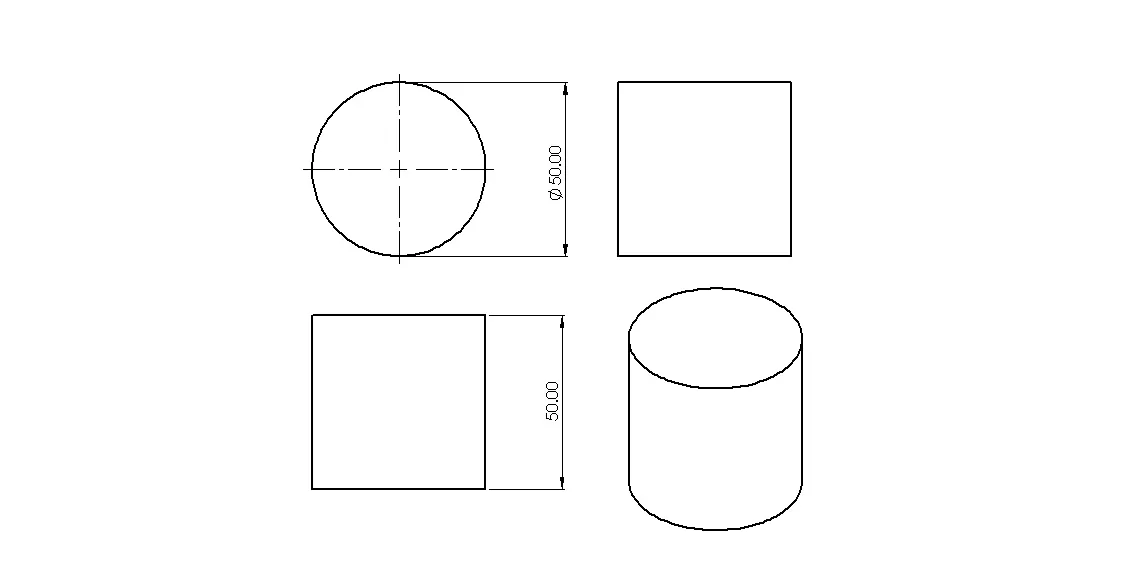
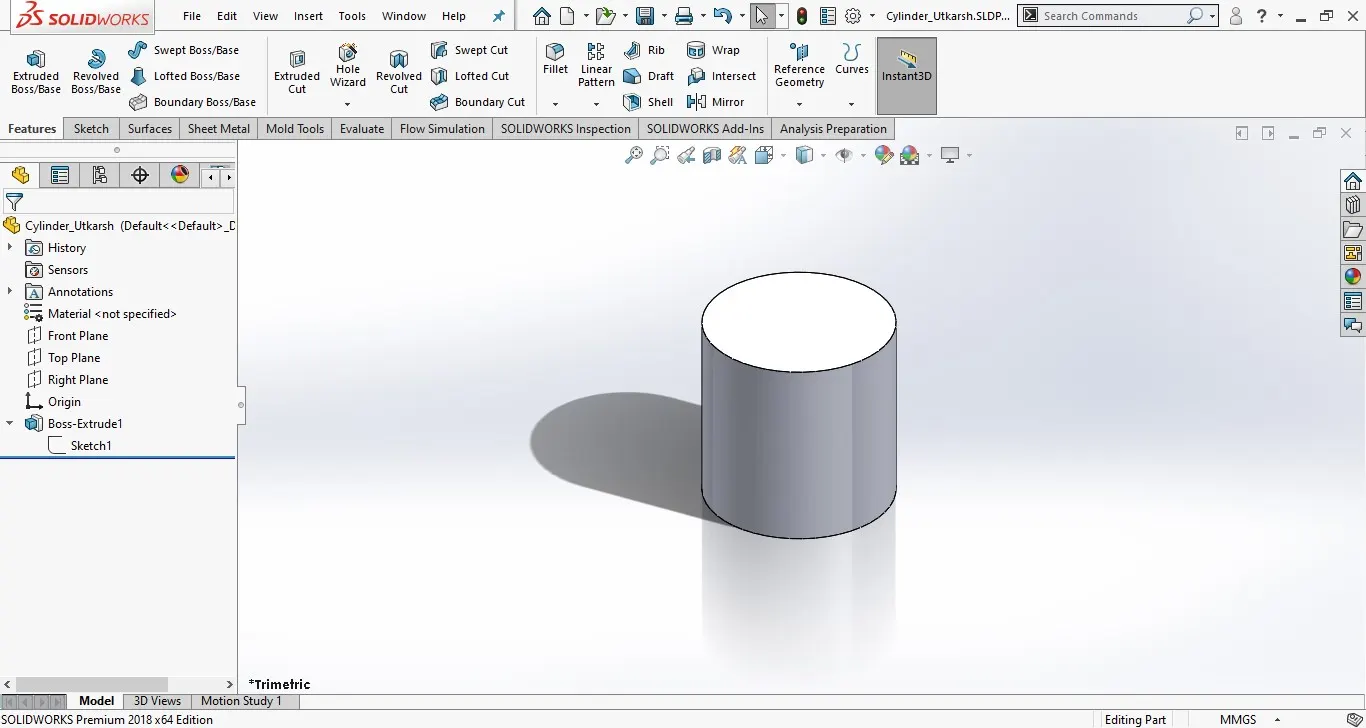
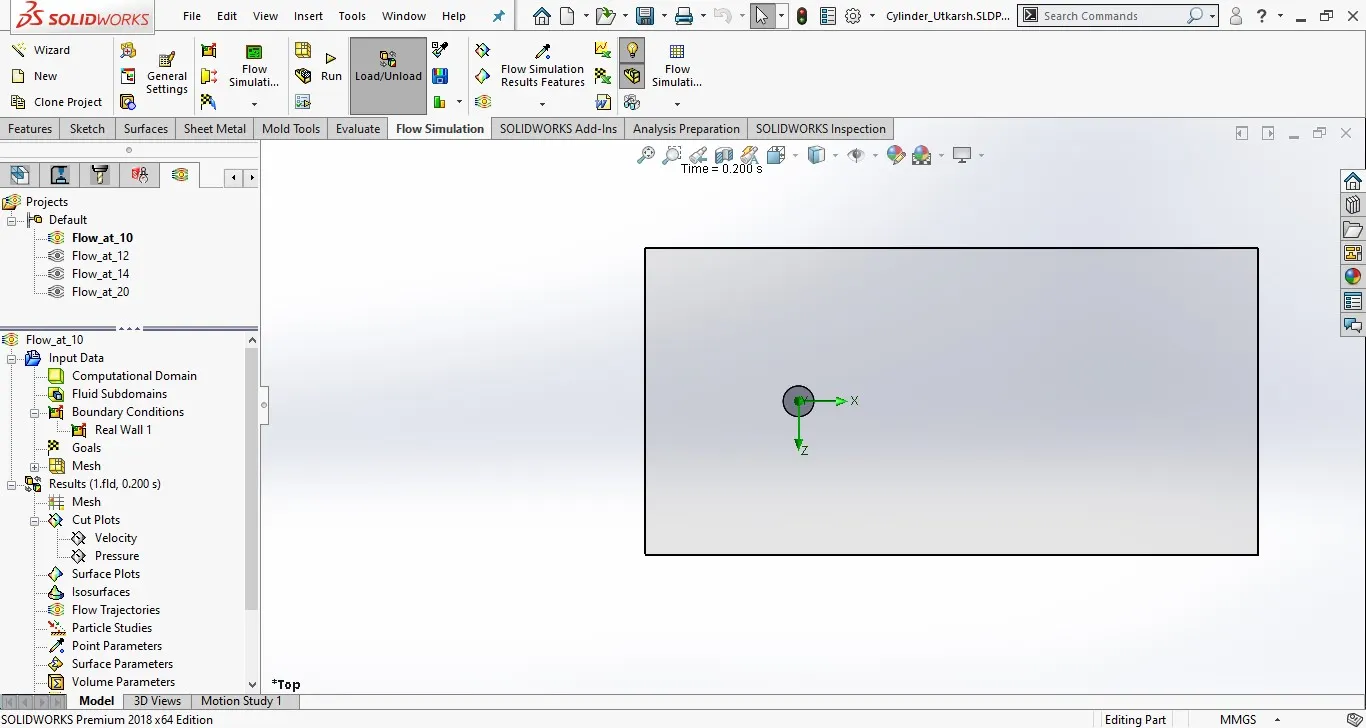
Model a cylinder of 0.05m diameter and 0.05m length.
Flow Simulation –
Click on new wizard and select following options:
Analysis time – External
Fluid type – Air
Wall condition – Adiabatic
Roughness – 0 micrometre
Pressure – 101325 Pa
Temperature – 293.2 K
Velocity in X-direction – 10m, 12m, 14m and 20m for case 1, 2, 3 and 4 respectively.
Finish.
Adjust global mesh setting to 4 and select advanced channel refinement.
Add Boundary condition over the length of cylinder as real wall.
Add two cut plots with XZ Plane for velocity and pressure. Finally, click on Run.
RESULTS:
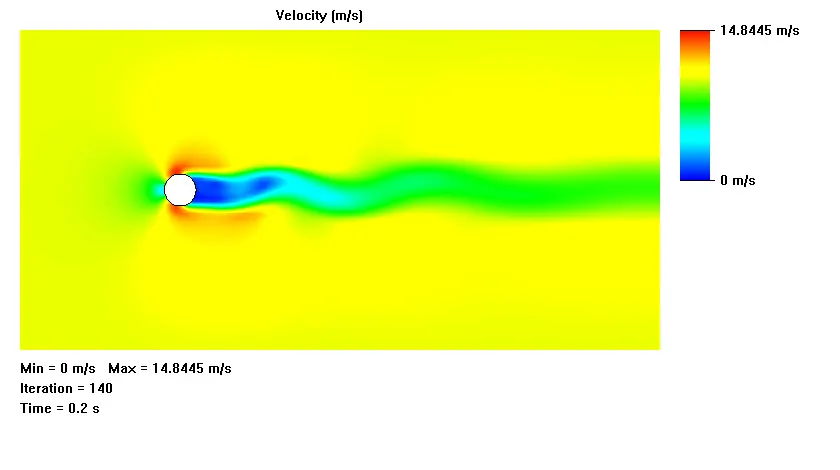
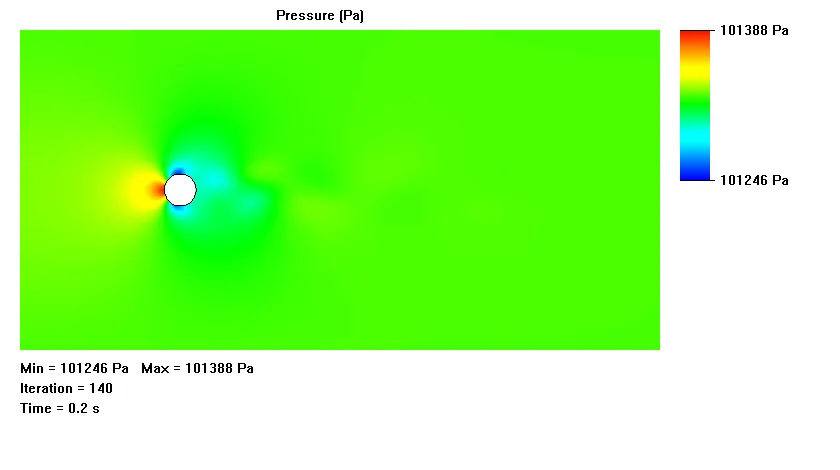
Case 1: Inlet flow Velocity =10 m/s
Velocity contour
Pressure contour
Velocity animation
Pressure animation
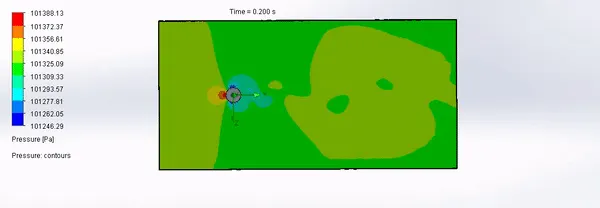
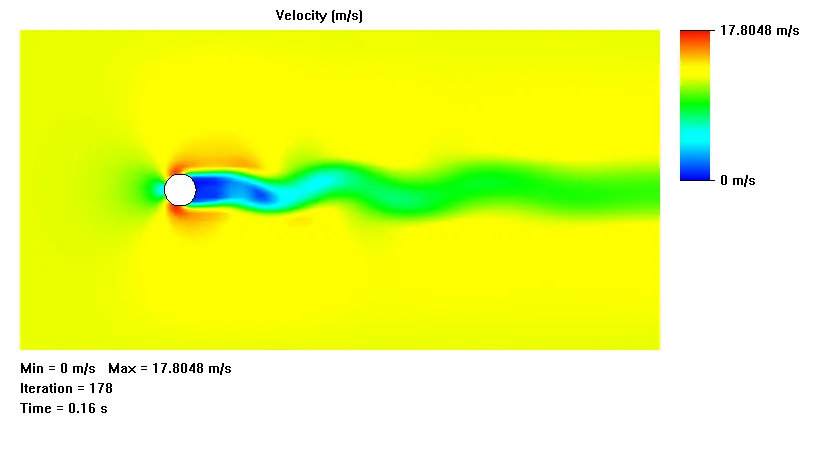
Case 2: Inlet flow Velocity = 12 m/s, Reynolds number increased by 20%
Velocity contour
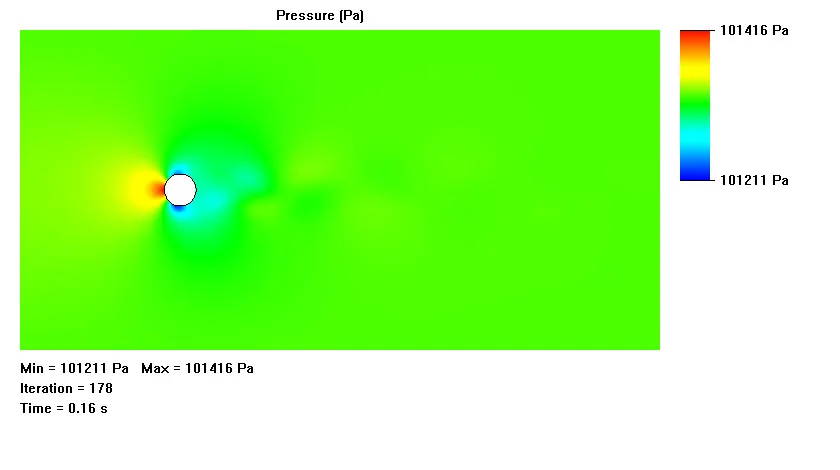
Pressure contour
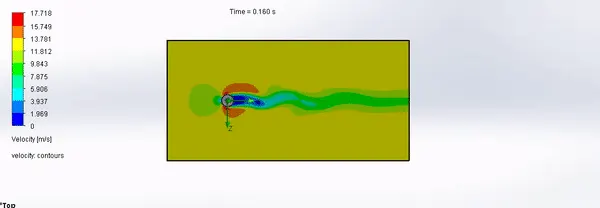
Velocity animation
Pressure animation
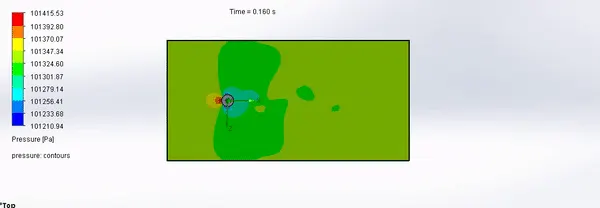
Case 3: Inlet flow Velocity = 14 m/s, Reynolds number increased by 40%
Velocity contour
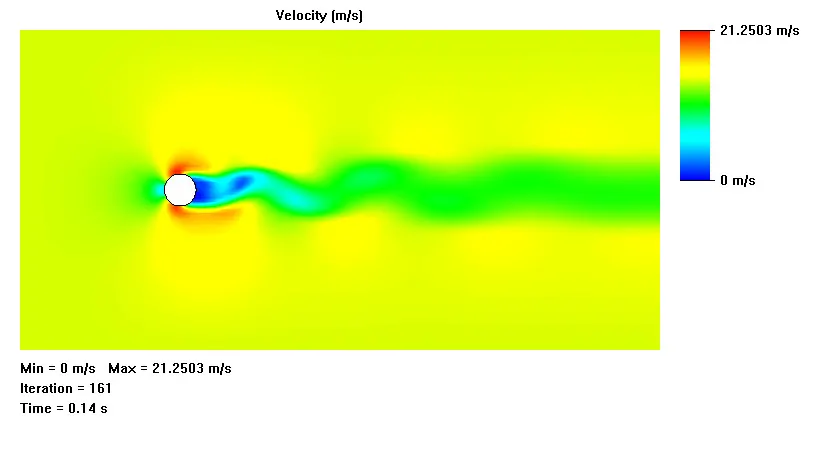
Pressure contour
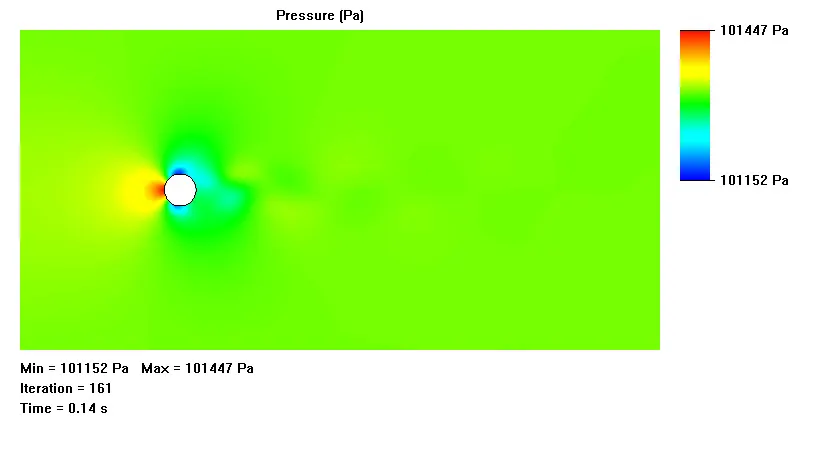
Velocity animation
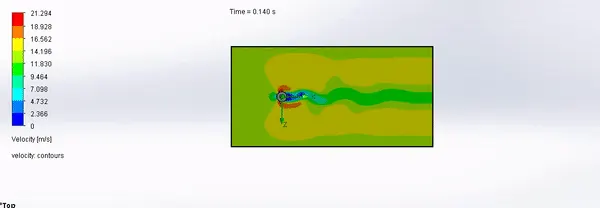
Pressure animation
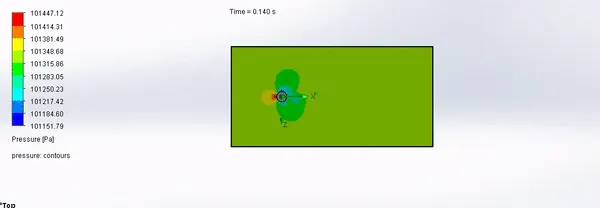
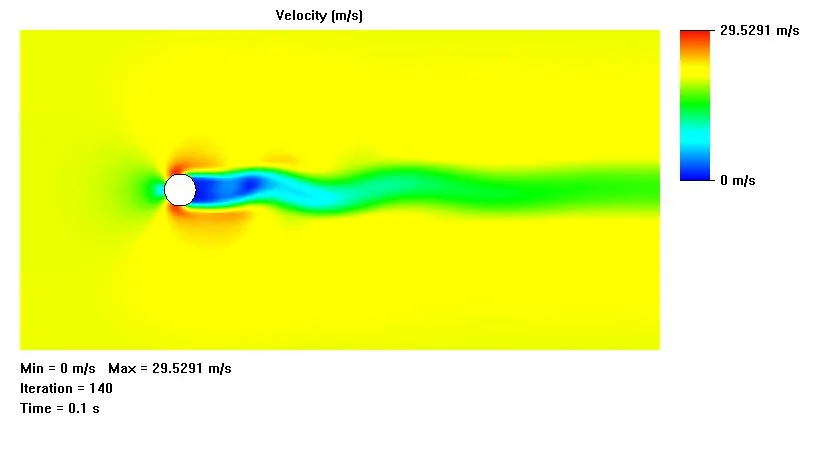
Case 4: Inlet flow Velocity = 20 m/s, Reynolds number increased by 100%
Velocity contour
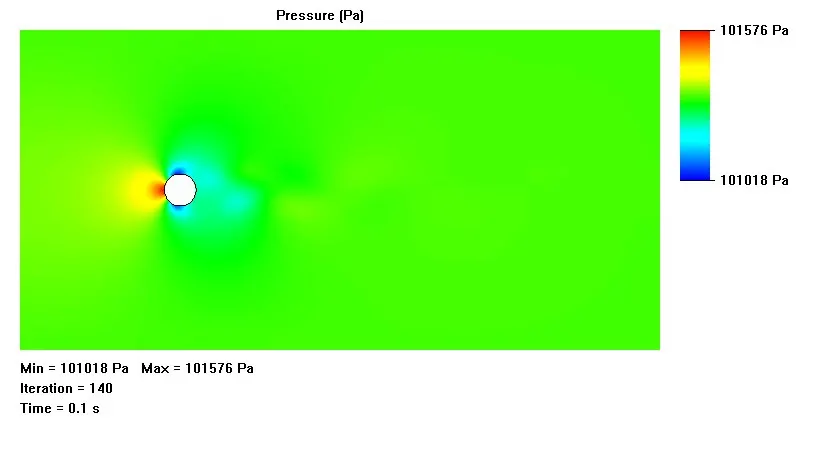
Pressure contour
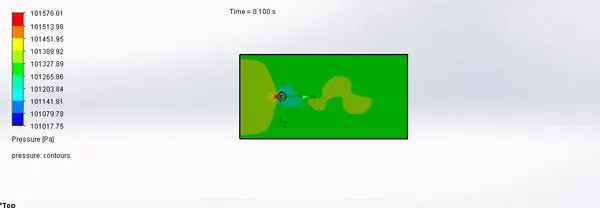
Velocity animation

Pressure animation
Observation table -
|
Sr. No. |
Inlet Velocity (m/s) |
Reynolds No. |
Velocity (m/s) |
Pressure (Pa) |
||
|
Minimum |
Maximum |
Minimum |
Maximum |
|||
|
1 |
10 |
33,840 |
0.239 |
14.409 |
101250.76 |
101385.53 |
|
2 |
12 |
40,607.73 |
0.226 |
17.278 |
101217.57 |
101411.86 |
|
3 |
14 |
47,375.7 |
0.218 |
20.709 |
101162.21 |
101441.71 |
|
4 |
20 |
67,679.5 |
0.502 |
28.698 |
101034.87 |
101565.89 |
- For each Reynolds number, the maximum air velocity can be observed on the portion of the leading face and the minimum air velocity on the front quarter-point & trailing or back face of the cylinder.
- For each case, the front quarter point of the circular cross-section is the stagnation point (the point where the velocity is zero) and experiences the maximum pressure & minimum velocity.
- On increasing the Reynolds number, the inlet velocity also increases.
- From all 4 cases, the maximum velocity & pressure is experienced in the case of the flow with the highest Reynolds number.
CONCLUSION:
The flow simulation analysis helps to analyse the maximum & minimum regions of velocity & pressure over the cylinder with different inlet velocities.
The highest the Reynolds number, the higher will be the velocity & pressure experience over the geometry.