Flow over an airfoil
OBJECTIVE
- Model the flow over a NACA0017 airfoil
- For the angle of attacks 0,2,4,6,8,10 compare the lift and drag forces
introduction:
Lift
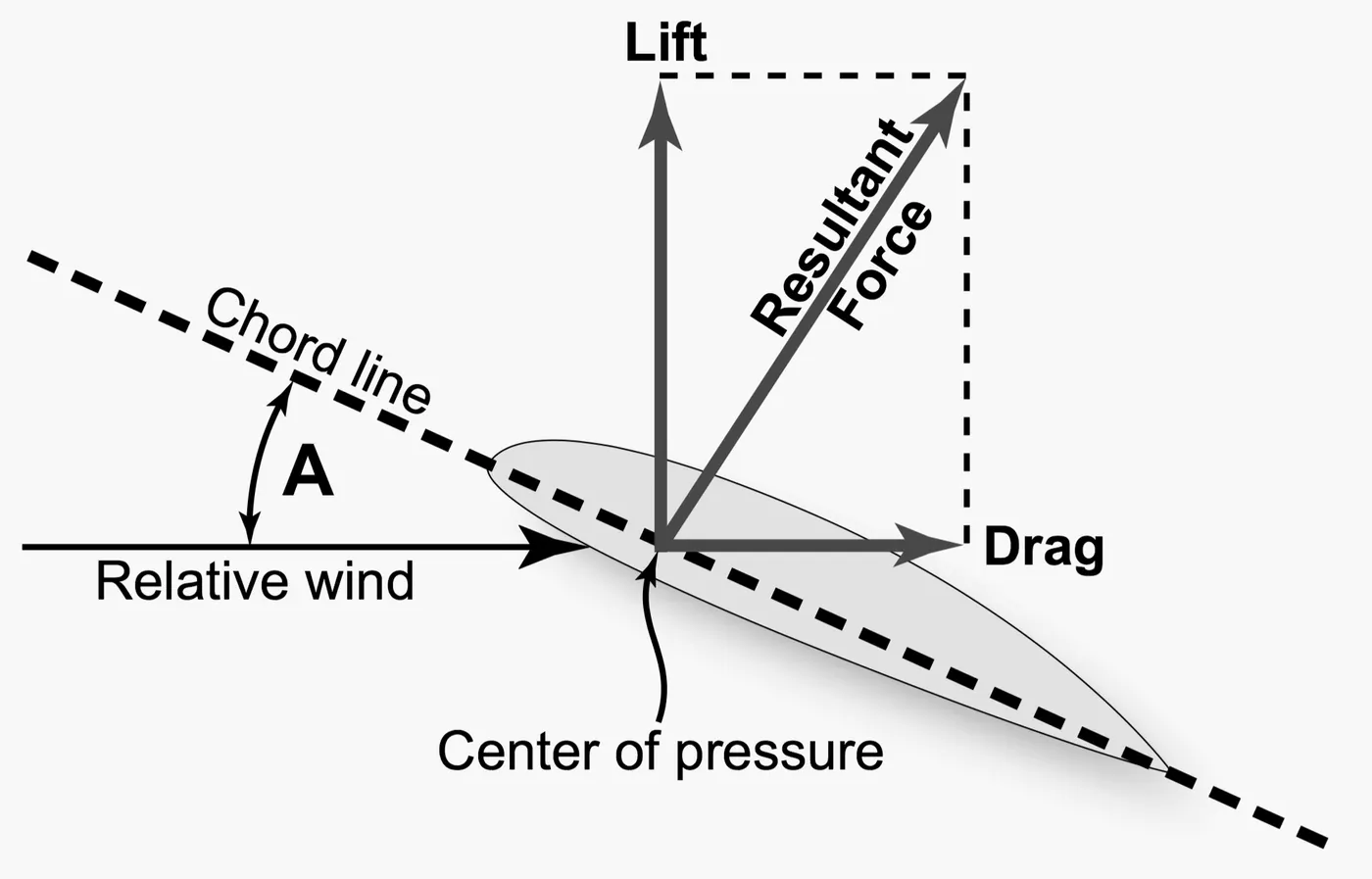
Lift, or downforce as its known in the motor racing world, is the force generated perpendicular to the direction of travel for an object moving through a fluid (gas or liquid). The same effect occurs when a fluid moves over a stationary object, such as an airfoil in a wind tunnel. Airfoils are the most efficient shapes found so far that can generate lift while at the same time minimizing drag.
Drag
Drag is an unavoidable consequence of an object moving through a fluid. Drag is the force generated parallel and in opposition to the direction of travel for an object moving through a fluid. Drag can be broken down into the following two components:
- Form drag (or pressure drag) - dependent on the shape of an object moving through a fluid
- Skin friction - dependent on the viscous friction between a moving surface and a fluid, derived from the wall shear stress
L = CL . A . qinf
D = CD . A . qinf
where:
L is the lift force
CL is the dimensionless lift coefficient
D is the drag force
CD is the dimensionless drag coefficient
A is a reference area, usually the plan area (maximum projected area onto a plane) of an airfoil or wing
qinf = 1/2 rhoinf . Vinf2
where:
rhoinf is the free stream fluid density
Vinf is the free stream fluid speed
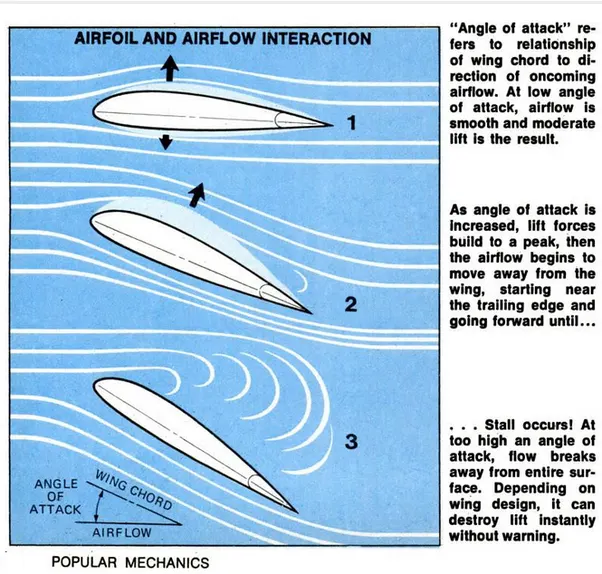
stall:
case setup
naca airfoil
chord length of airfoil: 1m
width of airfoil=0.1m
surface force in the x and y direction lead to the net drag and net lift on the air foil hence here set as goals
inlet velocity : 600m/sec
meshing :
a very refined non uniform mesh was kept near the airfoil boundry to keep the results more accurate but the mesh quality is still very poor to encapsulate more accurate results.
required level of meshing near the surface
case 1:
angle of attack =0
velociity profile:
pressure profile :
surface force in x direction::159N
surface force in y direction::0.01N
drag coefficient:0.003005
lift coefficient:2.27E-7
observation:
a very laminar flow can be observed over the airfoil ie very low drag force and minimal lift
case2:angle =2 degrees
surface force in x direction::180N
surface force in y direction::340
drag coefficient:0.004005
lift coefficient:0.0077
case3:angle=4 degrees
surface force in x direction::241N
surface force in y direction::750N
drag coefficient:0.0054
lift coefficient:0.017
case4:angle=6 degrees
pressure :
observation:
a low pressure zone can be seen above the airfoil and a high pressure region can be observed below the airfoil hence resulting in lift
surface force in x direction::366.448N
surface force in y direction::1183.97N
drag coefficient:0.0082
lift coefficient:0.02
case5:angle =8 degrees
a turbulent wake region can be seen
observation:
a low pressure zone can be seen above the airfoil and a high pressure region can be observed below the airfoil hence resulting in lift
surface force in x direction::578N
surface force in y direction::1616N
drag coefficient:0.013
lift coefficient:0.03
case 6 angle =10 degrees
pressure distribution
a low pressure zone can be seen above the airfoil and a high pressure region can be observed below the airfoil hence resulting in lift
surface force in x direction::868N
surface force in y direction::2803N
drag coefficient:0.019
lift coefficient:0.068
plot of the net drag force on the airfoil with increase in angle of attack from zero degree to 10 degrees
plot of the net lift force on the airfoil with increase in angle of attack from zero degree to 10 degrees
observations:
- We can see from the graphs that as the angle of attack is increased from 0° to 10°,the drag force has increased gradually, but the lift force increases rapidly.
- at an angle of attack of 0°, there is some drag force due to the surface area of airfoil, but the lift force is close to zero, which is negligible.
- Similarly, there is rapid increase in Lift Force in comparison to the increase in Drag Force as we increase the angle of attack.
- Similarly, the Coefficient of Drag and the Coefficient of Lift have increased in co-ordination to the Drag force and Lift Force respectively.