Flow over a cylinder
Objective:
To perform the external pipe flow simulation. Run a baseline simulation and then calculate the Reynolds number. Then increase the Reynolds number by a factor of 20%, 40%, and 100% then run the transient flow simulation.
Introduction to the underlying Concept and Software used:
Engineering Fluid Dynamics (EFD) is a new breed of Computational Fluid Dynamics (CFD) software that enables mechanical engineers to simulate fluid flow and heat transfer applications with powerful, intuitive, and accessible 3D tools. Engineering fluid dynamics is driven by engineering criteria and goals so every product engineer can get the technical insights necessary to answer the questions faced in the product development process.
SOLIDWORKS Flow Simulation is based on the same mathematical foundation as traditional computational fluid dynamics (CFD) software, but key benefits set SolidWorks Flow Simulation apart, making it quicker and easier to use, while still delivering a robust and highly accurate solution.
Theoretical Aspects:
Fluid Flow is a part of fluid mechanics and deals with fluid dynamics. It involves the motion of a fluid subjected to unbalanced forces. This motion continues as long as unbalanced forces are applied.
While pouring water from a mug, the velocity of water is very high over the lip, moderately high approaching the lip, and very low at the bottom of the mug. The unbalanced force is gravity, and the flow continues as long as the water is available and the mug is tilted.
Reynolds Number:
The Reynolds number is the ratio of inertial forces to viscous forces and is a convenient parameter for predicting if a flow condition will be laminar or turbulent.
It can be interpreted that when the viscous forces are dominant (slow flow, low Re) they are sufficient enough to keep all the fluid particles in line, then the flow is laminar. Even very low Re indicates viscous creeping motion, where inertia effects are negligible. When the inertial forces dominate over the viscous forces (when the fluid is flowing faster and Re is larger) then the flow is turbulent.
It is a dimensionless number comprised of the physical characteristics of the flow. An increasing Reynolds number indicates increasing turbulence of flow.
where:
V is the flow velocity,
D is a characteristic linear dimension, (traveled length of the fluid; hydraulic diameter, etc.)
ρ fluid density (kg/m3),
μ dynamic viscosity (Pa.s),
ν kinematic viscosity (m2/s); ν = μ / ρ.
Laminar flow:
It is characterized by smooth streamlines and highly ordered motion. If the pipe is sufficiently long (relative to the entry length) then the entrance effects are negligible and therefore the flow if fully developed. Laminar flow occurs when the fluid flows in parallel layers without mixing. The velocity is constant at any given moment. Since the flow is steady, there is no acceleration.
For practical purposes, if the Reynolds number is less than 2000, the flow is laminar. The accepted transition Reynolds number for flow in a circular pipe is = 2300.
Transitional flow:
At Reynolds numbers between about 2000 and 4000, the flow is unstable as a result of the onset of turbulence. These flows are sometimes referred to as transitional flows.
Turbulent flow:
It is characterized by velocity fluctuations and highly disordered motion. Most flows encountered in practice are turbulent. Turbulent flow occurs when streamlines of the liquid are irregular and change over time. The paths of the fluid flow are also irregular and form tiny whirlpool regions.
If the Reynolds number is greater than 3500, the flow is turbulent. Most fluid systems in nuclear facilities operate with turbulent flow.
Geometric Parameters:
Diameter= 0.02m
Length= 0.05m
Fluid= air
Density= 1.225kg/m3
Dynamic Viscosity= 1.81 x 10^(-5) kg/(m.s)
Computational domain in x direction = 0.5m
Calculation:
For the baseline simulation, the velocity is 10m/s
where D= cylinder diameter
V= inlet velocity
Flow through time= Length of domain/Velocity
End time= 2* Flow through time
For case 1: v1=10m/s
Re= (1.225*10*0.02)/ (1.81 x 10^(-5))= 13535.91
Flow through time= 0.5/10 = 0.05
End time= 0.1s
For case 2: By increasing the Reynolds number 20%, Re= 16243.09
16243.09= (1.225*v*0.02)/ (1.81 x 10^(-5))
Therefore, v= 12 m/s
Flow through time= 0.5/12 = 0.041666
End time= 0.08333s
For case 3: By increasing the Reynolds number by 40%, Re=18950.27
18950.27=(1.225*v*0.02)/ (1.81 x 10^(-5))
Therefore, v=14m/s
Flow through time= 0.5/14 = 0.035714
End time= 0.0714s
For case 4: By increasing the Reynolds number by 100%, Re= 27071.8232
27071.8232=(1.225*v*0.02)/ (1.81 x 10^(-5))
Therefore, v=20m/s
Flow through time= 0.5/20 = 0.025
End time= 0.5s
Procedure:
- Cylinder of above-mentioned dimensions is created.
- Calculate the baseline Reynolds number by using the given parameters using the Reynolds number formula
- Using this calculate the three Reynolds number by using 20%, 40% and 100% of baseline Reynolds number.
- Set the external flow analysis in the wizard and set the required condition like air medium, time dependent, external flow, and velocity.
- Measure the computational domain. The calculated end time is taken as total analysis time.
- The fluid is considered to be air.
- The velocity in the x-direction is considered as inlet velocity
- Run the Project and finally get the cut plots of Relative pressure and Velocity
- Create an animation for both velocity and pressure plot for all three values.
Results:
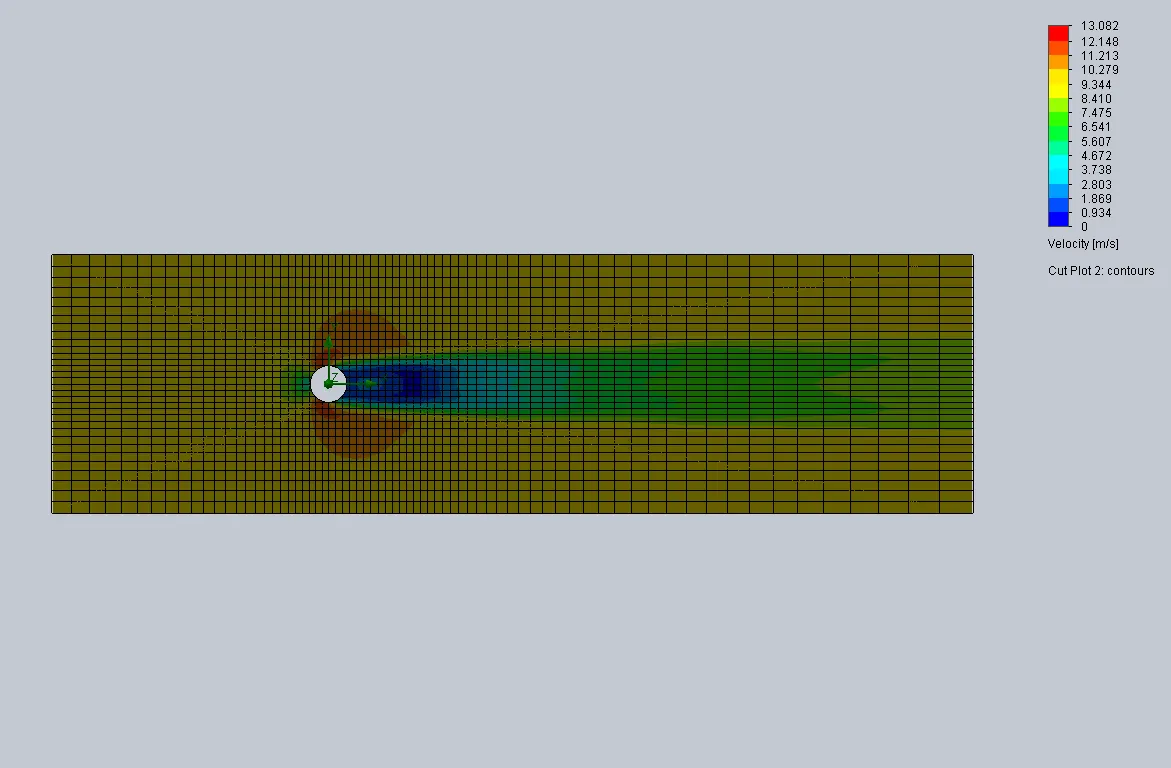
Velocity at Baseline Reynolds number
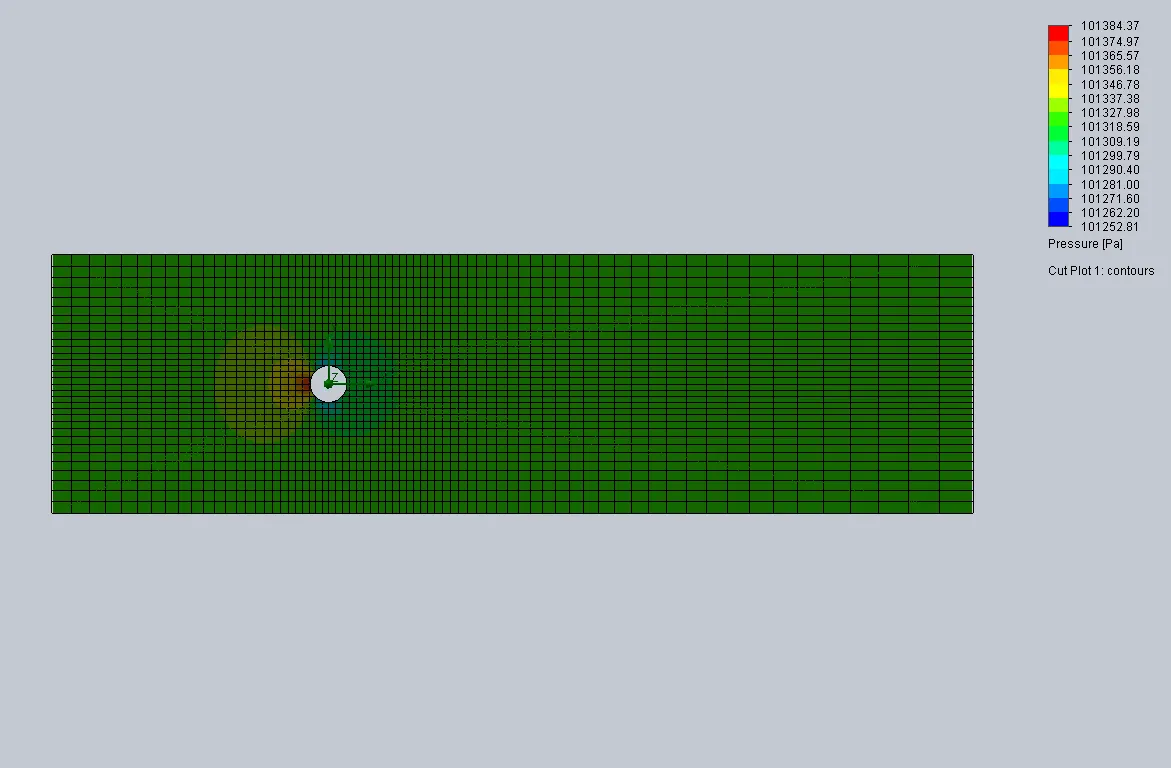
The pressure at Baseline Reynolds number
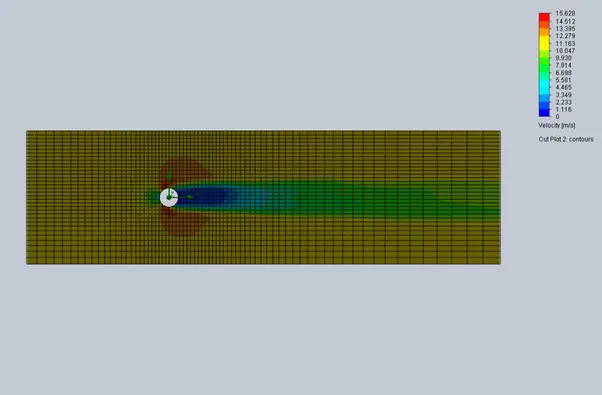
Velocity when Reynolds number is increased by 20%
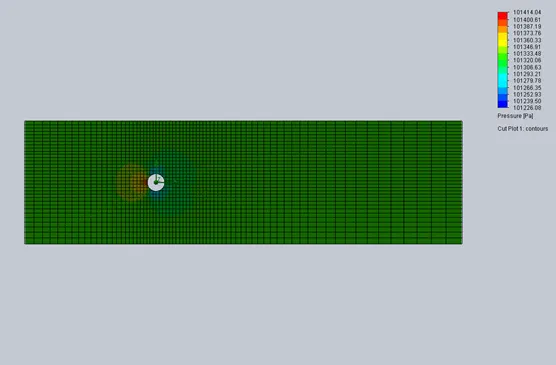
Pressure when Reynolds number is increased by 20%
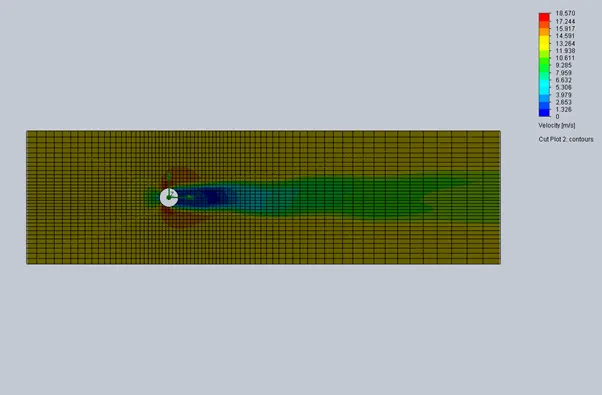
Velocity when Reynolds number is increased by 40%
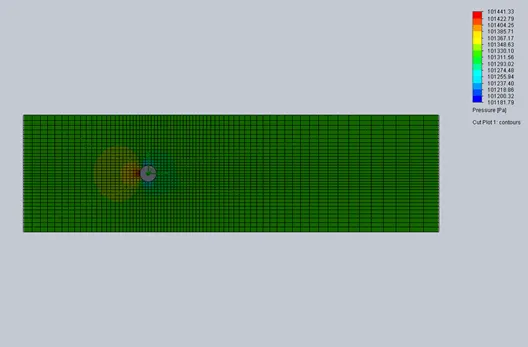
Pressure when Reynolds number is increased by 40%
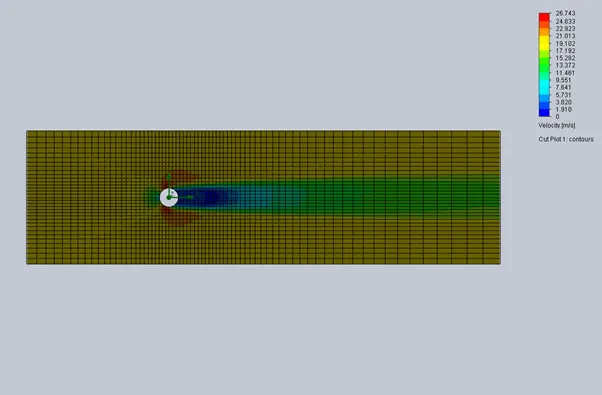
Velocity when Reynolds number is increased by 100%
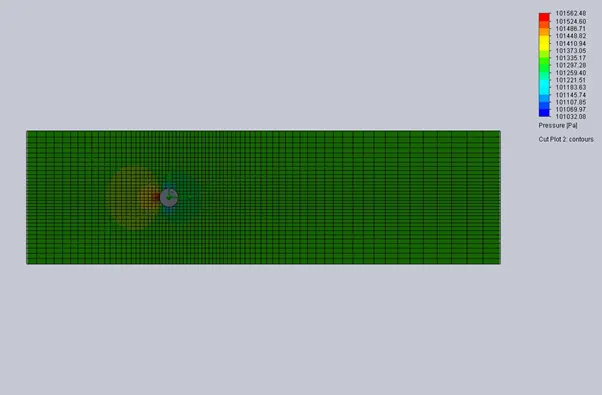
Pressure when Reynolds number is increased by 100%
Conclusions:
- With an increase in Reynolds number, the velocity and pressure-flow are increased
- The velocity at the front side of the cylinder is very high when compared to other sides of the cylinder
- The high pressure is created on the surface on the surface facing the inlet velocity
- The relative pressure variation does not vary to a large extent for the Reynolds numbers taken