Final Project: Electric Rickshaw modelling
Aim: Design an Electric Rickshaw using MATLAB Simulink.
Abstract:
In this venture, we going to construct the MATLAB model of the ELECTRIC RICKHAEW by utilizing a PM brushed type DC engine and a reasonable Lithium-Particle battery for the engine. Before that, we will realize what is Electric RICKHAEW, how it works and the advantages of EV RICKHAE. Then we make a genuine EV RICKHAEW model in SIMULINK with reasonable blocks from the powertrain block set. My principal saying is to check "how my RICKHAEW performs for any three standard driving cycles showing energy utilization, the temperature increase of engine and regulator for vehicle cover around 100 km at steady speed driving 45 kmph. Made a correlation with Mahindra e-Rickhaew and my Simulink model.
OBJECTIVES :
Create a detailed MATLAB model of an electric rickshaw (three-wheel passenger vehicle) as per the details below:
- Rear wheels are driven by PM brushed-type motor
- Assume the efficiency points of the motor controller and motor
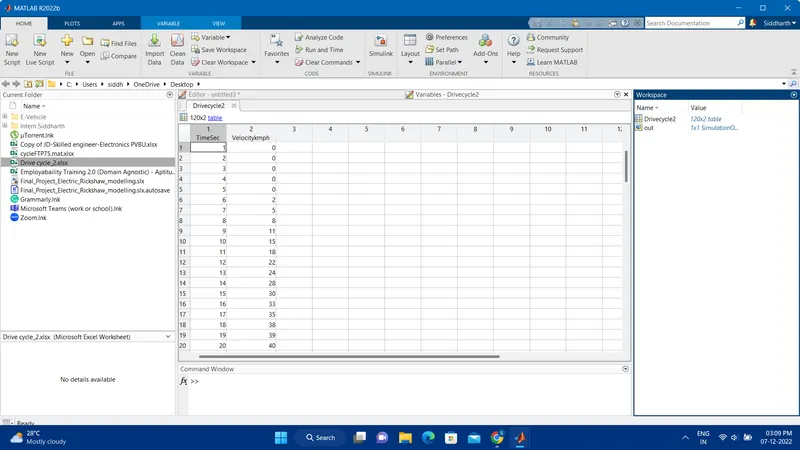
- Make an excel sheet of all input and assumed data
- Results: For any three standard driving cycles show energy consumption, the temperature rise of motor and controller for 100 km constant speed driving at 45 kmph.
METHODOLOGY:
- The electric vehicle comprises a battery, engine, and regulator then it produces impetus power.
- To plan any vehicle first we need to work out impetus power, then, at that point, the engine is chosen.
- Finally found on the engine rating or working reach and no km/charge we need to rely upon everything battery limit and afterwards battery limit is chosen. So the Plan stream of vehicle engineers must resemble the accompanying :
Recognize what measure of impetus power is required. the kind of battery and scope of the battery is as per the reach.
INTRODUCTION:
- Electric E-Cart otherwise called electric tuk, e-cart and autos are going more well known after 2018 in the Indian market. This E-cart is the best option for petroleum/CNG auto carts and human or pony-pulled carts due to their low fuel cost, zero outflows and fewer human endeavours.
- The electrical framework utilized in Indian adaptation is 48VDC can run 90-100 km/full charge, maximum velocity of 25 km/hour and this electric engine power goes from 650-1400 Watts; the battery takes 8-10 hrs to turn out to be completely energized. The essential seating limit is a driver in addition to 4 travellers absolute 5 people.
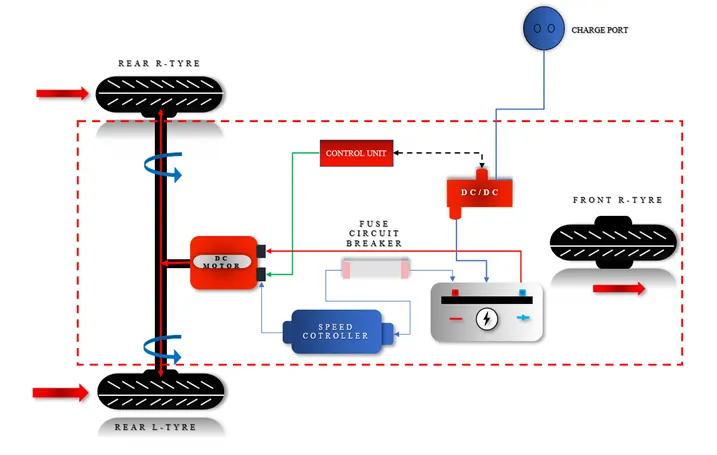
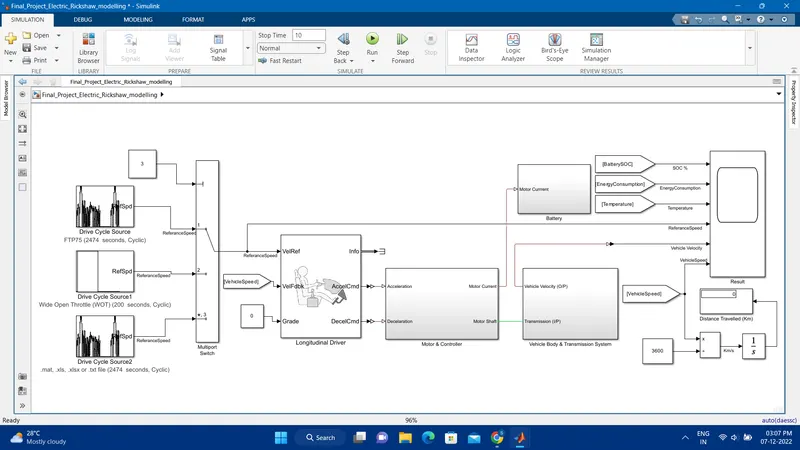
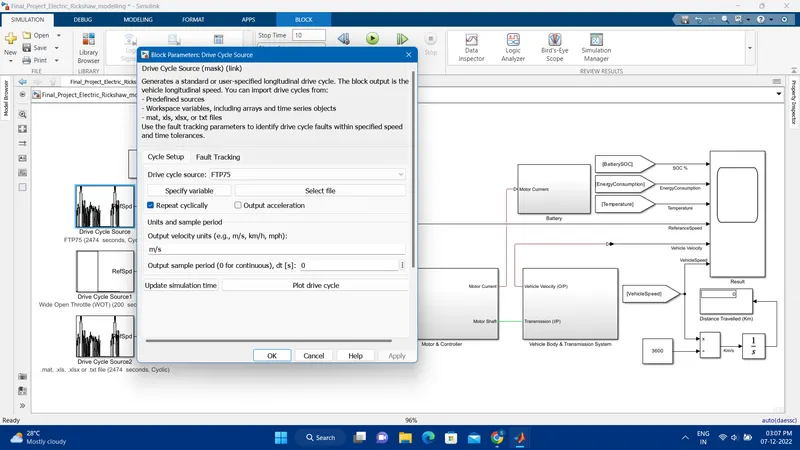
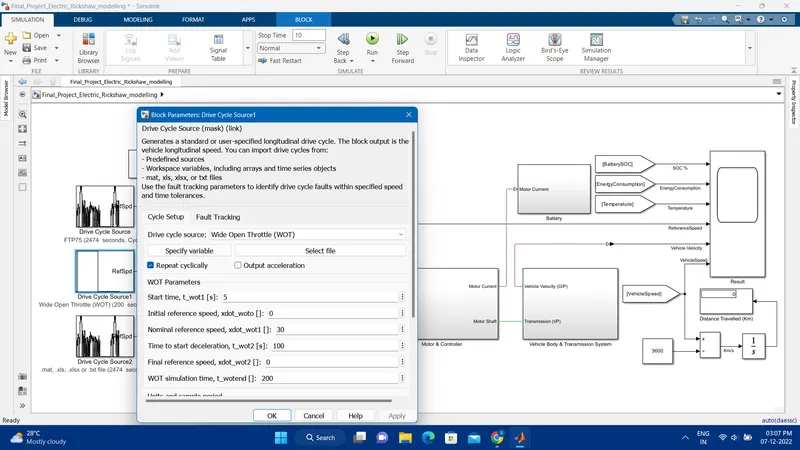
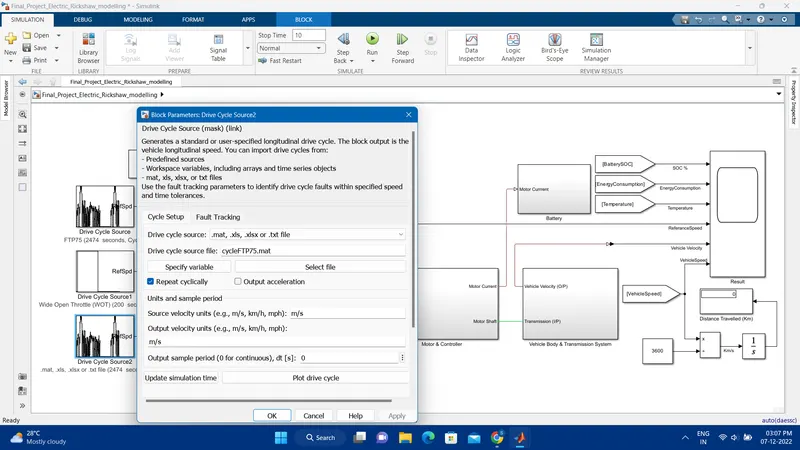
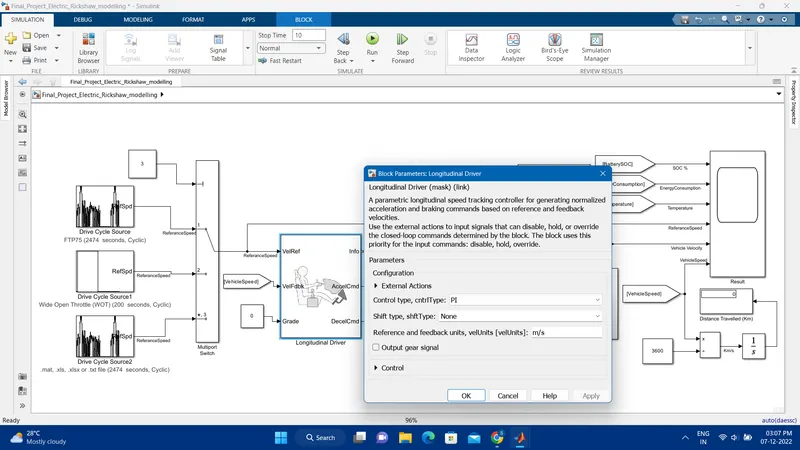
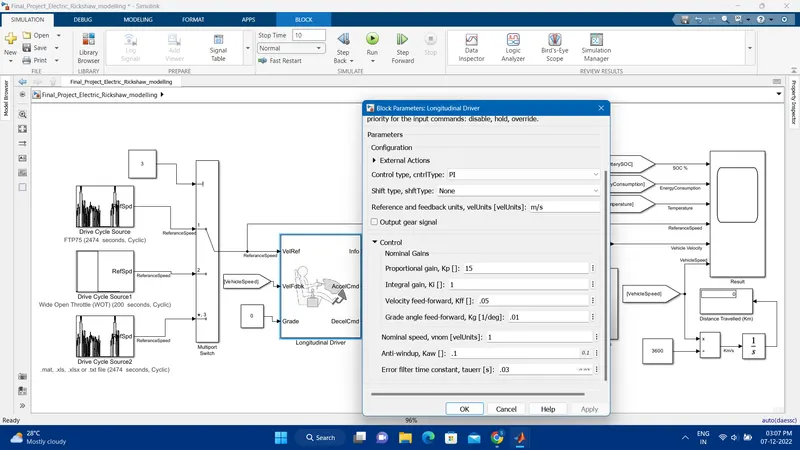
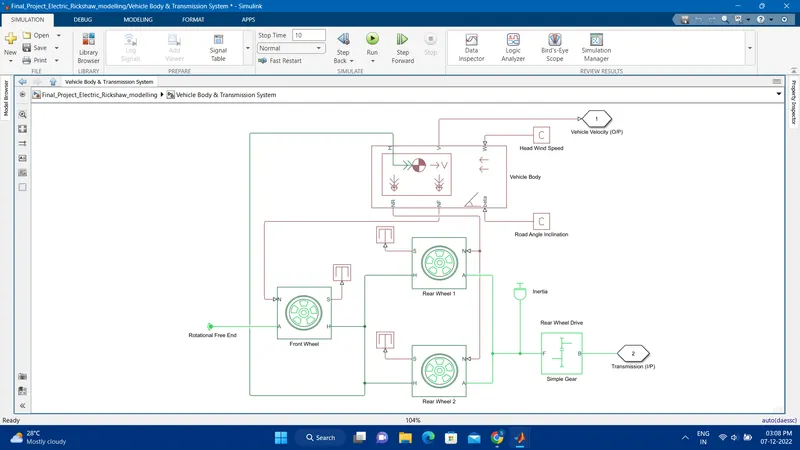
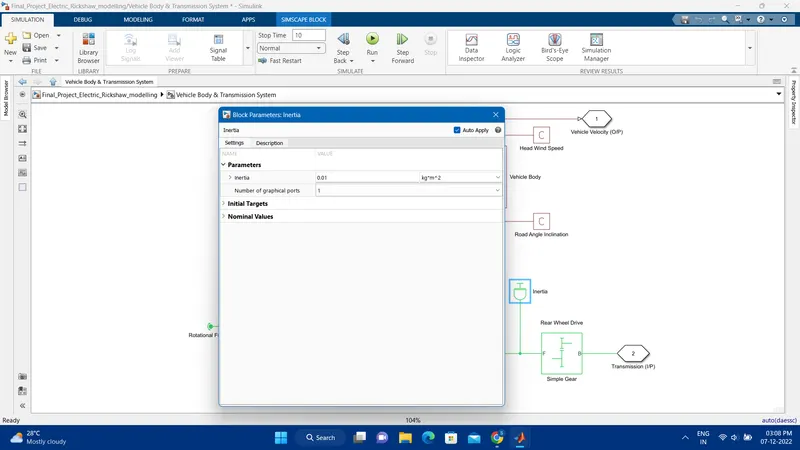
- Here fundamentally, e-cart is planned in CREO and MATLAB Simulink. In the planned electric cart fundamental blocks are the battery, drive cycle, controlled, DC Engine, Vehicle body and transmission framework. The Drive cycle is the contribution of human exertion that how he will drive his genuine cycle. We can utilize drive cycles like FTP75, and WOT or by utilizing Succeed.
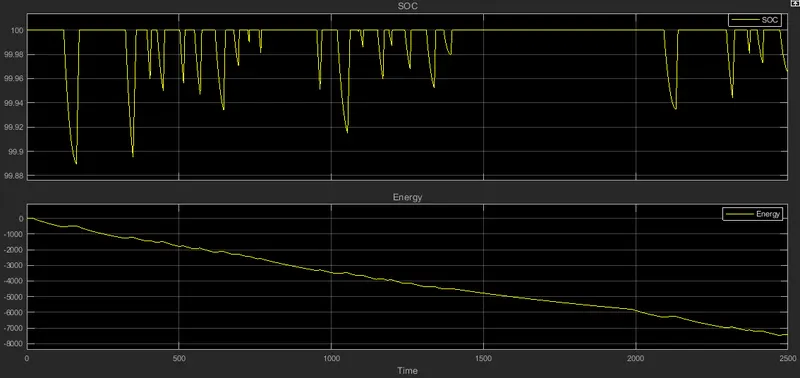
- The fundamental goal of this undertaking is to acquire speed by the driver, to gauge the temperature of the engine and regulator, and to appraise the condition of charge (SOC) and distance travelled by the vehicle. There is a SOC block that will gauge the condition of the charge of the battery, distance is determined by speed and time boundary for all three Drive cycles.
Design and Construction :
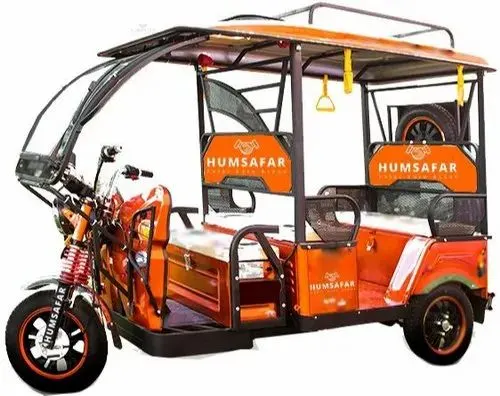
- These carts have an M.S. (Mild Steel) rounded suspension, comprising three wheels with a differential system at the back tires. The engine is a brushless DC engine fabricated for the most part in India and China.
- The electrical framework utilized in the Indian rendition is 48V and in Bangladesh is 60V. The body plan from the most famous Chinese adaptation is of exceptionally slender iron or aluminium sheets.
- Vehicles made in fibre are additionally famous due to their solidarity and sturdiness, bringing about low support, particularly in India.
- The body configuration is shifted from load transporters, traveller vehicles with no rooftop, to full body with windshield for drivers' solace. It comprises a regulator unit.
- They are sold based on the voltage provided and current result, likewise, the quantity of MOSFET (metal oxide field-impact semiconductors) utilized.
- The battery utilized is for the most part a lead-corrosive battery with a life of 6-12 months. Profound cycle batteries intended for electric vehicles are seldom utilized. The heaviness of the electric vehicle has likewise been a common plan trouble in them.
General detail of E-Rickshaw -
- Battery Type Lithium Ion 330 V 75 Ah
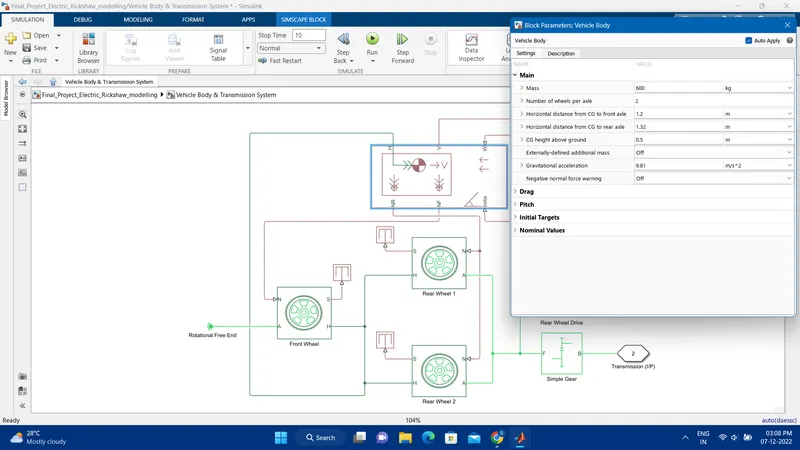
- Vehicle kerb weight 260 kgs
- Load capacity 340 kgs
- Vehicle speed 7 kmph
- Driving range 140 km (160 Ah)
- No of wheels per axel 2
- Frontal Area 91m
- Drag coefficient 5
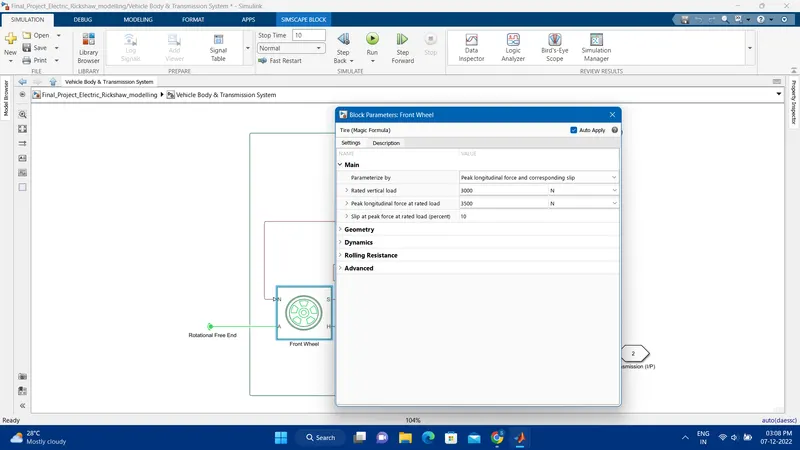
- Wheel radius 306m
- Vertical load 3000 N
- Nominal Voltage 330 V
- Rated Capacity 75 Ah
- Initial SOC % 100
- Internal Resistance 5 ohm
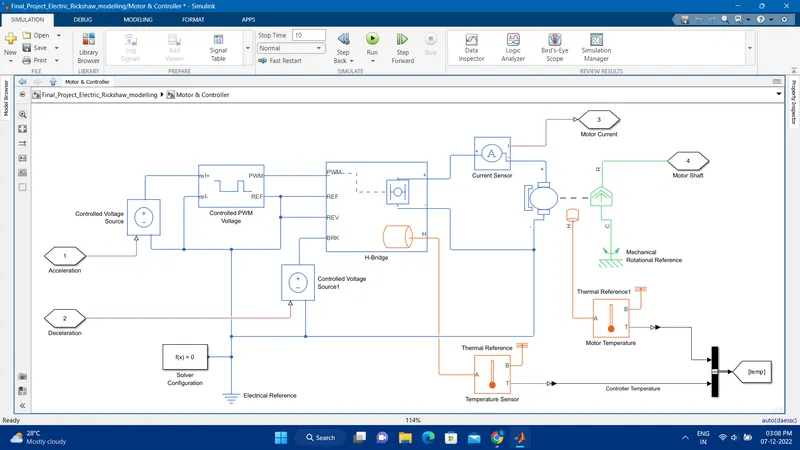
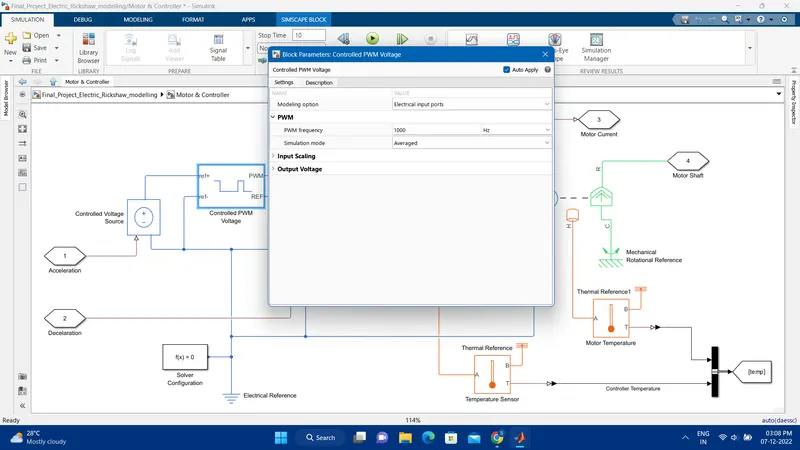
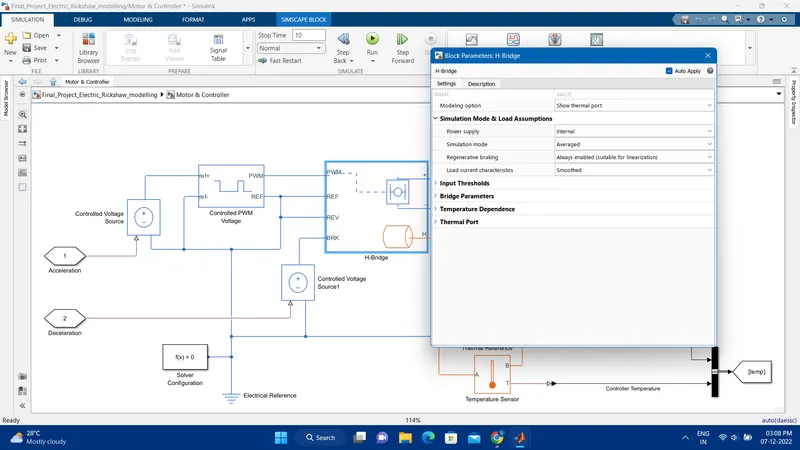
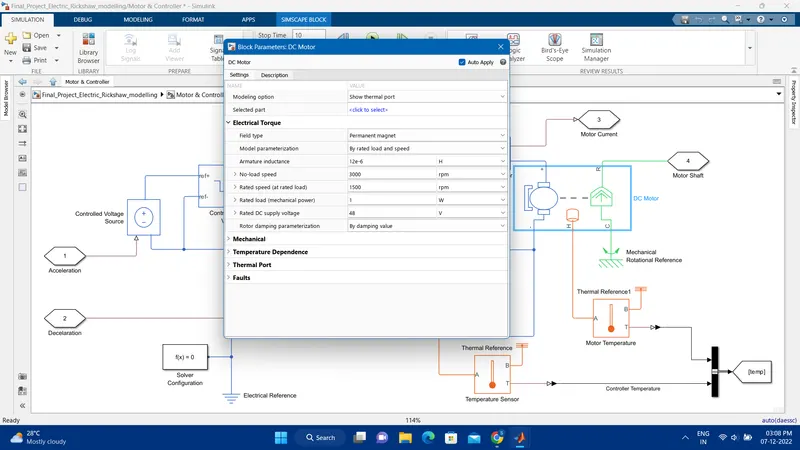
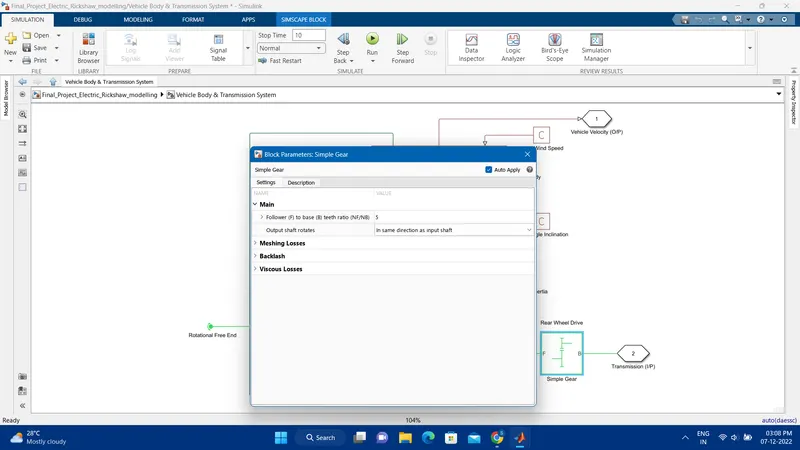
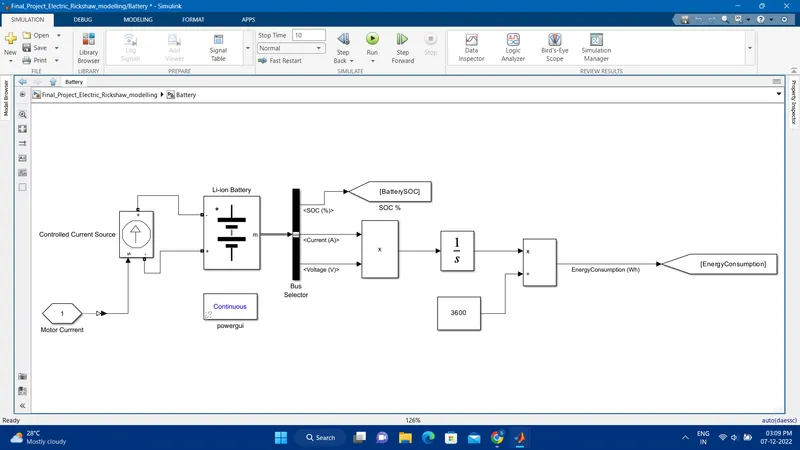
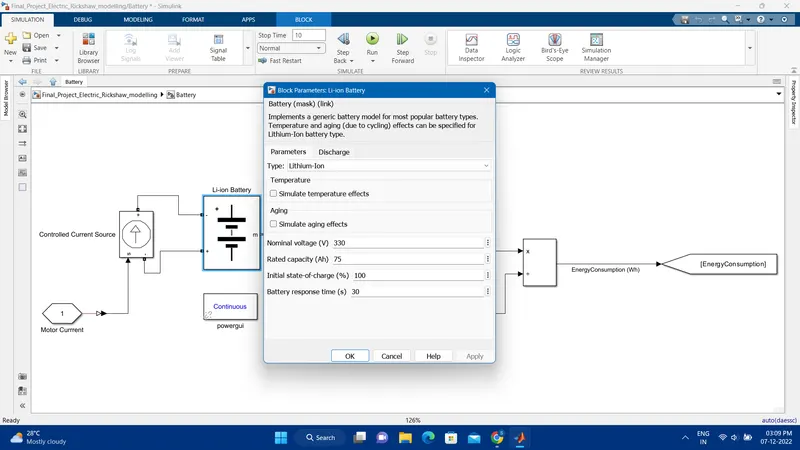
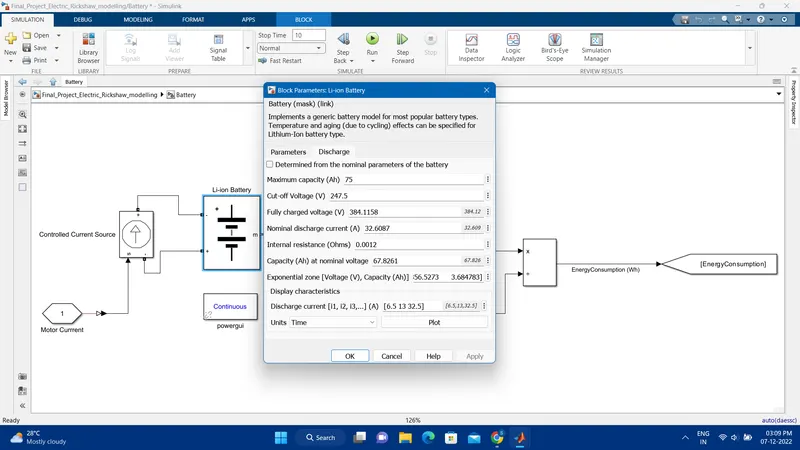
Output Plots :
1. For FTP75 Drive Cycle :
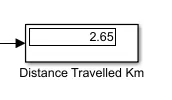
- By running the Vehicle with FTP75 Drive cycle for 2474 sec. the distance travelled is 19.44km.19.44km.
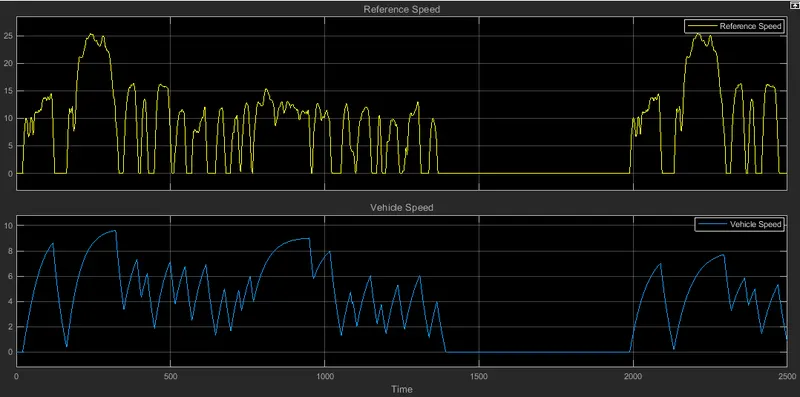
- The actual Speed is approximately followed 90% of the reference Drive cycle.
- The Temperature of the Motor is increased to 4150C.4150C.
- The Temperature of the Controller is ≈5000C≈5000C.
2. For WOT Drive Cycle :
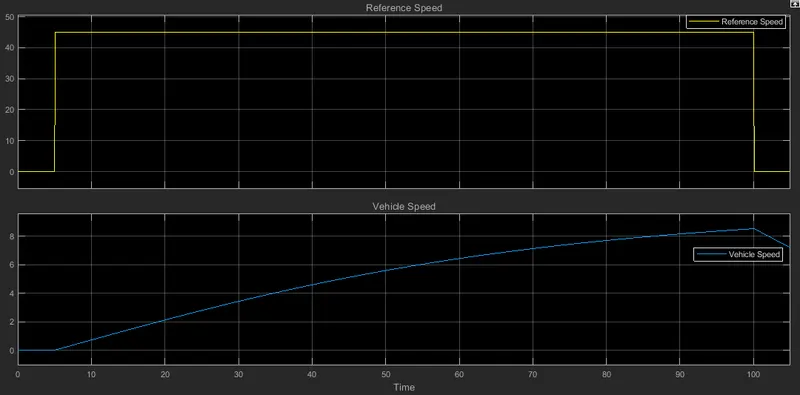
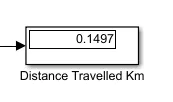
- By running the Vehicle with WOT Drive cycle for 200 sec. the distance travelled is 0.1497km.0.1497km.
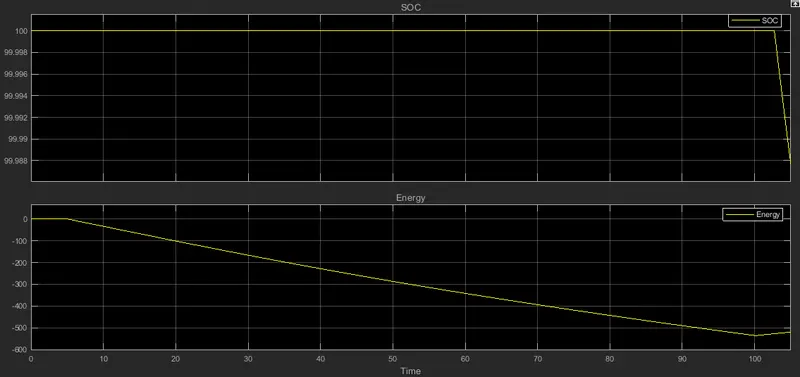
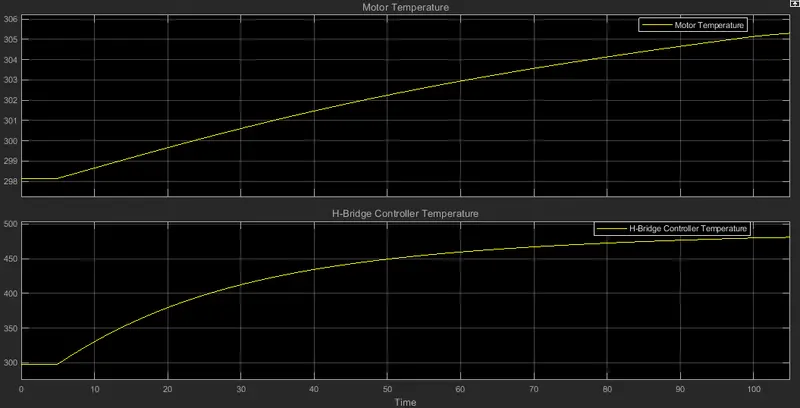
- The actual Speed is approximately followed 85% of the reference Drive cycle.
- The SoC% of the battery is reduced to ≈91%≈91% at the 100th sec and after that 100 to 200 sec., the battery gets charged by back EMF.
- The Temperature of the Motor is increased to 3050C3050C.
- The Temperature of the Controller is ≈4800C≈4800C.
3. For Manually prepared Drive Cycle :
- To increase the speed of the vehicle, the output voltage amplitude is applied to 400 V.
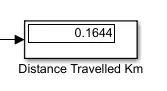
- By running the Vehicle with a Manually prepared Drive cycle for 120 sec. the distance travelled is 0.1644km.0.1644km.
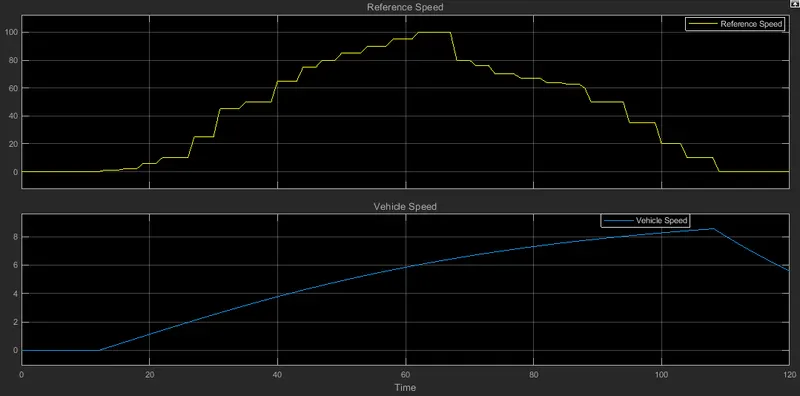
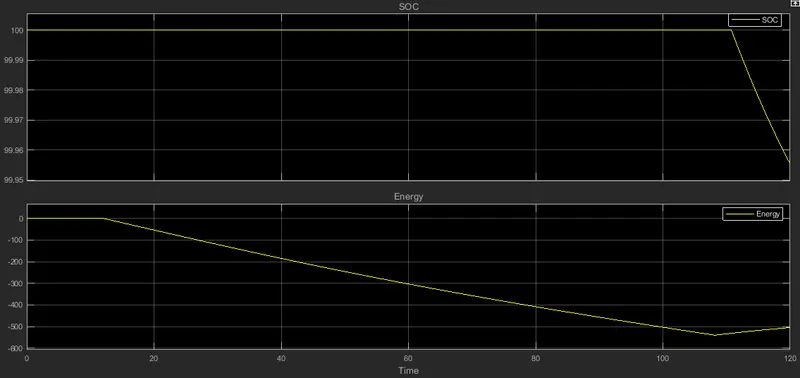
- the actual path of the speed is approximately followed by the reference Drive cycle as above.
- The SoC% of the battery is reduced to ≈94.2%≈94.2%.
- The Temperature of the Motor is increased to ≈3050C≈3050C.
- The Temperature of the Controller is ≈4800C≈4800C.
CONCLUSION :
Here I have compromised with the temperature of the Engine and regulator to accomplish vehicle speed close to reference speeds. Since I haven't involved any cooling framework in the model. In the ongoing application, the engine temperature is under 100 C.
In the ongoing application, the engine, battery and regulator temperature is constrained via air cooling. Thus, the temperature of these parts isn't expanded to this degree.
Consequently, Made a MATLAB model of an Electric Cart (three-wheel traveller vehicle) utilizing a Li-particle battery, and PM Brushed DC Engine.
Decided the varieties of Temperature of the Engine and regulator, SoC% and Energy consumed by the vehicle for each of the three Reference Drive cycles (i.e.; FTP75, WOT, Physically ready).
This Battery fueled Cart will be the most well-known method of transport from here on out.