Final Project: Design of an Electric Vehicle
Project 2 - Design of an Electric Vehicle
Theory
An electric vehicle (EV) is defined as a vehicle that uses an electric motor or a traction motor for propulsion as opposed to an internal combustion (IC) engine used by conventional vehicles. Electric vehicles use electricity for power instead of fossil fuels as conventional vehicles would and because of this difference, electric vehicles do not produce any exhaust gases or pollution. The power needed for the operation of an EV can come from a variety of sources such as batteries, generators, or through a collector system. Batteries fitted in to the body of an EV are capable of high energy densities in order for them to meet the power demands and range requirements. Generators are machines which generate electrical energy from an input of mechanical work and are a part of the electric motor, and they operate during braking to produce the phenomenon of 'regenerative braking'. Collector systems are off-vehicle systems which allow for the charging of an EV from homes or public charging stations. The electricity used for charging in these systems are generated from solar panels which can be used by the grid or by homes of EV owners so that they can charge their vehicles more conveniently.
EVs are increasing in demand in recent years due to the need to reduce vehicle emissions which are damaging to the environment. Government incentives and private companies are working on schemes to quicken the adoption of electric vehicles. Since EVs do not produce any emissions, they are more environmentally friendly than conventional vehicles are. The generation of the electricty used to charge the vehicles also comes from solar energy (a renewable energy source) and not fossil fuels which makes them sustainable. EVs can meet the same performance standards of conventional vehicles and even surpass that of theirs and this has been seen with the automotive company Tesla. The Tesla Model 3 is the best selling EV in the world and is capable of a range of approximately 350km on single charge. It also has an acceleration of 0 - 60 mph in 5.6 seconds and a top speed of 130 mph.
EVs offer several advantages over conventional vehicles besides the lack of pollution and lack of need to rely on fossil fuels. One is that, EVs are more efficient meaning that they offer more MPGe (miles per gallon gasoline equivalent), meaning that you will spend lesser on recharging an EV than you would to refuel a conventional vehicle. This because the more efficient the EV is, the more distance you travel with the available energy. In the US, Tesla owners can charge their EVs for free at their private charging stations for life which results in significant savings in fuel. Regenerative braking in EVs adds to their efficiency as the unused energy in braking gets reused purposefully. Another benefit is that EVs have fewer moving/rotating parts and this means lesser maintenance costs than you would have with IC engine vehicles e.g. changing oil, transmission fluid. This, in the long term would give better savings than you would get with conventional vehicles. Lesser moving parts means there is lesser friction between moving parts and hence quieter operation.
In spite of these feats, it will be difficult for a worldwide adoption of EVs for several reasons. One reason is convenience. In order for EVs to dominate the automotive market, their needs to be more convenient ways for consumers to be able to charge their vehicles. Their needs to be several charging stations on the highways and roads and this can be supported if everyone's homes were generating solar power. It needs to be as easy to charge an EV as it is to fill an IC engine vehicle with fuel at a petrol station. Another reason is the cost of the EVs. EVs are still a relatively new technology and only account for 2-3% of the worldwide market. This is because they cost considerable more than conventional vehicles due to the high cost of batteries and electric components. But, the cost of batteries is getting cheaper over time and manufacturers are developing newer and more efficient batteries. The goal is to produce a 'million mile' battery which, if made will be a revolution in the automotive sector. Another disadvantage is that the components in EVs operate at high voltages and currents and this can be a hazard if the components explode or don't work as they should.
A compromise between IC engine vehicles and EVs exists as Hybrid Electric Vehicles (HEVs). HEVs combine an IC engine with an electric propulsion system to produce a 'hybrid' between the two different classes of vehicles. The purpose of this is to use the power available form the electric powertrain to improve the fuel economy of the vehicle so that it does not rely solely on the petrol/diesel it uses as fuel. This in turn will also improve the overall performance of the HEV. The IC engine can be used to power the electric motor to charge the battery or use directly in the electric drive motor with a combination of a motor and generator in one. HEVs also implement regenerative braking to recharge their batteries among other features used in EVs. Compared to EVs, HEVs represent more of the automotive market with a 19% market share on all automobiles in the world. This is because HEVs still run on fossil fuels which is still more convenient as a fuel source in most parts of the world. The all time best selling HEV to date is the Toyota Prius.
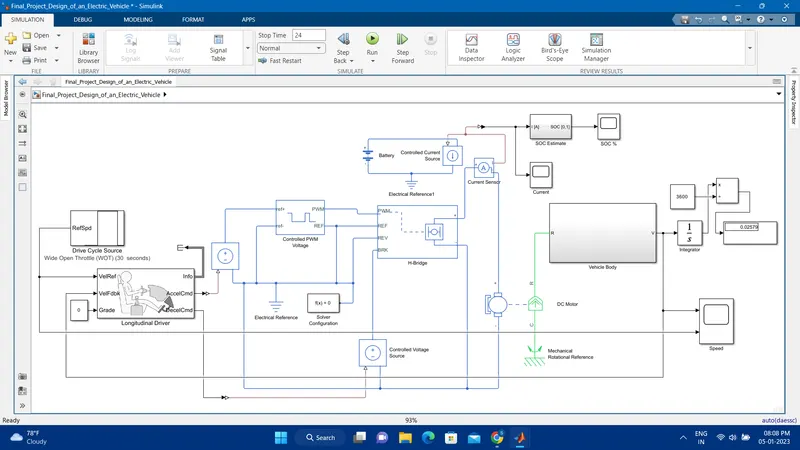
In this report, I will be modelling an electric vehicle with a DC motor and battery system using the SIMULINK software. The components I will need for my model exist as blocks in the SIMULINK block library. I will be modelling this EV for a drive cycle and measure the velocity characteristics and the current and SOC characteristics of its battery system.
Components
The main components of an EV are:
- batteries
- power converters
- motor controllers
- motor/generator
- transmission system
- wheels/tires
Batteries store the electrical energy needed to power the EV in all of its systems and needs. Power converters convert the power coming from the battery to a usable form for the motor. This conversion can be from DC to AC or vice versa and can even be between 2 different magnitudes of DC to DC or AC to AC. Motor controllers are electronics which control the amount of power delivered to the motor via control signals so that the motor is running as commanded. The motor is used for propulsion in order to move the vehicle in forward or reverse motoring. The generator is a part of the motor and just works in the opposite method to the motor. When braking, the vehicle can generate electricity and send this power back to the battery, charging it (regenerative braking). The transmission system is needed for the vehicle to change speeds as it accelerates/decelerates. The wheels are needed for traction on the roads and depending on the powertrain, the EV may be an FWD or RWD (forward or rear wheel drive). If a vehicle is an FWD, only the front axle wheels produce propulsion i.e.. rotate from motor effect and if it is an RWD, the back axle wheels produce it instead. All wheel drives (AWDs) also exist where the front and rear axle wheels work together to produce propulsion.
System Level Configuration
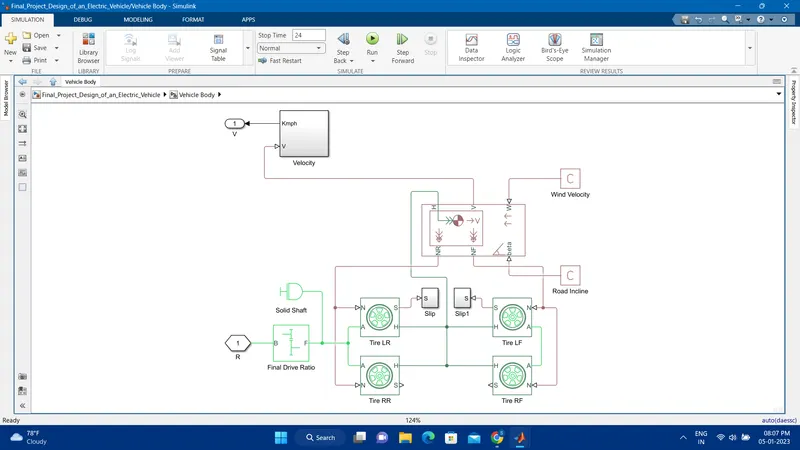
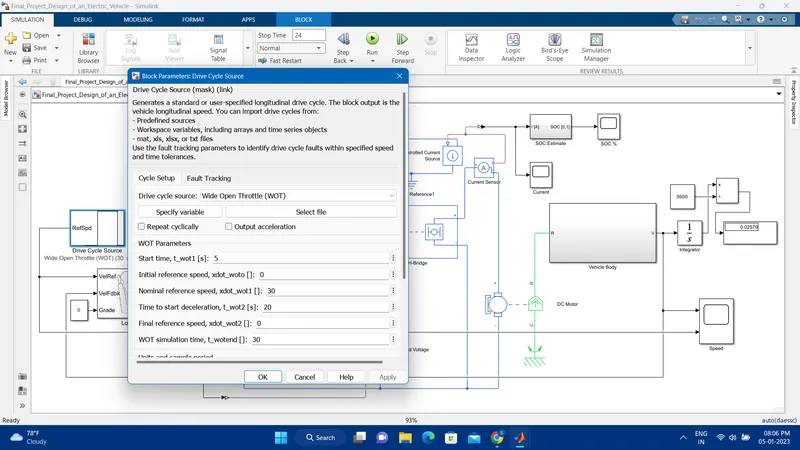
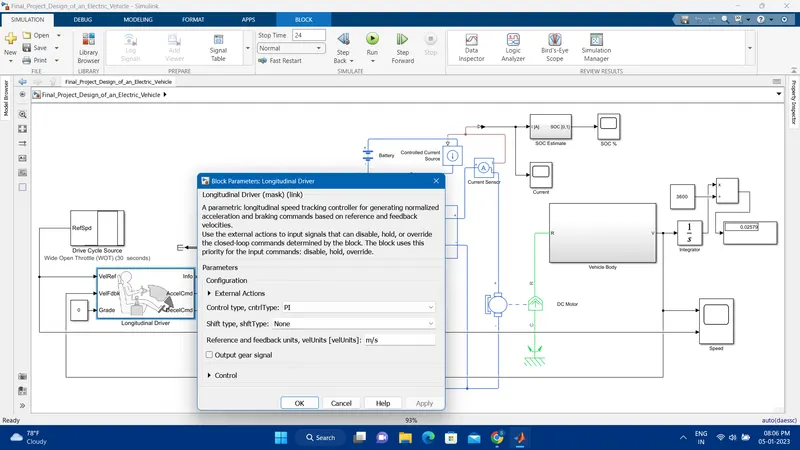
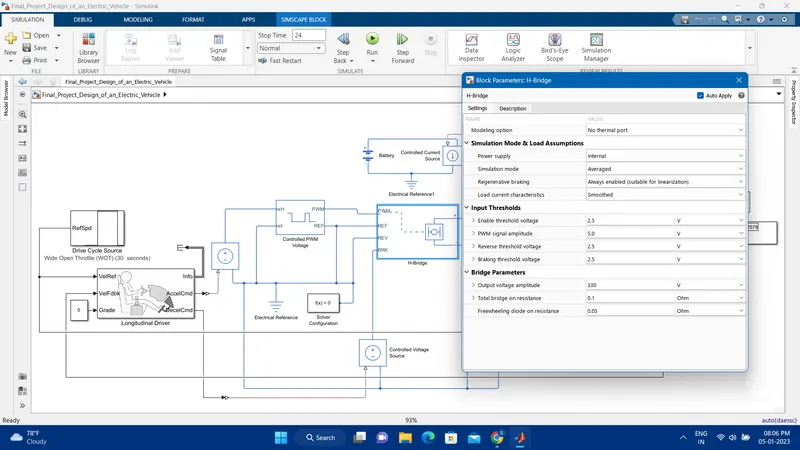
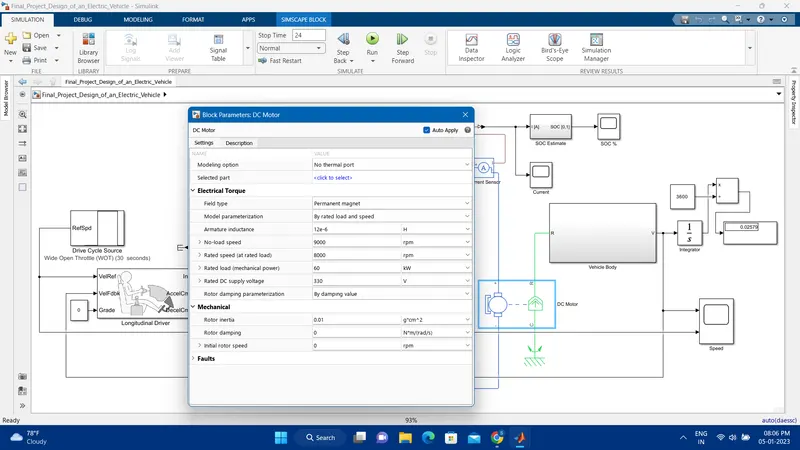
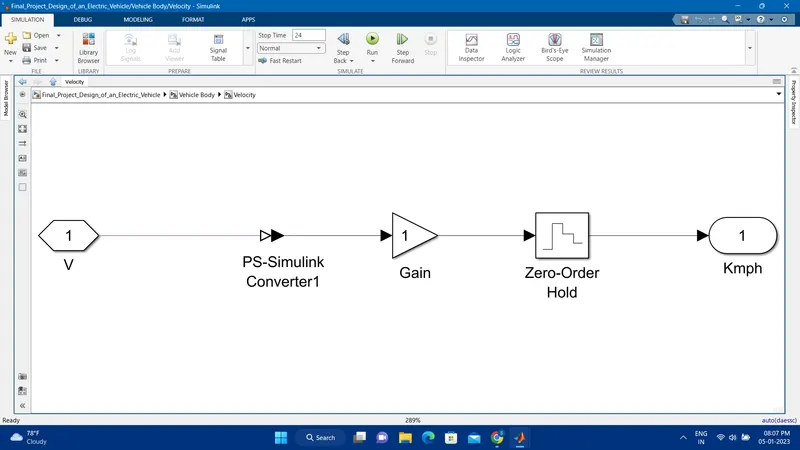
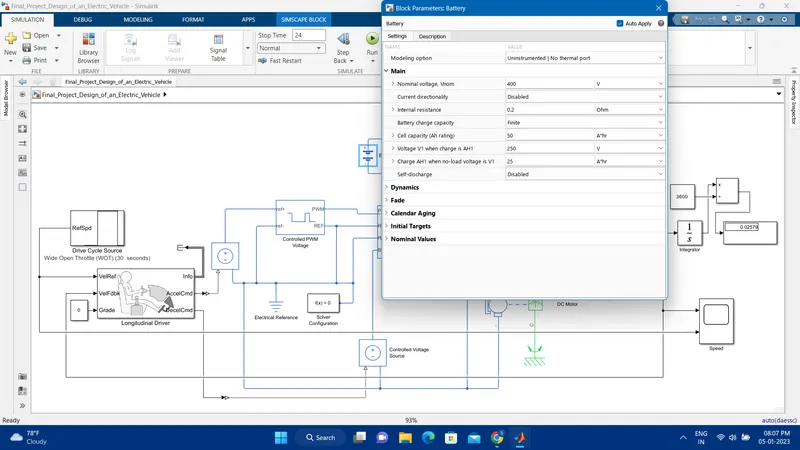
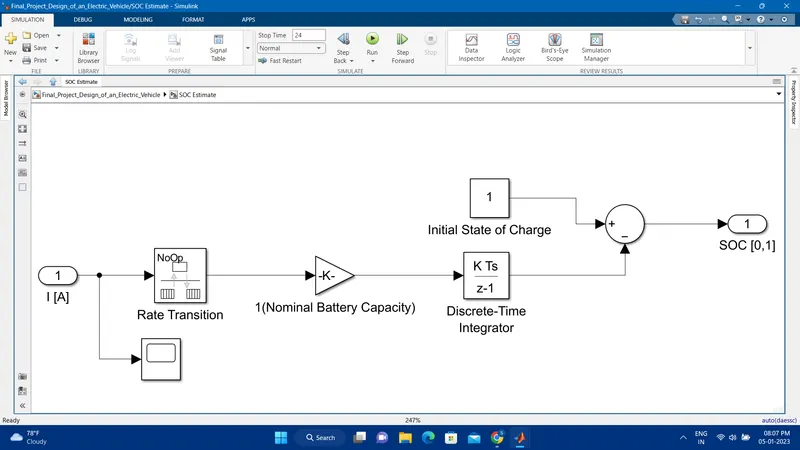
To model an EV in SIMULINK, we will need to model the aforementioned components separately and then have them work together. All the main components are available in the library of SIMULINK blocks and we will be adding each component and configuring its parameters to fit the requirements of the model. First, I have modelled the vehicle main body.
Vehicle Body
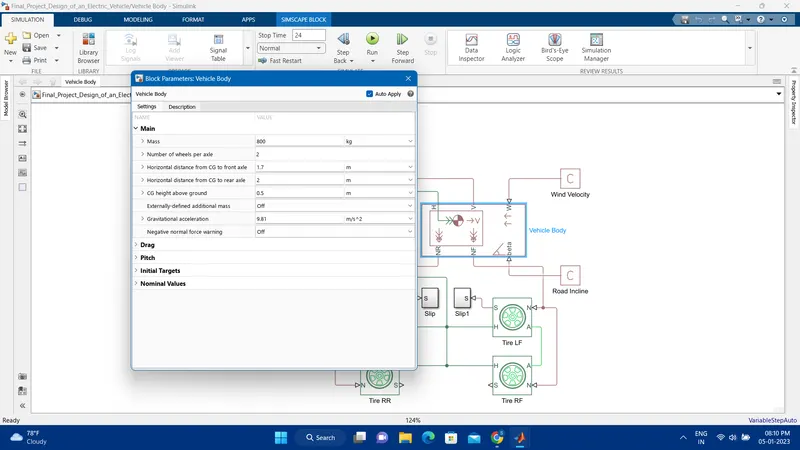
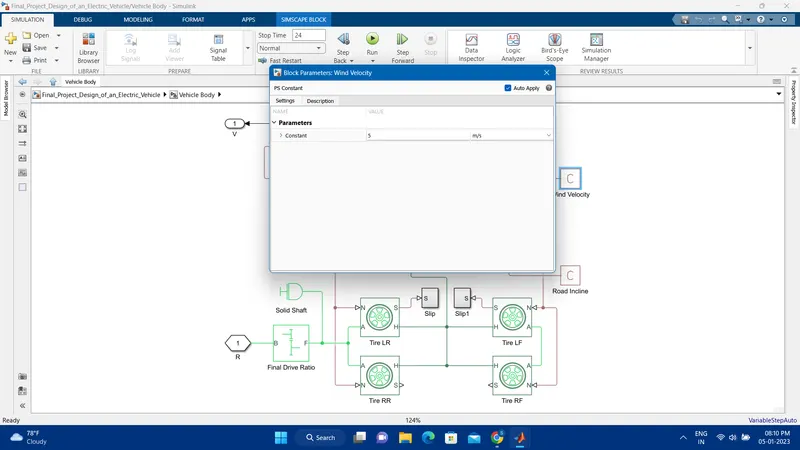
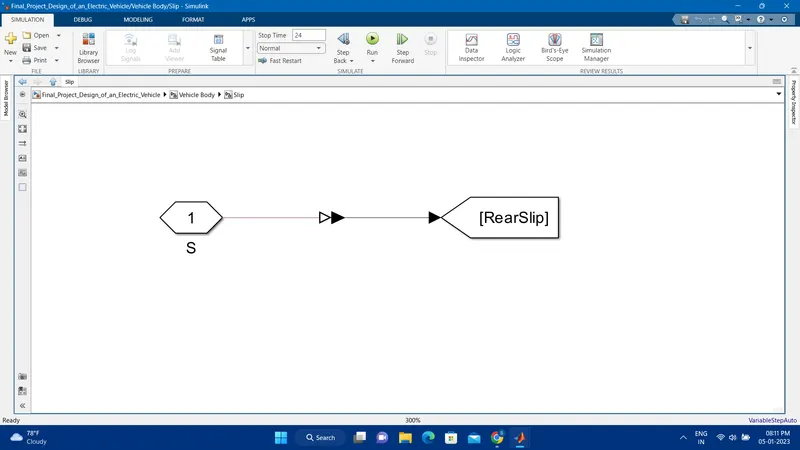
To model a vehicle's body, we need to first add the vehicle body block and this is shown below:





Results
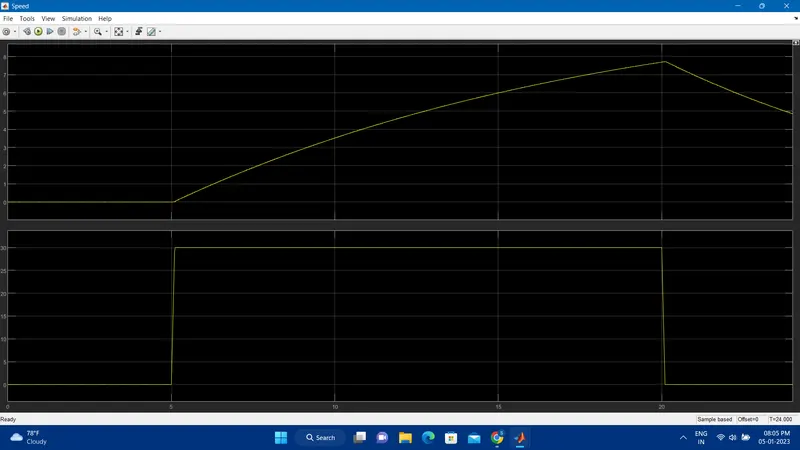
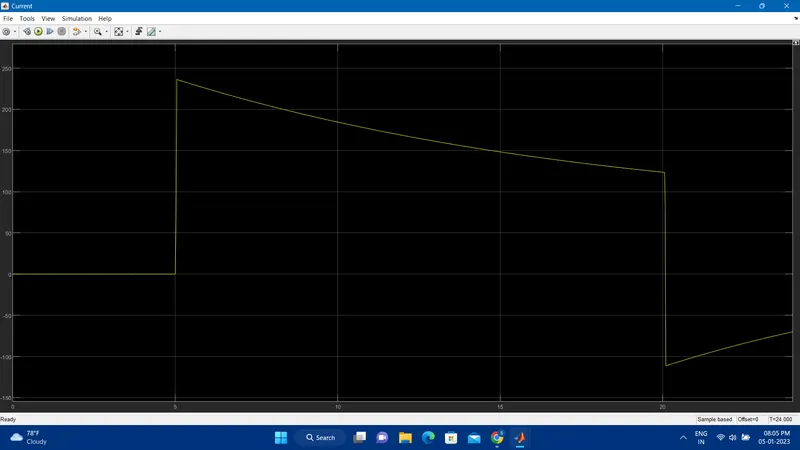
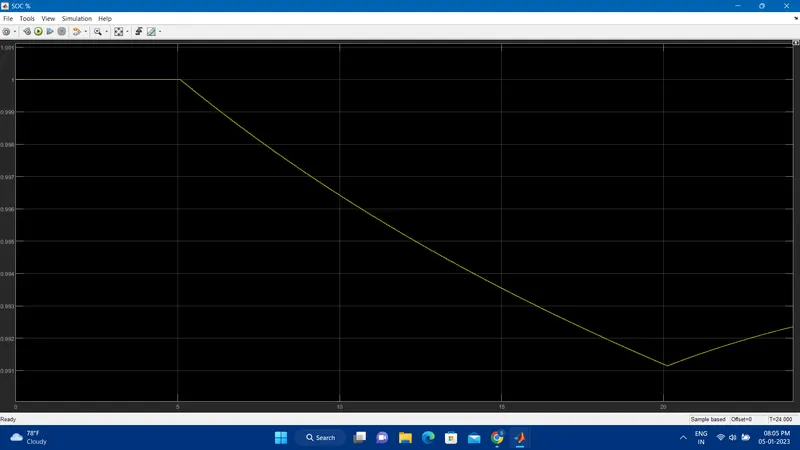
I run the WOT drive cycle for my EV model and took the outputs given from the speed, current and SOC scopes. The distance travelled by the vehicle in the drive cycle was also measured using the display block. Before running, the 'Stop Time' for the simulation was first set to 30 seconds which is the duration of my customized WOT drive cycle.
Speed Scope
Current Scope
SOC Scope
Conclusion
In conclusion, the EV model has been created with the necessary block components using the SIMULINK software and the model has been simulated for a customized WOT drive cycle. The simulation has produced results of the velocity of the vehicle, current flowing from the battery, and the SOC of the battery as well as the distance travelled by the EV. Since the EV model was parameterized to simulate averaged voltage pulses in the H-Bridge and Controlled PWM voltage blocks to be fed in to the DC motor, the simulation was run very quickly within a matter of seconds. The EV model was able to follow the commands given by the reference velocities from the drive cycle data, although it could have followed the reference signals more closely. The discrepancy between the reference velocity and actual velocity of the vehicle may be attributed to a variety of factors e.g. vehicle inertia, transmission system, transmission inertia. If the EV model was designed in such a way as to improve upon those factors, the model would follow the reference signals more closely and would improve the performance characteristics as well. The distance travelled by my EV model was measured at 0.1106km and seems to be an appropriate value based on the WOT drive cycle used.
I had observed that the SOC of the battery used in my EV model did not get discharged in a way I had expected it to. This could be because the drive cycle commands did not push the EV model to its limits or it could be due to the fact that the battery model was very efficient and was suitable for the driving application. My EV model had also included some actual features of EVs such as regenerative braking and this was evident in the current - time and SOC - time graphs whenever the EV decelerated. If the duration of the WOT drive cycle was modified to be longer, I could have seen my EV model exhibit its true performance characteristics. For instance, the EV model may achieve its top speed and it may also have been possible to see the time it takes for the vehicle to decelerate from that top speed and hence the time taken for the acceleration e.g. 0 to 60 kmph.
My EV model has been attached to this report as a .slx file along with the velocity, current and SOC plots obtained from their respective scopes.