Final Project: Design of an Electric Vehicle
1.Create a MATLAB model of electric car which uses lithium ion battery and induction motor. Choose suitable blocks from Powertrain block set. Prepare a report about your model.
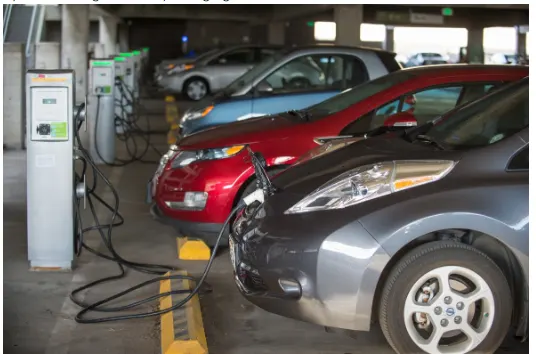
Fueling with electricity offers some advantages not available in conventional internal combustion engine vehicles. Because electric motors react quickly, EVs are very responsive and have very good torque. EVs are often more digitally connected than conventional vehicles, with many EV charging stations providing the option to control charging from a smartphone app.
Just like a smartphone, you can plug in your EV when you get home and have it ready for you to use the next morning. Since the electric grid is available almost anywhere, there are a variety of options for charging: at home,at work and home. By charging often, you may never need to go to a gas station again!
But EVs provide more than just individual benefits. EVs can help the United States have a greater diversity of fuel choices available for transportation. The U.S. used nearly nine billion barrels of petroleum last year, two-thirds of which went towards transportation. Our reliance on petroleum makes us vulnerable to price spikes and supply disruptions. EVs help reduce this threat because almost all U.S. electricity is produced from domestic sources, including coal, nuclear, natural gas, and renewable sources. EVs can also reduce the emissions that contribute to climate change and smog, improving public health and reducing ecological damage. Charging your EV on renewable energy such as solar or wind minimizes these emissions even more.
Plug-in electric vehicles (also known as electric cars or EVs) are connected, fun, and practical.they can reduce emissions and they can even save your money.
Fueling with electricity offers some advantages not available in conventional internal combustion engine vehicles. Because electric motors react quickly, EVs are very responsive and have very good torque. EVs are often more digitally connected than conventional vehicles, with many EV charging stations providing the option to control charging from a smartphone app.
Just like a smartphone, you can plug in your EV when you get home and have it ready for you to use the next morning. Since the electric grid is available almost anywhere, there are a variety of options for charging: at home,at work and home. By charging often, you may never need to go to a gas station again!
But EVs provide more than just individual benefits. EVs can help the United States have a greater diversity of fuel choices available for transportation. The U.S. used nearly nine billion barrels of petroleum last year, two-thirds of which went towards transportation. Our reliance on petroleum makes us vulnerable to price spikes and supply disruptions. EVs help reduce this threat because almost all U.S. electricity is produced from domestic sources, including coal, nuclear, natural gas, and renewable sources. EVs can also reduce the emissions that contribute to climate change and smog, improving public health and reducing ecological damage. Charging your EV on renewable energy such as solar or wind minimizes these emissions even more.
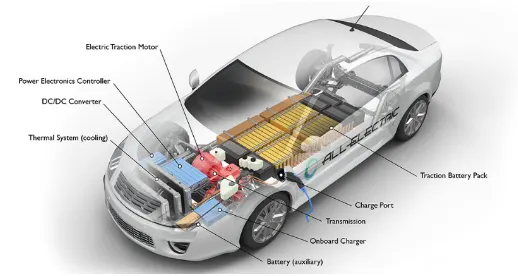
The majar blocks used to design the EV vehicle using matlab simlink are:
- drive cycle
- driver
- controlled PWM voltage
- H-bridge
- battery source
- dc motor
- vehicle and others.
MATLAB MODEL OF ELECTRIC CAR
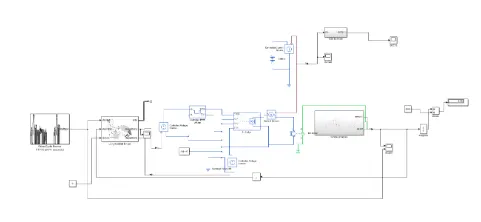
1. Drive cycle
Starting with the drive cycle I have used FTP75 for the operation of the cycle where the stop time is 2474seconds
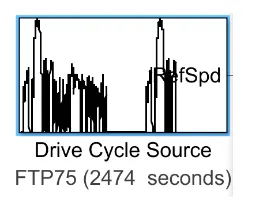
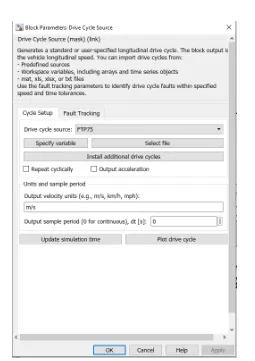
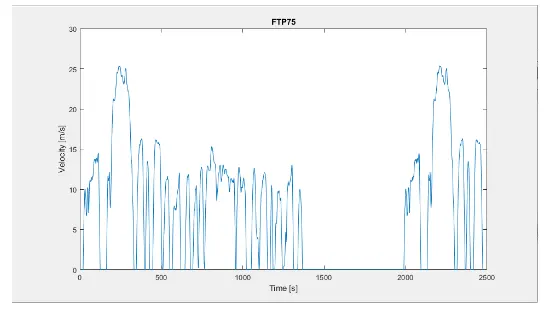
The above snap is the FTP75 drive cycle with the max velocity of 26m/s.
Then the drive cycle is connected to Vehicle reference of Longitudinal drive block.
2.Longitudinal driver
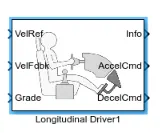
The Longitudinal Driver block implements a longitudinal speed-tracking controller. Based on reference and feedback velocities, the block generates normalized acceleration and braking commands . we can use the block to model the dynamic response of a driver or to generate the commands necessary to track a longitudinal drive cycle.
It consists of six ports they are:
VelREf = vehicle reference
VelFdbk = vehicle feedback
Grade= gradability
info= information which is terminated here.
AccelCmd = acceleration command
DecelCmd = decceleration command
Here speed is taken as feedback through a Smulink PS converter from Vehicle subsyntem and given gradeability for speed calculation integrator blook and a constant is connected with Divide blocks positive and negative terminal respectively. Acceleration command is given to Control Voltage sourcel through a simulink PS Converter.
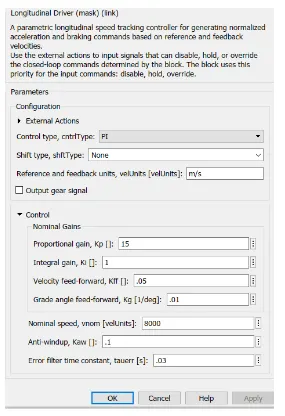
Parameter considered:
3.Controlled PMW voltage:
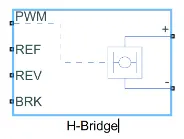
The value of the Output voltage amplitude parameter determines amplitude of the output voltage.
The Controlled PWM Voltage block represents a pulse-width modulated (PWM) voltage source.
-
Electrical input ports — The block calculates the duty cycle based on the reference voltage across its ref+ and ref- ports. This modeling variant is the default.
-
PS input — Specify the duty cycle value directly by using an input physical signal port.
where
-
Vref is the reference voltage across the ref+ and ref- ports.
-
Vmin is the minimum reference voltage.
-
Vmax is the maximum reference voltage
parameters considered:
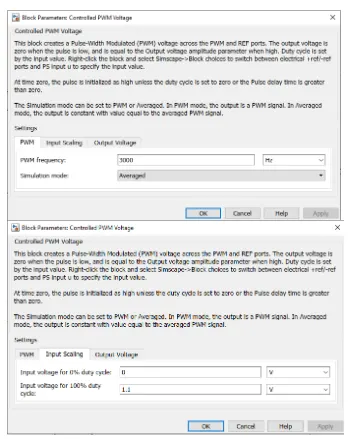
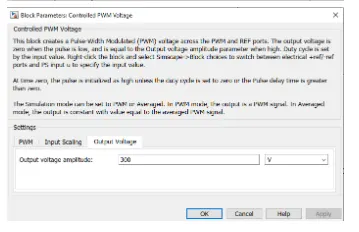
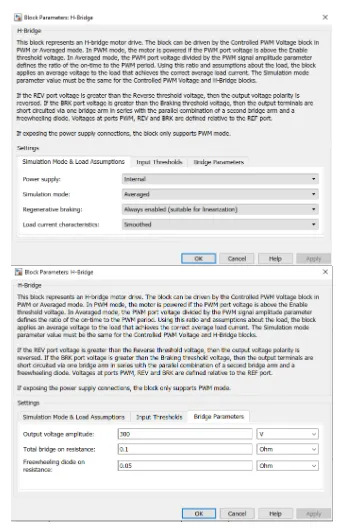
4. H-bridge
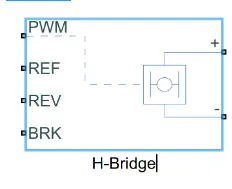
This block represents an H-bridge motor drive. The block can be driven by the Controlled PWM Voltage block in PWM or Averaged mode. In PWM mode, the motor is powered if the PWM port voltage is above the Enable threshold voltage. In Averaged mode, the PWM port voltage divided by the PWM signal amplitude parameter defines the ratio of the on-time to the PWM period. Using this ratio and assumptions about the load, the block applies an average voltage to the load that achieves the correct average load current. The Simulation mode parameter value must be the same for the Controlled PWM Voltage and H-Bridge blocks.
Reverse of H-Bridge and both Reference output ot Control PWM voltage and H-bridge is grounded. A solver configuration is connected to the ground reference. Reference output of Control PWM voltage and HBridge is connected.
Two output port of HBridge is connected to a DC motors. Also the positive output of bridge is connected to a controlled courent source through a current sensor.
parameter considered:
5. Battery source
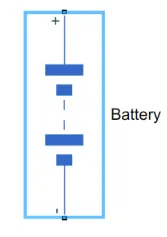
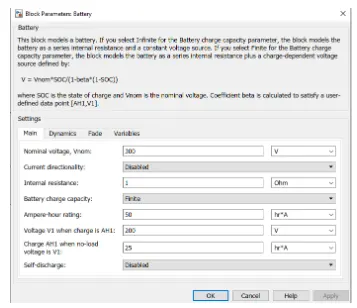
The battery is connected to the H-bridge through the current sensor where the battery is the main power source of the model.
The below model is the complete battery blocks and connections which includes SOC , controlled current sourceand PS simulnk
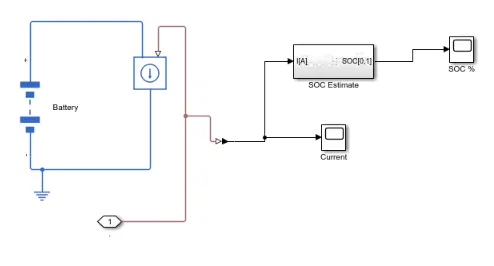
SOC estimate block
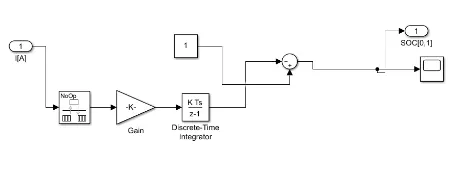
The above subsystem is the SOS estimate block where the rate transition, gain, and discrete time integrator , are connected in series after that this series is added with constant block.This arrangement gives us the SOC
Parameters considered
6.DC motor
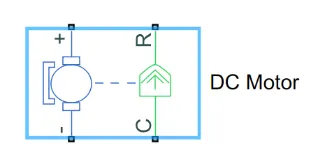
This block represents the electrical and torque characteristics of a DC motor.
When a positive current flows from the electrical + to - ports, a positive torque acts from the mechanical C to R ports. Motor torque direction can be changed by altering the sign of the back-emf or torque constants.
Here the + and - terminals of the dc motor the + and - of the H-bridge respectively.
The mechanical C port is connected to the mechanical rotational reference and R port is connected to the simple gear of the vehicle dynamics block.
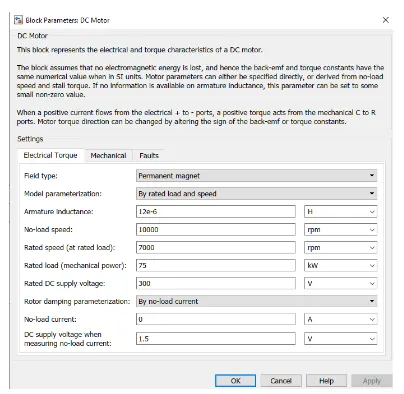
Parameters considered:
7. Vehicle dynamics
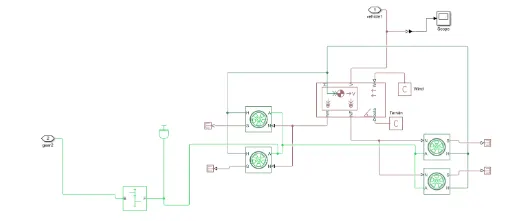
Vehicle dynamic block is a subsystem block which includes vehicle body, gear, terrain, wind, tires, inertia, ideal translational motion sensor and PS converter.
TIRE:
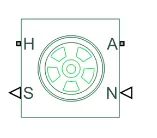
The above block is Tire with longitudinal behavior given by Magic Formula coefficients.
where H= Hub(Mechanical translational port associated with the wheel hub that transmits the thrust generated by the tire to the remainder of the vehicle).
S= slip (Physical signal output port associated with the relative slip between the tire and road).
a=axle (Mechanical rotational port associated with the axle that the tire sits on).
N=normal force (Physical signal input port associated with the normal force acting on the tire. The normal force is positive if it acts downward on the tire, pressing it against the pavement).
The parameters of the tire is taken as same as default value.
8. Vehicle body:
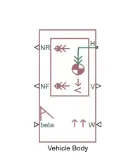
The Vehicle Body block represents a two-axle vehicle body in longitudinal motion. The vehicle can have the same or a different number of wheels on each axle. For example, two wheels on the front axle and one wheel on the rear axle. The vehicle wheels are assumed identical in size. The vehicle can also have a center of gravity (CG) that is at or below the plane of travel.
where;
NRNR=rear axle normal force (Physical signal output port for normal force on the rear axle. Wheel forces are considered positive if acting downwards.)
NFNF=front axle normal force (Physical signal output port for normal force on the front axle. Wheel forces are considered positive if acting downwards.)
beta= road incline angle (Physical signal input port for road incline angle.)
WW= wind (Physical signal input port for headwind speed.)
HH= horizontal motion (Conserving port associated with the horizontal motion of the vehicle body. Connect tire traction motion to this port.)
VV=longitudinal velocity ( Physical signal output port for vehicle longitudinal velocity).
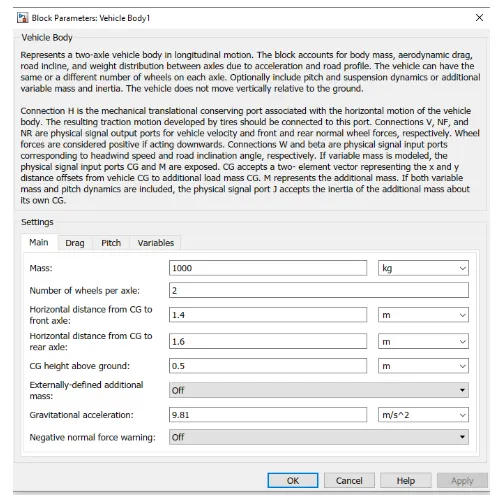
Parameters considered:
RESULTS:
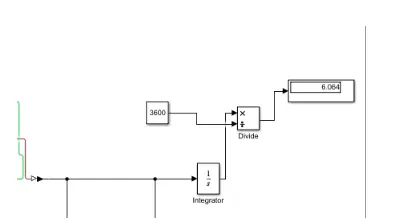
The distance obtained for a given FTP75 DRIVE CYCLE with 300V battery capacity is able to cover 6.064KM distance.
State of charge(SOC):
The state of charge represents the battery capacity left over for the vehicle and it is showed by the below graph.
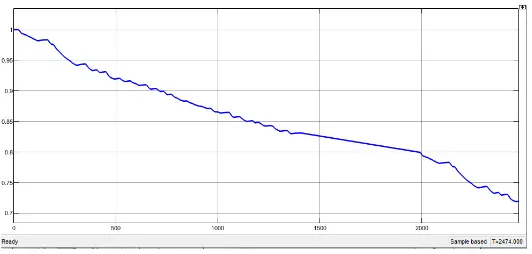
In the above graph we can see ups and downs this indicates the accelaration and de accelaration of the vehicle,constant value is because of re generative braking,at initial the battery capacity was 100 % and to complete the drive cycle it is dicharged by 28 %.
Current:
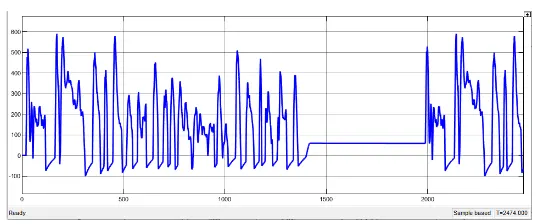
This graph shows the current flow varying from battery to motor for the given FTP75 drive cycle.
Vehicle speed performance:
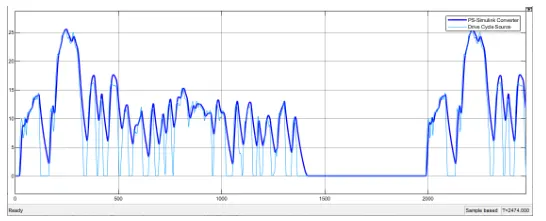
From the obtained vehicle speed performance we can conclude that vehicle has attained its maximum speed and there is a very slight delay in the de accelaration but the accelaration and top speed were performed very well by the vehicle.We can also obtained the current and voltage profiles from the simulation using scope.
CONCLUSION:
EV has obtained an ouput according to the FTP75 drive cycle and it can be tested for many drive cycle by selecting in the drive cycle block.It has travelled 6.064 km by the present 300V battery capacity if we increase the battery capacity to higher levels we can travel more distance but in real time this should be done by considering the space and cost.