Fender Design - Wheel Arch Challenge
Aim:
To calculate the Wheel Arch gap at required points and check whether the car passes the European standard.
Process:
- A study of different wheel arch gap standards.
- Prepare a sketch with lines and points with angles to calculate the european standard.
- Measure the distances from the wheel to the fender and prepare a table for conclusion.
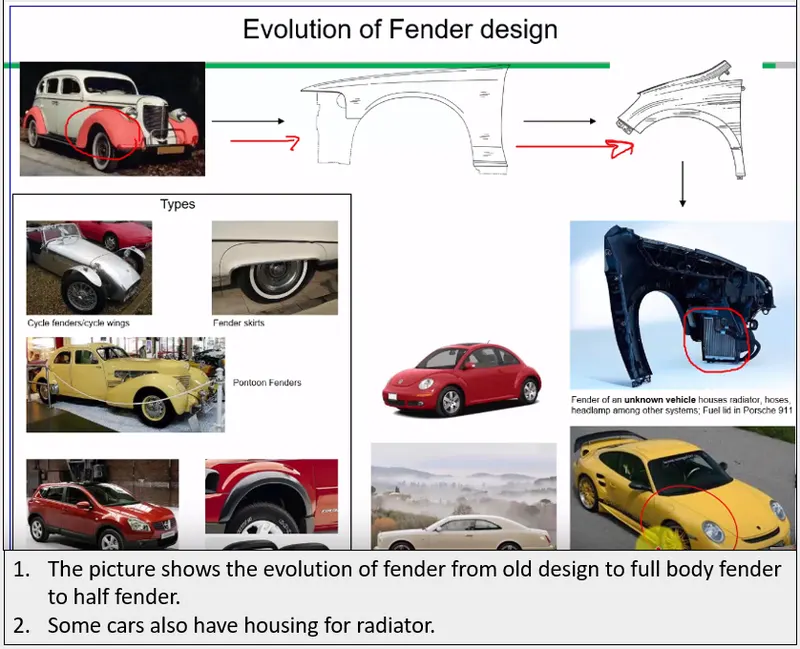
Fender:
- Fender is the American English term for the part of an automobile, motorcycle or other vehicle body that frames a wheel well (the fender underside).
- Its primary purpose is to prevent sand, mud, rocks, liquids, and other road spray from being thrown into the air by the rotating tire.
- Sticky materials, such as mud, may adhere to the smooth outer tire surface, while smooth loose objects, such as stones, can become temporarily embedded in the tread grooves as the tire rolls over the ground.
- These materials can be ejected from the surface of the tire at high velocity as the tire imparts kinetic energy to the attached objects.
- For a vehicle moving forward, the top of the tire is rotating upward and forward, and can throw objects into the air at other vehicles or pedestrians in front of the vehicle.
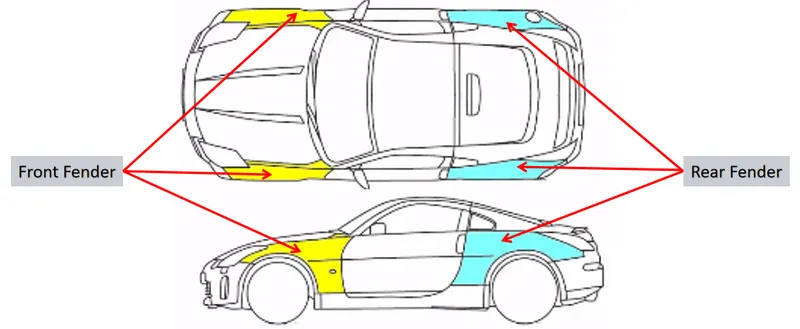
Front and rear fender location:
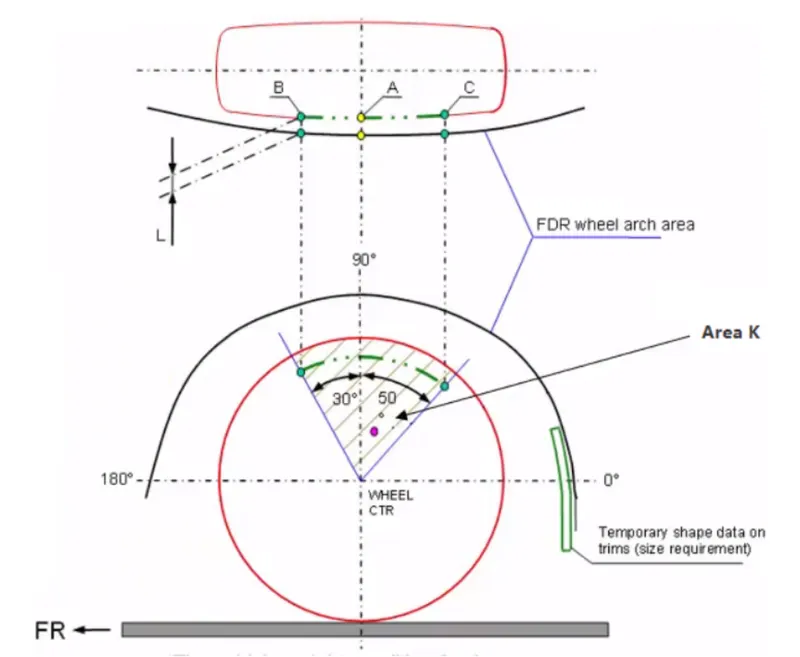
wheel Arch:
- Wheel Arch is the semicircular curve on the fender just above the wheels of a car
- It has some standard specifications
- The standards vary from country to country, the wheel arc of the fender must satisfy the standards set by the respective countries to permit the vehicle to use.
Japan standards:
- Measure the clearance "L" for tire, hub, cap & fender in 3 diff variations within area K and create clearance check chart to validate.
- The clearance must be greater than 5mm at all 3 positions.
- Wheel guard requirement : The value of "a" should be more than 5mm at line 30* forward and 50* rear wards from the central vertical axis of the wheel.
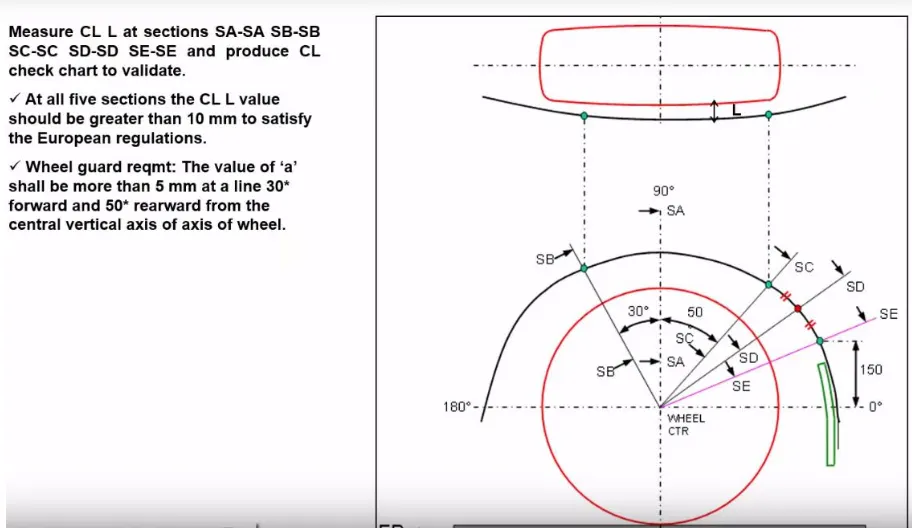
European Regulations/Standards:
Given:
Wheel Arc Calculation:
A sketch is prepared as mentioned above.
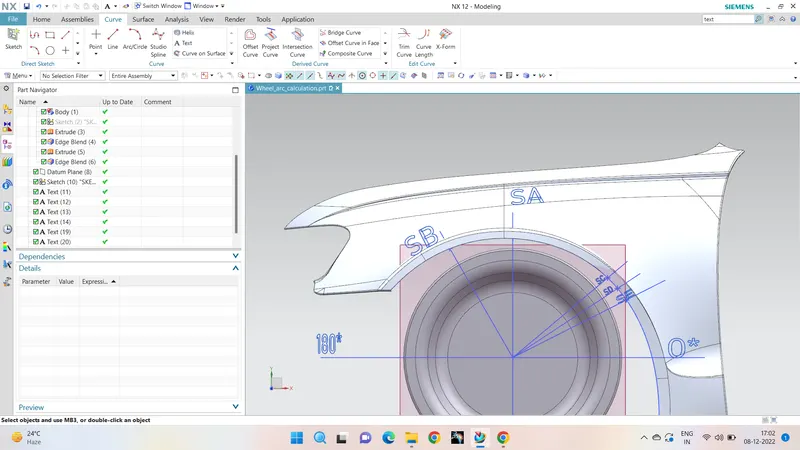
A clear picture of sketch with dimensions:
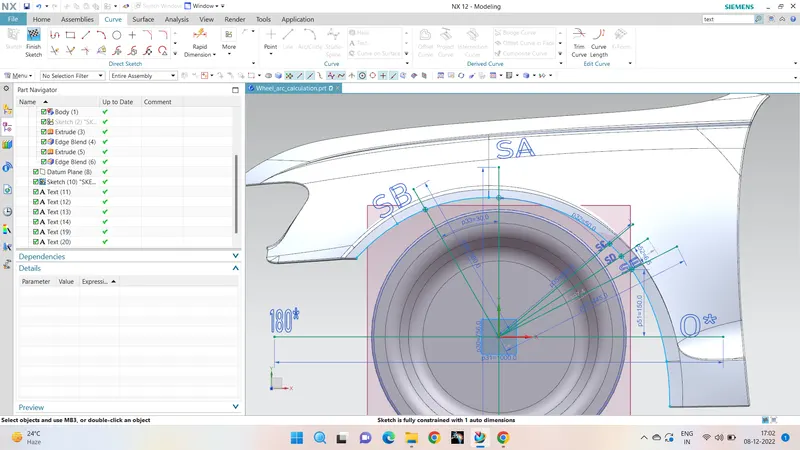
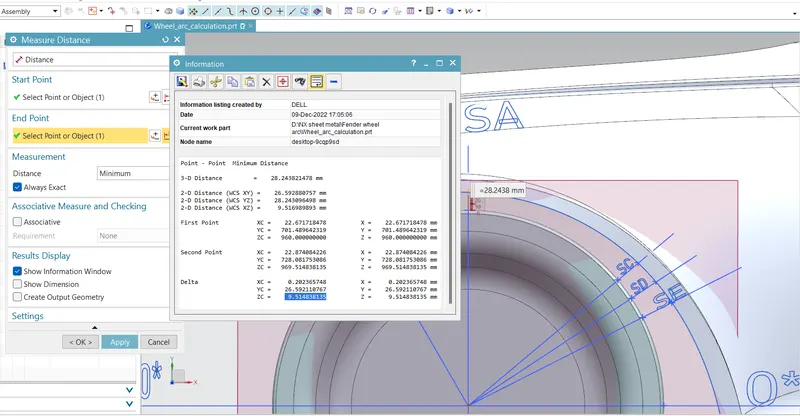
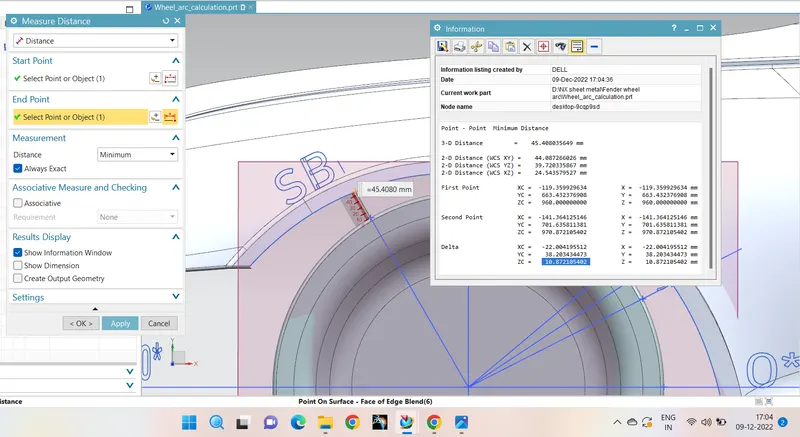
Measuring the values of clearance "L" at all sections & "a" at SB and SC:
At all five sections the value of 'L' should be > 10mm to satisfy the European regulations.
The value of "a" should be more than 5mm at line 30degree forward and 50degree.
Measuring "L" at SA:
Measuring "L" and "a" at SB:
Measuring "L" and "a" at SC:
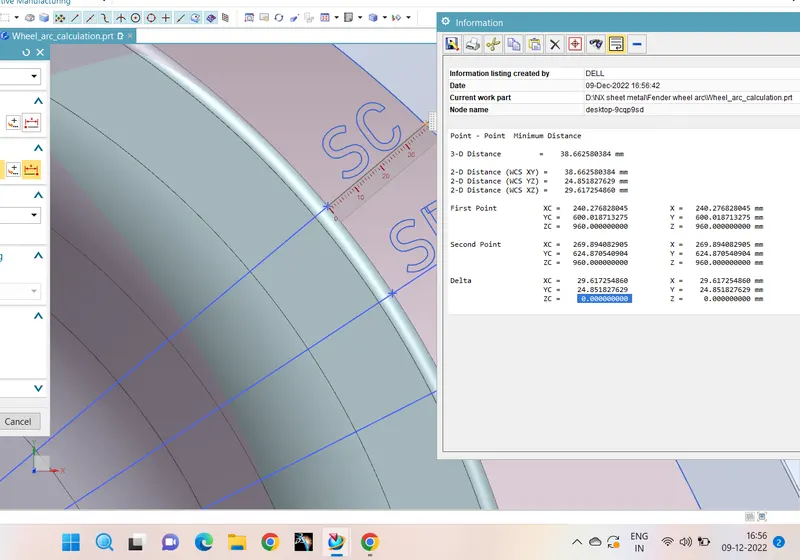
Measuring "L" at SD:
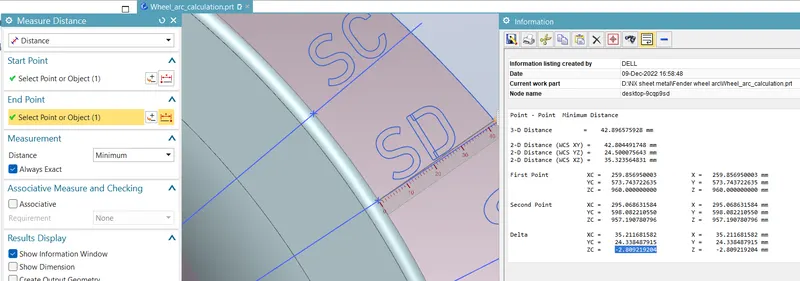
Measuring "L" at SE:
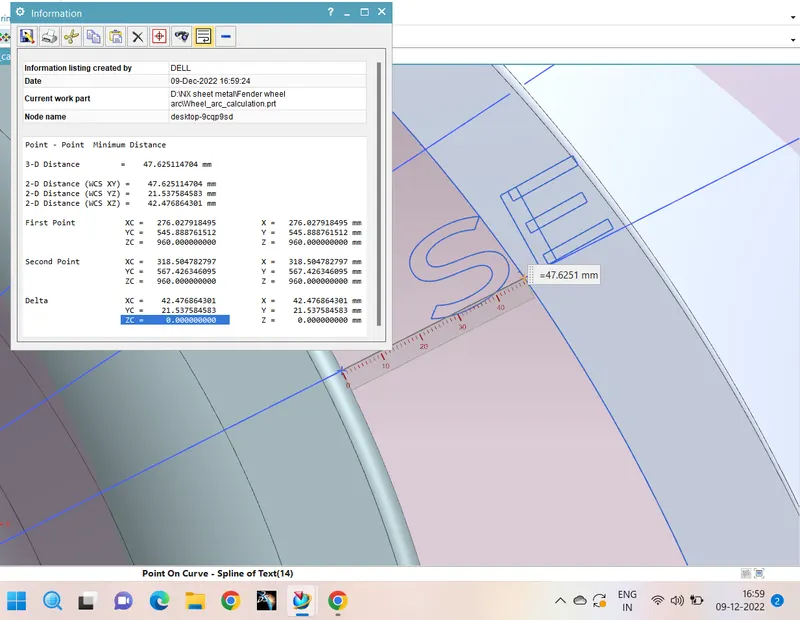
The observation table from the values obtained after measuring for the clearance are as follows:
| SECTION | CLEARANCE 'L' in (mm) | CLEARANCE 'a' in (mm) | RESULT(L) | RESULT(a) |
|---|---|---|---|---|
| SA | 9.51 | Fail | ||
| SB | 10.87 | 45.40 | Pass | Pass |
| SC | 0.00 | 38.66 | Fail | Pass |
| SD | -2.80 | Fail | ||
| SE | 0.00 | Fail |
CONCLUSION:
The given Fender doesn't satisfy the european standards as the length "L" is not >10mm. Though the clearance value 'a' was more than 5mm at a line 30° forward and 50° rearward from the central vertical axis of wheel, This fender doesn't pass for European standards.