Fender Design
Objective:
To design front fender of a car with the help of given master section using NX CAD software.
Introduction:
A fender is a curved panel that sits above the wheels of a car and runs from the bumper to its doors. It protects the car by picking up all the dirt and other things on the road, which would otherwise damage the car.
Fenders can be made of different components depending on the make and model of the car. They can be made of plastic, aluminum, rubber, and fiberglass. Expensive cars like models of Mercedes, Audis, and BMWs use fenders made of aluminum and its alloys. However, this isn’t always right, as there are expensive cars with thermoplastic fenders like the one on a Lamborghini Gallardo.
Apart from their regular function of protecting the car from mud splashes and debris, fenders also play a key role in improving the aerodynamics of the car. To put it simply, when the tires are spinning at high speeds, they generate a lot of drag due to the turbulence they create. A fender that houses the wheels helps to reduce that turbulence. This is due to its curved design, which increases the vehicle’s aerodynamic efficiency.
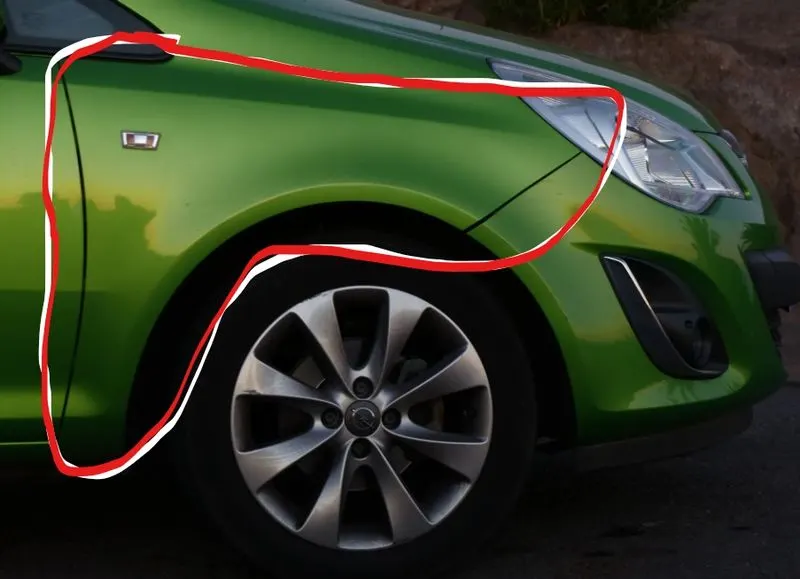
Fender Design:
Fender is going to fix on following locations
Drip Area:
- Two main points to be remembered while designing the drip area.
- A minimum gap of 200 mm should be maintained from the rear end of the fender. This is because to have spacing for cowl mounting.
- The second thing is to maintain a minimum gap of 150 mm front end of the fender for headlamp mountings.
- It is considered to be important because it is mounted on the engine compartment.
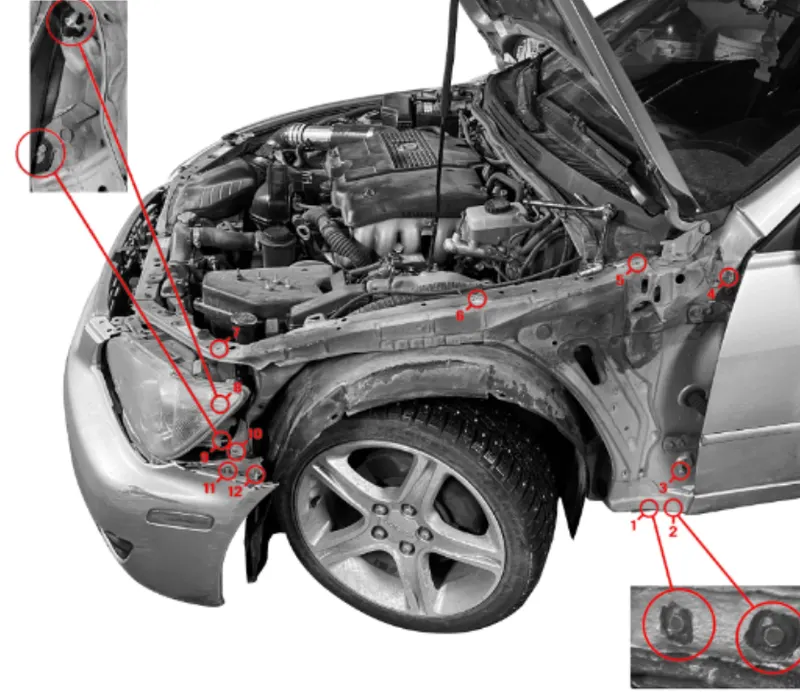
Bumper mount:
It is the front portion of the fender where the bumper is mounted with the help of brackets.

Splash mount:
- The Splash area also plays a vital role in anti-chipping.
- It protects the dust particles, spray particles from being entered inside the car.
- Thus Splash plays a vital role in the fender.
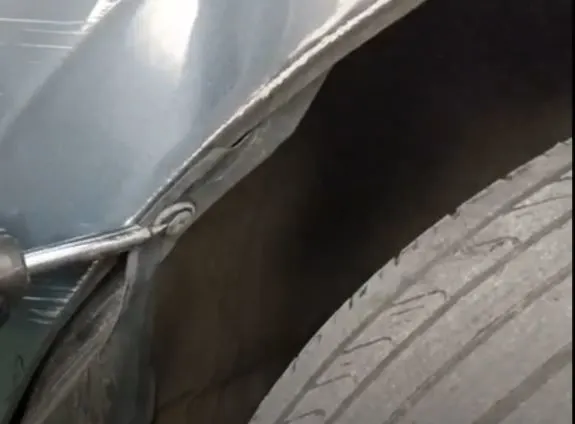
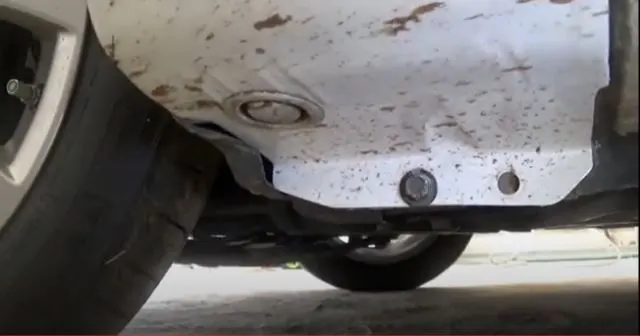
Sill mount: It is the front portion of the fender where the bumper is mounted with the help of brackets.
A-Pillar mount:
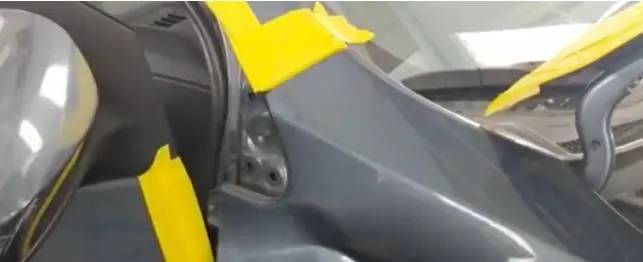
A pillar is a region where the A-pillar of the car is mounted from the front fender. It is located at the top right corner of the fender.
FENDER Manfacturing process
The manufacturing of the fender majorly involves these operations.
Embossing
Embossing Embossing is a metal forming process for producing raised or sunken designs or relief in sheetmetal using matched male and female roller dies, theoretically with no change in metal thickness, or by passing sheet or a strip of metal between rolls of the desired pattern.
Bending
Metal bending is a process by which metal can be deformed when applying force to the subject, which causes it to bend at an angle and form the anticipated shape, which often results in it being in a 'V' or a 'U' shape. This is done through the application of force on a workpiece. The force on the work piece can be mechanical, pneumatic or hydraulic
Cutting and Blanking
Cutting processes are those in which a piece of sheet metal is separated by applying a great enough shearing force to cause the material to fail. Blanking is a steel manufacturing process in which a flat, geometric shape is created by feeding a coil of sheet metal into a press and die in this process, the blank is punched out from the large metal sheet.
Design Procedure:
Drip area Design
Drip area mounting is the important part in the fender . This mounting is attached to the engine compartment of the car . Fender drip area is mounted via weldnuts to the engine compartment.
- The height of drip area mounting should be less than 40mm so that it reduces the springback effect during manufacturing and reduce NVH issues during vehicle movement.
- Mounting screw holes of dia 5mm are and locator pin holes are created for mounting guidance.
- It should be distanced atleast 150mm from the front side ande 200m from the rear side .
- Ribs are to be provided in order to increase the strength of the mounting part .
Bumper area and A-pillar design Design
The A-pillar area mounting depends upon the A-pillar of the car .
This is designed by consulting the bumper design team to design the bumper and fender assembly fixation.
Sill area mounting Design
Sill area mounting is also an important mounting part .This mounting point is basically on the bottom of the fender . The mounting part should be created such that the fender is firmly attached to the sill to avoid NVH issues.
A thickness of 0.75mm is given to the surface to produce solid body.
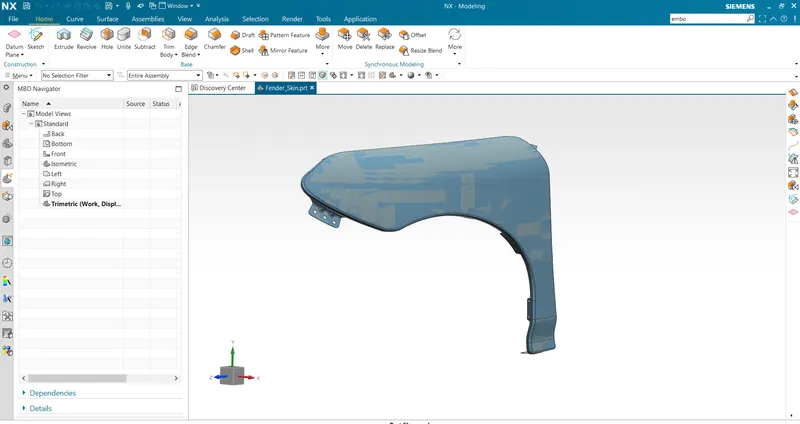
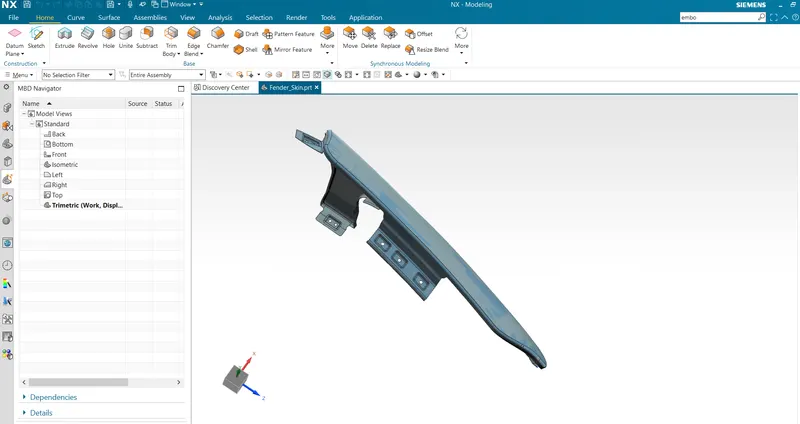
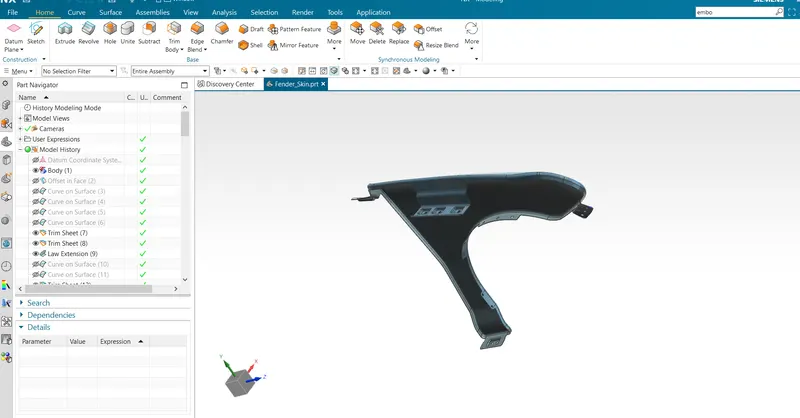
Fender views:
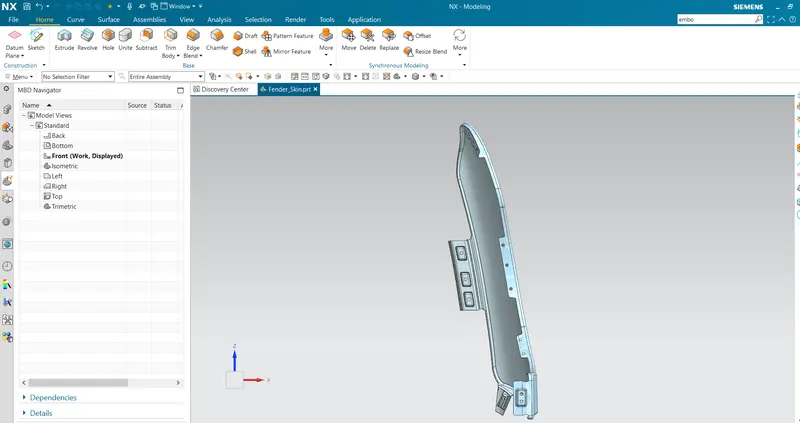
Part file and step file is attached below