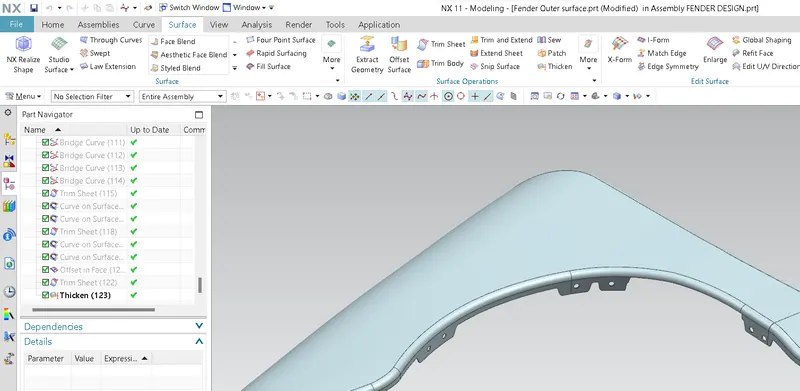
Fender Design
FENDER:
Fender is apart of vehicle that surrounds the wheel. It prevents debris, water, small stones, mud from entering the engine compartment or someone getting hit by a stone and also it is an exterior aesthetic part.
There are two types of fenders: 1.) full bumper type.
2.) half bumper type
USES: Car Fender limit the exposure of your car's body and engine to external elements that are harmful. Fender flares are attached to ensure that both the body and engine have minimal contact with corrosive elements. Car Fenders provides safety to the driver and the passengers at the time of accidents or collisions. They are manufactured in a way to provide bend during front and side collisions. Car Fenders are designed to avoid wind resistance and make your car more aerodynamic. Car Fender enhance the overall look of your cars. Fender flares are available in distinctive designs in the market. Mostly you find universal Fender flares, but you can get customized cars Fenders to fit your car wheels.
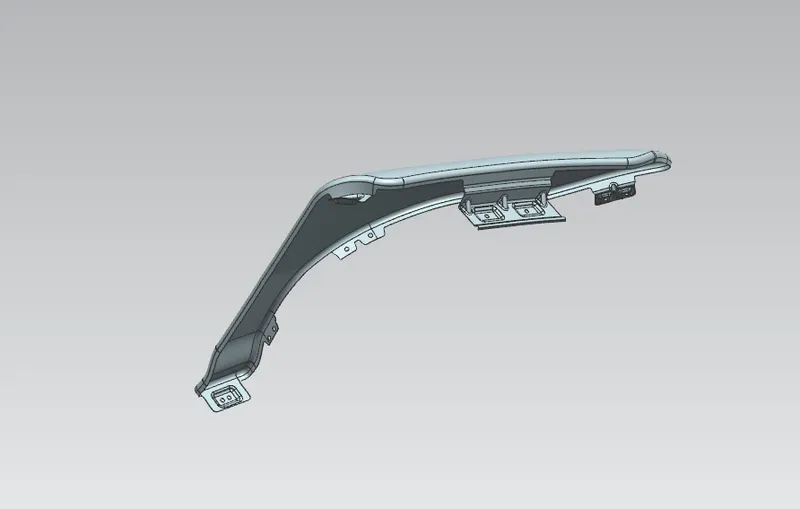
ISOMETRIC VIEW:
DRIP AREA:
It is the area through which the Fender is attached to engine housing through fasteners. There shold be some consideration followed to design the drip area, from back side of the fender there should be 200mm clearence for cowl mounting area and from the front there should be 150mm clearence for the head lamp housing unit.
Considering the above design constrains we have to design the drip area. Embosses are provided to increase strength, corners of the flanges are smoothen to ease of the production. Uniform wall thickness of 0.75mm.
Design Consideration for drip area are150mm distance from front end of the fender and the gap is filled with headlamp200mm distance from rear end of the fender and the gap is filled with wiper motor assembly.
Initially 3-degree angle and 9mm length is given while creating a drip area because the engine component should not be visible from outside.
The depth of the drift should be between 40 to 60mm. If the depth exceeds from 60mm then forming is not feasible due to spring back and wrinkles.Embosses and ribs are given to drip area to give strength.
Embosses dimensions are depth 3.5mm and 15 degree of angle for all three embosses.
SILL MOUNT AREA:
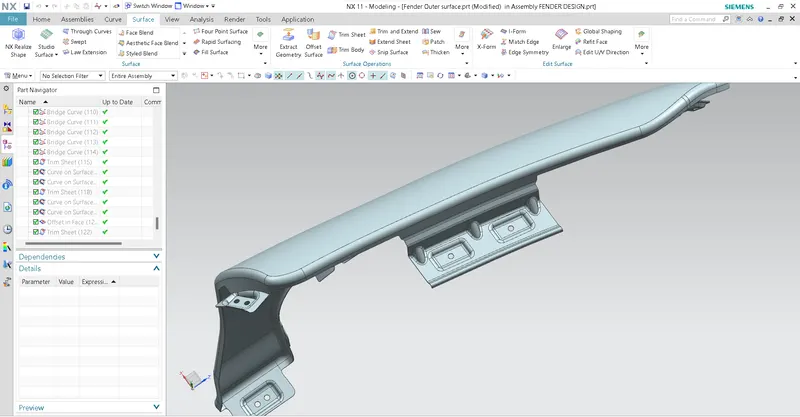
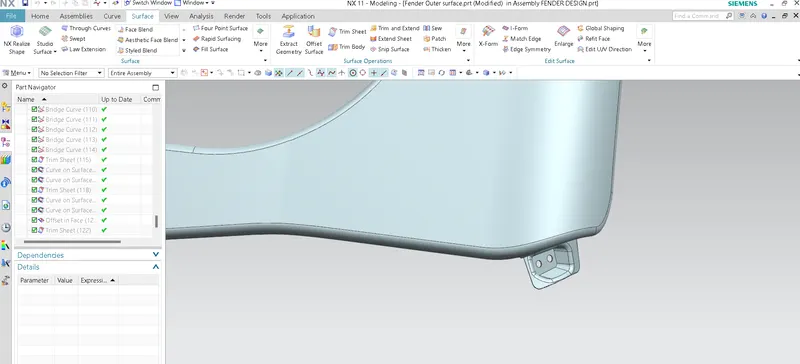
Extend sheet to 15mm to make the sheet length 30mm.Giving relief by manual like creating a sketch and trim the sheet both sides.Emboss dimensions are depth 3.5mm and 15 degree of angle.Edge blend is 3mm.Trim sheet is used to create a 6mm hole on sheet.
The Sill Mounting area is in the bottom of the fender. It is mostely gets connected with the door region of the car. Here, proper embossing and holes for the fasteners are provided.
A PILLAR:
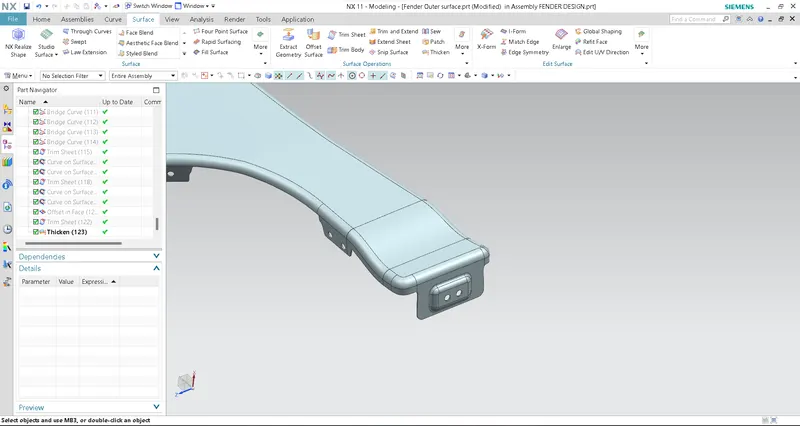
A Piller is on the cars either side of the front windshield which is the reason the windshield in the place. It is Mounted on the A Pillar by means of fasteners and these are covered by outer side view mirrors. Here, the proper embossing are provided along with holes for fasteners.
BUMPER MOUNTING AREA:
In this Mounting, the Fender connects with the bumper.The Bumper Mounting region must be rigid in order to withstand the force acting upon it during collision.
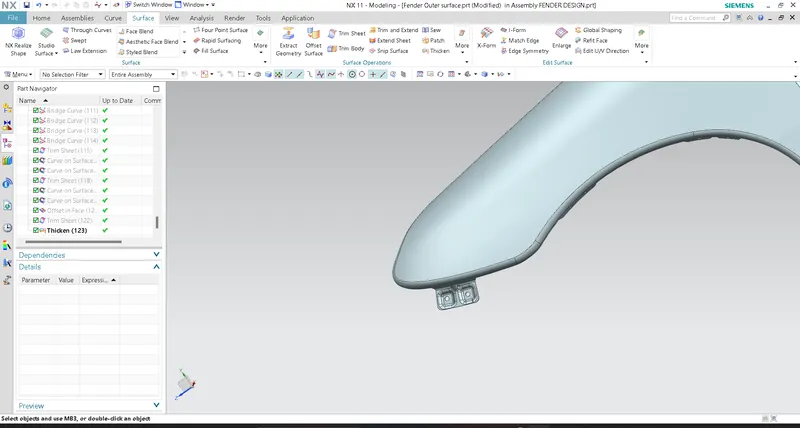
Law extension length 20mm.Skew to join the two surfaces.Dart angle 45 degrees, depth 5mm and radius 3.75mm. Create two darts in existing spaces.Trim sheet is used to create a hole of dia 5mm.For skew use 3mm edge blend and for dart and embosses 3mm edge blend.
BAFFLE AREA:
creating holes of 5mm for fastners.