Design of Shallow Foundation (Isolated Footings)
Design a square footing for a column size of 400x400. The compression axial load for the load combination of (1.5 DL + 1.5 LL) is 2000 KN. The safe soil bearing capacity is 150 KN/m2 at a depth of 2 metres below E.G.L. Participants are free to go for either a tapered or stepped footing. Besides the total axial load, also account for the self-weight of the footing and soil above it. Assume M25 concrete grade. Do the following checks:
- If the gross bearing pressure under the footing is within safe bearing capacity
- Provide sufficient depth and longitudinal steel for resisting bending and shear
- Sufficient anchorage for column steel into the footing
- If the bearing pressure at column-footing joint is within 0.45 times the maximum concrete compressive strength
Provide a simple sketch showing the size of the footing, maximum and minimum depth of the section, flexural reinforcement in both directions and anchorage of column steel.
Please do go through the solved examples in the document provided with the challenge.
Answer :
Introduction:-
- Footings and other foundation units transfer loads from the structure to the soil or rock supporting the structure.
- The distribution of soil pressure under a footing is a function of the type of soil and the relative rigidity of the soil and the foundation pad.
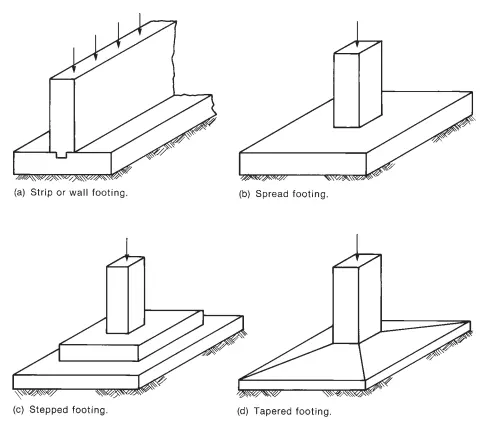
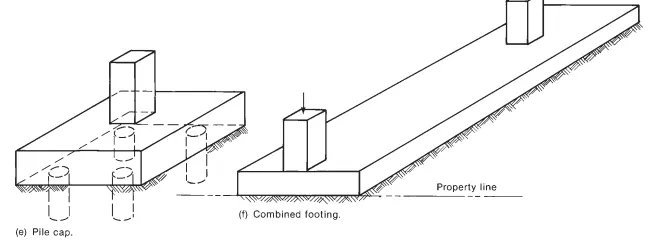
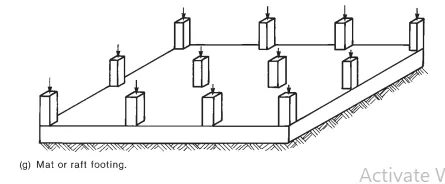
- Most common types of footings used are:
- Strip or wall footing
- Spread footing
- Stepped footing
- Tapered footing
- Pile cap
- Combined footing
- Mat or raft footing.
Step 1: Load calculations
Given load P = 2000kN
Factor load (or) ultimate load = 2000kN
Consider self-weight of footing and backfill is 10% column load
= (10%column load) = (10/100)2000 = 200 kN
Now the total load on the column = Factor load + 10% column load
= 2000+200 =2200 kN
step 2
As per step1 the total load is obtained as 2000 kN
Let us consider the square footing which is having length and width as B
So the area of footing is given by BXB = B2
As per formula of area of footing is given by
B2 = Total load/SBC = 2200/150x1.5 = 9.78 m2
By solving we can get the value of B = 3.2m
So final area of footing provided is = 3.2mX3.2m =9.61 m2
Step 3: Calculation of net upward pressure at ultimate load
The calculated ultimate load from the column is 2000 kN
Soil pressure = qu = Total load/Area of footing = 2000/3.2 X3.2 = 195.3 kN/m2
So take soil pressure qu = 200 kN/m2
Assuming the depth of the beam as 500 mm
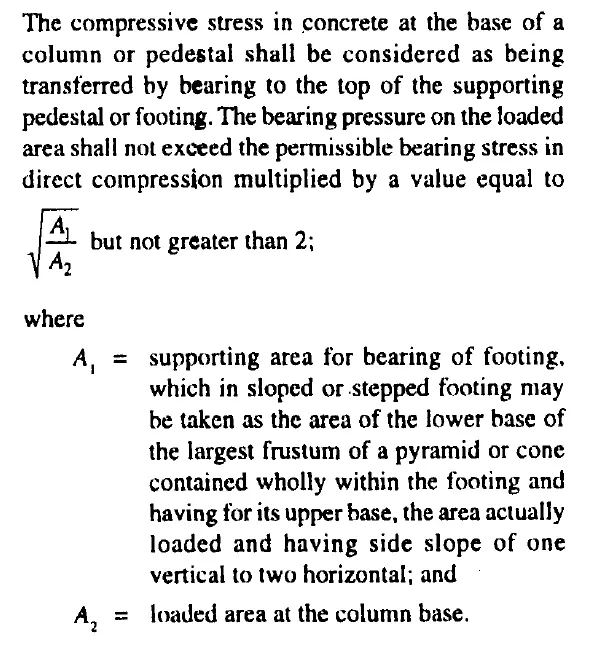
according to clause 34.4 IS 456
TAKING 1:2 for load distribution
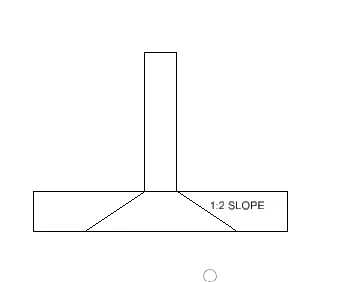
Now applying the above formula as follows
`square root`(2400X2400/400X400) =6 <= 2
now permissible bearing stress at the intersection of column and foundation =0.45 fck =11.25 kN/m2
permissible bearing stress with a multiple are = 11.25X2 = 22.5 kN/m2
now the actual bearing stress =2000X1000/400x400 = 12.5 N/mm2
hence 12.5 N/mm2 <22.5 N/mm2 , Hence OKAY
we can proceed with the 500 mm depth of the footing
assuming the 50 mm cover, and effective depth as 450mm
We have Net Pressure of 195.8 kN/m2
converting intoo the UDL
195.3 Kn/m2 X 3.2 = 625kN
bending moment fot the udl is
Wl2/2 625X1.6X1.6/2 =800kN/m
Mu = 0.87fyAstd(1-(Astfy/bdfck))
Ast required = 4350 mm2
provide 16mm@125mm spacing
Actual Rebar provided = 3200X125X201
Ast provided = 5416 mm2
Step 4: Calculation and check for one way shear to determine the depth
From formulae of factored shear force for one-way shear
Factored shear force Vu1 = (quB/2) (B-C1-2d)
By taking the values Vu1 =0.95X3.2x195.3 =593.7 kN
By solving the above equation we can get
tau v = 597.3X1000/3200X450 =0.412 N/mm2
From table 19 of IS 456-2000 code
we have tau = 0.425N/mm2
Step 5: Check for punching shear / Two way shear
Since we have formulae
Factored shear force / Two way shear = Vu2 = qu (B2-(C1+d)2)
- Check for Two way shear
The critical section for two way shear is located at a distance of d/2 from the face of the column
Shear force on critical section
V = 238.66 ( 4x4 – 1.1 x 1.1) =3155.8 KN
Periphery of the section b0 = 2 ( 1.1 + 1.1) = 4.4m = 4400mm
Tv = Vu / b0 d = 3155.8 / 4400 x 700 = 1754.44 KN = 1.025N/mm2
The permissible shear stress = ks Tc
ks =(0.5+Bc) > 1
Bc= b/b = 400/400 = 1.00
ks = 0.5+ 1 = 1.50
Permissible shesr stress (Tcxk) (N/mm2) = 1.50
0.25 x SQRT (fck) = 1.25
Tv < Tc
1.25 1.50
Hence shear stresses are within safe permissible limits