Design of backdoor
DESIGN OF BACK DOOR
OBJECTIVE:
To design the back door of the car and make the inner panel for the back door and also design the necessary reinforcements.
BACK DOOR:
A door is a hinged part which is used for entry and exit of the vehicles. Back doors are one of the type doors of the vehicle which are located next to the passenger seat which provides access to the luggage compartment. In most of the cars, these back doors are operated with the help of gas stay which in turn reduces the effort required to lift open the door. Some luxury cars have powered backdoor which in turn is driven by an electric motor. This kind of system is also called a powered trunk lid system. Hatchback or station wagons are sold as 3 door or 5 door models. In this case, the rear hatch is classified as door this is because it enters the passenger compartment. The naming is mainly used in Europe countries. In case of safety, the back door designed should meet the safety requirement for the rear collision.
TYPES OF BACK DOOR:
- TOP MOUNTED DOOR
- SIDE MOUNTED DOOR
- BOTTOM MOUNTED DOOR
TOP MOUNTED DOOR:
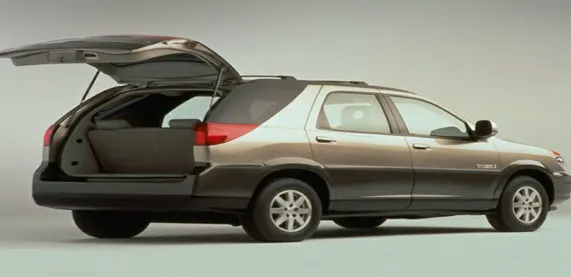
This type of back doors is used in a station wagon, pickup truck and some of the sport utility vehicles. Today’s modern cars use top-mounted tailgating systems which are both powered and also gas stay supported. These top mounted tailgates provide greater rear visibility compared to side-mounted or bar doors which have canter pillars in it.
SIDE MOUNTED DOOR:
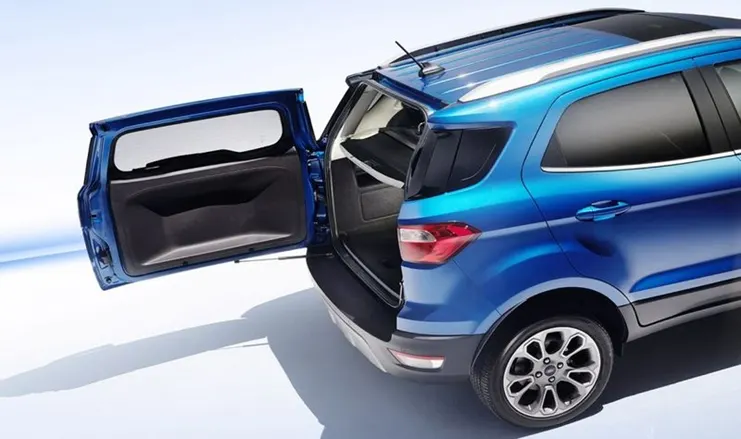
It is generally used in van type MPVs, SUVs, pickup truck vehicles. These side mounted door/barn doors are a lot easier compared to top mounted ones. These doors are generally small in size and can be easily accessed. These doors are more convenient for the goods handlers carrying lengthy objects, long pipes where one door is kept open. It also saves accidental head impacts. It is a lot easier to load /unload things in vehicles having side-mounted doors.
BOTTOM MOUNTED DOOR:
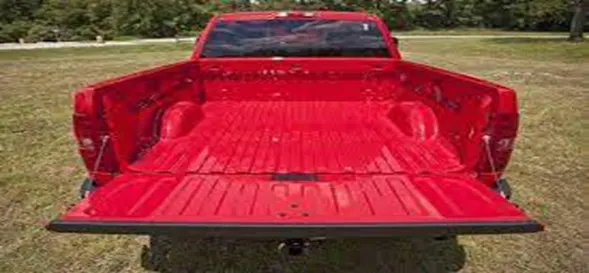
Bottom type or split type backdoor system is used in estate type cars, pickup trucks and some luxury SUVs. These are most convenient type of backdoor in which the bottom split is used as a support or even as a table for the touring people.
MATERIAL SELECTION:
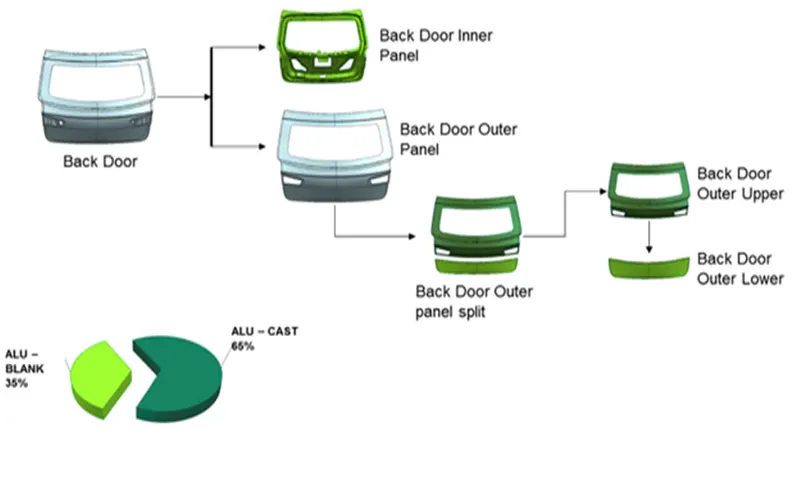
Material plays a major role in determining the overall weight of the back door. The common materials used are Steel & Aluminium. The density of Steel is higher than Aluminium thus adding more weight to the door. The material used in the manufacturing of the backdoor depends upon the budget of the car, most low-cost vehicles use steel as it is cheaper compared to Aluminium. Another aspect to be noted is that, if casted Aluminium parts are used instead of deep drawn steel parts there is no need of reinforcements and the overall weight of the car is reduced by approximately 5-10kg thus increasing the performance of the vehicle. Also, the draft angle for casted parts is around 3 degrees while for deep drawn parts is around 7-10 degrees which helps in increasing the luggage/ cabin space.
FOR ALUMINIUM,
FOR STEEL,
BACK DOOR SHEETMETAL OPERATION:
DEEP DRAWING:
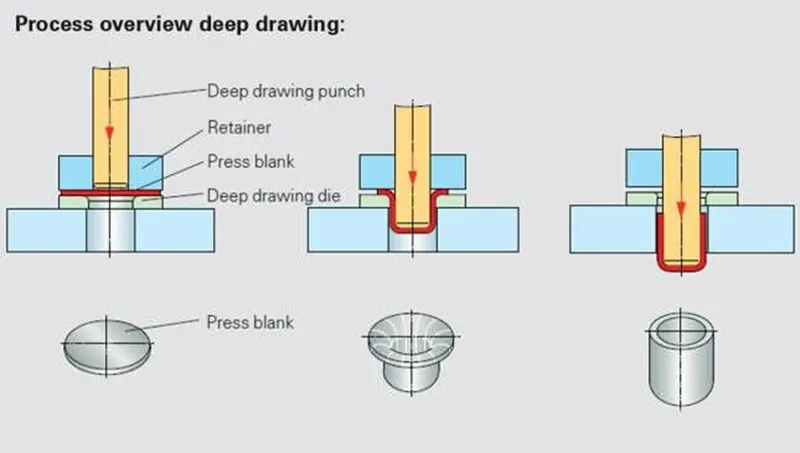
The metal deep drawing process is an effective method of manufacturing of cups, cans and other similar deep drawing products. The deep drawings having two main categories,
FIRST STAGE DRAWING:
The blank shape of metal is placed on the die and contact with the punch. When the metal specimen is flat piece of sheet metal used in forming and finish the product. Initially the punch moves in downward direction. The outer rim of blank is subjected to pure radial drawing (drawing toward in vertical axes) between die and blank metal. The metal become a bend and sliding over die and also stretched between die and punch. The metal in vicinity of punch head and contact with it bend and slide over radii and stretch over punch head.
REDRAWING:
The components drawn from first stage again it is redrawn convert into more depth to form a cup shape in the die and punch. The second stage of drawing is called as redrawing.
HEMMING:
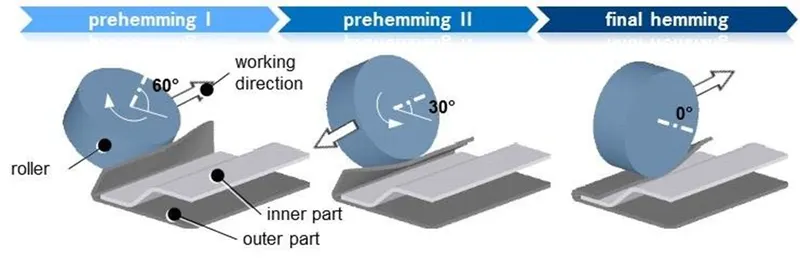
Hemming is a forming operation in which the edges of the sheet are folded or folded over another part in order to achieve a tight fit. Normally hemming operations are used to connect parts together, to improve the appearance of a part and to reinforce part edges. In car part production, hemming is used in assembly as a secondary operation after deep drawing, trimming and flanging operations to join two sheet metal parts (outer and inner) together. Typical parts for this type of assembly are hoods, doors, trunk lids and fenders.
PUNCHING:
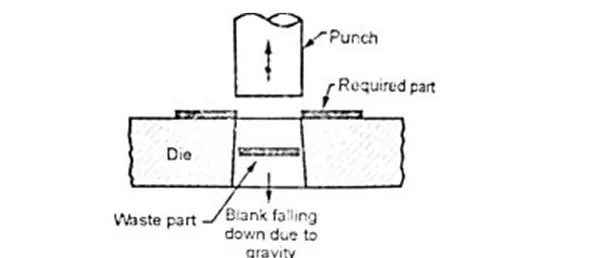
It is similar to blanking only the main difference is that, the hole is the required product and the material punched out from the hole is considered as a waste.
BLANKING:
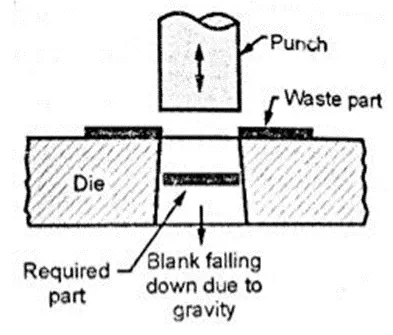
Blanking is a cutting operation of a flat metal sheet and the article punched out is known as blank. Blank is the required product of the operation and the metal left behind is considered as a waste.
COMPONENTS TO BE DESIGNED:
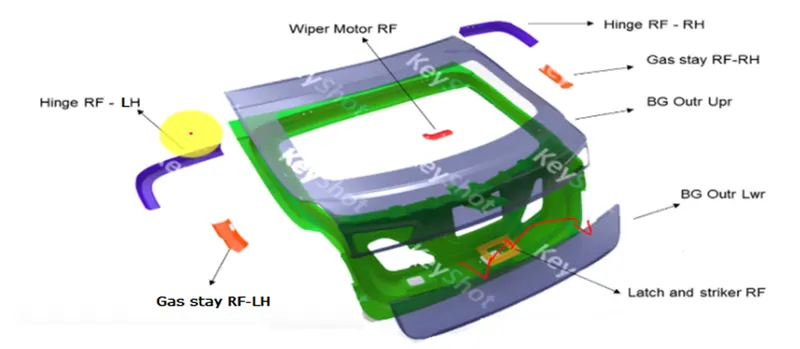
- OUTER PANNEL UPPER
- OUTER PANNEL LOWER
- INNER PANNEL
- GAS STAY REINFORCEMENT LH AND RH
- HINGE REINFORCEMENT LH AND RH
- STRIKER REINFORCEMENT
- WIPER REINFORCEMENT
CLASS A SURFACE:
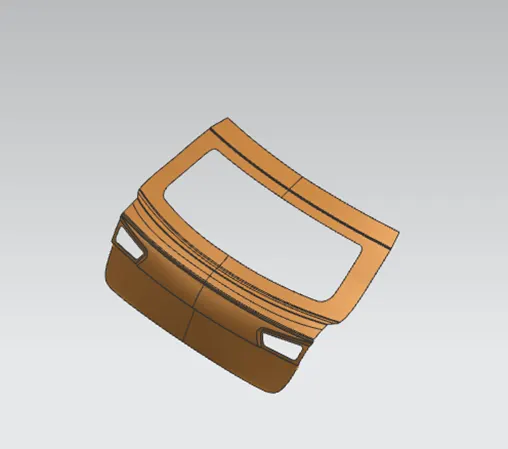
Backdoor outer upper and lower class a surface has to be repaired according to the smoothness. After repairing the surfaces, the door is divided into two parts as Door Outer Upper and Door Lower Panel.
TOOLING DIRECTION:
It shows that all the operations like embossing is done by considering this vector direction and it will help in manufacturing the part,
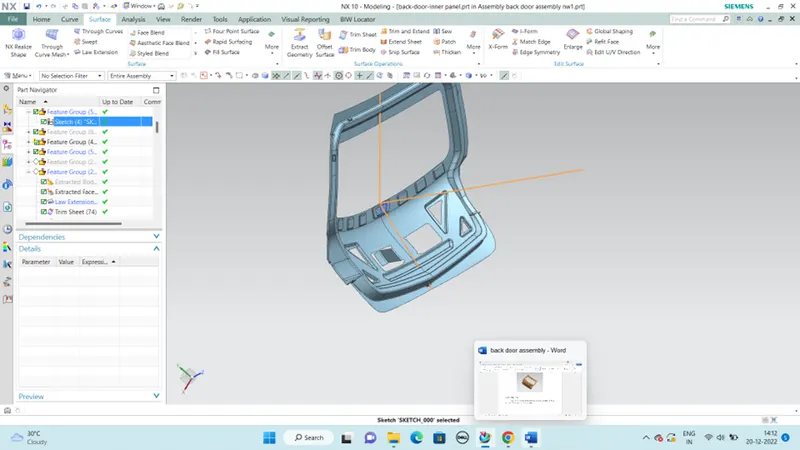
- After that we have to create Sealing Flange by offsetting the outer panel to the specific distance.
- Then we will be creating the Back door inner panel flange by offsetting the outer surface at a distance considering the sheet thickness and thickening direction.
- Then created the connecting flange to join the inner panel and sealing flange.
- Then for the windshield panel mounting, windshield panel is created and joined with sealing flange.
- Now to assemble the back door with the vehicle Hinges are used to open and close the door. For that to increase the local area strength we have to design the emboss and provide the appropriate reinforcements to withstand the load acting upon it.
SEALING FLANGE:
It is that section of the inner panel which enables the backdoor to sit over the rear body side of the car. Its design is important as it decides how a backdoor is mounted on the rear body side of the car and also restricts any external matter to enter inside the vehicle.
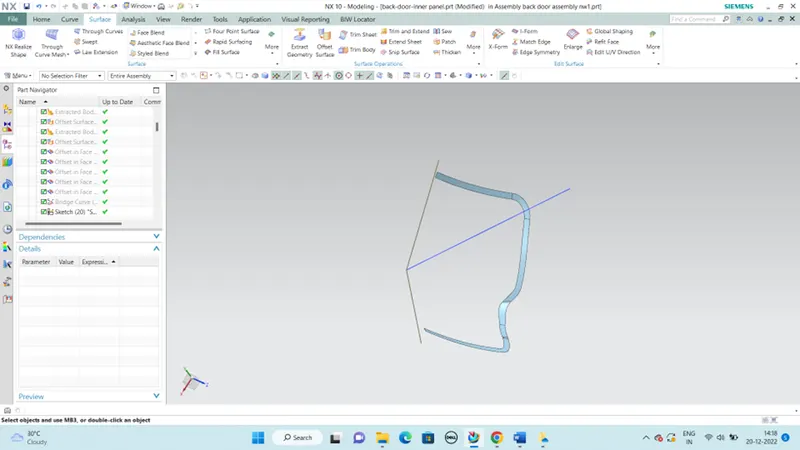
HINGE REINFORCEMENT:
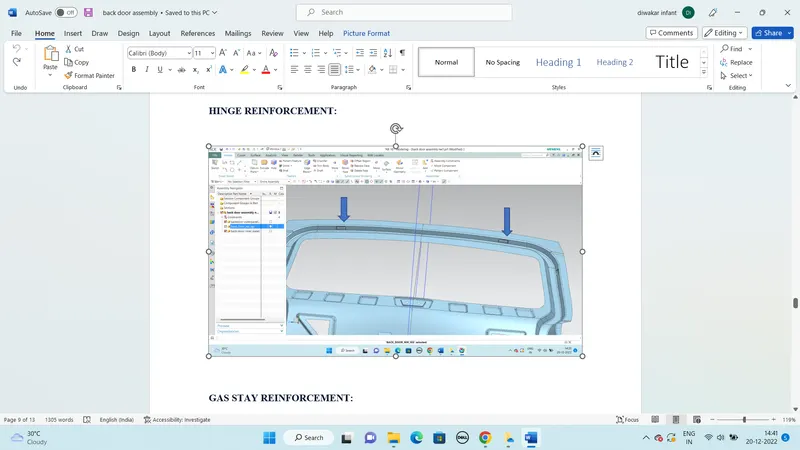
GAS STAY REINFORCEMENT:
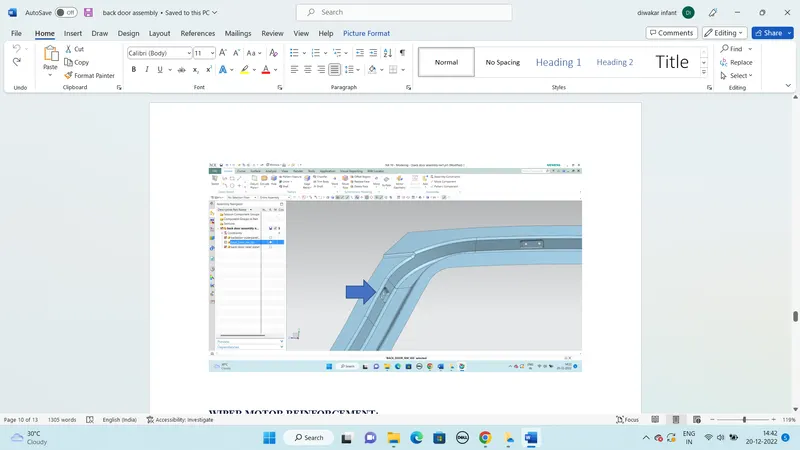
WIPER MOTOR REINFORCEMENT:
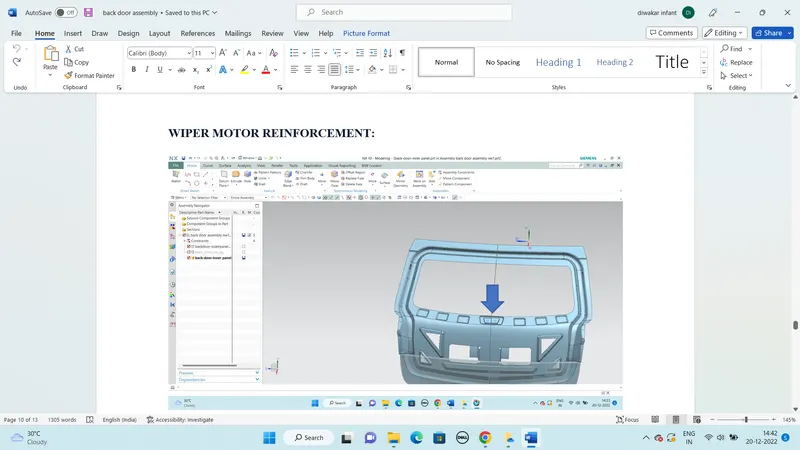
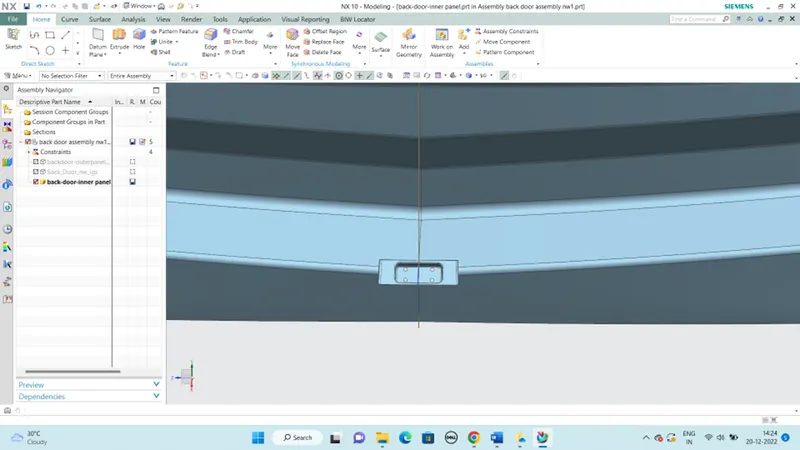
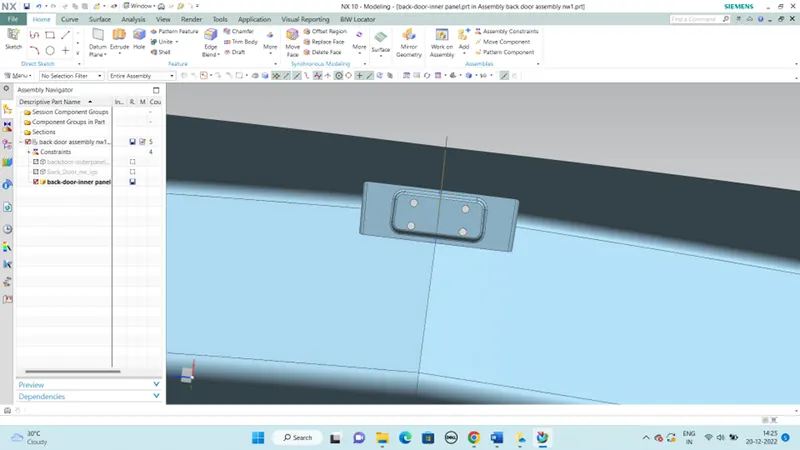
LATCH AND STRIKER REINFORCEMENT:
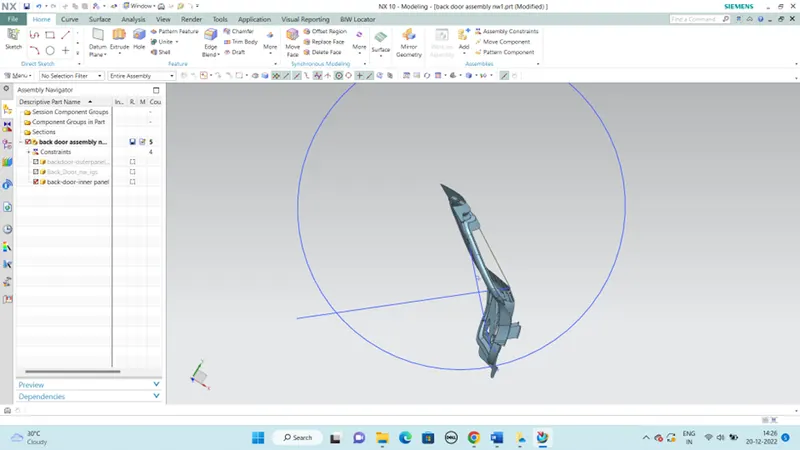
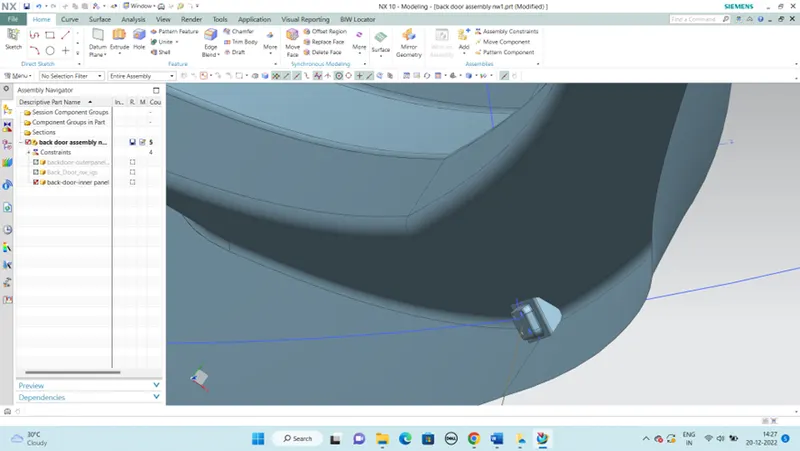
LATCH TRAJECTORY:
Backdoor is the swinging part which rotates about hinge axis. The position and orientation of latch striker is important for proper opening and closing of the backdoor. The positioning is done by sketching a circle with center as the axis of the hinge which passes through the striker at appropriate position with respect to inner panel.
DRAFT ANALYSIS:
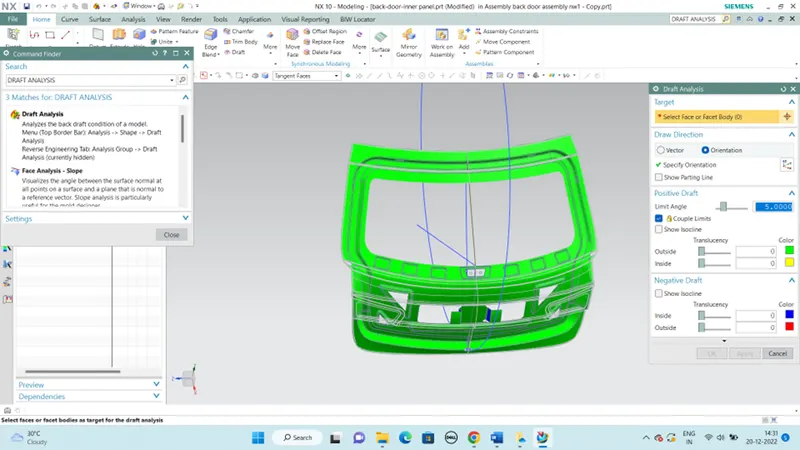
Every part which is manufactured from press tool or other forming tools require some positive draft on the faces which are parallel to the tooling direction. If we don’t give draft (Zero Draft) or give negative drafts on these faces it will stick to the mould surface and when the mould is in motion it will destroy surface thus reducing its surface finish. This Draft Analysis command enables us to detect if the part we have drafted can be easily ejected or not. It also give insights about the critical zones, so that appropriate changes in the design can be made if needed.