Design of backdoor
AIM
To design the back door of a car from the styling surface provided using NX CAD. The ultimate aim is to design the back door as per the industrial standards.
INTODUCTION
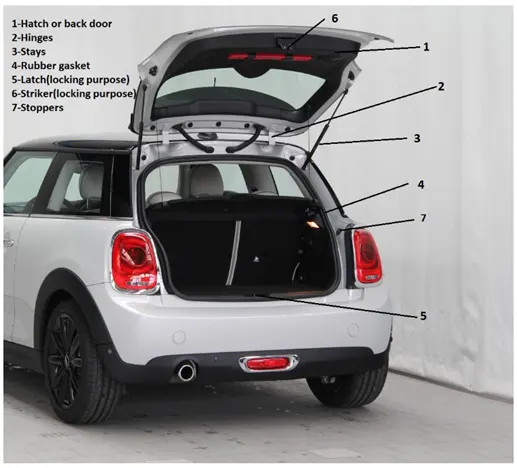
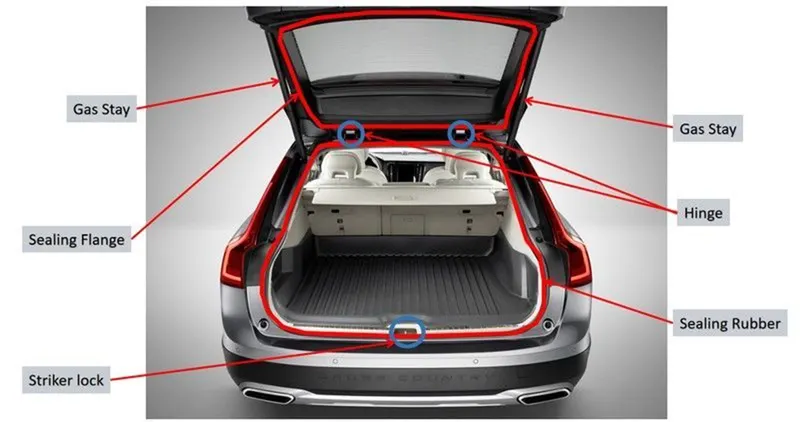
A back door is a BIW component found in all Automotive car generally used for opening and closing of the so-called car luggage that is usually used for storing items inside a car. In general, the opening and closing of the door is co-ordinated by the Latch and Stricker position and the Gas stay position that is mounted on the body and back door of the car. These positions play a major role in ensuring smooth opening and closing of the tail gate. The back door comprises of certain components which form the back door assembly together.
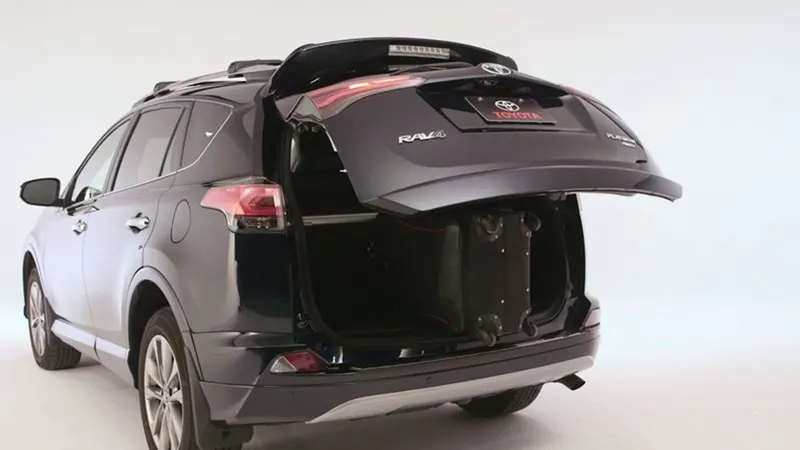
FUNCTIONS OF BACK DOOR
- It protects the occupants and luggage from getting damaged.
- It houses assembly of tail lamps, wiper motor and other components.
- It serves as entry and exit point for luggage/passengers.
- It houses windshield glass which helps in rear visibility.
- Parking sensors, rear view camera is mounted on it.
TYPES OF BACK DOOR MOUNTING
- Top Mounted Door
These types of back doors are used in a station wagon, pickup truck and some other sports utility vehicles. Today’s modern cars use top mounted tailgating systems which are both powered and also gas stay supported. These tailgates provide greater rear visibility compared to other types.
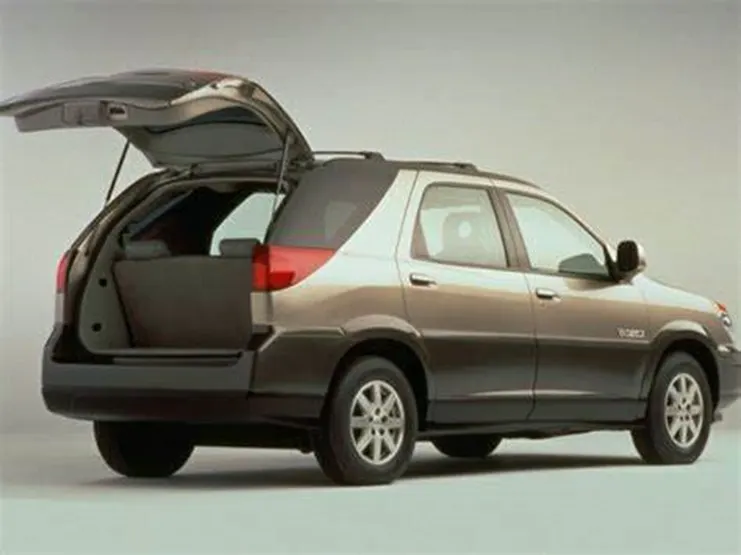
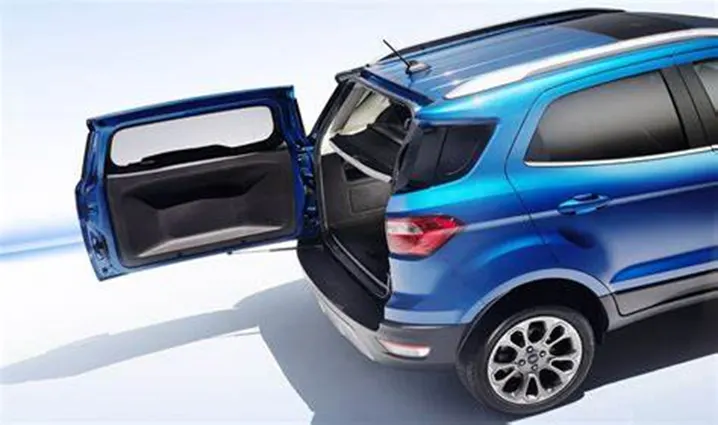
- Side Mounted Door
It is generally used in van type MPVs, SUVs, pickup truck vehicles. These side mounted door/barn doors are a lot easier compared to top mounted ones. These doors are generally small in size and can be easily accessed. These doors are more convenient for the goods handlers carrying lengthy objects, long pipes where one door is kept open. It also saves accidental head impacts. It is a lot easier to load /unload things in vehicles having side-mounted doors.
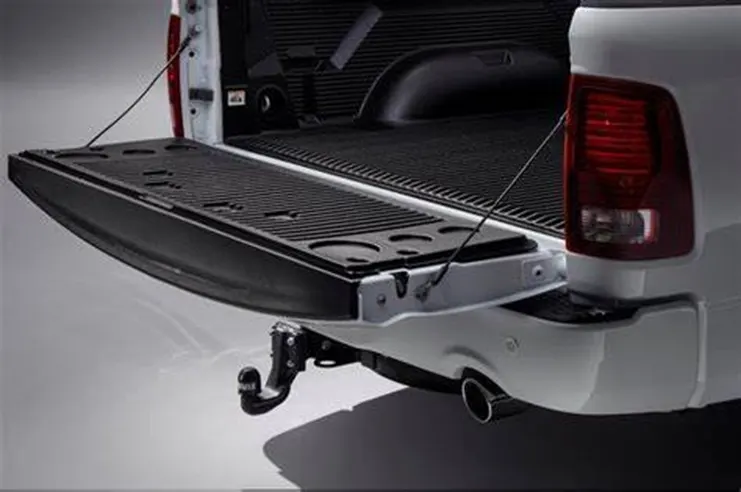
- Bottom Mounted Door
Bottom type or split type backdoor system is used in estate type cars, pickup trucks and some luxury SUVs. These are most convenient type of backdoor in which the bottom split is used as a support or even as a table for the touring people.
BACK DOOR PARTS
- OUTER PANEL UPPER
- OUTER PANEL LOWER
- INNER PANEL
- HINGE REINFORCEMNTS
- WIPER MOTOR REINFORCEMNET
- LATCH & STRICKER REINFORCEMENTS
- GAS STAY REINFORCEMNTS
All these parts are assembled together to obtain the back door of a car.
DESIGN CONSIDERATIONS FOR BACK DOOR
The following design factors were taken into account when creating the back door:
- Visibility Criteria
- Force Dissipation
- Latch and Stricker Positions
- Hinge Position
- Gas Stay Position
- Material Selection
- Space Availability
- Hemming and Relief Areas
All of these design factors must be taken into account because certain positions are dependent upon others, and if one position changes, all of the other positions must also change for the back door to open and close properly. In order for them to play a significant part in the opening and closing of the car's doors as well as the rear visibility requirements, the latch and Stricker, hinge position, and gas stay positions must be maintained properly.
OUTER PANEL
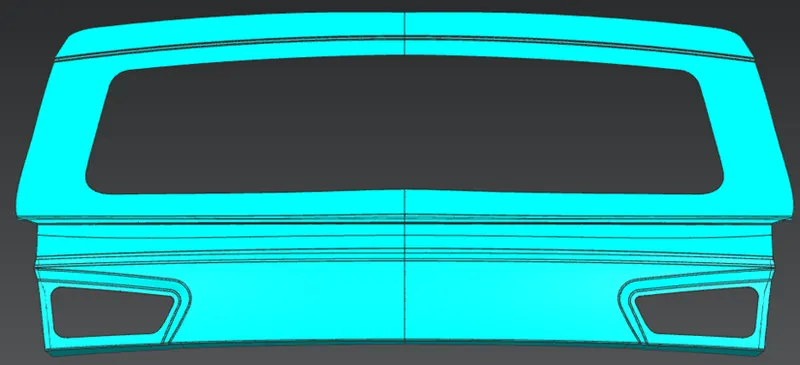
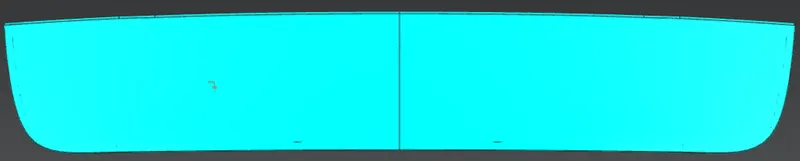
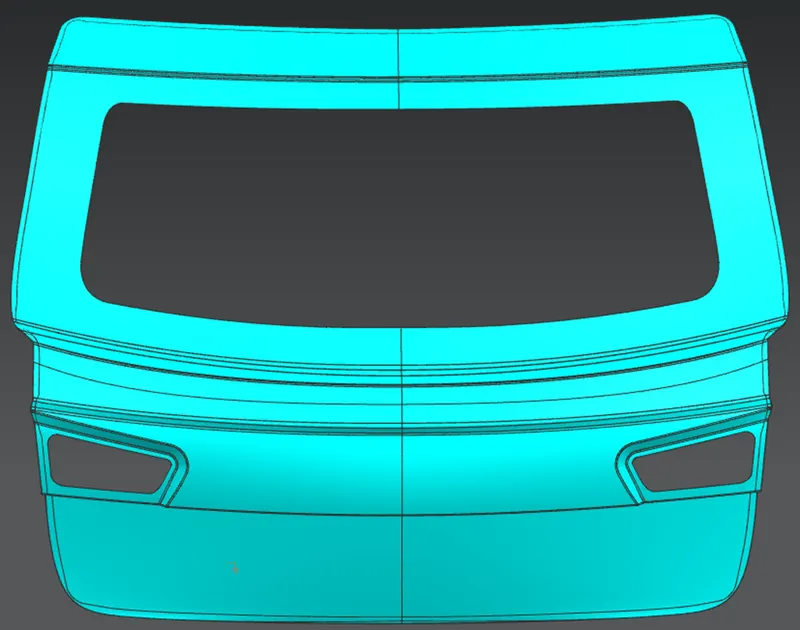
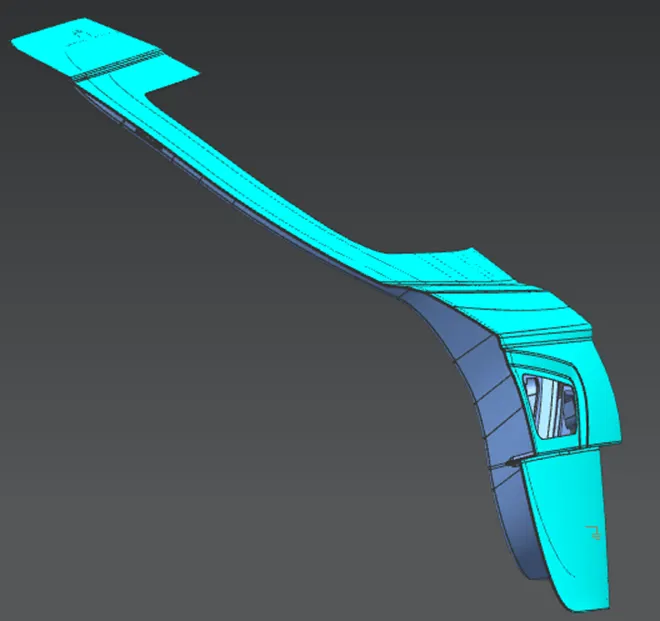
As the name suggests, it is the outer part of the rear door and is mostly responsible for aesthetics of the vehicle. Outer and inner panels are connected by mastic sealants in centre and by hemming process at edges. The outer door handle and in some cases, the number plate may also be installed on the outer panel of the back door. We have divided outer panel into 2 parts for our design i, e. outer panel upper and outer panel lower respectively. Outer panel is manufacture by stamping a sheet metal. Thickness for outer panel is 0.75 mm
OUTER PANEL UPPER
OUTER PANEL LOWER
INNER PANEL
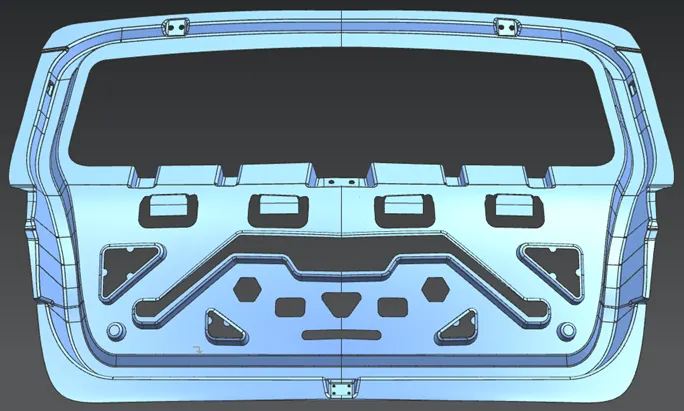
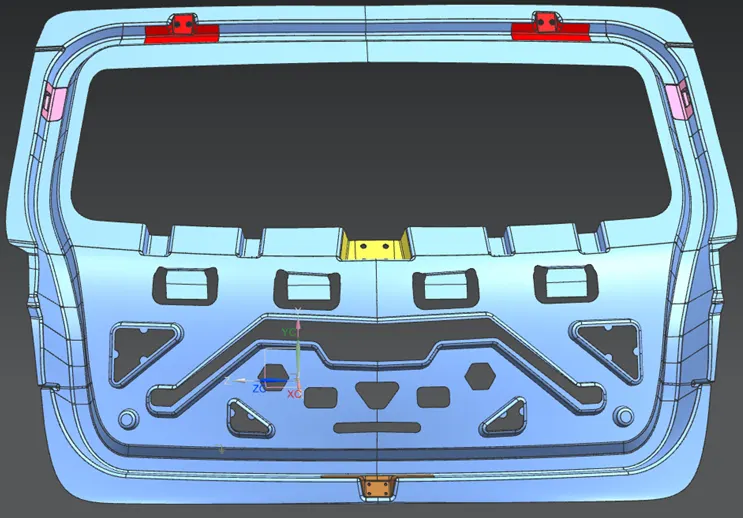
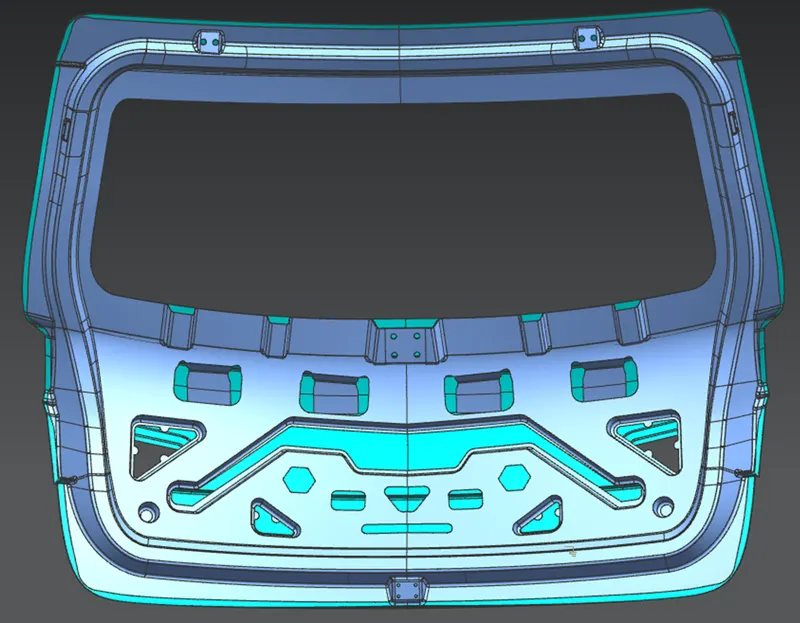
The inner panel is one of the most important components of backdoor assembly. It provides strength and helps in dissipation of forces outside the part with the help of embosses made on it. It helps in mounting of accessories like hinges, wiper motor, gas stay, latch & striker etc. It is manufactured either by casting (aluminium) or sheet metal stamping (steel). Thickness of inner panel is 0.75 mm.
INNER PANEL WITH REINFORCEMENTS
REINFORCEMENTS
Reinforcements are generally placed to increase the strength of the panel in localized areas which is relatively small compared to sheet metal parts for absorbing loads imposed thereon and dissipating such loads throughout the panel assembly to help maintain rigidity of the panel assembly. This not only add strength to the part but also increase the overall stiffness of the part so that the part is completely stable. The Reinforcements used are
1) Latch and Striker Reinforcement
2) Wiper Mounting Reinforcement
3) Hinge Reinforcement
4) Gas Stay Reinforcements
Latch and striker Reinforcement
In the bottom part of the panel emboss is created for placement of latch and striker assembly. Latch & striker is used for locking the backdoor with the car BIW. it's usually placed on the space provided on the inner panel. Striker is U shaped bend that attaches to the latch in order to lock the back door and prevent any loose movement during the car motion. There is over slamming and abusing while opening and closing of the door, thus arising the need for reinforcement to be placed.

Wiper Mounting Reinforcement
Wiper is used to Wipeout the dust particles/water on the windshield glass which affects the rear visibility. It is actuated by the motor which is mounted on the inner panel. Due to vibration and heat of the motor, inner panel gets deformed which results in loss of strength & rigidity of the panel thus leading to poor NVH. So, reinforcement is provided to avoid these conditions.

Hinge Reinforcement
Hinges connect the door with the vehicle body and allow the door to rotate around a fixed axis for opening and closing movement. Generally, hinges are a 2-part assembly, where one part is bolted to door and other is bolted to vehicle body. It is a pivot mechanism which supports the total weight of the backdoor. So, reinforcements are added for strength and rigidity.

Gas Stay Reinforcement
Gas stay is basically a gas spring that relies on elastic deformation of a compressed gas which is enclosed in a cylinder. It is used to reduce required effort while opening the back door. Although all the cars don’t come with gas stays, it may be required in case of a heavy back door. To improve the strength and stability of that region, reinforcements are provided.

FORCE DISSIPIATION
The major criteria in designing the back door or any BIW part is the force dissipation during an impact or a collision. Hence studies are being done in order to dissipate the force on the sides and avoiding it reach the inner cabin of the car so that possible damage of impact inside the car is reduced. Hence in order to do that the V or Y embosses are created on the inner panel so that the force gets transmitted on to the sides instead reaching it on the cabin. This is one of the main criteria in back door design.
LATCH AND STRICKER POSITION
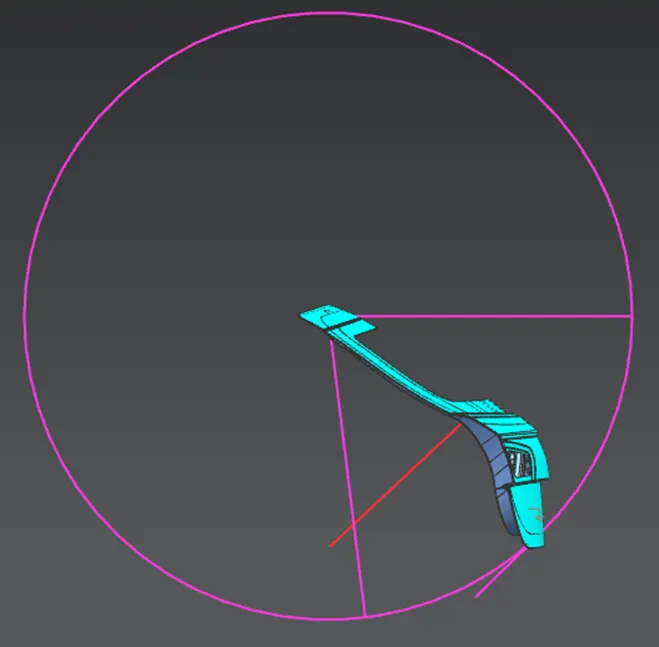
Latch trajectory is given by the circle drawn from the hinge axis point. Hinge axis point is the centre point of the hinge axis. First, we can fix either the latch or the hinge. If we have fixed the hinge position then we should plot the Trajectory circle for the latch. For proper mating condition the striker axis through the tip of the striker should be tangential to the latch trajectory.
The Latch and Stricker positions are crucial in determining how the back door opens and closes. As a result, the opening and closing of the had to be smooth, and the trajectory had to be tangent to the open close circle that is drawn, and the centre point of the latch and Stricker had to be at the same point. This is depicted in the image below. Only if the centre points and tangent line are perfect will the back door open and close smoothly and clearly. Otherwise, the Hinge, Gas stay, Latch, and Stricker positions must be modified to accommodate the change.
MATERIAL SELECTION
The material selection plays a major role in determine the overall weight of the back door. The materials generally used are Steel and Aluminium. The Density of Steel is higher than Aluminium thus it results in adding more weight of the door. Basically, the material is used based on the budget of the car, because the cost of steel very cheap than Aluminium. If aluminium is used instead of steel there is no need of many parts like Reinforcements for each mounting and the overall weight geta reduced by 6-10 kg approximately. But the drawback is Aluminium is much costlier than Steel. Hence based on the budget of the car aluminium is used. In higher end models like Benz, Audi, Porsche and BMW we can find aluminium is used instead of steel resulting in reduced weight and increased performance of the vehicle.
Another Factor to make a note is using Casted Aluminium instead of deep drawn Steel components and adding reinforcements to it is the space of the luggage commodity gets increased by a certain amount because the draft angle for Casted aluminium is much lesser (3 degree) than the deep drawn Steel inner panel (7-9 degree). Thus, it reduces the space between the inner and outer panel resulting in much larger cabin space than the deep drawn steel inner panel. Thus, the material selection is one of the design considerations taken. Since it reduces the space between the inner and the outer panel the rear visibility of the car is also improved giving more space for the mirror to view.
Hence in this design the material chosen is steel since it is designed for a medium budget car and hence high cost could not be afforded to design the back door.
SEALING FLANGE
It is that section of the inner panel which enables the backdoor to sit over the rear body side of the car. Its design is important as it decides how a backdoor is mounted on the rear body side of the car and also restricts any external matter to enter inside the vehicle.
MASTIC SEALANTS
Mastic is a form of sealant or adhesive used to fill the joints or as a bond for different materials and gaps. It is an elastic and flexible material used to create a durable bond between two different surfaces or to protect a particular surface. We cannot use other joining techniques like welding, riveting etc because they leave marks on the roof outer panel which spoil its aesthetic appearance. So, mastic sealants are used to stick the inner surfaces of roof outer panel and rear and front end of front roof rail and rear roof rail respectively. Mastic sealants are elastic compound that behave like rubber. It is applied between at specified spots. Each spot of mastic sealants has its effect around a circular region of 80mm diameter.
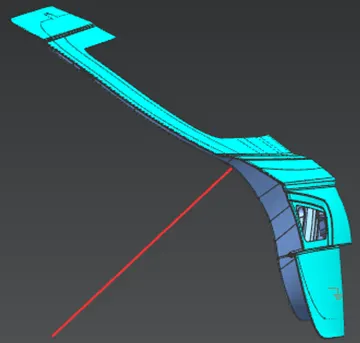
TOOLING DIRECTION
MANUFACTURING METHODS
BLANKING
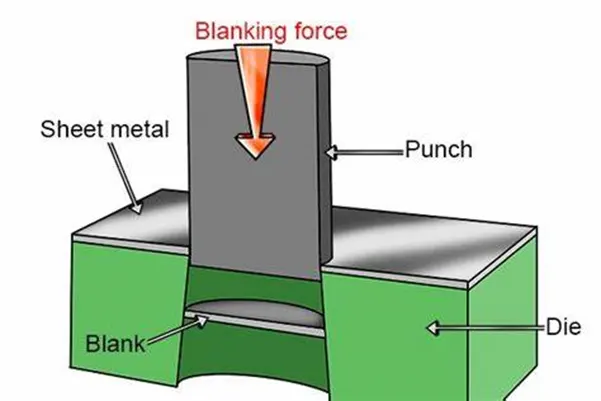
It is the process where the required sheet metal material is cut from the sheet metal coil for the manufacturing of the hood using a blanking die. Blanking is a punching operation in which entire periphery is cut out and the cut-out portion required is known as STAMP OR BLANK.
- When a component is produced with one single punch and die where the entire outer profile is cut in a single stroke the tool is called a blanking tool.
- Blanking is the operation of cutting flat shapes from sheet metal.
- The outer area of metal remaining after a blanking operation is generally discarded as waste.
- Size of blank or product is the size of the die & clearance is given on punch.
- It is a metal cutting operation.
TRIMMING
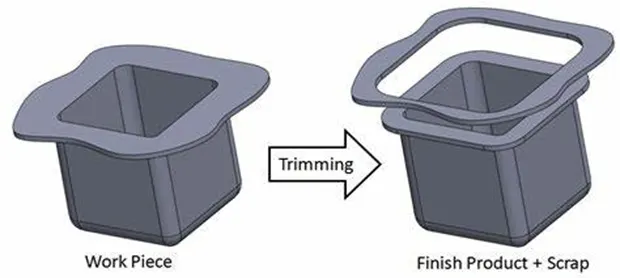
When cups and shells are drawn from flat sheet metal the edge is left wavy and irregular, due to uneven flow of metal. Shown is flanged shell, as well as the trimmed ring removed from around the edge. While a small amount of Material is removed from the side of a component in trimming tool.
DEEP DRAWING
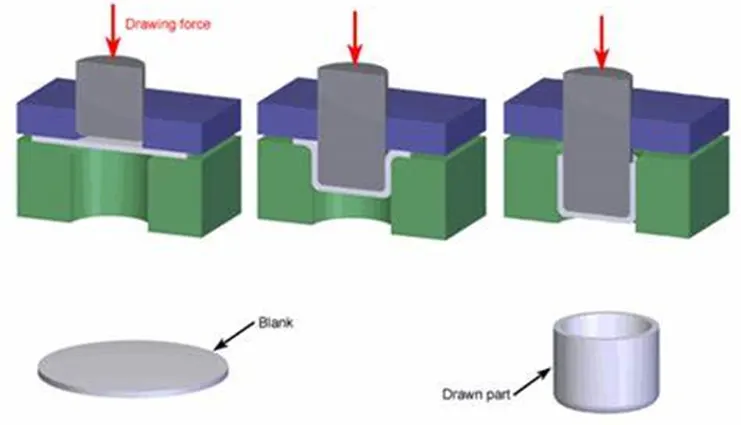
Deep drawing is one of the most widely used processes in sheet metal forming. Apart from its use in many other sectors, it is applied in the automotive industry for the manufacturing of car body parts. The deep drawing process is a forming process which occurs under a combination of tensile and compressive conditions.
Sheet metal blank is radially drawn into a forming die by the mechanical action of a punch. It is thus a shape transformation process with material retention. The process is considered "deep" drawing when the depth of the drawn part exceeds its diameter. This is achieved by redrawing the part through a series of dies. The flange region (sheet metal in the die shoulder area) experiences a radial drawing stress and a tangential compressive stress due to the material retention property. These compressive stresses (hoop stresses) result in flange wrinkles. Wrinkles can be prevented by using a blank holder, the function of which is to facilitate controlled material flow into the die radius.
EMBOSSING
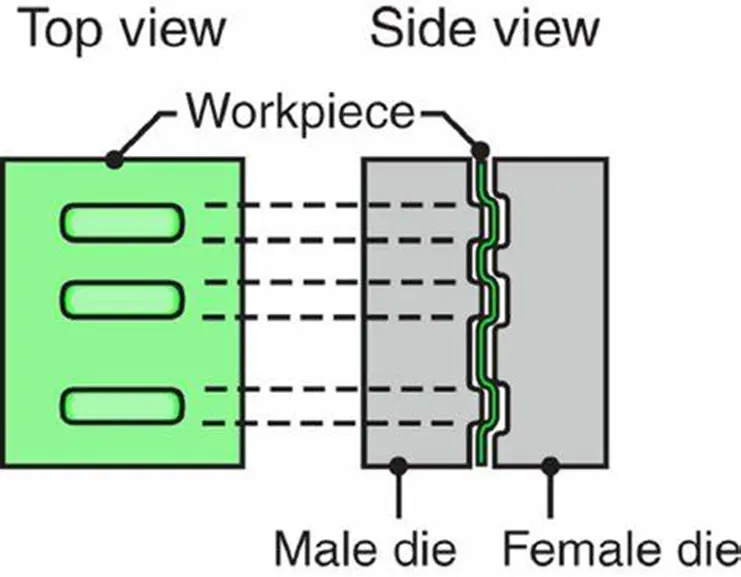
Sheet metal embossing is the stamping process to obtained raised or sunken edges for the desired design pattern on the sheet metal. This is done with help of male and female dies between which sheet metal is placed and the dies are pressed against the sheet metal to obtain the designed pattern. In some cases, roller dies are used to get the raised edges in the sheet metal.
Manufacturing considerations for the emboss creation
- The distance between the outer edges of the emboss should be a minimum of 5mm
- Draft angle should be provided to the emboss with 7degree- 9degree for the easy removal of the part from the die
- No sharp corners to be provided in the emboss can it would lead to inefficient manufacturing
- The height of the emboss should not be more than 5mm
HEMMING
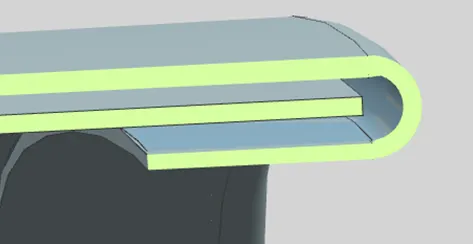
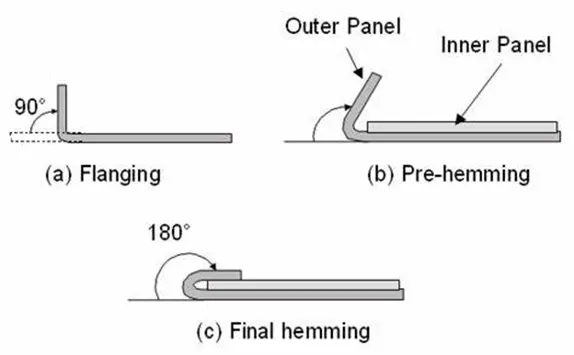
Hemming is a forming operation in which the edges of the sheet are folded or folded over another part in order to achieve a tight fit. Normally hemming operations are used to connect parts together, to improve the appearance of a part and to reinforce part edges.
In car part production, hemming is used in assembly as a secondary operation after deep drawing, trimming and flanging operations to join two sheet metal parts (outer and inner) together. Typical parts for this type of assembly are hoods, doors, trunk lids and fenders.
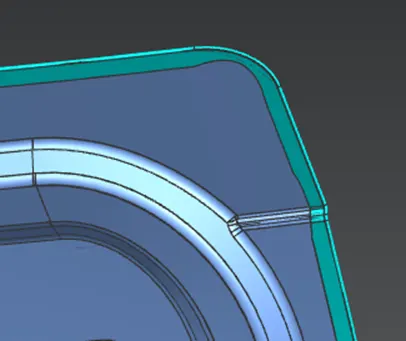
The accuracy of the hemming operation is very important since it affects the appearance of the surface and surface quality. Material deformations, which occur during the hemming process, can lead to dimensional variations and other defects in parts. Typical hemming defects are splits or wrinkles in the flange, material overlaps in the corner areas or material roll-in. This is why it is important to provide required reliefs at the corners.
CORNER RELIF
DRAFT ANALYSIS
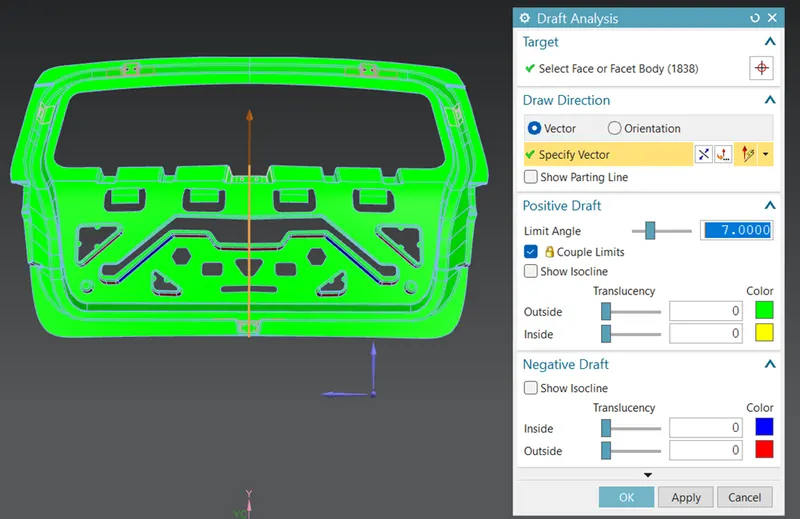
Draft analysis is done to check if the component does not have any negative draft. A negative draft can create a problem during the manufacturing process. Sheet metal parts must have a draft of atleast 7 degrees for proper tooling.
OVERALL VIEWS
CONCLUSION
The car back design and its reinforcements were developed from the given stylish surface. A detailed report about the engineering standards for back door design, its analysis for tooling feasibility as well as manufacturing techniques were prepared with necessary pictures.
THANK YOU………….