Section Modulus calculation and optimization
OBJECTIVE
To find the section modulus of the hood and optimisation to improve the overall section modulus.
SECTION MODULUS
It is termed as the ratio of the second moment of area and distance from neutral axis to the extreme fiber. It is the measure of the strength of the given member. It is a direct measure of strength of any sectional area of an object about a reference axis. The stress in the outermost section of the beam is computed with the help of section modulus. It is indicated by S.
The formula of section modulus is defined as the ratio of total moment resisted by the section to the stress in the extreme fibre which is equal to yield stress. Therefore
S = I/Y
Where,
S = Section modulus (mm^3)
I = Moment of inertia of the section about the bending axis. (mm^4)
Y = Distance between the neutral axis and extreme end of the object. (mm)
Area moment of inertia:
The area moment of the inertia of a beams cross sectional area measures the beam ability to resist bending. The larger the moment of inertia, less will be the bend.
Where,
M = Bending moment
I = Area moment of inertia
E = young’s modulus
R = Radius of gyration
Neutral axis: When beam is subjected to pure bending, the top most fibres of the beam are subjected to maximum compression, while the bottom most fibres of the beams are subjected to maximum tension.
KEY POINTS:
- Section modulus depends only on the cross-section shape of the structure. For symmetric sections, the value of “section modulus” is for both above and below of centroid of the fibre. An asymmetric section has two values for top and bottom of the fiber due to different distance from the centroid to top and bottom of the material, the maximum “section modulus” is Smax and the minimum is S min.
- Moment of inertia is nothing but offering resistance against the moment, bending or twisting, i.e., if we applied any external load on the body, how much resistance its offering to tend to deform.
- So, higher the value of moment of inertia, have higher resistance to deform under certain load, hence we can say that moment of inertia directly proportional to the strength of the material, and strength of the material can be calculated with help of section modulus.
- More the section modulus, the more the member is resistant to the bending of the beam. If two beams are made of the same material and comparing the “section modulus” of two beams, the beam with bigger section modulus will be tougher and more capable to withstand larger loads.
Section Modulus calculation of the hood Design
CASE 1: Initial Hood Design (before optimization)
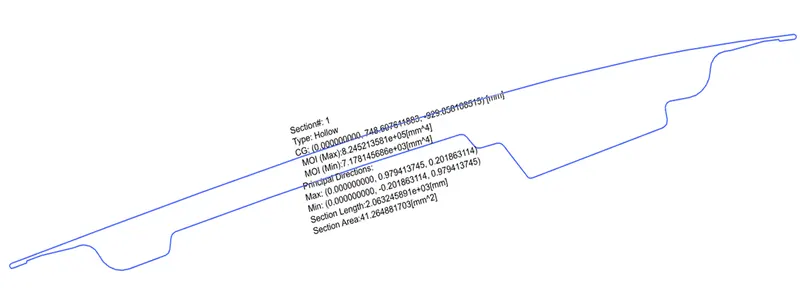
As per the section modulus equation,
S = I / Y
I = MOI (min) value is considered
Y = Total distance / 2
Y = 486.5 / 2
= 243.25 mm
Therefore, S = 7.178145686 / 243.25
= 0.0295093348 mm^3
CASE 2: Optimized Hood Design
The distance between hood inner panel and outer panel is increased to 0.6mm than initial distance.
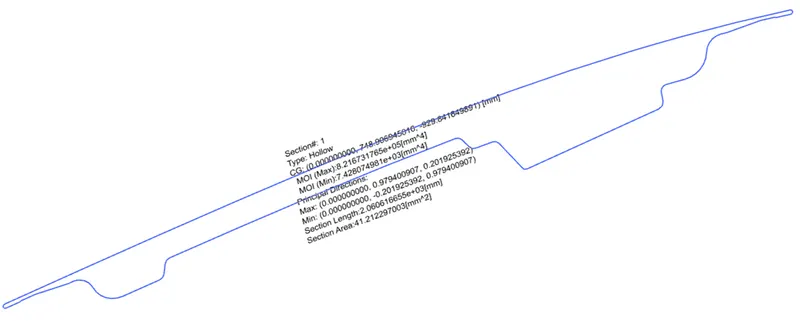
S = I / Y
I = MOI (min) value is considered
Y = Total distance / 2
Y = 486.5 / 2
= 243.25 mm
Therefore, S = 7.428074981 / 243.25
= 0.0305367933 mm^3
CASE 1: S = 0.0295093348 mm^3
CASE 2: S = 0.0305367933 mm^3
CONCLUSION:
Hence, with comparing above cases 1 and 2,
- The section modulus value of case 2 is higher than the case 1.
- As we increase the section area, the moment of inertia and section modulus increases which means strength and load on material also increase.