Design of backdoor
Aim
To Design Back Door using given Styling Surface.
Introduction
The backdoor or tailgate is the rearmost part of the automobile which opens upwards, downwards, and sideways to give access to the luggage space or seating. In most automobiles, the backdoor opens upwards. It is hinged to the roof and a gas stay support fixed at the body side outer for keeping the backdoor in the open position.
The material used in making the backdoor of the car is mainly steel but nowadays Aluminium is also used in making the panels.
The main advantage of Aluminium is that the density of Aluminium is very less as compared to steel so it reduces the overall weight of the car. But Aluminium is more costly as compared to steel.
TYPES OF DOOR OPENING:
- Top-mounted door
- Side-mounted door
- Bottom Door
Different processes used for manufacturing the Back Door
Deep Drawing:
The metal deep drawing process is an effective method of manufacturing cups, cans, and other similar deep drawing products. The deep drawings having 2 main categories.
- First-stage drawing: The blank shape of metal is placed on the die and in contact with the punch. When the metal specimen is a flat piece of sheet metal is used in forming and finish the product. Initially, the punch moves in a downward direction. The outer rim of the blank is subjected to pure radial drawing (drawing toward vertical axes) between the die and blank metal. The metal becomes a bend and slides over the die and is also stretched between die and punch. The metal in the vicinity of the punch head and contact with it bend and slide over the radii and stretch over the punch head.
- Redrawing: The components drawn from the first stage again it is redrawn convert into more depth to form a cup shape in the die and punch. The second stage of drawing is called redrawing.
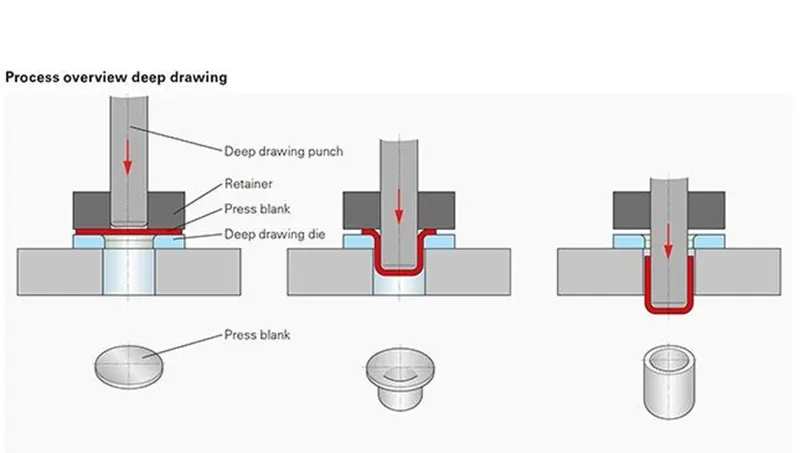
Fig.2. Process of deep drawing
Hemming
The inner & outer panels are joined by the process of hemming.
Hemming is a forming operation in which the edges of the sheet are folded over other parts in order to achieve a tight fit. Usually, hemming operations are used to connect parts together, to improve the appearance of a part, and to reinforce part edges.
In car part production, hemming is used in assembly as a secondary operation after deep drawing, trimming & flanging operations to join two sheet metal parts together. Typical parts for this type of assembly are hoods, doors, trunk lids & fenders.
The accuracy of the hemming operation is very important since it affects the appearance of the surface & surface quality. Material deformations, which occur while the hemming process, can lead to dimensional variations & other defects in parts. Typical hemming defects are splits and wrinkles in the flange, material overlaps in the corner areas. So it is very important to use simulation software tools to better understand the hemming process and minimize the number of “trial & error” during the tryout.
There are different types of hemming operations:
- Conventional die hemming
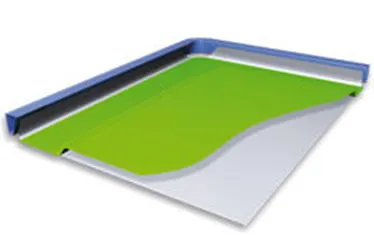
In conventional die hemming, the flange is folded over the total length with a hemming tool.
- Roll Hemming
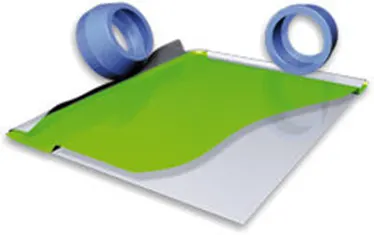
In roll hemming, the hemming roller is guided by an industrial robot to make the flange.
COMPONENTS OF BACKDOOR:
- Inner panel
- Outer panel
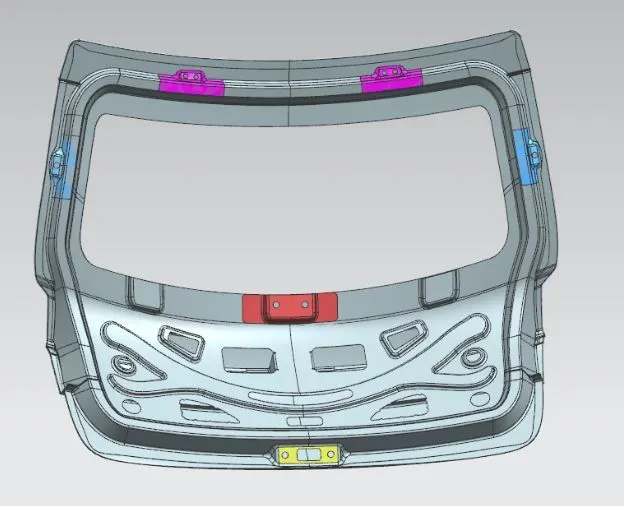
- Hinge reinforcement
- Gas stays reinforcement
- Wiper motor reinforcement
- Latch & striker reinforcement
DESIGN CONSIDERATION OF A BACKDOOR:
- Functional Requirement of Hinge and gas stay
- Rear visibility criteria
- Luggage volume area
- Crash Analysis
- Bend Test, Dent Test, Torsion Test & Endurance Test
- Rear Crash Regulation
- Gap and flushness Requirements
DESIGN OF BACKDOOR
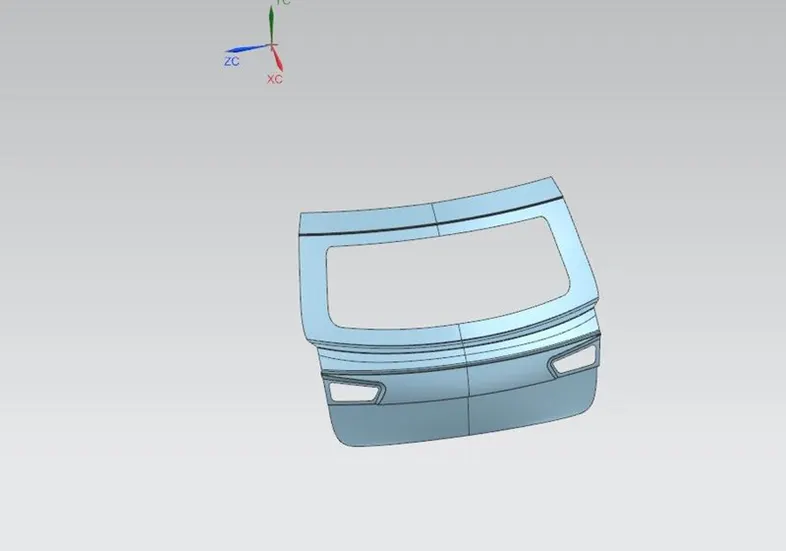
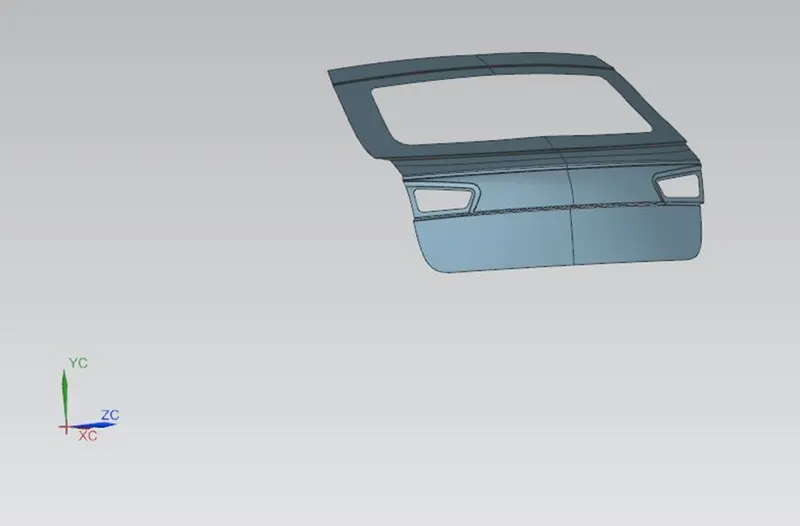
The Outer Panel is the styling surface of the back door design. Other components of the backdoor are designed with reference to the outer panel surface. It acts as the outer cover & deals with the aesthetics of the car.
In this design outer panel is divided into two-part.
- Outer Upper Panel
- Outer Lower Pane
Outer Upper Panel:
The Outer Upper Panel Extracted from a provided styling surface.
The panel is modified for the required design with the surface tools of NX CAD.
The thickness provided to the outer panel is 0.75 mm.
Hemming is provided with corner reliefs.
2) Inner Panel
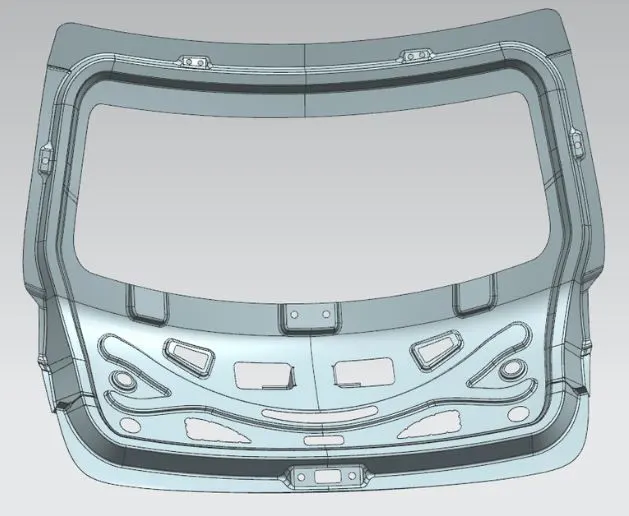
3) Reinforcements
Conclusion:
Thus the designing of the Back Door or Tail Gate is done as per Industrial standards and Manufacturing Techniques.