Design of backdoor
Backdoor Introduction:-
The Car Backdoor is situated at the rear end of the vehicle. Based on the initial development of vehicle design, the backdoor is supported by hinges present either near to vehicle roof-top, which enables the backdoor to open vertically upwards or the hinges are situated at the left/right sides of the vehicle rear end, to open it on sideways (Right / Left) as observed in most of the SUV’s. The backdoor of a vehicle is carefully designed, for meeting the requirement of safety and storage accommodation. The amount of space to be accommodated either for luggage or passenger seating are decided by the design and development team.
The various components/parts of backdoor are shown below,
- Back door outer panel (upper)
- Back door outer panel (lower)
- Back door inner panel
- Hinge reinforcements
- Gas stay reinforcements
- Latch and striker reinforcements
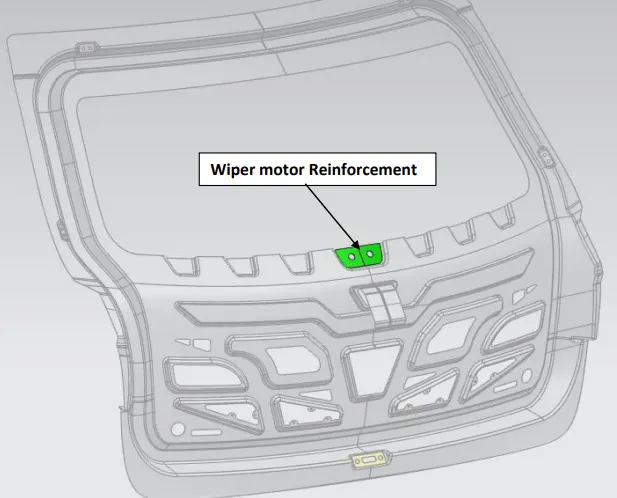
- Wiper motor reinforcements
Back Door Outer Panel (UPPER & LOWER).
As the name suggests, it is the outer part of the rear door and is mostly responsible for aesthetics of the vehicle. Outer and inner panels are connected by mastic sealants in center and by hemming process at edges. The outer door handle and in some cases, the number plate may also be installed on the outer panel of the back door. We have considered a 2-part outer panel for our design, outer upper panel and outer lower panel prospectively. Outer panel is manufacture by stamping sheet metal. Thickness for outer panel is 0.75 mm.
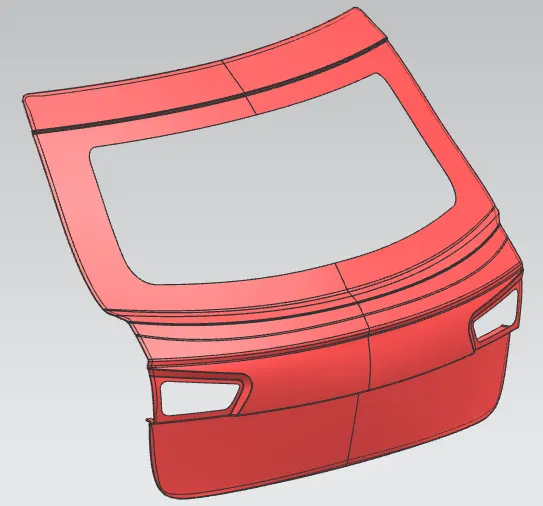
Back door inner panel.
The Back Door Inner panel is the crucial and most important segment of the backdoor. The inner panel forms the skeletal system of the Backdoor. The Structure of the backdoor inner panel has to be designed with basic requirement of maintaining sturdy strength and absorbing the external impacts by deforming at a minor extent. The Backdoor Inner Panel has to have certain number of cut-outs at the center part, to make the impact load distributed equally at all directions, thus making the backdoor to maintain uniform stability and good NVH levels. It is where most of the reinforcements and components are mounted. It is manufactured either by casting (aluminum) or sheet metal stamping (steel). Thickness of inner panel is 0.75 mm.
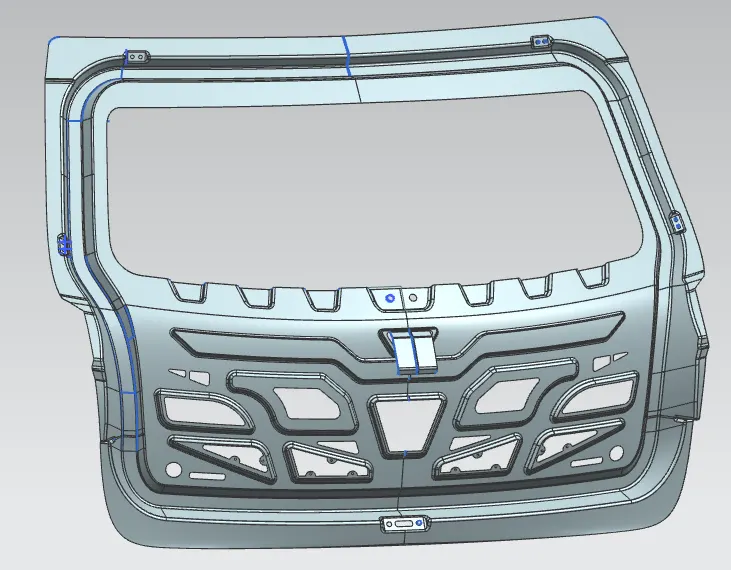
Hinge Reinforcement assembly.
Hinge Reinforcements are added in the Inner Panel of the vehicle backdoor. As the opening of the vehicle backdoor considered for design is of a car with vertical upward movement, the hinges are provided at the rear roof rail. The Hinges are provided on left and right extreme position of rear roof for a pivotal action of backdoor to facilitate opening and closing operation. During the opening and closing of backdoor, the self-load of backdoor is being impacted on the hinges, and in turn, may damage the roof structure and hinges at a certain point due to buildup of deformation load. To avoid the damage of hinges due to stress buildup, the reinforcements are added in the inner panel for hinges to strengthen the local area and increase its life. The Hinge reinforcement assembly comes with two hinge reinforcements, one for left hand side and other one is on right hand side in extreme backdoor inner panel. The thickness of Hinge Reinforcement maintained in the design is 0.75 mm.
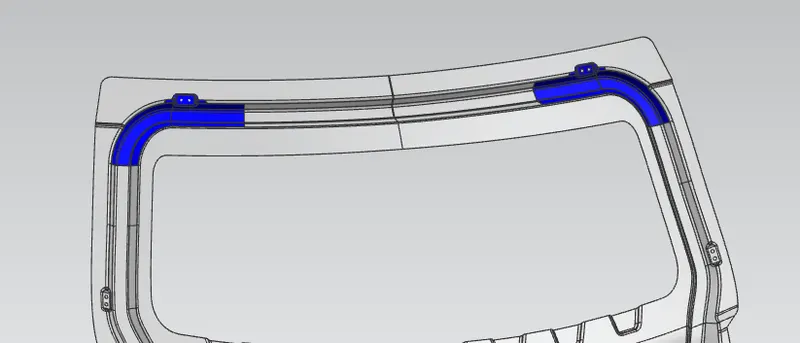
Gas stay reinforcements.
Gas Stay systems are the advanced type of supporting system, for lifting the backdoor by the help of a linear actuating device. Gas stay systems in general reduces the effort on hand for opening the backdoor and also to close the backdoor smoothly. There are usually two type of gas stay systems – one which is semi-automated type and other is of power driven fully automatic controlled by car key remote or pushbuttons present inside the car. As like hinges, even gas stay system is mounted on the sides of the backdoor. The load of backdoor is supported by gas stay system both during opening and closing operation.
Due to the concentrated load acting on the gas stay systems; its mountings are bound to undergo internal stresses followed by deformation thus damaging the sides of the inner panel. To avoid the deformation, the gas stay reinforcements are added to strengthen the local area of inner panel at the gas stay mountings. The Gas stay reinforcement assembly comes with two gas stay reinforcements, one for left hand side and other one is on right hand side in extreme positions of sides in backdoor inner panel.
The thickness of gas stay reinforcements maintained in the design is 0.75 mm.
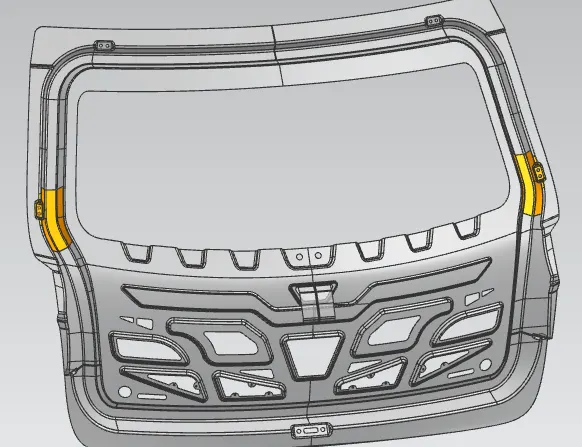
Latch and striker reinforcements.
Latch and striker are the locking system for backdoor. The Latch is present in the rear end at the bottom of the vehicle to engage and disengage the striker present in backdoor while opening and closing operation. Usually, during opening of the backdoor the pushbuttons near the backdoor outer panel enables to disengage the striker from the latch with less hand effort. But while closing operation, a swift force is provided on backdoor for striker to engage properly to the latch forming a complete locking. During the closing operation of backdoor, a swift force is provided on outer panel, which impacts the latch area as load is acting perpendicularly by the striker present in inner panel of the backdoor. Due to this quick impact load, the stress is being created on the latch area and which leads to deformation of the local structure.
To enhance the latch structure, the reinforcements are added to strengthen the local area.
The thickness of Latch reinforcements maintained in the design is 0.75 mm
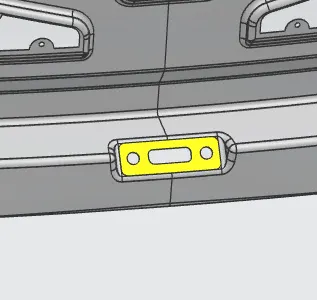
Wiper motor reinforcements.
Wiper motor is a device which is mounted on the inner panel of the backdoor, just below the glass in center position. The main function of the wiper motor is to wipe out the water present in the glass of the
backdoor. Its commonly used in operation during raining, as the water falls on the backdoor and makes the visibility of the rear road obstructed. Hence, the wiper is switched on, which actuates in to and fro motion on to the surface of the backdoor glass by the help of motor, to wipe of the water and provide clear visibility of rear road.
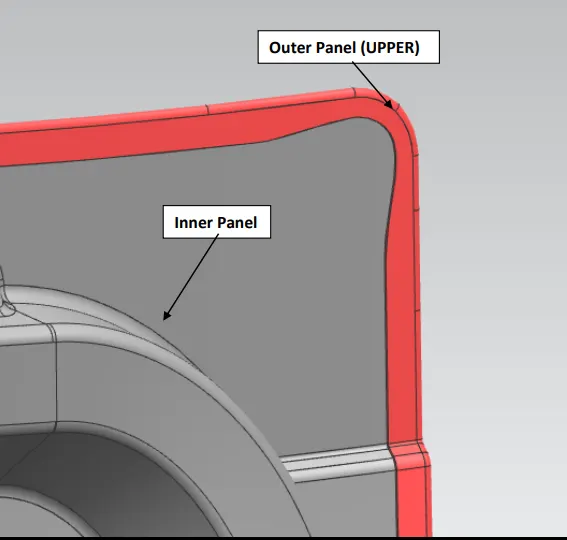
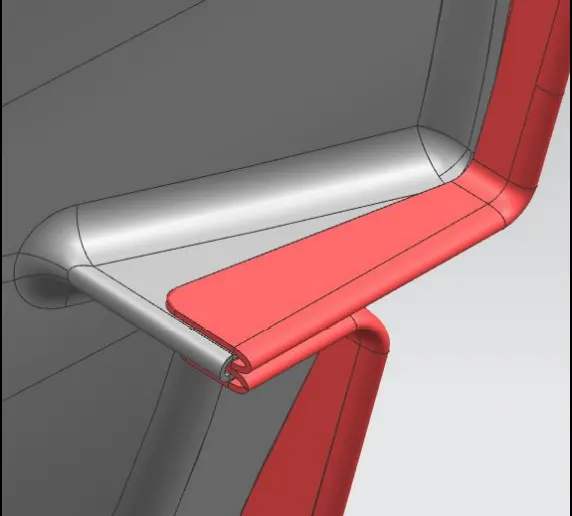
Hemming Operation.
The Hemming operation is performed between the Outer panel (UPPER)/ Outer panel (LOWER) and inner panel of backdoor.
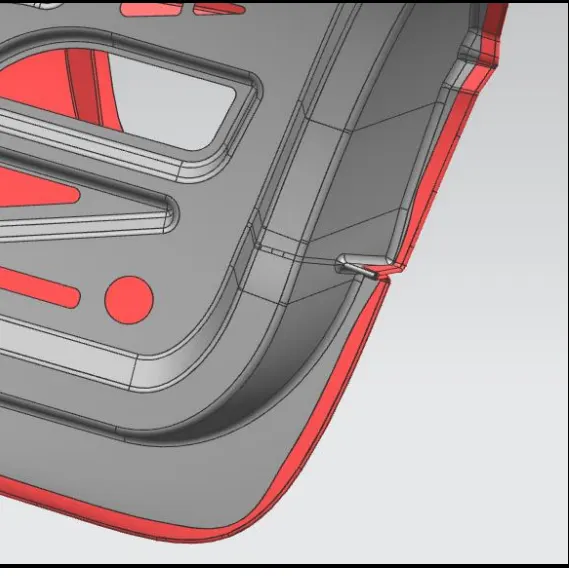
DRAFT ANALYSIS ON BACKDOOR INNERPANEL.
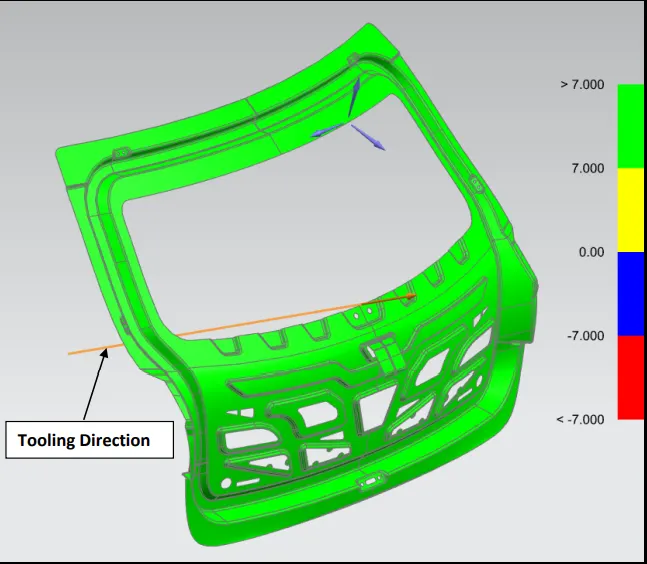
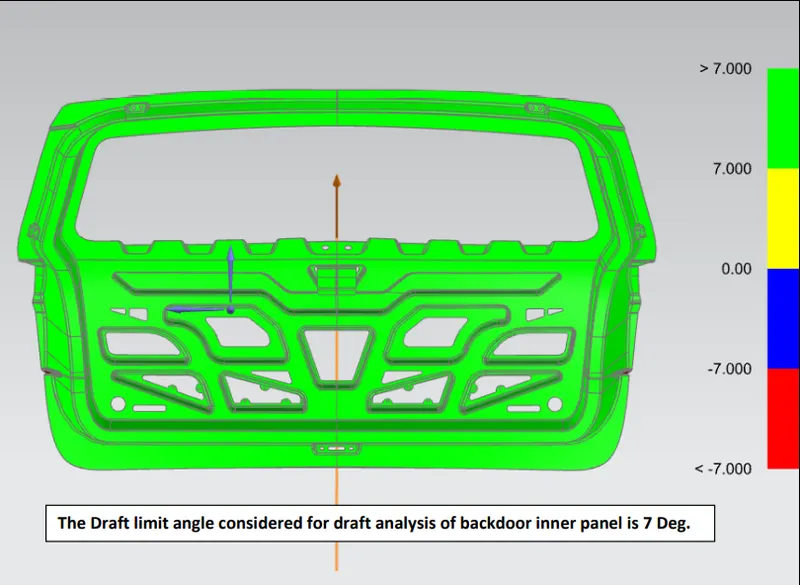
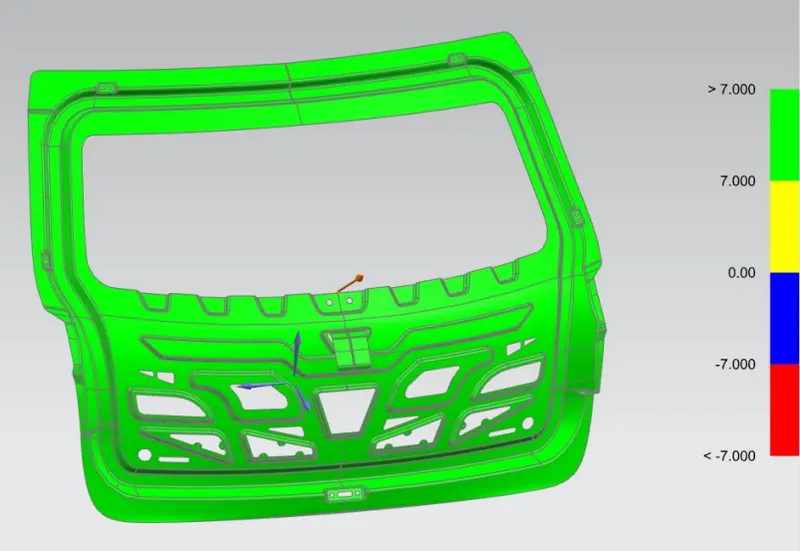
The sheet metal deep drawn technology is one of the most challenging processes in manufacturing. Drawing operation is the process forming a flat piece of material into a hollow shape by means of punch which causes the blank to flow into the die cavity. The depth of the draw may be shallow, moderate or deep, various geometries and sizes are made by drawing operation, especially automobile panels. Typical defects that occur due to incorrect flow of material into the die during the stamping process are wrinkling caused by excessive compression, tearing or splitting caused by excessive tension, and spring back caused by elastic recovery of the material. During development stage initially one simple design is made. After studying the component data decision is made to make the forming tool for the component. But, if the side walls of the designed components are having the straight walls having 90 deg. angle with the horizontal plane, then the side walls will rub to the die walls and may lead to adverse effect on die as well as on final product.
As far as sheet metal forming is concerned it is not possible to press such component without any draft angle for good effect. So, tool designer has requested to product designer to change the design on the basis of analysis results received and incorporate draft angle with a standard limit.