Design of backdoor
Aim
Use the provided styling surface to come up with a back door design, use appropriate design methodologies, and provide the necessary reinforcements and embosses
Backdoor Introduction
The trunk or boot of a car is the vehicle's main storage or cargo compartment, often a hatch at the rear of the vehicle. It is also called a tailgate.These doors can be operated manually or electric powered. In most of the luxury cars door is electrically operated. Ii involves a very major role during rear crash cases. so our design must be obeying the crash requirements. The institute of highway saftey analyze the different accidents and they set a test to rate the car. so these rating depends upon the design of the trunk and material used, flanges, embosses, type of joining of inner panel and outer panel.
Types of Backdoor on the basis of there position
- Top Mounted Door
- Side mounted Door
- Bottom Door
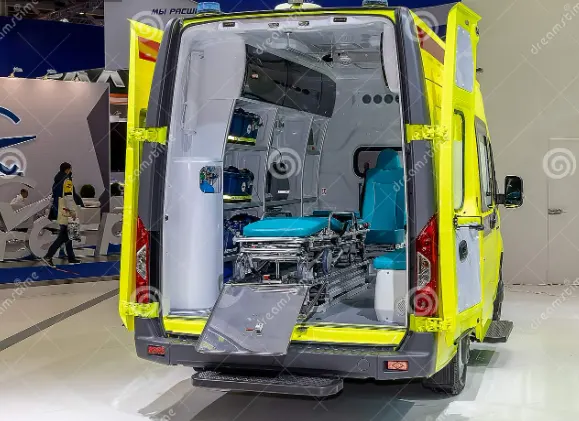
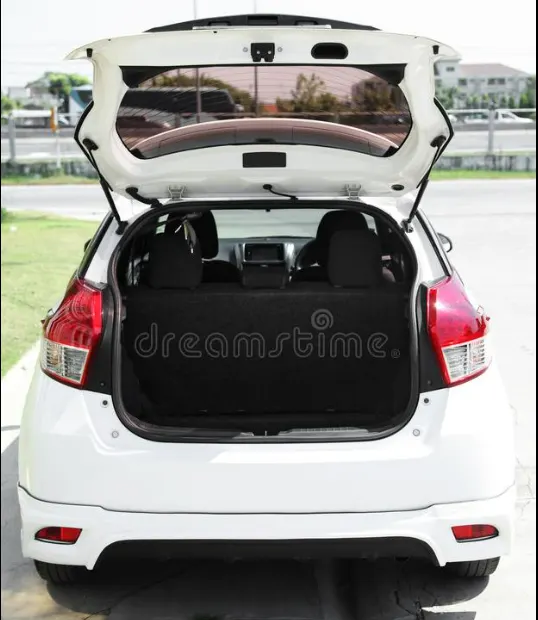
Types of Backdoor on the operating Type
- Electrically operated
- Gas stay powered
The vital purpose of using these mechanisim is to open the back door without doing much efforts, because the backdoor have different parts and the weight of the back door is high, so we are not able to open the back door manually, so we introduced these two types of doors and these mechanism also decides the premiumness of the car, premium cars mostly used the electrically operated doors.
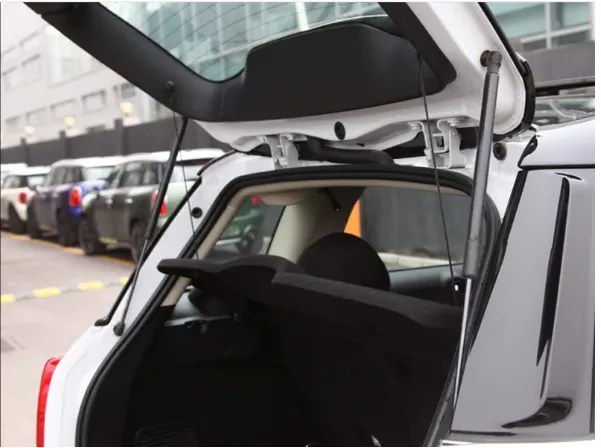
Gas stay powered: In gas powered stay there is hydraulic mechanism is used to uplift the backdoor
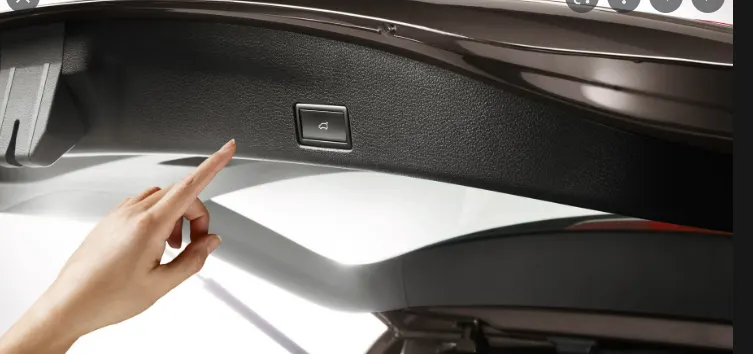
Electrically operated: There are electrically operated motor used to operate the opening and closing of door and sometimes in premium car there are sensor operated backdoor which sense the motion of hand and operated according(eg in car like Mercedes, BMW etc)
The Crucial Parts in the Backdoor Assembly:
- Inner panel
- outer panel
- hinge and its reinforcement
- wiper motor reinforcement
- latch & stricker and its reinforcement
- gas stay reinforcement
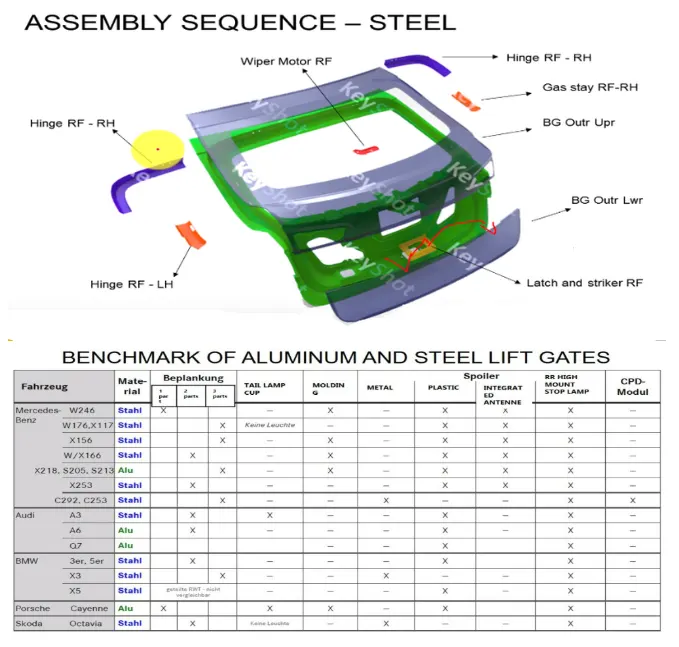
The major problem in back door is material selection. in earlier days steel is used, but the problems with the steel parts is that part becomes more heavy in weight,so to avoid that we presently using aluminium in high end cars, the main objective of using aluminium over stell is it has less desnser material and its sutaible for complex shapes, and it also gives the thcikness locally because it it done by casting, in case of steel we used deep drawing operation.
The comparison between Aluminium and steel is mentioned below
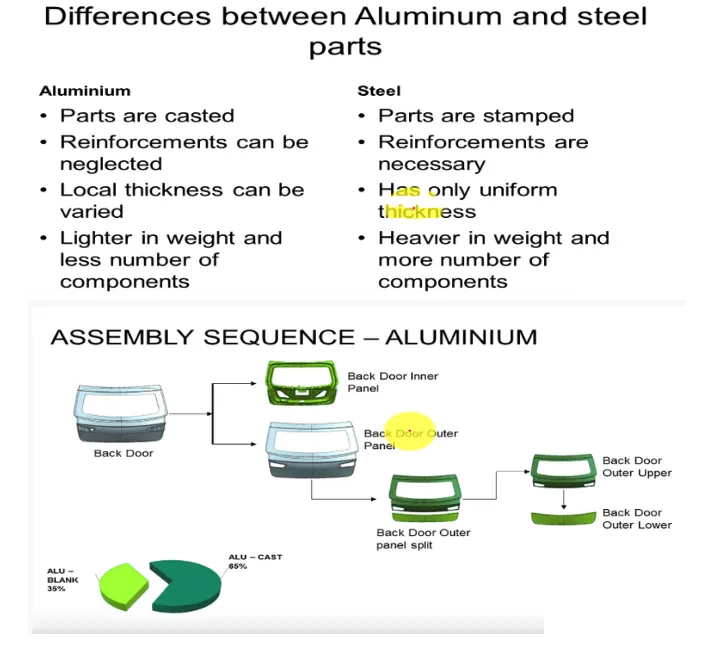
So by use of aluminium we can reduce the number of parts and assembly involvement and reduce the weight and increase the strength but it is costly material so it is mostly used by Big Brands in there luxrious cars
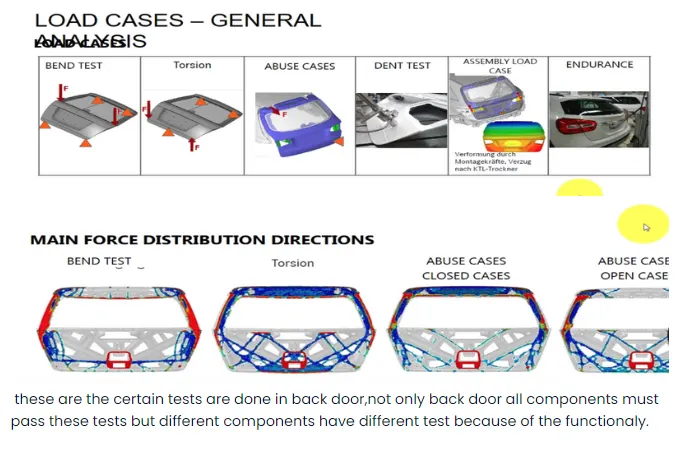
Various Load cases and force distribution
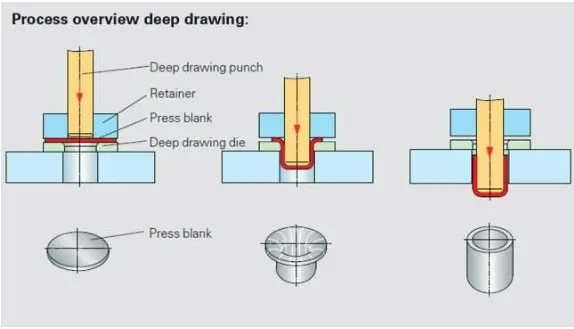
Different types of Sheetmetal operations
Deep Drawing:
The metal deep drawing process is an effective method of manufacturing of cups, cans and other similar deep drawing products. The deep drawings having two main categories.
- First- stage drawing: The blank shape of metal is placed on the die and contact with the punch. When the metal specimen is flat piece of sheet metal used in forming and finish the product. Initially the punch moves in downward direction. The outer rim of blank is subjected to pure radial drawing (drawing toward in vertical axes) between die and blank metal. The metal become a bend and sliding over die and also stretched between die and punch. The metal in vicinity of punch head and contact with it bend and slide over radii and stretch over punch head.
- Redrawing: The components drawn from first stage again it is redrawn convert into more depth to form a cup shape in the die and punch. The second stage of drawing is called as redrawing.
Embossing:
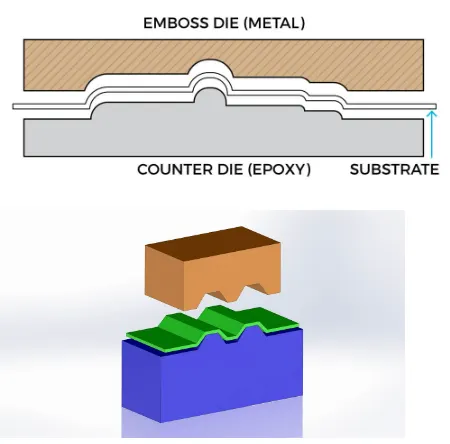
Embossing is a metal forming process for producing raised or sunken designs or relief in sheet materials by means of matched male and female roller dies, theoretically with no change in metal thickness or by-passing sheet or a strip of metal between rolls of the desired pattern. Metal sheet is drawn through the male and female roller dies producing a pattern or design on the metal sheet. Depending on the roller dies used, different patterns can be produced on the metal sheet.
Materials commonly used in the metal embossing process include:
- Aluminum alloys
- Steel alloys
- Zinc
- Copper
- Galvanized steel
- Brass
- Cold rolled steel
Hemming:
Hemming is a forming operation in which the edges of the sheet are folded or folded over another part in order to achieve a tight fit. Normally hemming operations are used to connect parts together, to improve the appearance of a part and to reinforce part edges.
In car part production, hemming is used in assembly as a secondary operation after deep drawing, trimming and flanging operations to join two sheet metal parts (outer and inner) together. Typical parts for this type of assembly are hoods, doors, trunk lids and fenders.
There are various types of hemming operations:
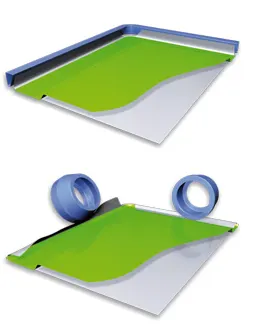
- Conventional die hemming: In conventional die hemming, the flange is folded over the entire length with a hemming tool.
- Roll hemming: In roll hemming, the hemming roller is guided by an industrial robot to form the flange.
Open Hem: A Hem has a full round feature and a return flange. In open hem bend angle is equal to 180 degrees.
Tear drop Hem: In tear drop hem the bend angle is greater than 180 degrees.
Closed Hem: Hems without any inside radius are called as closed hem. Closed hems are not recommended if the hem geometry is to be painted or if the material used is SST or Aluminium.
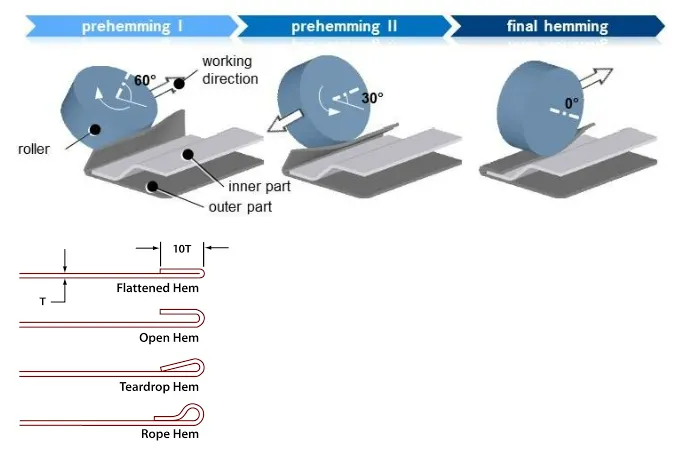
The main and crucial point to take under consideration for hemming is that there should be a 0.2 mm gap between the upper and down surface and it is given so that hem glue can be inserted and at the edges there should be relief provided so that there wont be any stress concentration at that area.
Blanking:
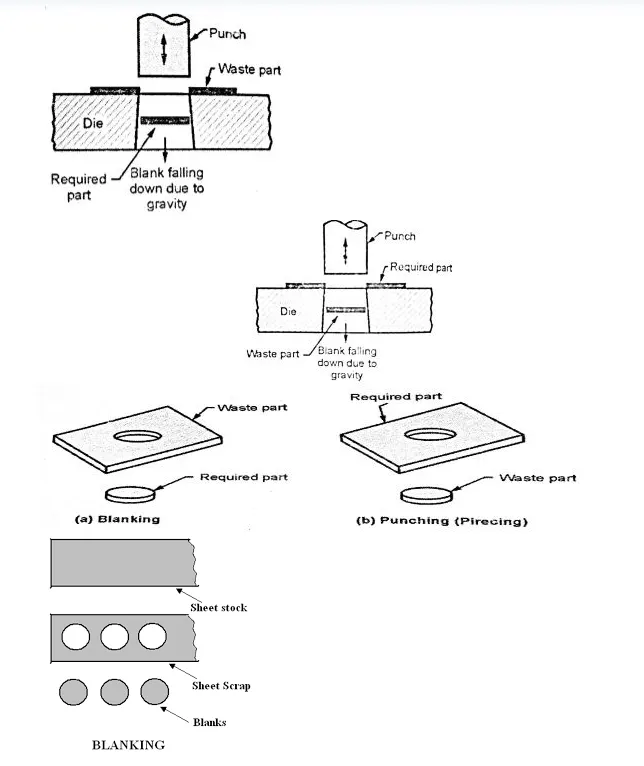
Blanking is a cutting operation of a flat metal sheet and the article punched out is known as blank. Blank is the required product of the operation and the metal left behind is considered as a waste.
Punching:
It is similar to blanking only the main difference is that, the hole is the required product and the material punched out from the hole is considered as a waste.
Inputs for designing of backdoor:
- Outer Panel - 0.75 mm
- Inner Panel - 0.75 mm
- Reinforcements - 1.5 mm
Class A surface:
Backdoor Outer Top and Bottom class A surface needs to be modified at some part and these changes has to be according to the smoothness and also these changes will be done in compliance with the Outer surface designing team.
Tooling Direction
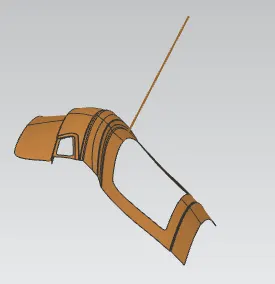
First, we need to create the Tooling direction for the Deep drawing operation. It shows that all the operations like embossing is done by considering this vector direction and it will help in manufacturing the part.
Inner Pannel
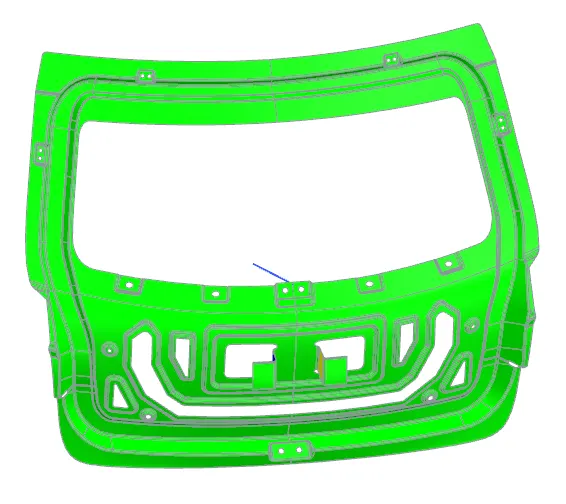
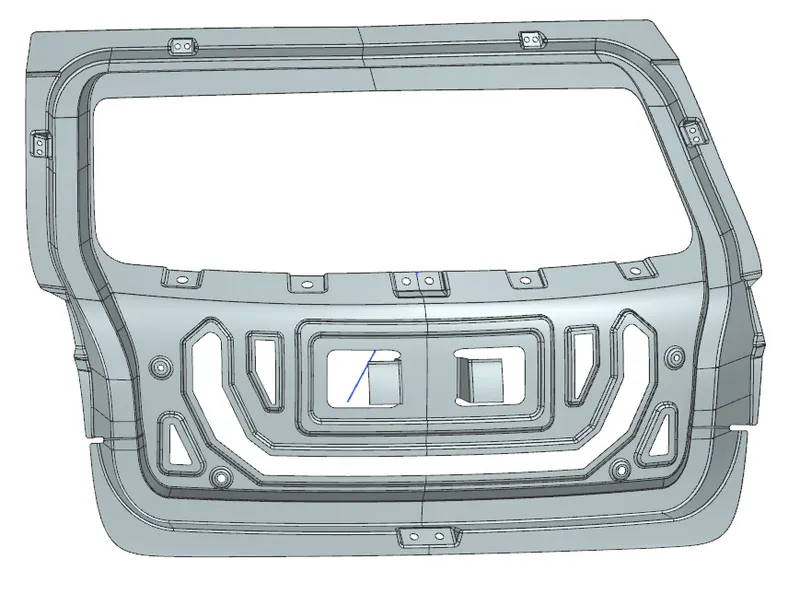
After modifying the surfaces, the door outer surfaces are extracted (wave geometry linker command) in 2 parts as outer upper pannel and outer lower pannel and then a new assembly file is created and the both outer upper pannel and outer lower pannel are add as component and with the help of these 2 surface the inner pannel is created with several different command (Law extension, Bridge curves, Through Curve mesh trim sheet offset surface and thiken command) and several mountings for Latch and Striker, Viper Motor, Gas Stay Mount are created and then the half part is mirrored and sewed and the analysis is done by examine the geometry and doing the draft analysis
The images of draft analysis and the Inner pannel and different mount is shown below
Mountings
Various mounting are created in order to place the Latch and Striker, Viper Motor, Gas Stay Mount and Hinge Mountings
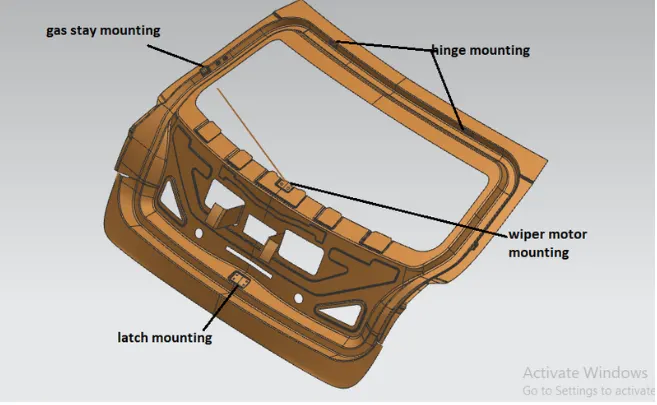
Annotation for the placement
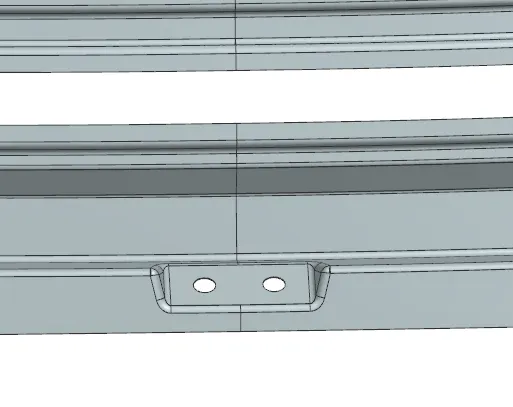
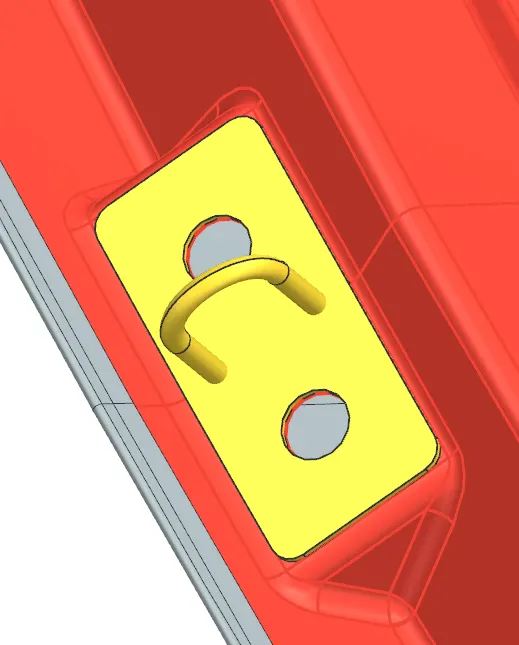
Latch and Striker Mount
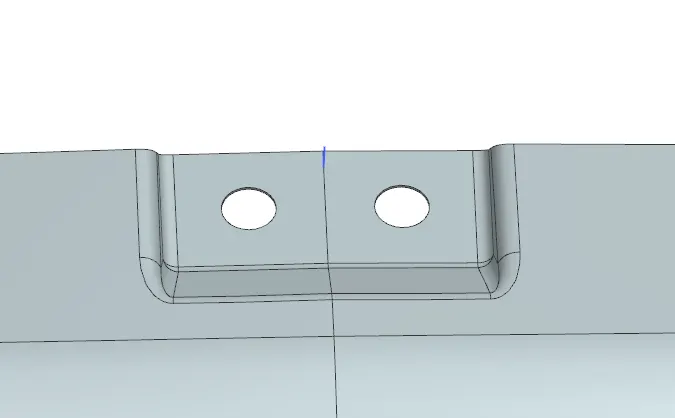
Viper Motor Mount
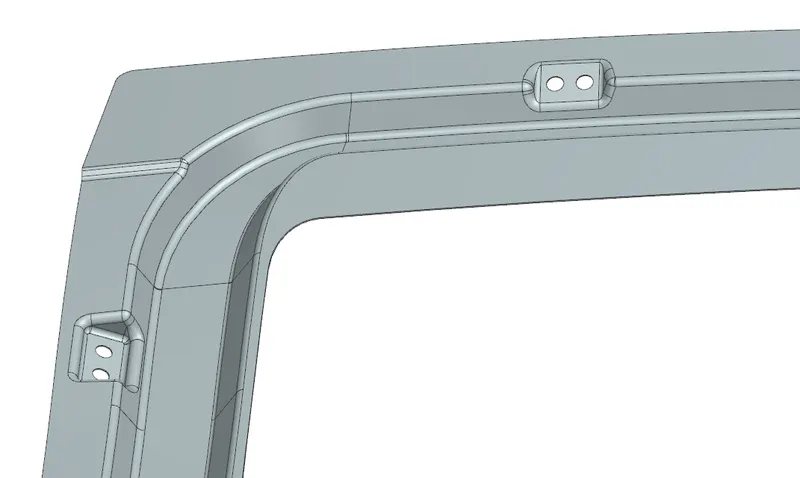
Gas Stay Mount and Hinge Mountings
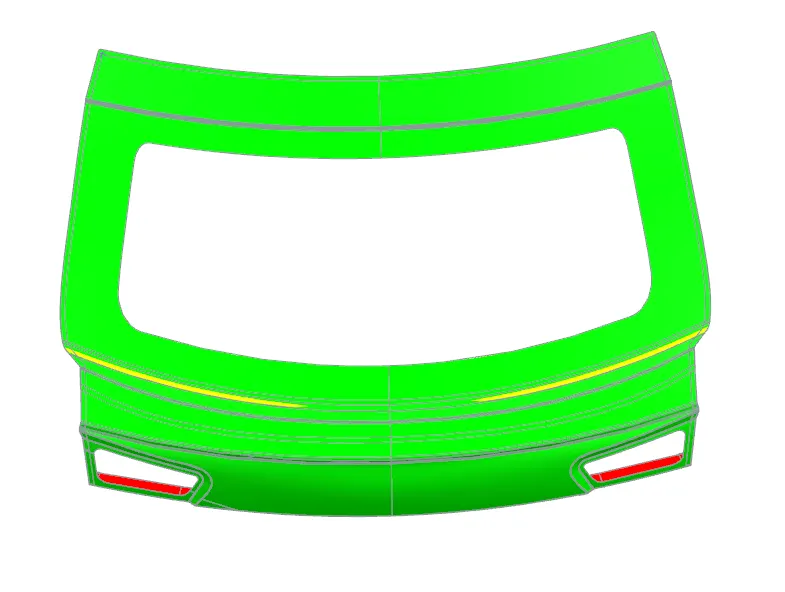
Outer Pannel Upper
Based on the styling panel the outer panel upper was designed. Giving it to wrap on by hemming around the inner panel to protect as well as it is outer most part to avoid the joints hemming is used and the design is shown below with the draft analysis done on the outer pannel
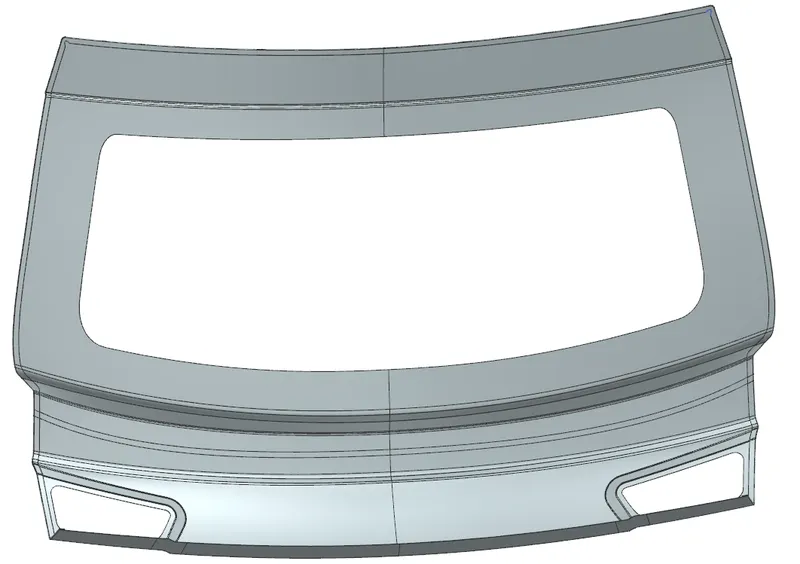
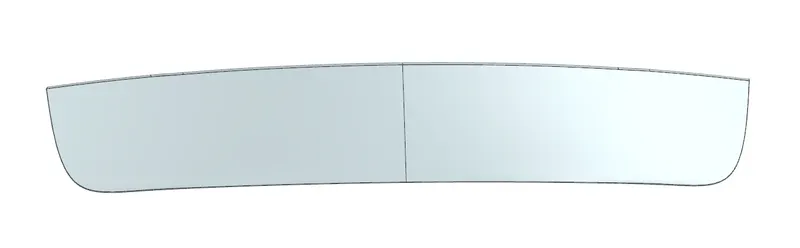
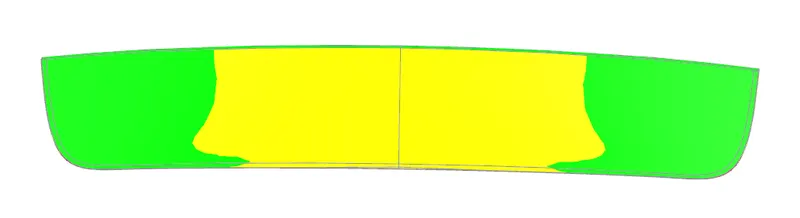
Outer Pannel Lower
It is lower panel for the outer panel, it is the second component in the outer panel. Even it is hemmed to the inner panel which doesn’t have any other joint method other than hemming. Thickness is 0.75mm for the outer panel the draft analysis is done on the part and the result is shown below
Latch and Striker
Reinforcements
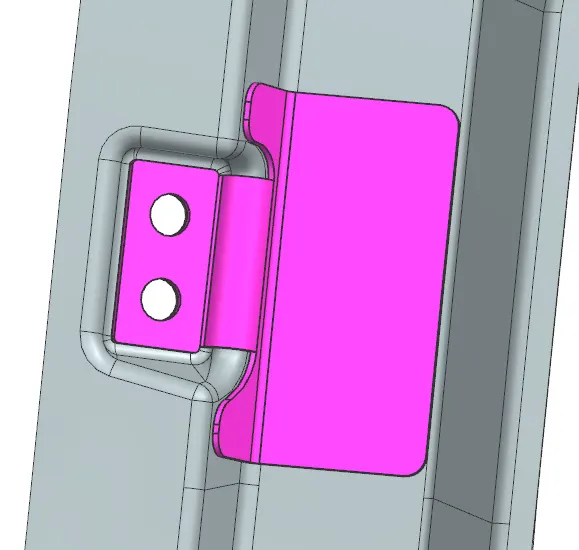
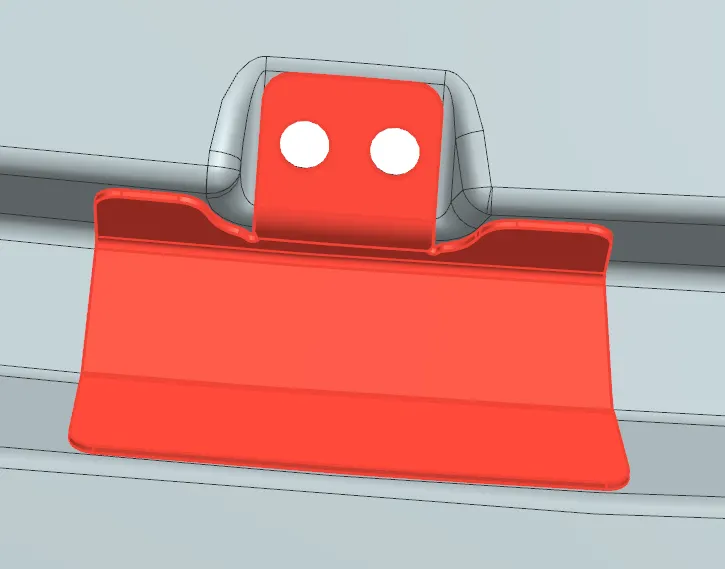
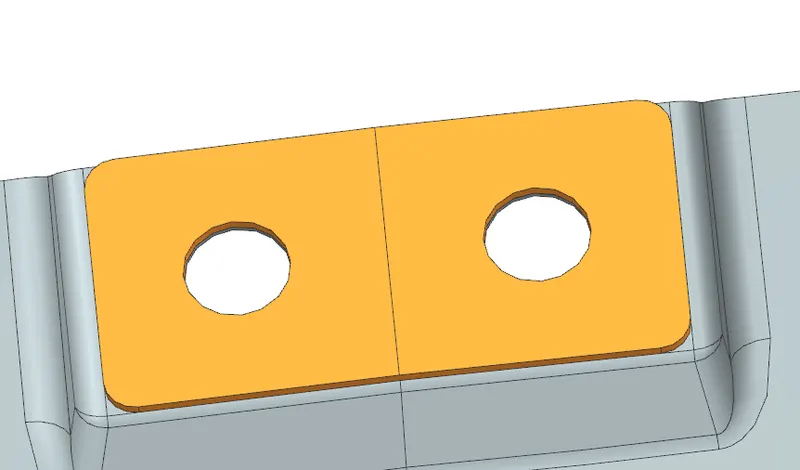
Reinforcement are provided in order to strenghten that part or region because there are chances while a shock or during vibration there will be a chances of failure at that part so to make it strengthen the reinforcement are provided
Gas Stay Reinforcement
Hinge Reinforcement
Viper Motor Reinforcement
Conclusion
The back door is designed as per the requirement and maintaining the passenger safety and security while designing. All parts are geometrically aligned well all the necessary consideration are taken for the designing which are listed below
- Rear Visibility Criteria
- Boot Space Criteria
- The minimum gap has been maintained for mastics (5mm)
- Reliefs are provided at the corners to avoid the stress concentration
- For hemming minimum 0.2 mm gap is maintained for hemming glue
- 0 mm gap has been maintained for spot weld the outer upper and outer lower pannel
- The 6 mm distance has been maintained between the edge and the hole flat surface
- 10 mm minimum distance have been maintained between the 2 holes flat surface
- Reinforcement thickness is maintained (2xThickness of sheet)
- 3 plus thickness has been maintained for blend radius for manufacturing feasibility.
Considering the manufacturability and the design consideration and NVH the Back door is designed
....................................................xxxxxxxxxxxx.................End Of Report.................................xxxxxxxxxxxxx..........................................