Design of backdoor
Backdoor Design
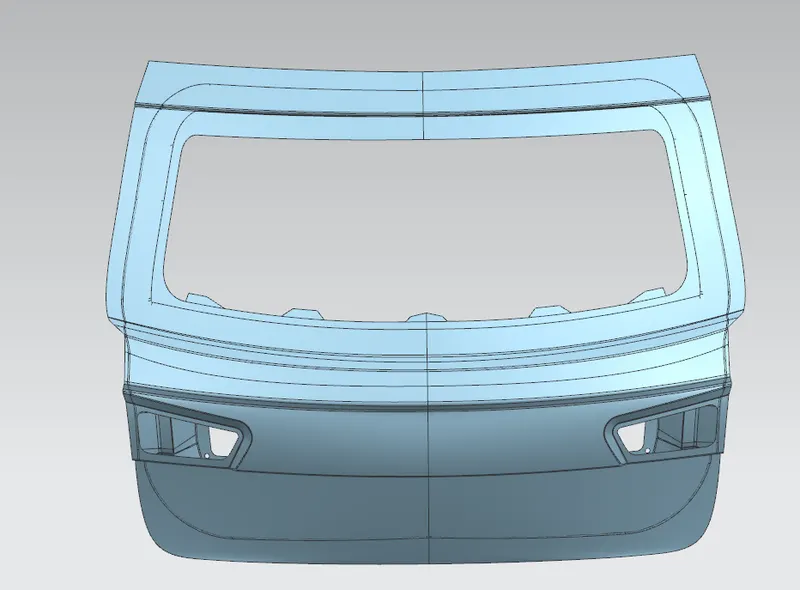
Aim: To design a sheet metal panel of backdoor from the provided skin data taking all the design rules into
consideration.
Abstract: A backdoor of a car also known as tail gate is a commodity which normally serves the purpose of covering
the car from the rear end. But there are more functions that come with it which has to be considered while making a
design of the same like rear visibility criteria and boot space. This part is usually designed keeping the master section
of the rear roof rail because of the sealant flange and also various other considerations, as it is also in contact with
the side body of the car.
Theory: Before starting the design of backdoor, we have to decide which type of backdoor we have to design
because this step includes the hinge axis. This axis is the one about which the backdoor will open and close. There
are three types of backdoor:
• Top mounted
• Side mounted
• Bottom mounted
It is needless to say that the hinge axis will be at that specific position where the tail gate is mounted. This initial step
helps us to determine the position of latch and striker.
REPAIRING INPUT
The first step is to organize the input skin data as upper outer surface and lower outer face. But before that we have
to check for any irregularities in the surfaces and repair if and sew them together.
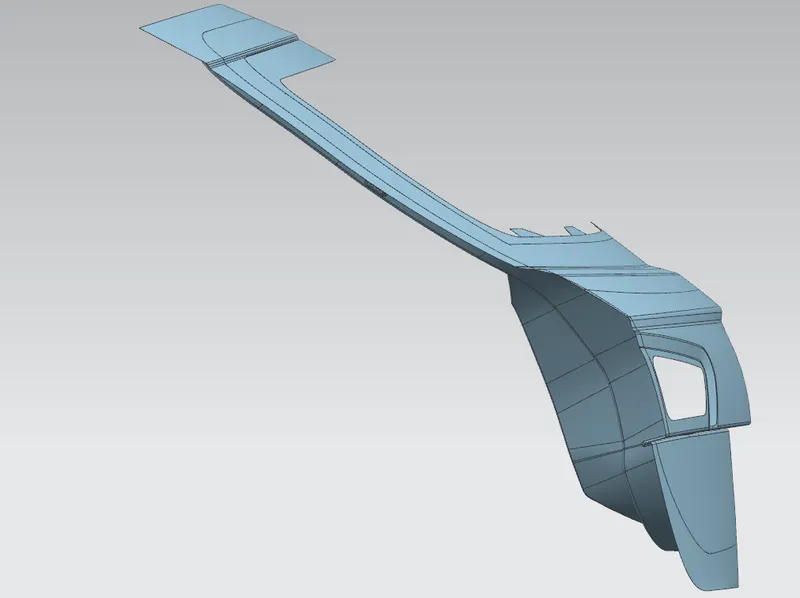
SEALING FLANGE
Usually we will take reference from the roof master section for the sealant flange, but as it was not available we have
made entire sealing flange in this model. The space occupied by the rubber sealant is usually in the range of 15mm-
25mm. 25mm is the open condition, so we made maintained that distance between inner panel and the sealing
flange. Once this flange is made, we make a connecting flange on both sides of it and complete this flange to be
joined with inner panel.
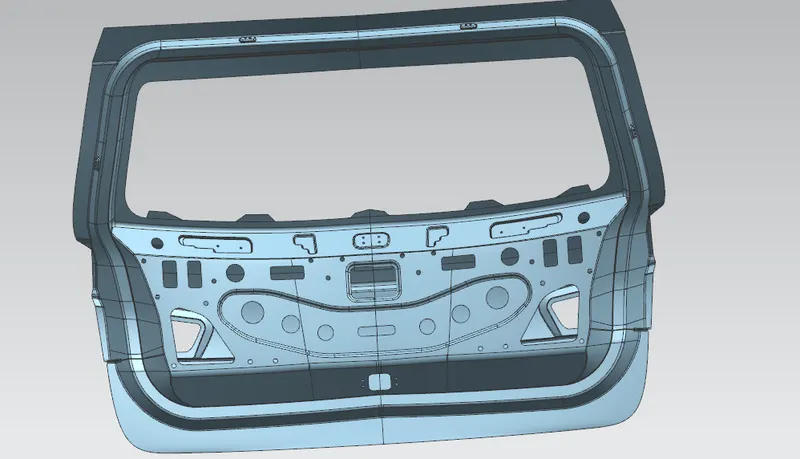
INNER PANEL
The shape of the inner panel is same as that of the outer panel up to the windshield surface. After that we have to
make space for various components such as latch and striker motor etc. So we make a proper curved surface at the
lower side so that we avoid kinks at the mirroring plane. Once the main body is ready, we have to decide the design
of the following things:
• Mastic region: whether we have to design it as a big one at a single region in the centre or two small regions.
• Emboss: we have to create proper emboss either Y or V or combination of both to diverge the force.
• Latch & striker motor space: this will be mounted on one side of the inner panel, but we must make a similar
cutout on both the sides keeping centre of gravity in mind.
• Material cut-outs: due to ample space, we should remove the material from few regions to reduce weight of the
inner panel.
There are few mountings which we have to keep in mind and make reinforcements for the same:
• Hinges: this model is made such that the backdoor will be mounted on the roof, so the hinges mounting
emboss has to be provided accordingly on the top somewhere.
• Gas stay: the backdoor will have gas stay method for opening and keeping it open. Thus this mounting emboss
will be needed somewhere on the side.
• Wiper motor: the backdoor will also have a wiper whose motor is to be mounted somewhere. As only single
wiper will be present, it is common to give this in the middle near windshield.
• Latch and striker: it is the one which locks and unlocks the backdoor and as the backdoor rotates on the hinge
axis, this must be present on that patch only.
Once all these design is made, we move on to make the mirror of the model in order to make it complete. After
mirroring the inner panel, a handle mounting space is provided. After the detailing work is done, it is thickened with
the thickness of 0.75mm.