Design of backdoor
BACKDOOR DESIGN
OBJECTIVE:
- To develop the car backdoor by using given surface method by automotive sheet metal design.
BACK DOOR:
- A backdoor is located at the rear end of the car which gives access for the boot space to store luggage,spare wheel etc. These doors can be operated mannualy or electric powered.
- In most of the luxuary car is electric powered.Back door also called as 'Hatch' or 'Tailgate','Truck-lid', 'Boot-door' is basically the 5 door in a 4-door car.Its the rearmost part of the vehicle which gives access to the trunk and has mounts for wiper motor,tail lamps,hinges for supporting its weight in opened position, gas stays which help with its opening and keeping it open, radars and cameras etc.
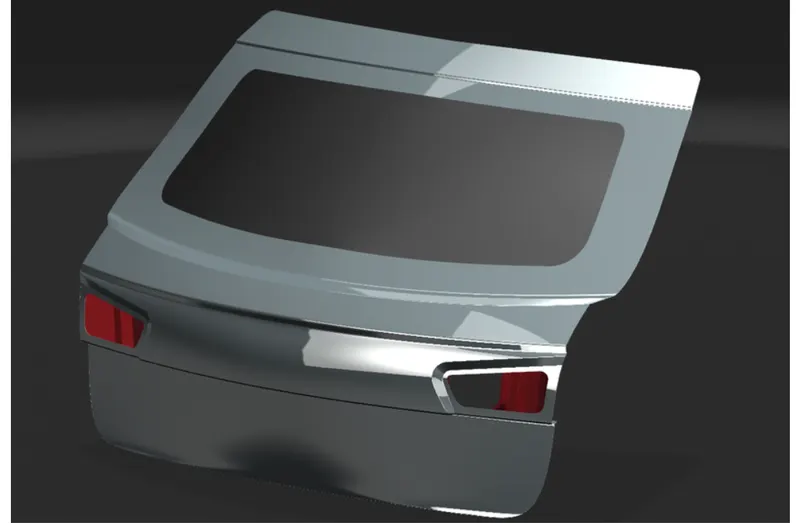
- A backdoor is usually made up of 1 inner panel and 2 or 3 outer panels joined together by hemming and spot welding wherever necessary.
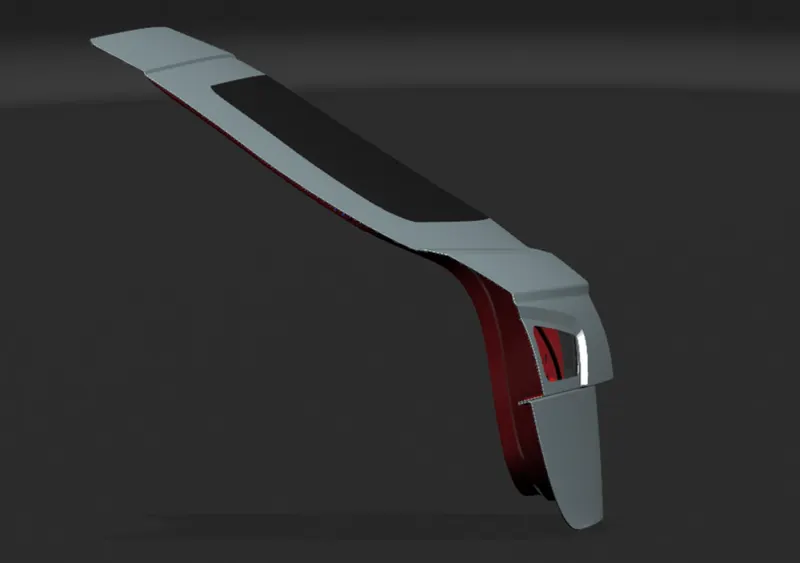
- The material used for backdoor varies as per the price range of the vehicle. Most of the low cost vehicles use steel as it is cheaper and use parts that are stamped using moulds.These parts are usually of uniform thickness and reinforcements are added to improve local strength where needed.
- The premium vehicles use aluminium parts which are usually die casted and hence can have variable thickness. This removes the need of reinforcements hence can have variable thickness. This removes the need of reinforcements hence keeping the weight even lower as aluminium parts are lighter in comparison.
- On the contrary aluminium is more expensive than steel hence its applications are limited in cheaper vehicle. Currently due to the extensive use of plastics trims and plastic parts the cost of aluminium are limited in cheaper vehicle.
- Currently due to the extensive use of aluminium is affordable for the manufactures in all price brackets.Use of aluminium reduces the overall weight of the component and hence the vehicle improving its fuel efficiency.
REINFORCEMENTS :
- As mentioned for local strengthening reinforcements are usually provided.Instead of making the whole panel off a thickner sheet, a thinner sheet with thicker local reinforcements wherever needed is preferred.The reinforcements are usually 1-1.5mm thick whereas the panel itself is 0.55-1 mm thick.
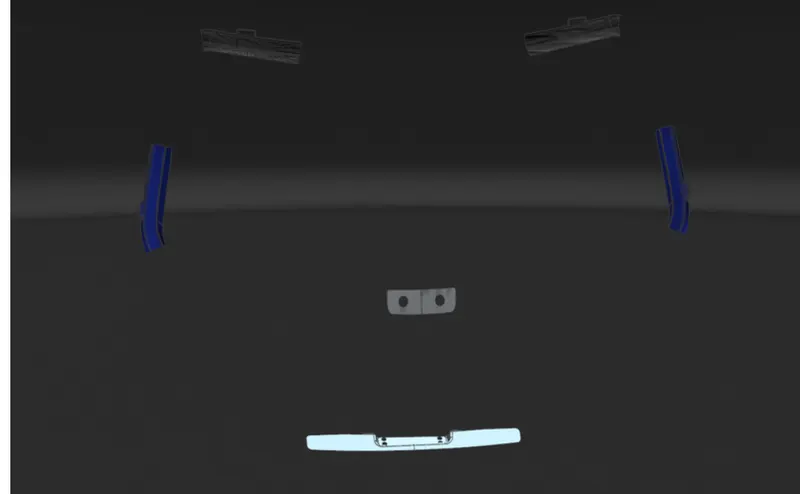
Backdoor parts thickness value used in this design :
1.Outter panel- 0.75mm 2.Inner panel- 0.75mm 3. Reinforcements- 1 mm
DESIGN CONSIDERATION FOR BACKDOOR INNER PANEL:
- Rear Visibility.
- Support structures like hinges and gas stays.
- Mounts for wiper motor, tail lamps, and other wiring loops.
- Fit and clearances.
- Boot space.
- Rear crash regulations and requirements.
- Sealing and its functions.
- Joining techniques like hemming, Spot welding etc.
TYPES OF DOOR OPENING :
- Top mounted door
- Side mounted door
- Bottom door
In these project, i designed top mounted door, so here we discuss mainly about top mounted door only.
COMPONENTS OF BACKDOOR:
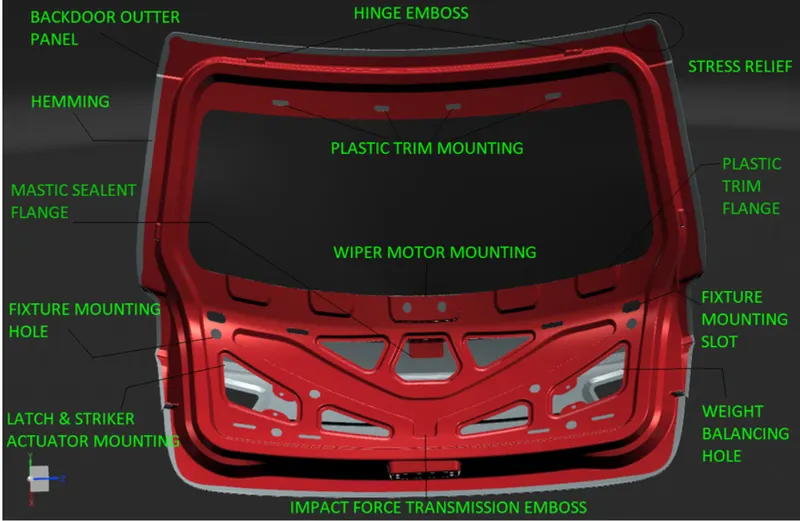
- Inner panel
- Outter panel upper
- Outter panel lower
- Hinge reinforcement LH
- Hinge reinforcement RH
- Gas stay reinforcement LH
- Gas stay reinforcement RH
- Wiper motor reinforcement
- latch reinforcement
INNER PANEL :
- Car backdoor inner panel is made of either steel or aluminium. Most of the luxuary car's inner panel are made of aluminium because of is properties. But the cost of aluminium is high.
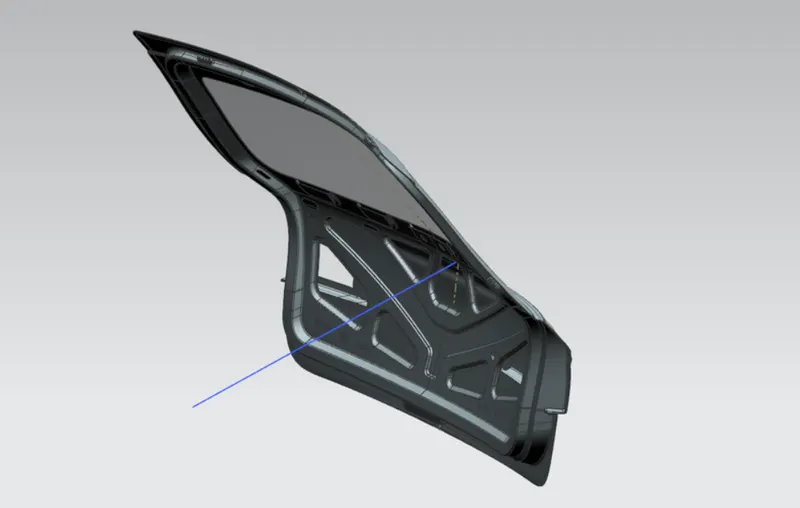
- The inner panel is produced by either casting or through deep drawn method. Mostly alumininium panel is only casted, steel inner panel is made by deep drawn process only. If it is deep drawn process only.If it is deep drawn, then there must be a tooling direction the panel is deep drawn.
DRAFT ANALYSIS :
- Draft analysis of inner panel is carried out through the tooling dirction only.Only the green areas are acceptable and i worst cases yellow regions are accepted but the blue and red regions are never accepted.
- The draft angle for aluminium casted panel is 2 to 3 degrees is enough but if it is steel then the angel is more than 7 degrees.
- In this project i considerd it as steel and used 7 degrees as draft angle and direction is choosen as tooling direction which is the deep drawn direction.
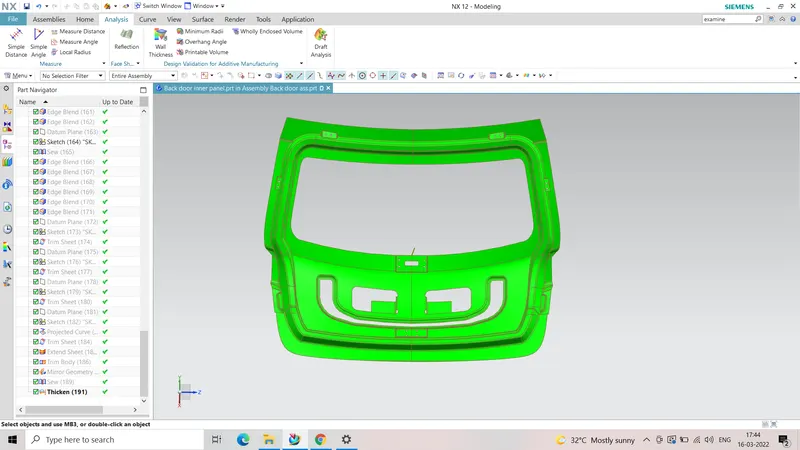
From the above fig.it is clear that all areas are in green color so my design is passed draft analysis.
OUTTER PANEL UPPER AND LOWER :
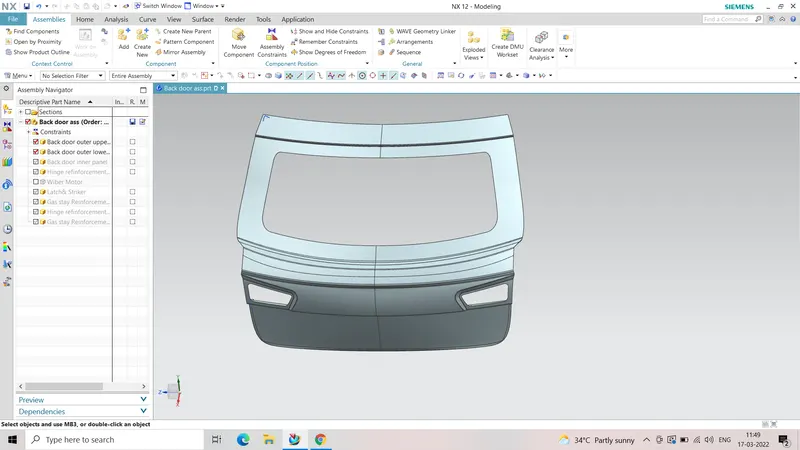
- Outter panel is the styling surface of the backdoor.Glass for rear visibility is mounted on the ouuter panel,Upper,Rear lights are also mounted on the outter panel upper.
- Number plate is mounted on the outter panel lower,spot welds and other manufacturing process should done only on the inner panel is the styling surface which should not have any scratches or welds because it affects the style of the car which leads to bad impression on the customers.
HINGE REINFORCEMENTS :
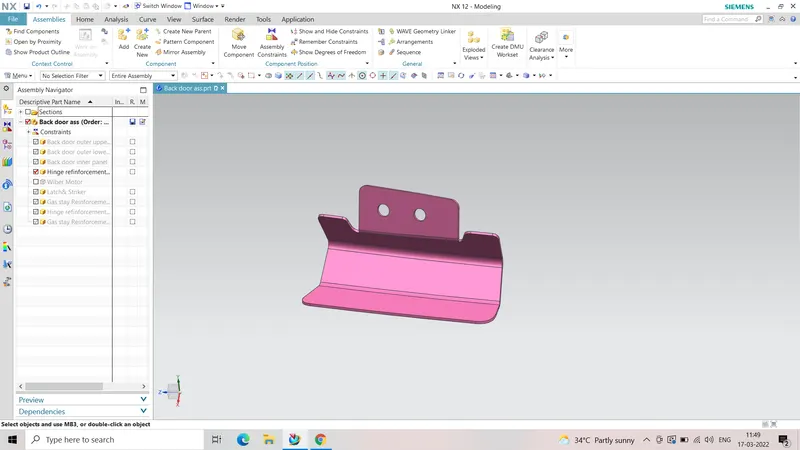
- Hinges support the weight of the whole backdoor. Hence, the reinforcements must be provided there too. The emboss is designed in such a way that the hinges should operate freely.The hinge is connected to the rear roof of the car.
GAS STAY REINFORCEMENT :
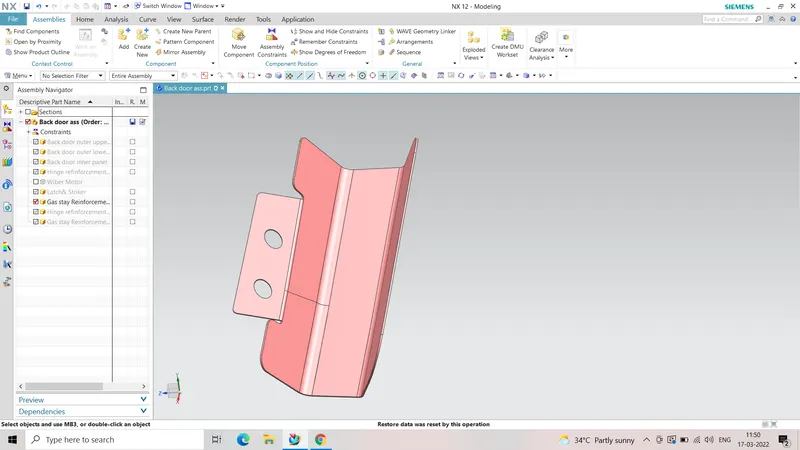
- Gas stay is used to lift the backdoor automatically. There are two types of gas stay one is semi-automated and another one is fully automated.
- In semi automated type the back boor needs little force to lift after that it lift the backdoor automatically.In fully automated ,it has power spindle which lift the backdoor automatically.
WIPER MOTOR REINFORCEMENT :
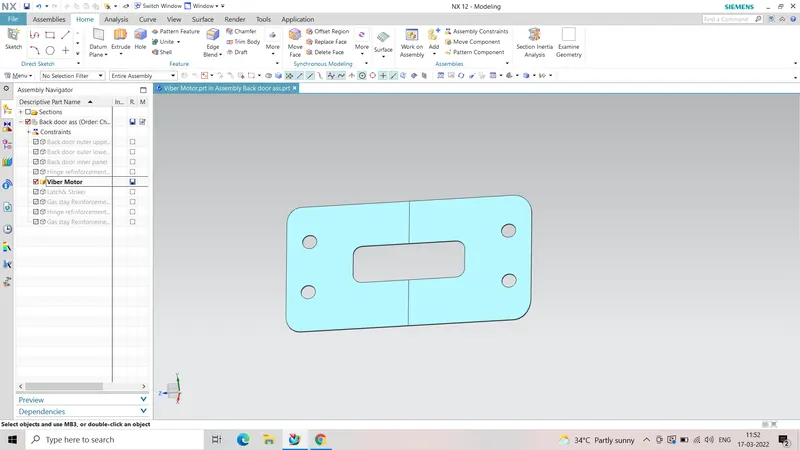
- Wiper is used to wipeout the rain water falls on the backdoor window. It is actuated by the motor which is mounted on the inner panel . Due to the vibration and heat created by the motor,the inner panel where the motor is mounted gets deform and the parts attached to the motor starts to vibrate which leads to poor NVH. So we have to provide the reinforcements where the wiper motor is placed.
LATCH REINFORCEMENTS:
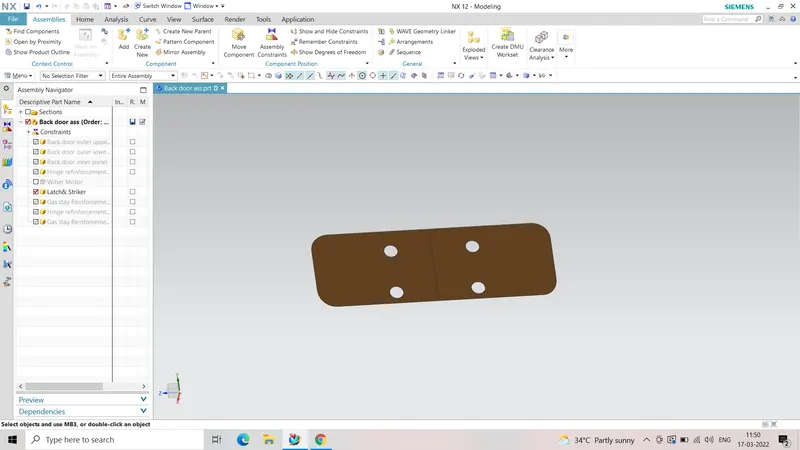
- At bottom of the panel, reinforcements and emboss are given to accomodate the latch and striker assembly. Generally key operated or automatic remotly controllable mechanisam is used to keep the door open or closed. The actuators receivers and other electronic devices are mounted on the inner panel only.
HEMMING :
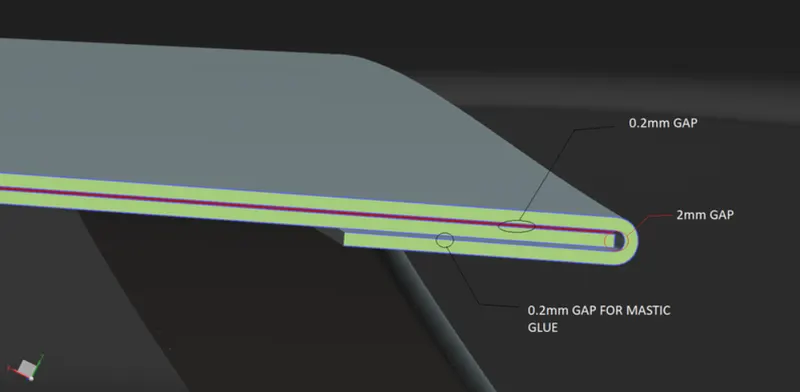
- Hemming is the metelworking process in which a sheet metal edge is rolled into itself. The outter surfaceof the panel is rolled 2 or 3 times over the innerpanel. In first roll the panel is bent slinghtly, and in the second roll the shnetmatel is rolled even more and in the last roll it completely fits or covered the inner panel.
- There must be a 0.2mm gap between outter and inner pannel in both upper and lower side.
SPOT WELDING:
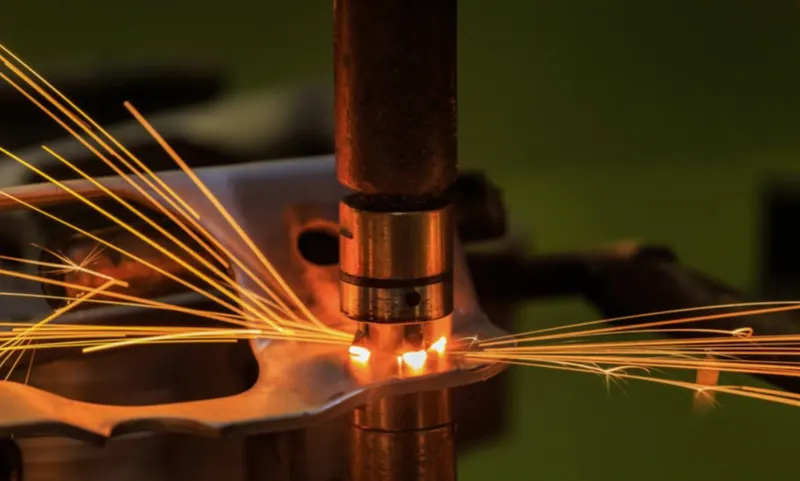
- Spot welding is a form of resistance welding also known as resistance spot welding(RSW). Spot welding involves using heat produced by resistance to an electrical current to join materials together.
- The current heats the materials to a point where they become malleable.The use of strong pressure bonds them together.
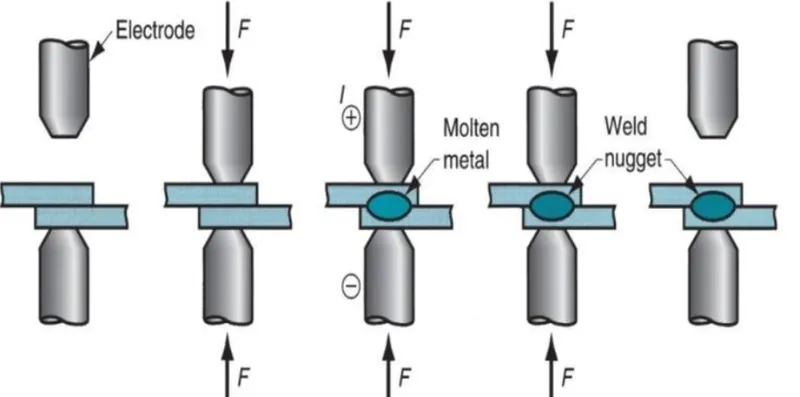
- Another form of resistance welding is projection welding. This process involves fusing a fastener's embossed or coined projections to the metal base material to form a weld.
- As the materials never melt, they do not intermix. This means the resuting weld is more like a forging of the materials. Spot welding is only suitable for a small selecction of base materials.Low carbon steel is the most suitable material for spot welding.
- This is because it is more resistant to electricity and has a lower thermal conductivity than the copper electrodes used to create the required electrial current.
- High carbon steels and aluminium alloys can form brittle welds that don't last with the spot welding process.Pure aluminium can qualify for spot welding but requires higher current levels. This is because it has a lower resistance to electricity than low carbon steel.
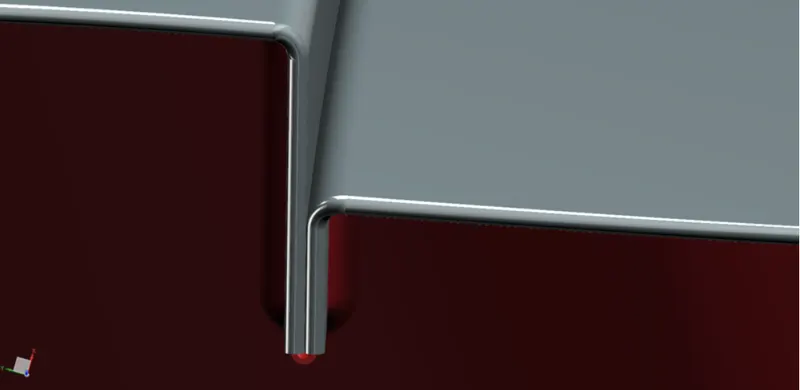
The outter panel upper and outter panel lower are joined through the spot welding. So there must be no gap between the outer panel upper and outer panel lower.
DIFFERENT VIEWS OF BACKDOOR ASSEMBLY:
FRONT view:
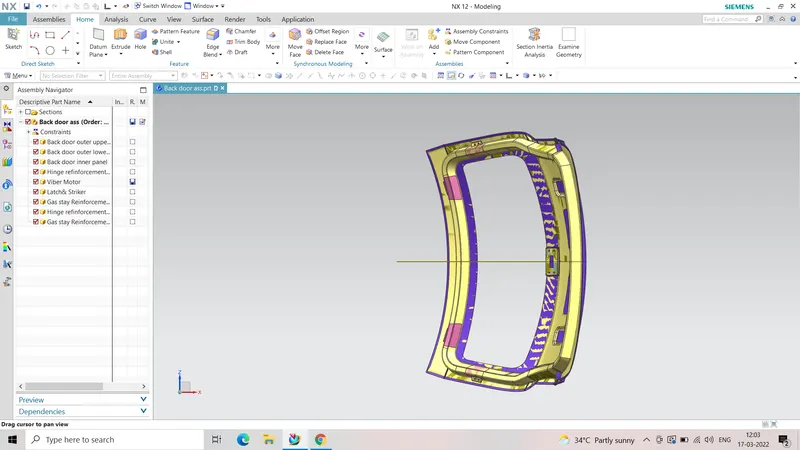
RIGHT view:
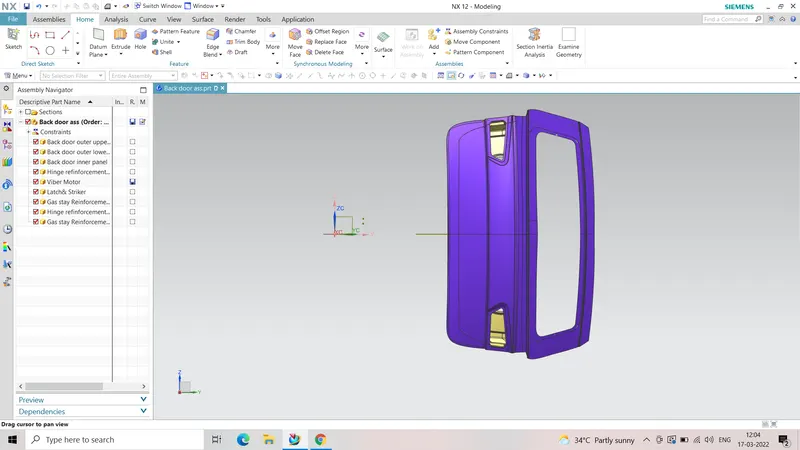
TOP view:
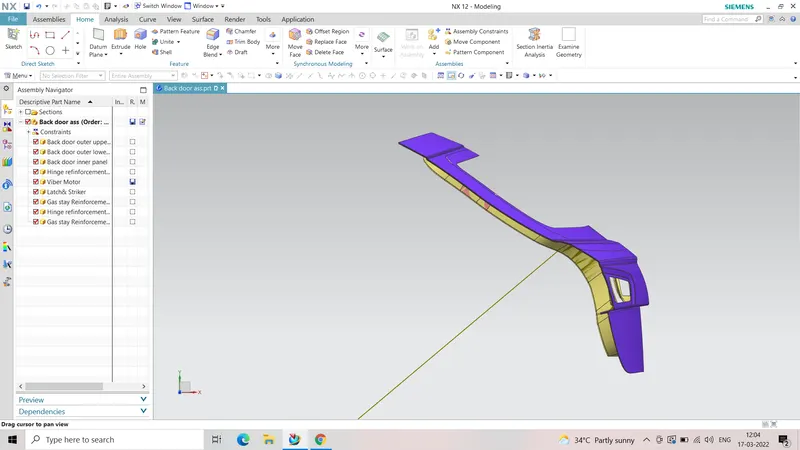
ISOMETRIC view:
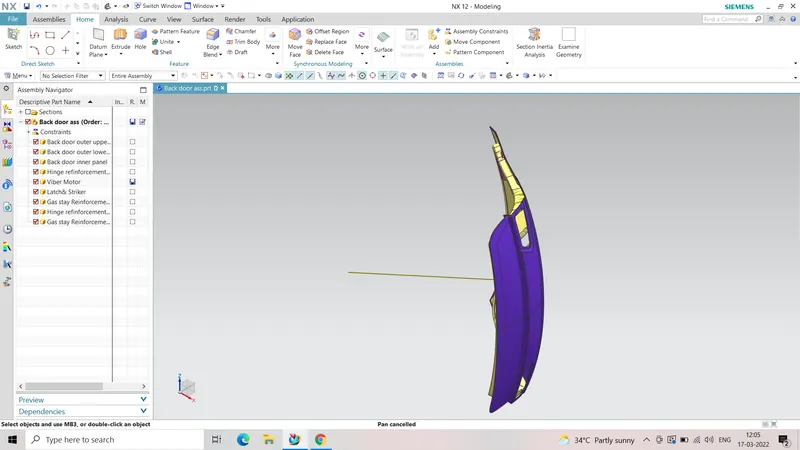
ASSEMBLY TREE STRUCTURE:
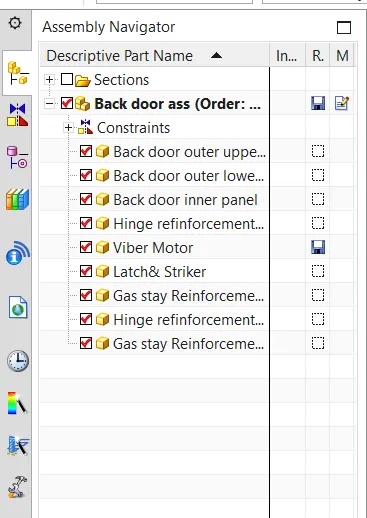
CONCLUSION :
- The back door outer and inner panel were designed with the help of the styling surface along the tooling direction.
- Draft analysis was performed on the inner panel and it was concluded that the component can be easily manufactured along the tooling direction
- All the reinforcements were designed and placed at appropriate positions to provide strength at critical regions.