Design of backdoor
Automotive Sheet Metal Design of Back Door
Objectives
Design a back door from the provided styling surface, use appropriate design methodologies and provide the necessary reinforcements and embosses.
Introduction
Back Door or Tailgate is a closure component in automotive, which provide access to luggage space. They are attached to the body of vehicle using latch and hinge joints. Gas stays are also provided to reduce human effort while operating them. In luxury segments they are operated using electric motors to avoid human effort.
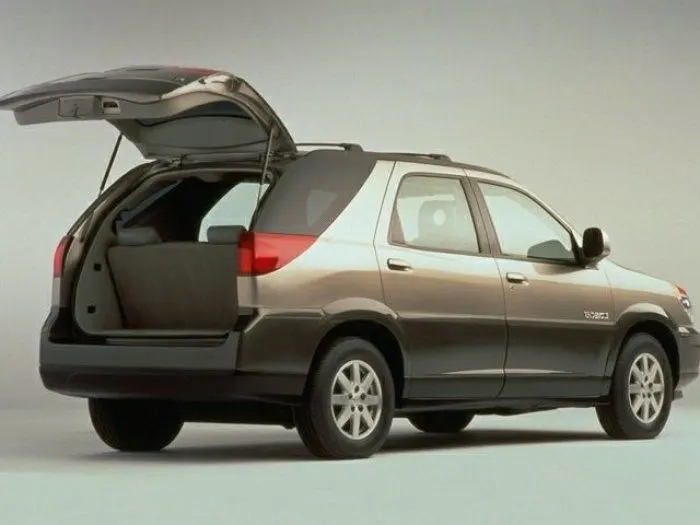
Through the project I have designed BIW parts of the back door for an SUV model. Common BIW components in a back door are its outer panels, inner panels and reinforcements if required. Usually aluminium and steel are used for manufacturing BIW parts. The use of aluminium is increasing now a days because, it helps engineers to reduce the weight without noticeable compromise in their strength. Aluminium can also be casted economically which helps to build the part with variable thickness. While steel is always deep drawn to get its shape and it will be of uniform thickness because, the sheet or the blank will be in uniform thickness. Thus, while using steel (deep drawing operations) we should provide reinforcements to improve the strength locally.
The methodology I used to design back door was Top-down approach. At the beginning I had to clean-up the class A surface for the design purpose like, trim and define new surfaces at some critical areas which may create errors while doing surface operations like offset, join, thicken etc.
Given Parameters
Skin data which contain upper half and lower half.
The material is steel and the thickness of the sheet is 0.75mm.
Different Components in Back door
- Outer Panels
- Inner Panel
- Reinforcements
Outer panel
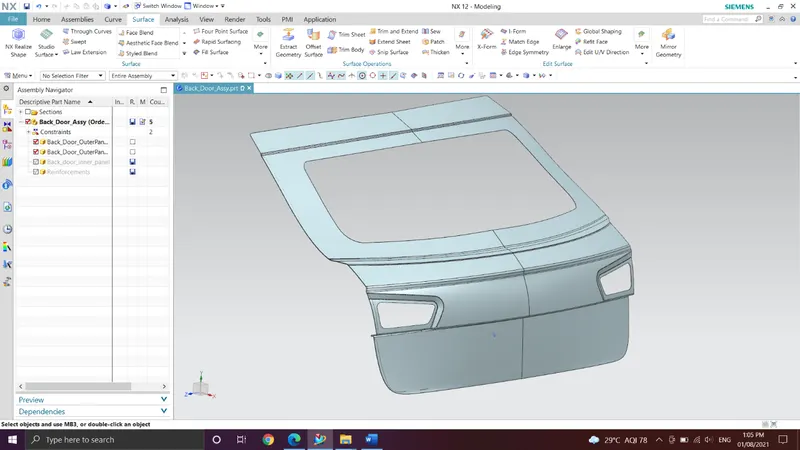
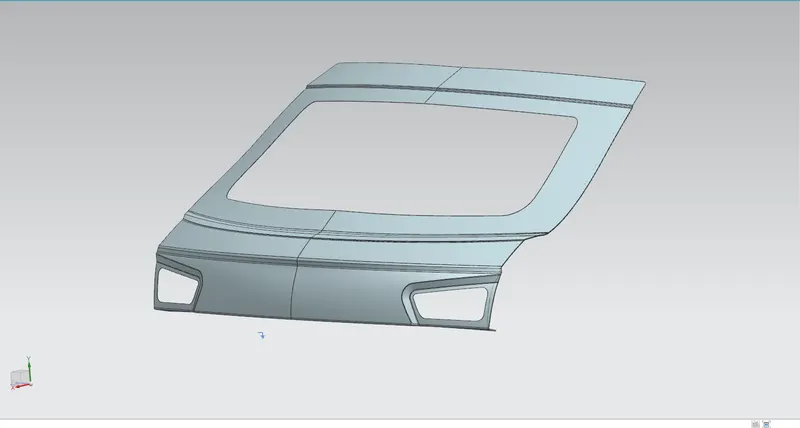
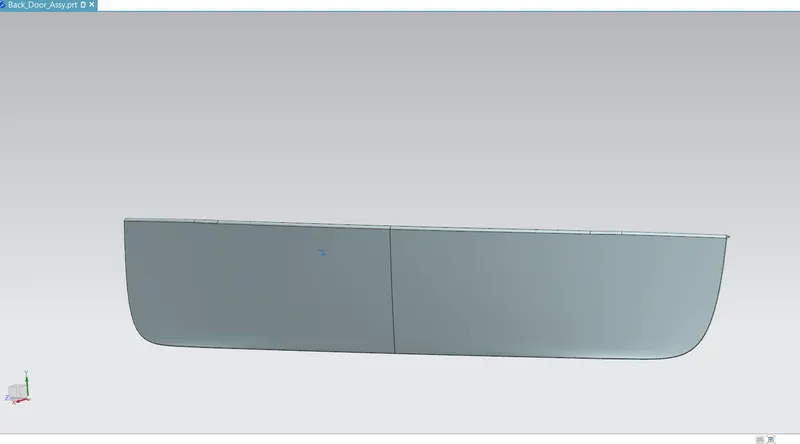
Outer panel is always subjected for the styling purpose. It is the styling colleagues who provide the class A surface for the outer panel. In this project it contains 2 outer surfaces such as Upper and Lower. While manufacturing the two outer panels are joint together by welding at the extended flange.
Outer Panel (upper)
Outer panel (Lower)
Tooling Direction
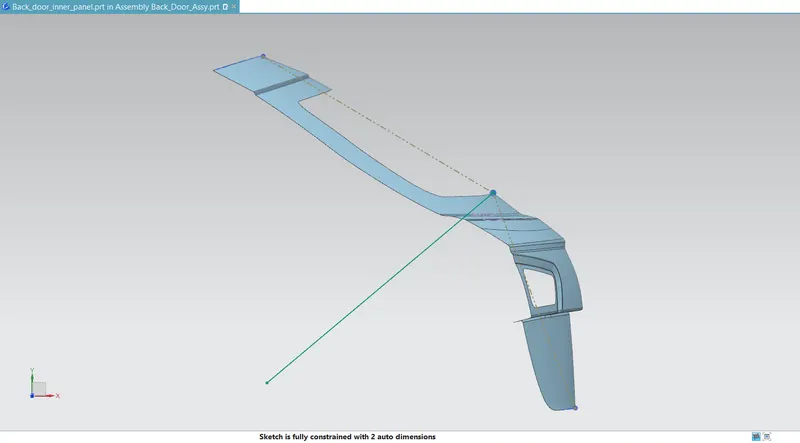
Before designing inner panel, we should define the tooling direction. The emboss which we are going to provide in the inner panel will be having a draft angle with this tooling direction.
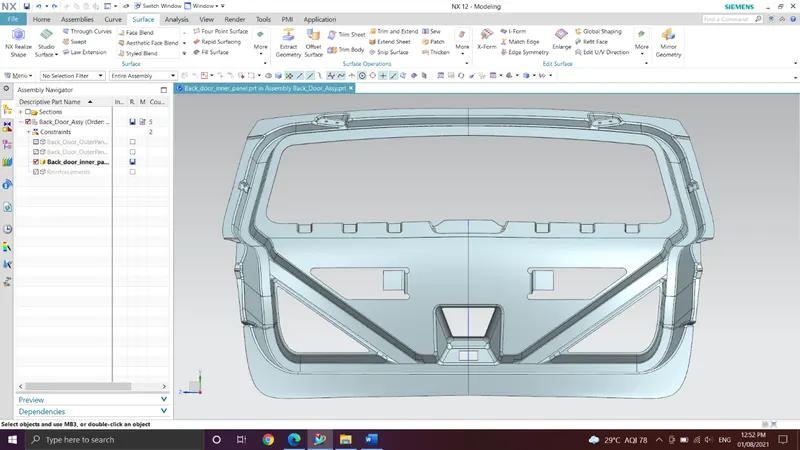
Inner Panel
It is the inner panel that provide necessary stiffness for the outer panel. Also, it should have strength and stiffness to carry load and hold the attachments that are constituted in back door. We can also provide emboss in inner panel so as to deviate the impact away from the passenger compartment which are subjected from the back collisions.
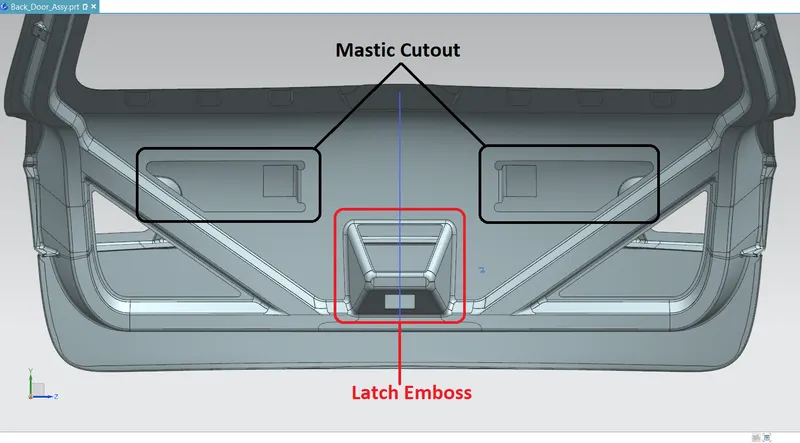
Mastic Cutout and Latch Emboss
Defining latch position
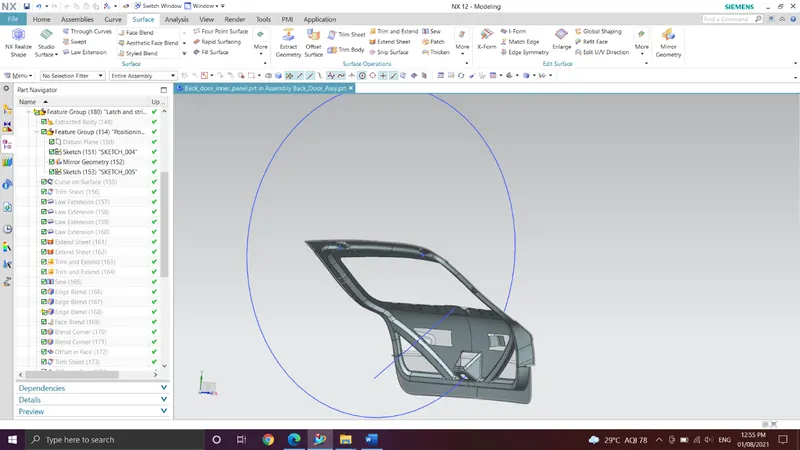
To define the latch trajectory, first I fixed the hinge axis. After fixing hinge axis draw a circle through bisect point and perpendicular to the hinge axis. Define the radius of circle so as to get most appropriate position for the latch. The latch surface should be perpendicular to latch trajectory.
Hemming Relief
Hemming is a forming operation in which the edges of the sheet are folded or folded over another part in order to achieve a tight fit. Normally hemming operations are used to connect parts together, to improve the appearance of a part and to reinforce part edges. In car part production, hemming is used in assembly as a secondary operation after deep drawing, trimming and flanging operations to join two sheet metal parts (outer and inner) together. Typical parts for this type of assembly are hoods, doors, trunk lids and fenders.
The accuracy of the hemming operation is very important since it affects the appearance of the surface and surface quality. Material deformations, which occur during the hemming process, can lead to dimensional variations and other defects in parts. Typical hemming defects are splits or wrinkles in the flange, material overlaps in the corner areas or material roll-in. In order to avoid such defects, we should provide necessary relief at sudden bends This is why it is important to use simulation tools in order to, on the one hand, better understand the hemming process and, on the other hand, significantly reduce the number of “trial and error” loops during tryout und production.
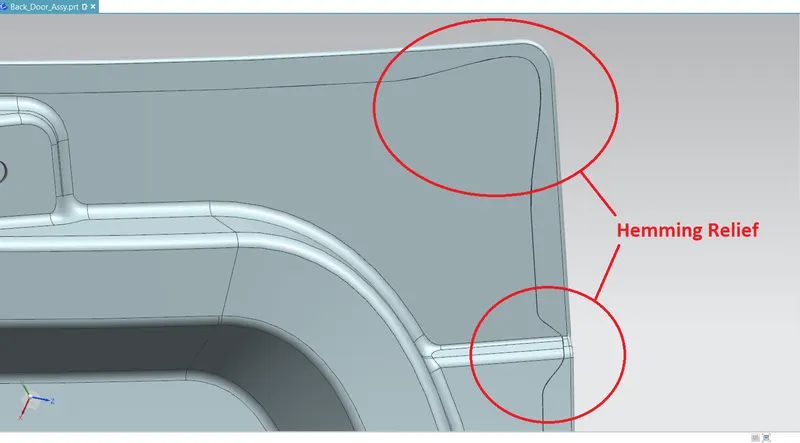
In order to attain better hemming surface while manufacturing, we should provide necessary relief at sudden bends.
Reinforcements
Reinforcements are added in different sheet metal parts, to improve their strength locally. In this project reinforcements are provided at hinge, latch and gas stay areas. The thickness for the reinforcements depends upon the requirements.
Gas stay reinforcement
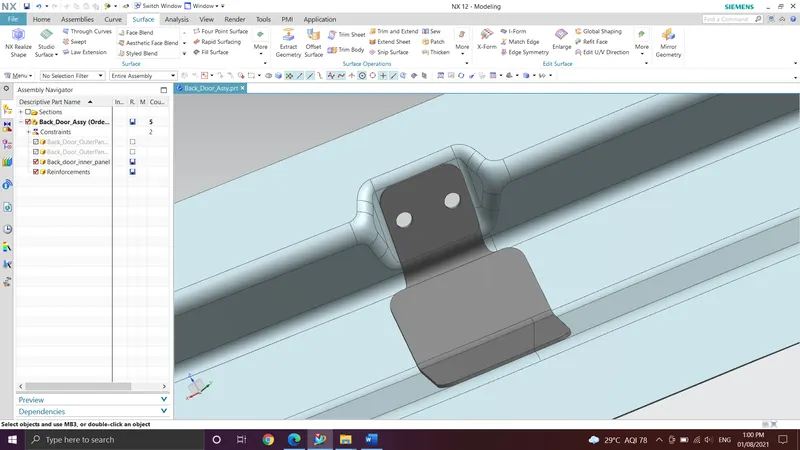
Latch reinforcement
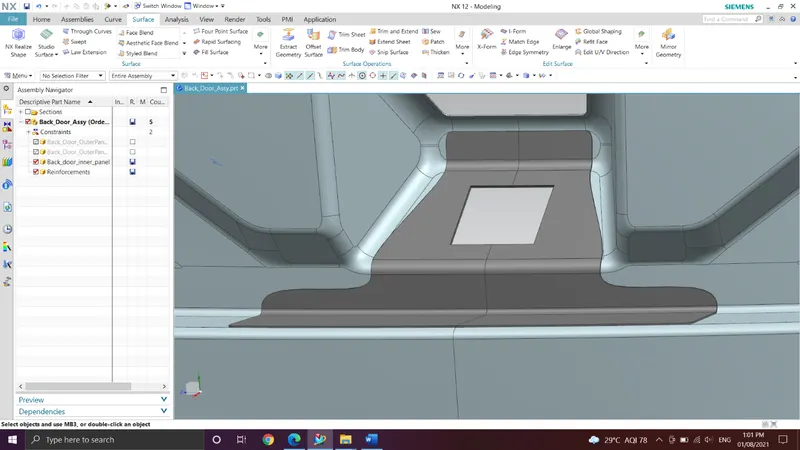
Hinge reinforcement
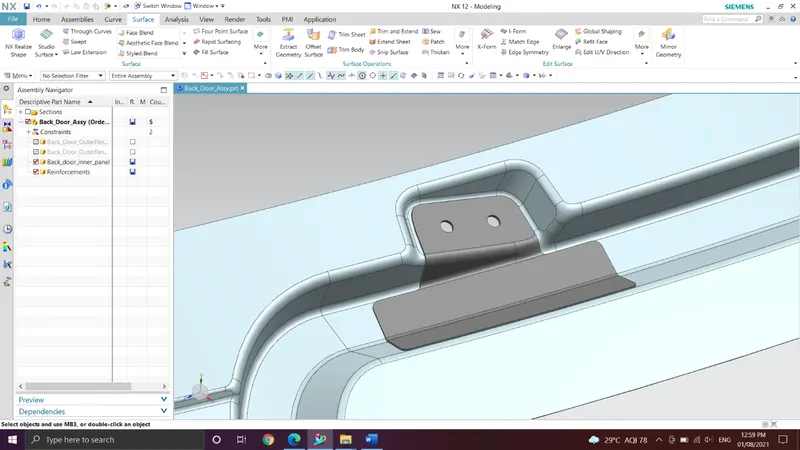
Draft Analysis
Every part like sheet metal parts which are generated from a Press Tool or some forming tools, may be the plastic parts which generally come out from the plastic molds and maybe the casting parts, all such kind of parts required some drafted face on the surfaces which are parallel to the tooling direction. If we don't provide drafts on the surface then it will stick to the mold surface and whenever the mold is in motion they will destroy the surfaces or also reduced the finishing of surfaces.
Draft is used for providing angles or tapers on product features such as walls, ribs, posts, and bosses that lie parallel to the direction of release from the mold eases part ejection. Draught angles are designed in such a way that they will assist depart rejection. By doing so we have a reduced cycle time and improved productivity. Draft value for a particular part is mostly decided by the material used for making it.
Draft analysis has done along tooling direction with a draft angle 10 degree.
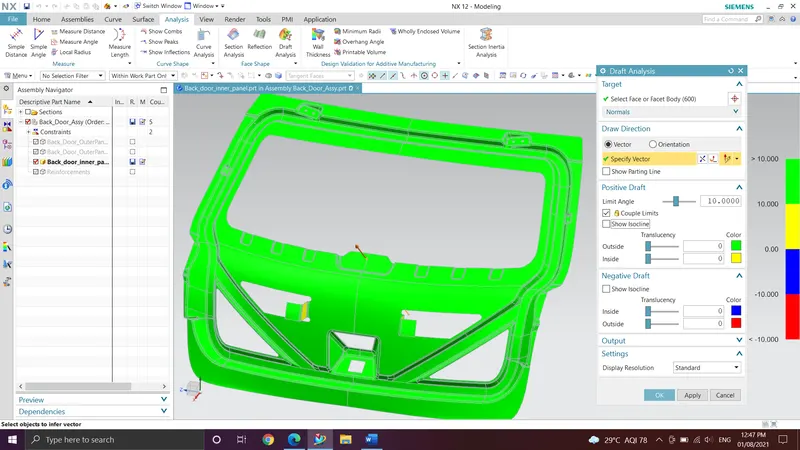
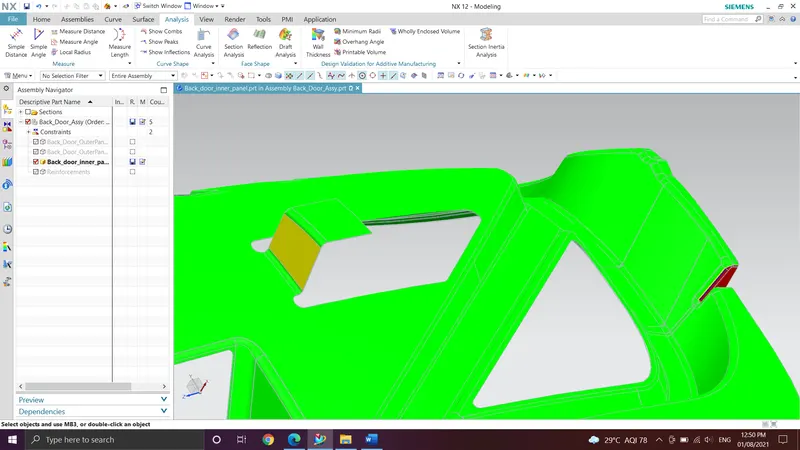
Except at two regions the draft analysis shows good. We can neglect these areas because they are produced after deep drawing process. They need additional operation to manufacture.
Conclusion
Completed the designing procedures for the Back Door. Also provided necessary reinforcements and examined the inner panel by Draft Analysis.