Design of backdoor
Design of Back door in NX CAD:
Door parts thickness is given below,
- Outer Panel - 0.75 mm
- Inner Panel - 0.75 mm
- Reinforcements - 1.5 mm
Parts Of the BackDoor
Inner Panel
Hinge Mounting Bracket ( LH & RH )
Gas Stay Bracket ( LH & RH )
Wiper Motor Support Bracket
Latch
Latch Reinforcement
Hinge reinforcement ( LH & RH )
Gas Stay Reinforcement ( LH & RH )
Given Data,
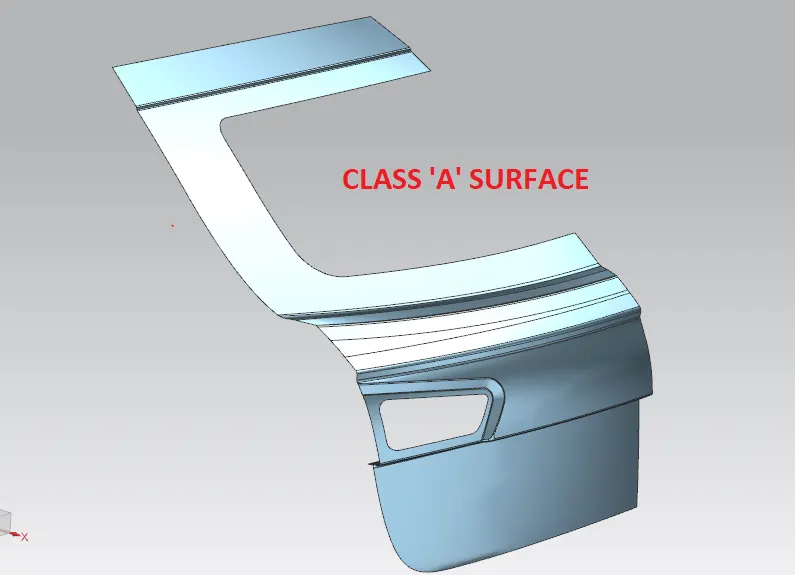
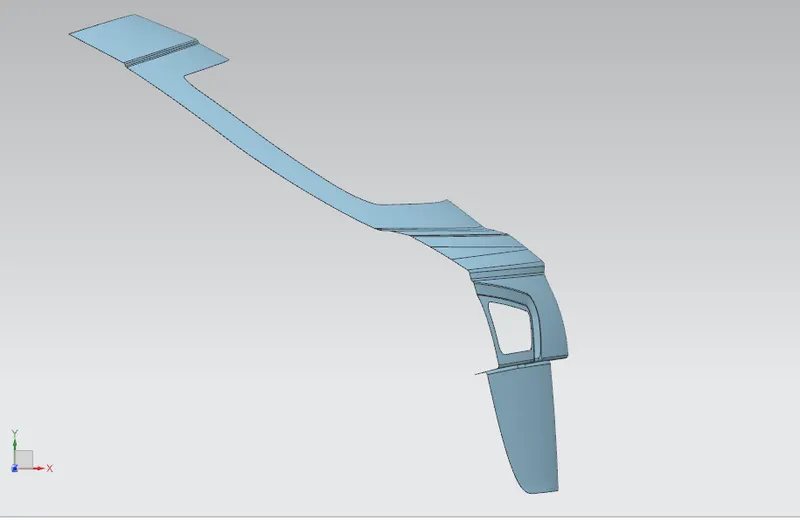
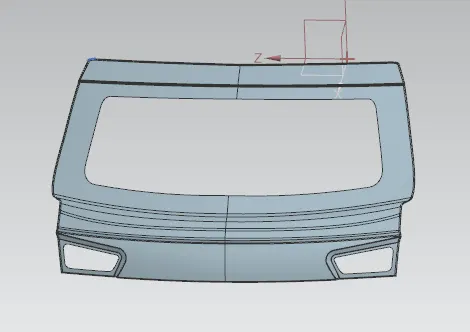
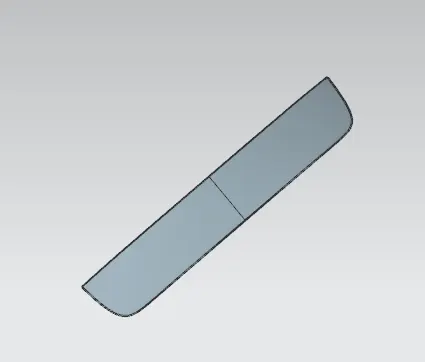
Given surfaces has to be repaired according to the smoothness. After repairing the surfaces, the door is divided into two parts as Door Outer Upper and Doo Lower Panel.
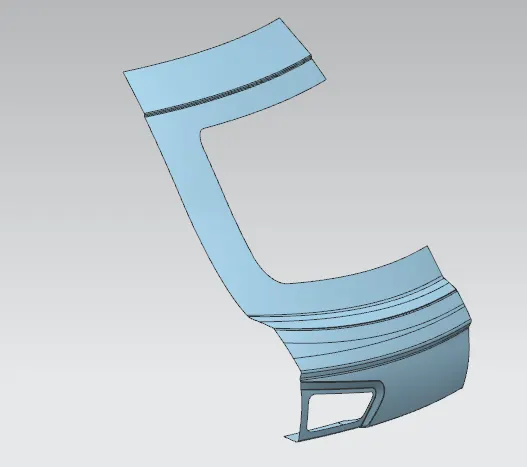
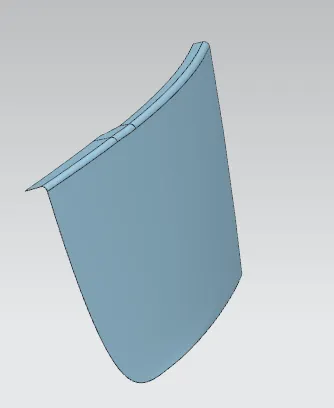
First, we need to create the Tooling direction for the Deep drawing operation. It shows that all the operations like embossing is done by considering this vector direction and it will help in manufacturing the part,
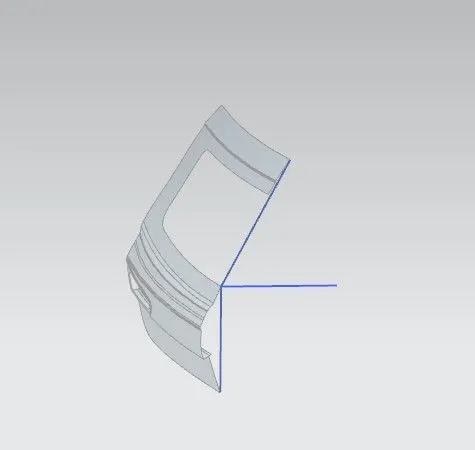
After that we have to create Sealing Flange by offsetting the outer panel to the specific distance.
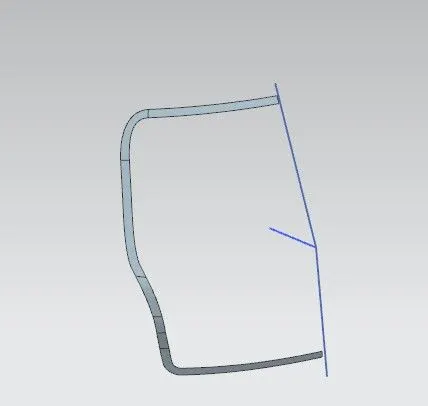
Then we will be creating the Back door inner panel flange by offsetting the outer surface at a distance considering the sheet thickness and thickening direction.
Then created the connecting flange to join the inner panel and sealing flange.
Then for the windshield panel mounting, windshield panel is created and joined with sealing flange.
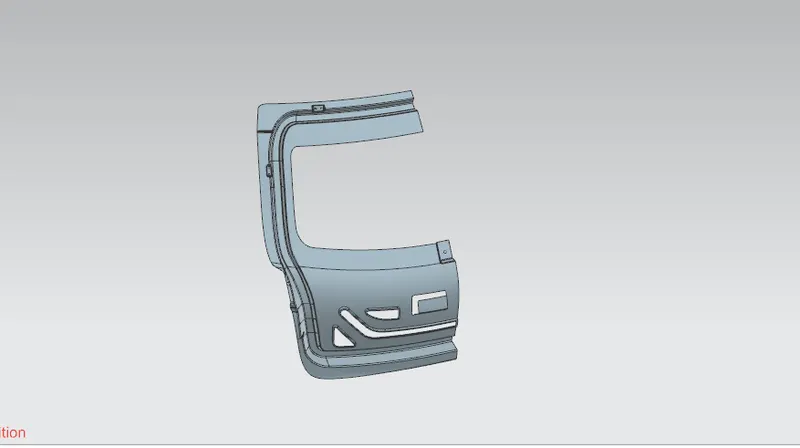
Then to improve the strength of the inner panel and to reduce the weight 'Y' type emboss and other cut-outs are created. Also, for Latch and Stricker mounting cut-out is created. This cut-out is also done on other side of the inner panel to maintain the centre of gravity of the Back door.
Parts Of the BackDoor
Inner Panel
Hinge Mounting Bracket ( LH & RH )
Gas Stay Bracket ( LH & RH )
Wiper Motor Support Bracket
Latch
Latch Reinforcement
Hinge reinforcement ( LH & RH )
Gas Stay Reinforcement ( LH & RH )
INNER PANEL
Inner door panel is a component which is use for strengthening the door assembly and it is one of the most important components on witch all accessories are mount like hinges, glass guide channel and gas stay.Back door inner panel is mounted with the the Roof.Inner is mounted with the outer panel with the help of hemming process.
- Materials used for the Inner panels are steels,Aluminum.
- For giving more strength to the inner panels by Adding extra reinforcements to strengthen the parts.
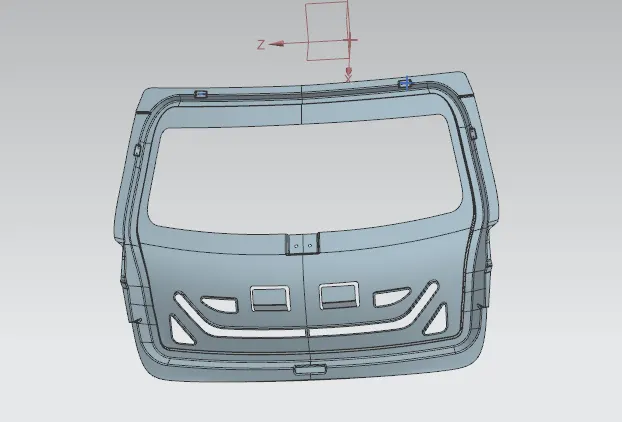
Above picture shows that the inner panel for Back door of a car.
In the Inner panel i used embosses,Outer panel and inner panel mounting area,space for Harness,Wind Glass Mount and fillets,No sharp corners.
Embossing
Embossing is a metal forming process for producing raised or sunken designs or relief in sheet material by means of matched male and female roller dies, theoretically with no change in metal thickness, or by passing sheet or a strip of metal between rolls of the desired pattern.
- Metal sheet is drawn through the male and female roller dies producing a pattern or design on the metal sheet. Depending on the roller dies used, different patterns can be produced on the metal sheet.
- Emboss should be in 7 degree to 25 degree inclinte in angle and it should not be in 90 degree angle,why because when we do stamping in manufacturing the stamping tool fits the sheet metal hence it will not come out of that sheet metal,So this is the main reason why the emboss face is in angle.
Characteristics of the metal embossing process include:
- Its ability to form ductile metals,
- Its use in medium to high production runs,
- The ability to maintain the same metal thickness before and after embossing,
- The ability to produce unlimited patterns, depending on the roll dies, and
- The ability to reproduce product with no variation.
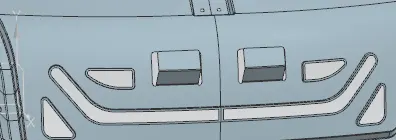
- Located within the embossing stand itself are two engraved and mated hardened steel rolls, geared together to maintain top-to-bottom pattern registration. The width and diameter of these rolls depends on the strip width, material thickness, pattern depth, and material tensile strength and hardness.
- In most machines, the upper roll blocks are stationary, while the bottom roll blocks are movable. The pressure with which the bottom roll is raised is referred to as the tonnage capacity. This figure also depends on the aforementioned parameters.
- Embossing machines are generally sized to give 2" of strip clearance on each side of an engraved embossing roll. Many embossing machines are custom-manufactured, so there are no industry-standard widths. It is not uncommon to find embossing machines in operation producing patterns less than 6' wide all the way up to machines producing patterns 70"+ wide.
- The illustration that follows provides a two-dimensional look at a typical embossing line setup with an embossing roller in the middle. The illustration shows the metal sheet entering the roller, and then the embossed sheet leaving toward the drawing rollers.
- Embossed metals are used in industry for two reasons: aesthetic and functional. Aesthetic applications also include appliance panels, building products, elevator panels, garage door panels, automotive trim, metal office furniture, and others.
- Functional applications are those in which a performance characteristic is enhanced. This can include a metal products ability to disperse liquid more effectively, reduction friction and static, increase a metal panel’s stiffness and rigidity, increase a metal surface area for acoustic or heat transfer applications, and improve traction.
- The embossing process can produce a variety of patterns. Some of the most common patterns include stucco, leather grain, wood grain, weather grain, and rough sawn cedar. Most embossers will tool to form any needed pattern, depending on the cost parameters involved.
Materials commonly used in the metal embossing process include:
- Aluminum (All Alloys)
- Aluminum (T1/T2)
- Brass
- Cold rolled steel
- Copper
- Galvanized steel
- High strength, low alloy, steel
- Hot rolled steel
- Steel (All Alloys)
- Zinc
I & O Panal Mounting Flange ( Inner and outer )
Highlighted red spot is the mounting portion of inner panel to the outer stylish part.
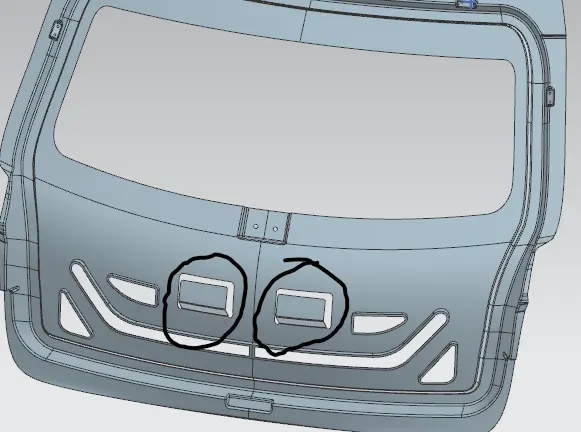
I provided two mounting Flanges for mounting the inner panel with outer stylish panel.
Two flanges is wnough strength for holding the outer and inner panels with the help of sealants.
In between inner panel and outer panel we providing sealants.
MASTIC SEALANTS
A mastic sealant is a type of liquid sealant that cures in an elastic state, thus making it flexible while holding the bond of the surfaces that has attached together. It adheres to just about any material making an all-purpose type of sealant.
- The main purpose of the outer panel is for the aesthetic looks. Thus we cannot use bolts or welding. This has to be done with the help of the hemming and mastic sealants. Mastic sealants are elastic compound that behaves like the rubber. It is placed between the outer and inner panel. Initially is it in paste form, but after the hot furnace bath it gets hardened thus joining the outer and inner panel. Mastic sealant has the tendency to increase the strength of the panel and has influence of 80mm diameter.
PROS
- One positive characteristic of mastic sealant is that it has a very smooth exterior while keeping its rigid form underneath.
- Surfaces do not have to be primed when using this type of sealant, and although applied thick, it adheres smoothly to any surface. It is important that the area to be joined or sealed be clean and dry, just like any other sealant on the market.
- Mastic sealant may be used outdoors as well because of its waterproof quality. It can be applied on rain duct leaks outdoors, for example.
- It is also favored for areas under high or low temperatures such as heater vents or drier vents and contains ultraviolet inhibitors to make sure that it is protected from damaging effects of the sun that will often weaken other types of sealants. That makes it a good choice for use on roofs, or any surface that is constantly exposed to sunlight. Most mastic sealants will also work well with metal because they do not corrode over time.
- it functions well in areas with mild vibration and heat, like heating ducts.
CONS
- Mastic sealant is not recommended for areas that have too much joint movement, or anything that will be moved a long length.
- It works well with constant pressure on it, but not constant movement.
- It also works best when applied thickly and is not recommended if only a thin layer is needed such as touch ups. Another sealant is a better choice for those types of repairs.
DRAFT ANALYSIS:
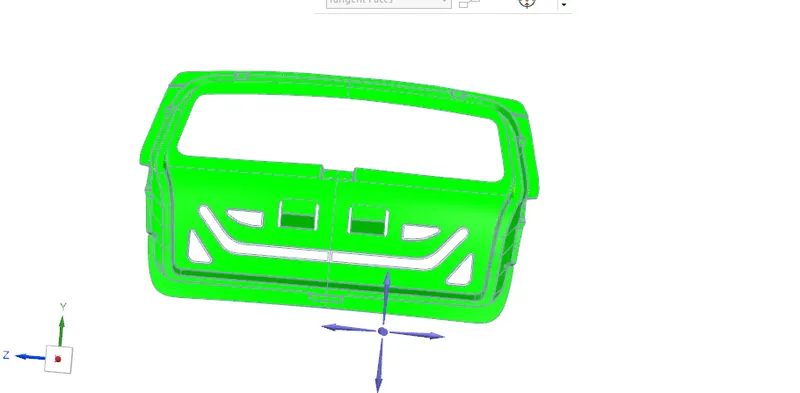
Draft analysis of inner panel is carried out through the tooling direction only.Only the green areas are acceptable and i worst cases yellow regions are accepted but the blue and red regions are never accepted.
The draft angle for aluminium casted panel is 2 to 3 degrees is enough but if it is steel then the angle is more than 7 degrees.
In this project i considered it as steel and used 7 degrees as draft angle and direction is choosen as tooling direction which is the deep drawn direction.
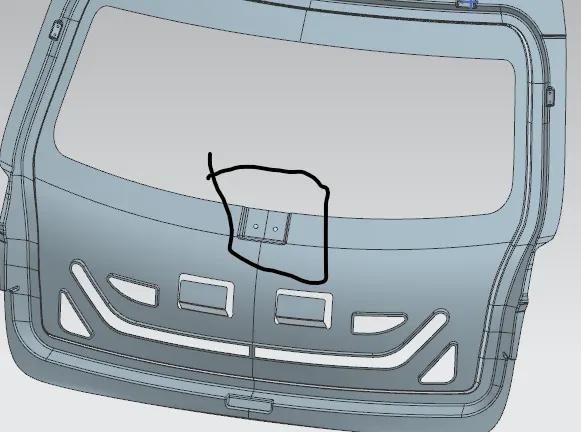
WIPER MOTOR MOUNTING
Below picture represents wiper motor mounting area,Highlighted red spot area is for wiper motor mouniting area.
BACK DOOR UPPER AND LOWER:
HEMMINNG OPERATION:
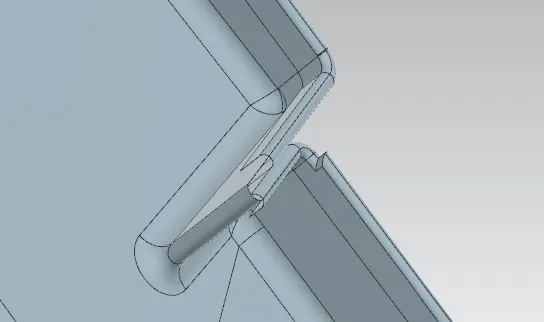
Hemming is a mechanical joints design which is used for joining inner and outer closure panels as found indoors, hoods, bonnets and lift gates. To increase crash resistance the gap between the hemmed panels is filled with a high strength adhesive which also prevents from corrosion.
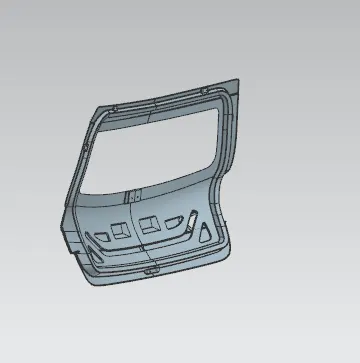
FINALLY BACK DOOR DESIGN:
CONCLUSION:
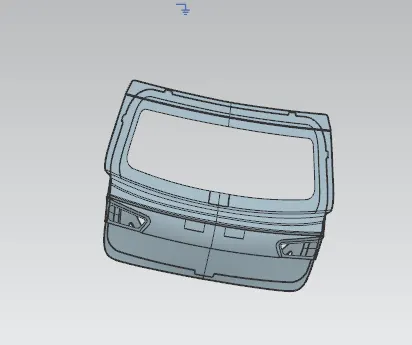
Thus,For the provided styling surface of a back door design, I used appropriate design methodologies and provided the necessary reinforcements and embosses for the BackDoor design.thus i designed a back door.