Design of backdoor
Aim:- Use the provided styling surface to come up with a back door design, use appropriate design methodologies, and provide the necessary reinforcements and embosses
Introduction:
The Back door is typically hinged, but sometimes attached by other mechanisms suchas tracks, in front of an opening which is used for entering and exiting a vehicle. A vehicle door can be opened to provide access to the opening, or closed to secure it these doors can be opened manually, or powered electronically. Powered doors areusually found on minivans, high end cars, or modified cars.
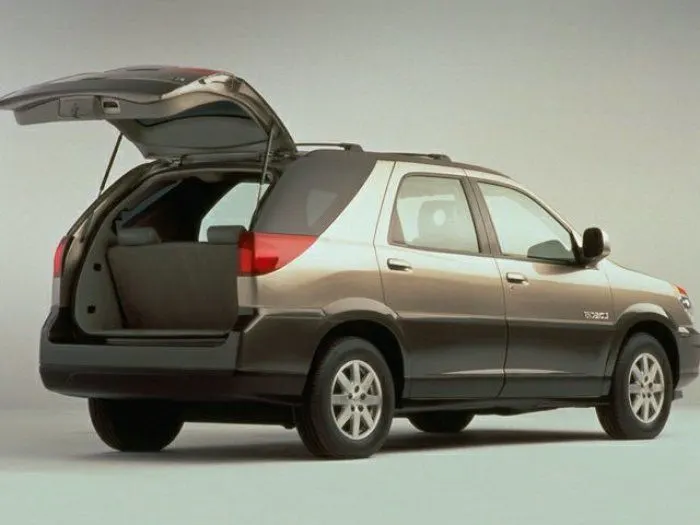
The material used in making the backdoor of the car is mainly steel but nowadays Aluminium is also used in making the panels.
The main advantage of Aluminium is that the density of Aluminium is very less as compared to steel so it reduces the overall weight of the car.
But Aluminium is more costly as compared to steel.
Types of door opening:-
- Top-mounted door
- Side-mounted door
- Bottom Door
Different processes used for manufacturing the Back Door:-
Deep Drawing:
The metal deep drawing process is an effective method of manufacturing cups, cans, and other similar deep drawing products. The deep drawings having 2 main categories.
- First-stage drawing: The blank shape of metal is placed on the die and in contact with the punch. When the metal specimen is a flat piece of sheet metal is used in forming and finish the product. Initially, the punch moves in a downward direction. The outer rim of the blank is subjected to pure radial drawing (drawing toward vertical axes) between the die and blank metal. The metal becomes a bend and slides over the die and is also stretched between die and punch. The metal in the vicinity of the punch head and contact with it bend and slide over the radii and stretch over the punch head.
- Redrawing: The components drawn from the first stage again it is redrawn convert into more depth to form a cup shape in the die and punch. The second stage of drawing is called redrawing.
Hemming:-
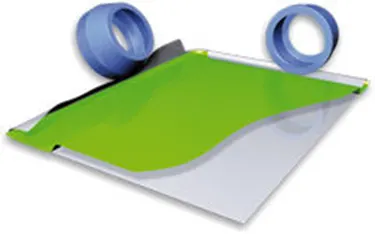
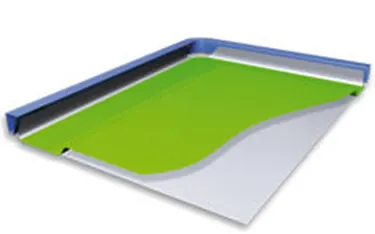
The inner & outer panels are joined by the process of hemming.
Hemming is a forming operation in which the edges of the sheet are folded over other parts in order to achieve a tight fit. Usually, hemming operations are used to connect parts together, to improve the appearance of a part, and to reinforce part edges.
In car part production, hemming is used in assembly as a secondary operation after deep drawing, trimming & flanging operations to join two sheet metal parts together. Typical parts for this type of assembly are hoods, doors, trunk lids & fenders.
The accuracy of the hemming operation is very important since it affects the appearance of the surface & surface quality. Material deformations, which occur while the hemming process, can lead to dimensional variations & other defects in parts. Typical hemming defects are splits and wrinkles in the flange, material overlaps in the corner areas. So, it is very important to use simulation software tools to better understand the hemming process and minimize the number of “trial & error” during the tryout.
There are different types of hemming operations:
- Conventional die hemming
- Roll Hemming
COMPONENTS OF BACKDOOR:-
- Inner panel
- Outer panel
- Hinge reinforcement
- Gas stays reinforcement
- Wiper motor reinforcement
- Latch & striker reinforcement
Design of Backdoor:-
First we need take a class-A surface
Class A surface:
The class A surface from the stying team is analysed for any surface corrections to be made and the flatness, surface continuity are inspected and the tooling direction and undercuts if required any are carried out initially. In the given inner panel there were some correction ove surfaces carried out to ensure the continuity and intersecting faces.
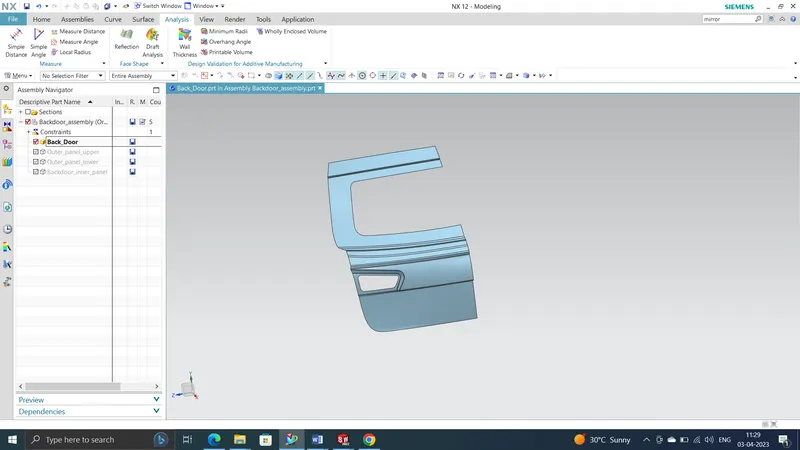
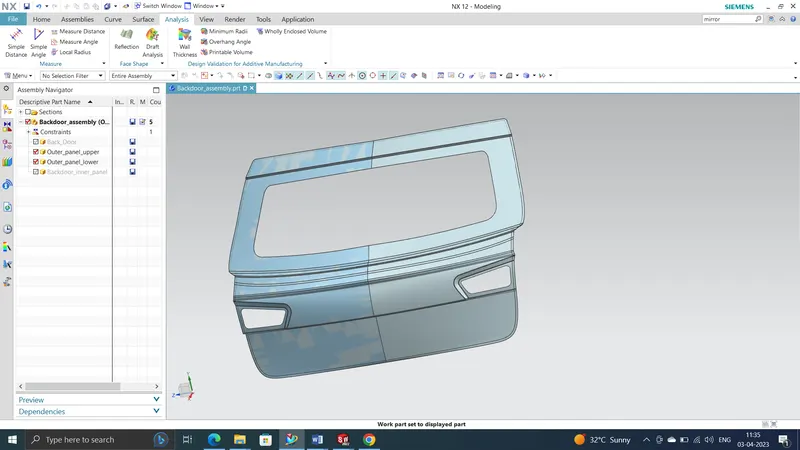
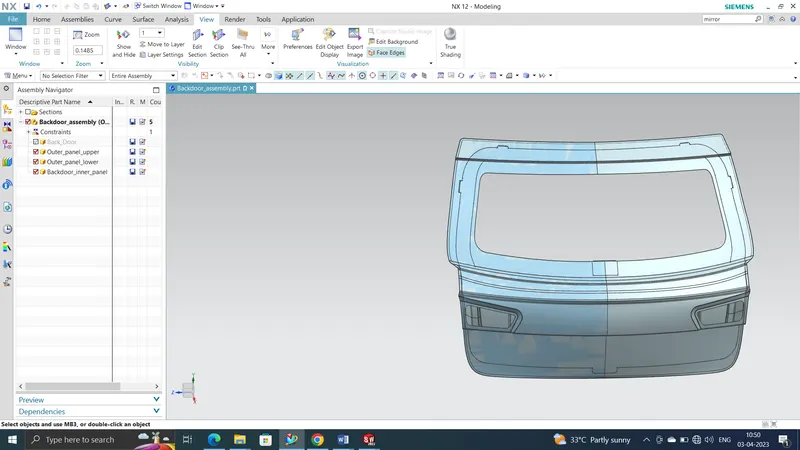
The Outer Panel is the styling surface of the back door design. Other components of the backdoor are designed with reference to the outer panel surface. It acts as the outer cover & deals with the aesthetics of the car.
In this design outer panel is divided into two-part.
- Outer Upper Panel
- Outer Lower Pane
Outer Upper Panel:-
- The Outer Upper Panel Extracted from a provided styling surface.
- The panel is modified for the required design with the surface tools of NX CAD.
- The thickness provided to the outer panel is 0.75 mm.
- Hemming is provided with corner reliefs.
Outer Lower Panel:
- The Outer Upper Panel Extracted from the given styling surface.
- The panel is modified for the required design with the surface tools of NX CAD.
- The thickness provided to the outer panel is 0.75 mm.
- Hemming is provided with corner reliefs.
Design a Backdoor inner panel:-
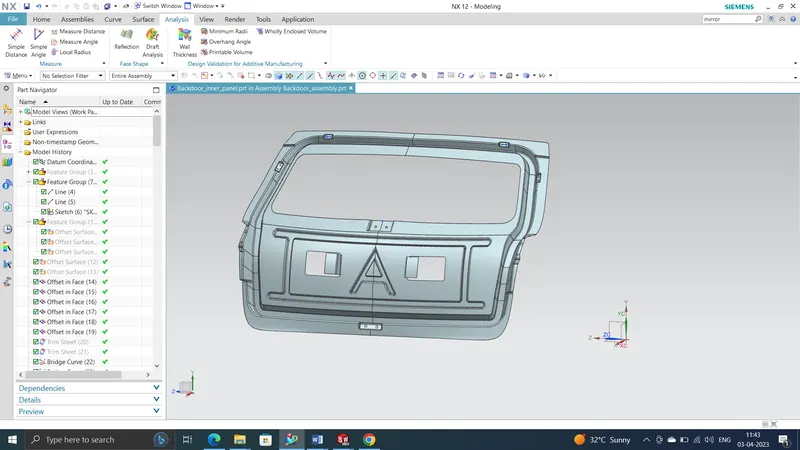
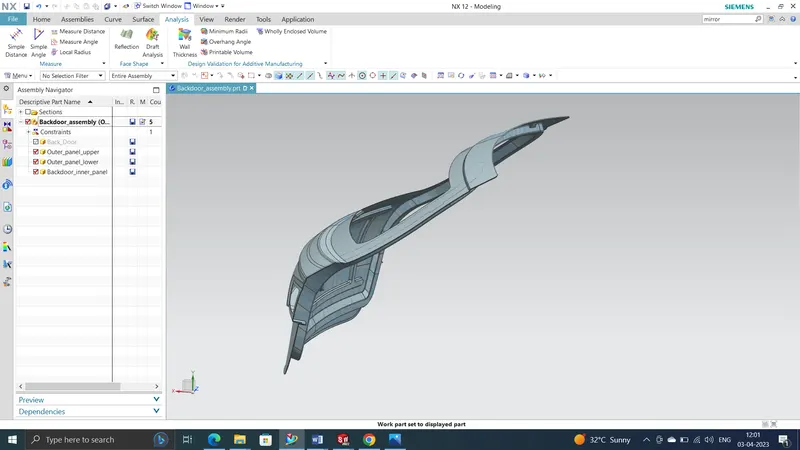
The inner panel is provided with reinforcements and embosses and relief areas. The inner panel is designed with its structural rigidity and load bearing capacity while the outer panel being for the styling, look and feel purposes. Initially, the inner panel is obtained by offsetting the outer panel. Then the sealing flange is created to the inner panel, this flange seals the gaps between the panel and the BIW restricting the micr dust, water splash and rainwater entering into the car interior.
- The sealing flange extracted from the offset surface of the class A surface.
-
Which is then connected to the inner using the connecting flange
- The inner panel with the sealing flange connected via the connecting flange and cut section for the tail lamp positioning.
- Considering the widened and continuous surface of the panel in this region there is a flange extended between the panels and sealed wiht mastic data to improve the collision bearing nature of the tailgate.
- Emboss definitions are provided at the inner panel.
- Hinge and gas stay relief cut sections are provided for the positioning their respective reinforcement.
- Then thicken the surface of inner panel 0.75 mm.
Trajectory:
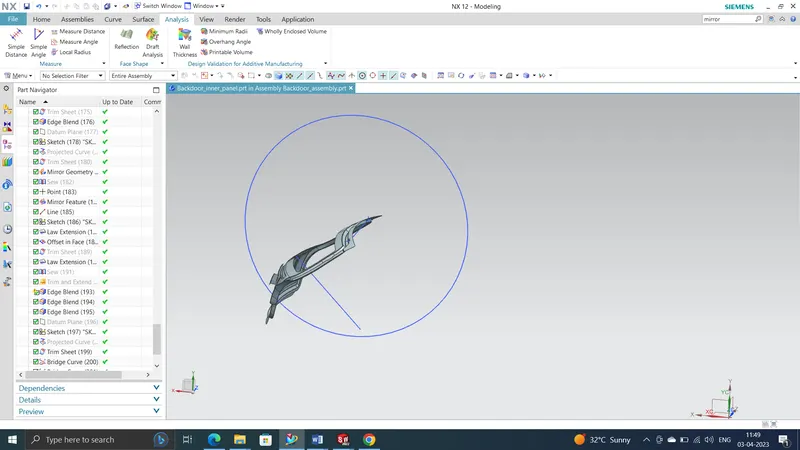
The position of the hinge should be perpendicular to the latch at the time of latch and striker meets. The circle is drawn from the centre of the hinge axis to find the path of the striker and perpendicular to the path.
HEMMING:-
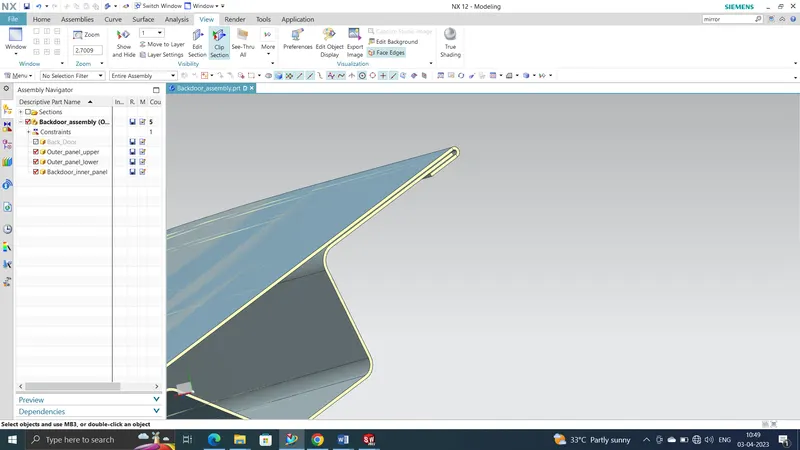
Hemming & seaming are two similar types of metalworking processes in which a sheet metal edge is rolled over onto itself. Hemming is the process in which the edge is rolled flush to itself.
- The outer panel was designed as two different parts named as outer upper panel and outer lower panel.
- After designing the outer panel, the Hemming was created by offsetting the surface with the help of face blend & swept surface.
- The two different outer panels will be joined using Blanking
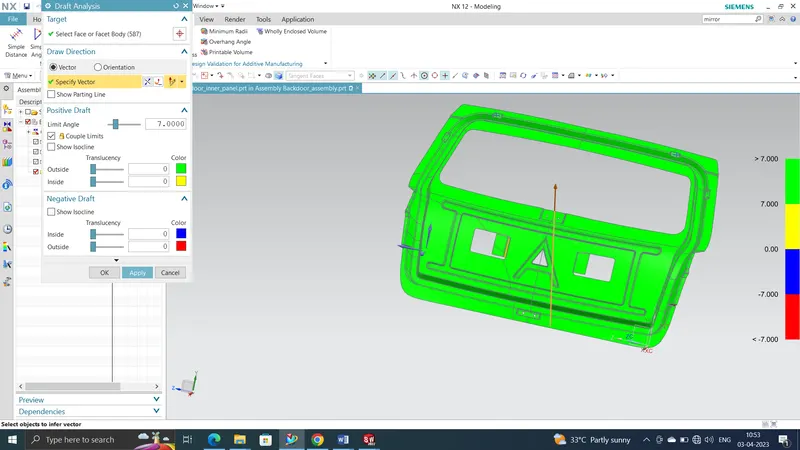
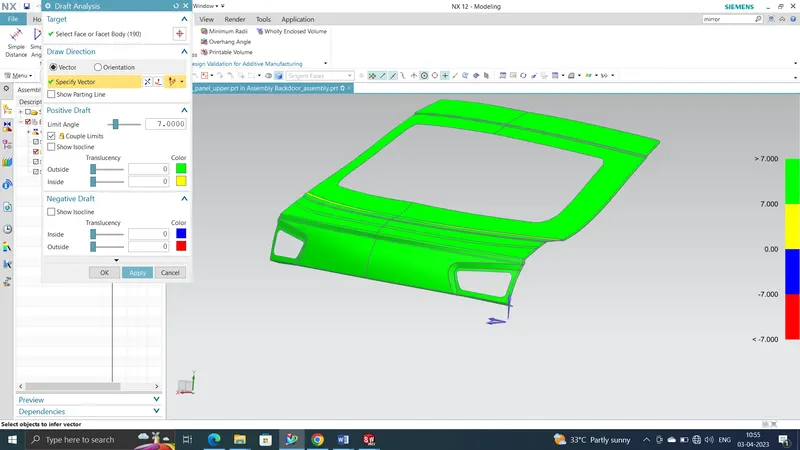
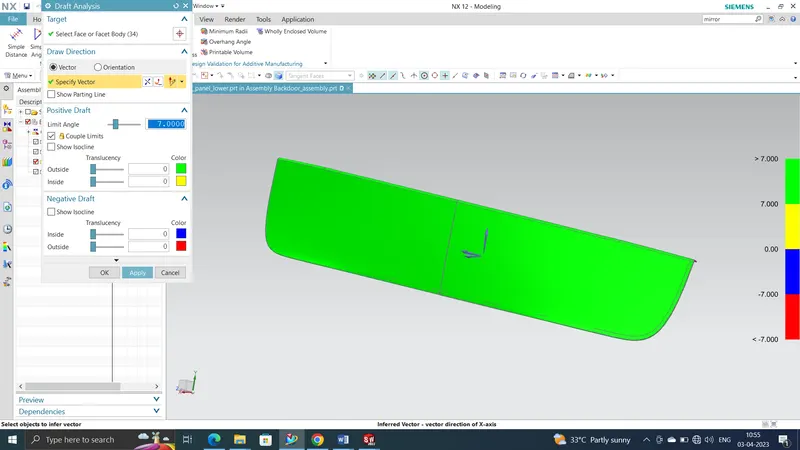
Draft analysis of Backdoor:-
- The draft analysis was performed for the tooling direction created at first and checked that the model is suitable for manufacturing.
- Then to get a complete green portion the required changes to the draft angle of the embosses were carried out by optimizing the model.
- The Draft Analysis command is used to detect that the part drafted will be easily removed or not.
- This type of draft analysis is performed based on colour ranges.
- The identifying zones on the analysed element where the deviation from the draft direction at any point, corresponds to specified values.
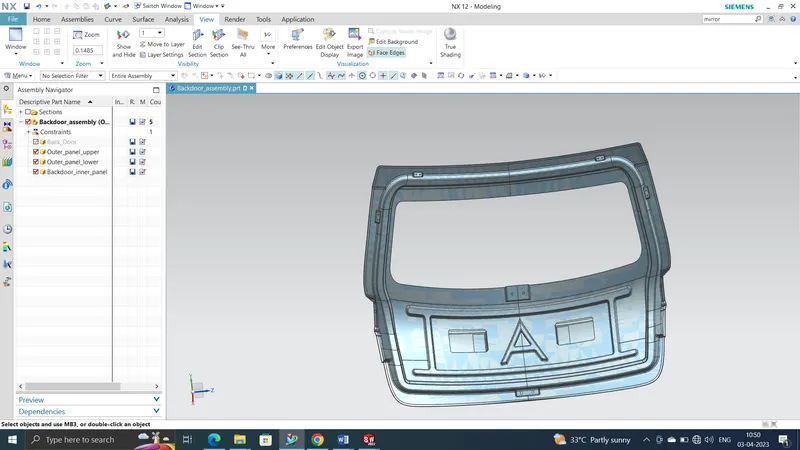
Final Backdoor:-
CONCLUSION:
Thus, the Body in White Back Door of a car IS designed using the engineering standards & also the deep drawing requirements consideration using NX cad software