Design of backdoor
DESIGN OF BACKDOOR
Design of Backdoor Objective:
* To design Back door of car using the given Class ‘A’ surface. Introduction It is a hinged board or door at the rear of the vehicle that can be moved up or down during loading and unloading. Back Door is also referred as 'Hatch' or 'Tailgate' or 'Trunk-lid'.......
*Introduction.
* The back door of a car is a component which hinges at the back of the car to cover the boot space or luggage area, but there are more functions that come with it which has to be considered while making a design of the same like rear visibility criteria and boost space.
This part is usually designed keeping the master section of the rear roof rail because of the sealant flange and also various other consideration, as it is also in contact with the side body of the car.
It has back lights / tail lamps and braking lights which is termed as “Third brake light” mounts on it, rear windshield fixes between inner and outer panel, in some back door spare wheel can be mounted on it, sometimes car registration number plate mounts on it and it gives a complete closed design to the car.
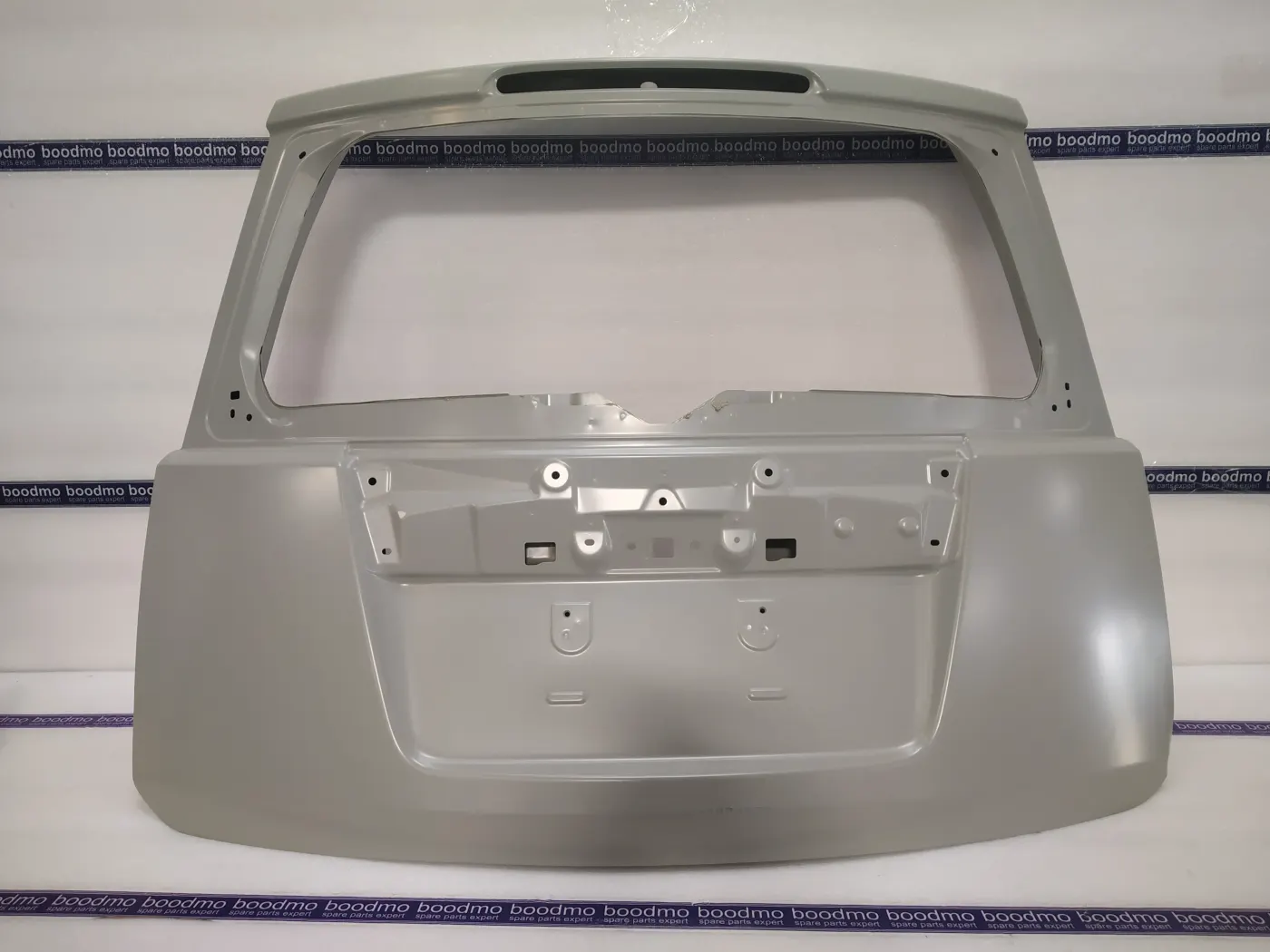
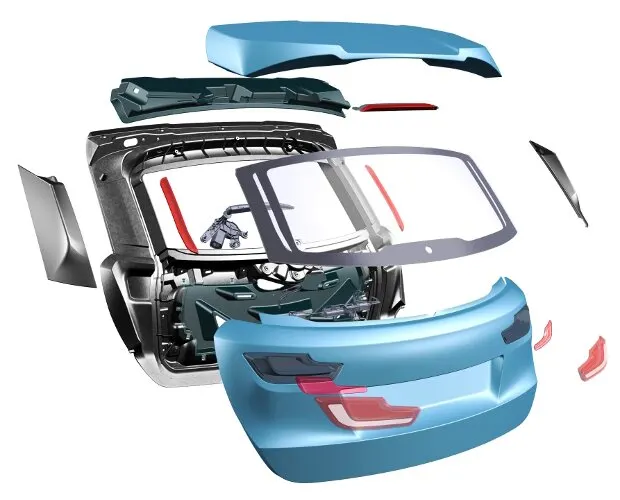
Functions of the Backdoor:
- It protects the occupants and luggage from getting damaged.
- It houses assembly of tail lamps, wiper motor and other components.
- It serves as entry and exit point for luggage/passengers.
- It houses windshield glass which helps in rear visibility.
- Parking sensors, rear view camera are mounted on it.
Materials Selection:
The selection of material plays a major role in determining the overall weight of the back door. The common materials used are Steel & Aluminum. The density of Steel is higher than Aluminum thus adding more weight to the door. The material used in the manufacturing of the backdoor depends upon the budget of the car, most low cost vehicles use steel as it is cheaper compared to Aluminium. Another aspect to be noted is that, if casted Aluminum parts are used instead of deep drawn steel parts there is no need of reinforcements and the overall weight of the car is reduced by approximately 5-10kg thus increasing the performance of the vehicle. Also the draft angle for casted parts is around 3 degrees while for deep drawn parts is around 7-10 degrees which helps in increasing the luggage/ cabin space.
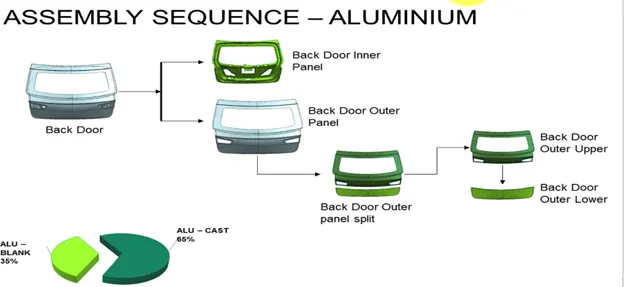
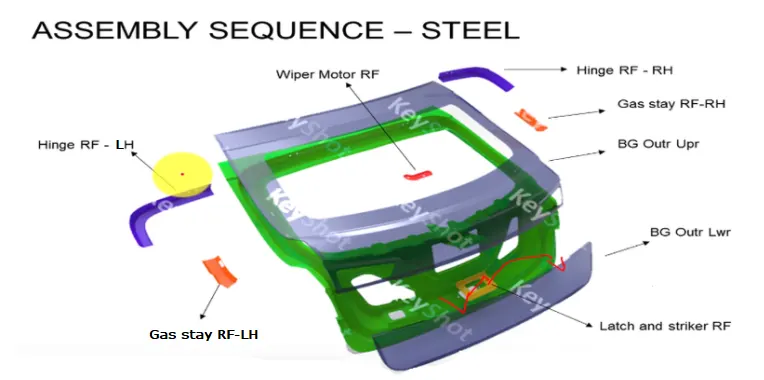
Different Sheetmetal processes used for manufacturing the Back Door
Deep Drawing:
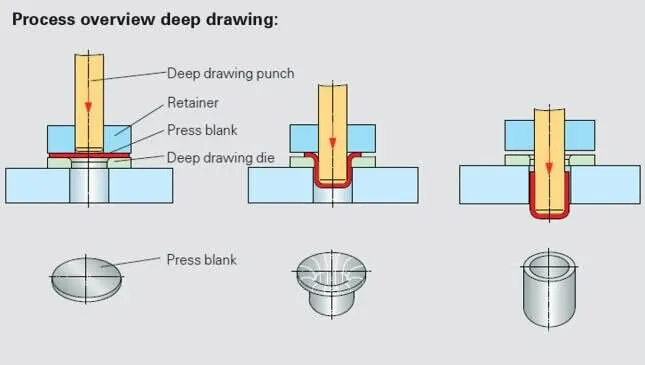
The metal deep drawing process is an effective method of manufacturing of cups, cans and other similar deep drawing products. The deep drawings having two main categories.
- First- stage drawing: The blank shape of metal is placed on the die and contact with the punch. When the metal specimen is flat piece of sheet metal used in forming and finish the product. Initially the punch moves in downward direction. The outer rim of blank is subjected to pure radial drawing (drawing toward in vertical axes) between die and blank metal. The metal become a bend and sliding over die and also stretched between die and punch. The metal in vicinity of punch head and contact with it bend and slide over radii and stretch over punch head.
- Redrawing: The components drawn from first stage again it is redrawn convert into more depth to form a cup shape in the die and punch. The second stage of drawing is called as redrawing.
Embossing:
Embossing is a metal forming process for producing raised or sunken designs or relief in sheet materials by means of matched male and female roller dies, theoretically with no change in metal thickness or by-passing sheet or a strip of metal between rolls of the desired pattern. Metal sheet is drawn through the male and female roller dies producing a pattern or design on the metal sheet. Depending on the roller dies used, different patterns can be produced on the metal sheet.
Materials commonly used in the metal embossing process include:
- Aluminum alloys
- Steel alloys
- Zinc
- Copper
- Galvanized steel
- Brass
- Cold rolled steel
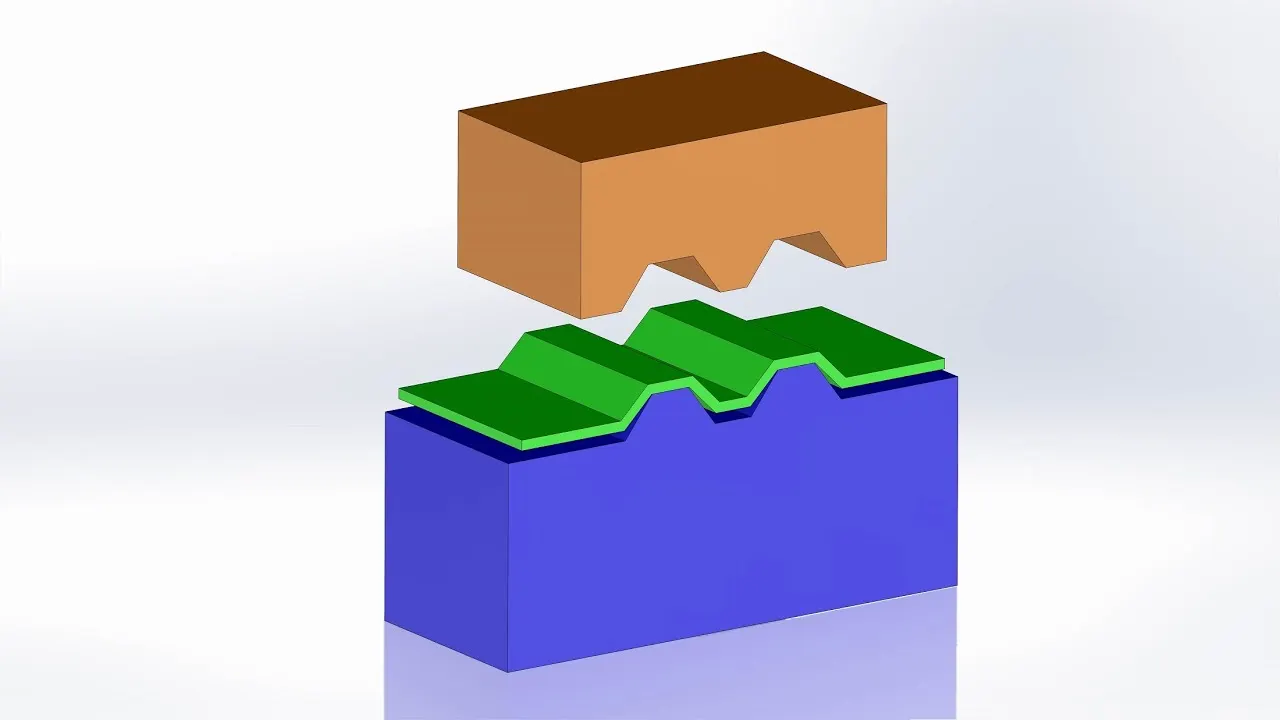
**Hemming
* Hemming is a forming operation in which the edges of the sheet are folded or folded over another part in order to achieve a tight fit. Normally hemming operations are used to connect parts together, to improve the appearance of a part and to reinforce part edges.
* In car part production, hemming is used in assembly as a secondary operation after deep drawing, trimming and flanging operations to join two sheet metal parts (outer and inner) together. Typical parts for this type of assembly are hoods, doors, trunk lids and fenders.
Blanking:
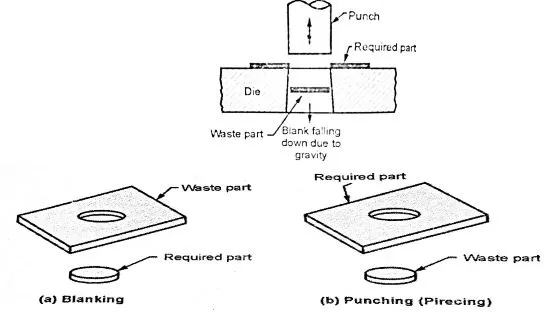
Blanking is a cutting operation of a flat metal sheet and the article punched out is known as blank. Blank is the required product of the operation and the metal left behind is considered as a waste.
Punching:
It is similar to blanking only the main difference is that, the hole is the required product and the material punched out from the hole is considered as a waste.
SPOT WELDING
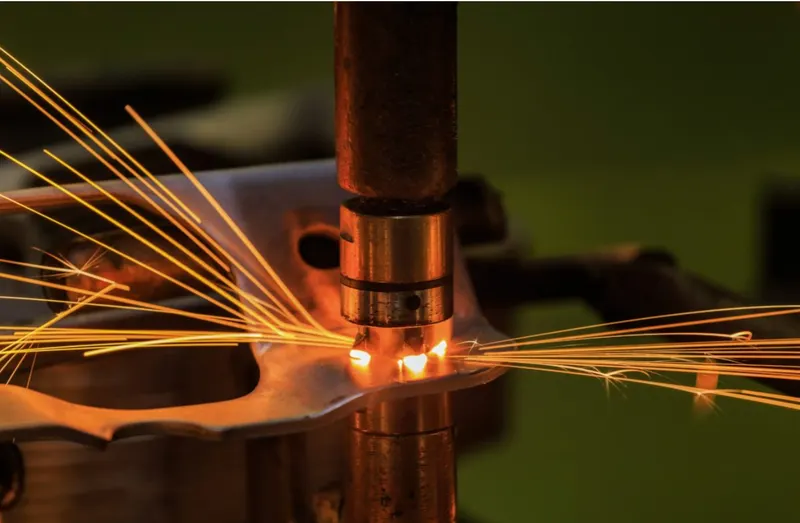
* Spot Welding is a form of resistance welding also known as Resistance Spot Welding (RSW). Spot Welding involves using heat produced by resistance to an electrical current to join materials together. The current heats the materials to a point where they become malleable. The use of strong pressure bonds them together.
* Another form of resistance welding is Projection Welding. This process involves fusing a fastener’s embossed or coined projections to the metal base material to form a weld. As the materials never melt, they do not intermix. This means the resulting weld is more like a forging of the materials.
*Spot welding is only suitable for a small selection of base materials. Low carbon steel is the most suitable material for spot welding. This is because it is more resistant to electricity and has a lower thermal conductivity than the copper electrodes used to create the required electrical current.
* High carbon steels and aluminium alloys can form brittle welds that don’t last with the spot welding process. Pure aluminium can qualify for spot welding but requires higher current levels. This is because it has a lower resistance to electricity than low carbon steel.
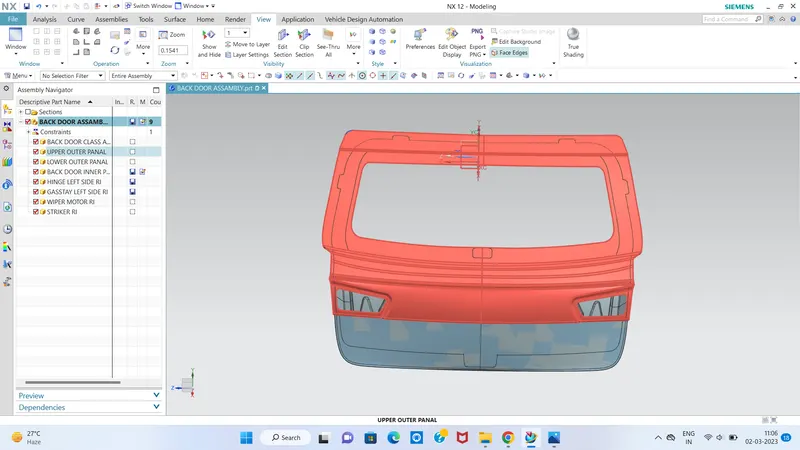
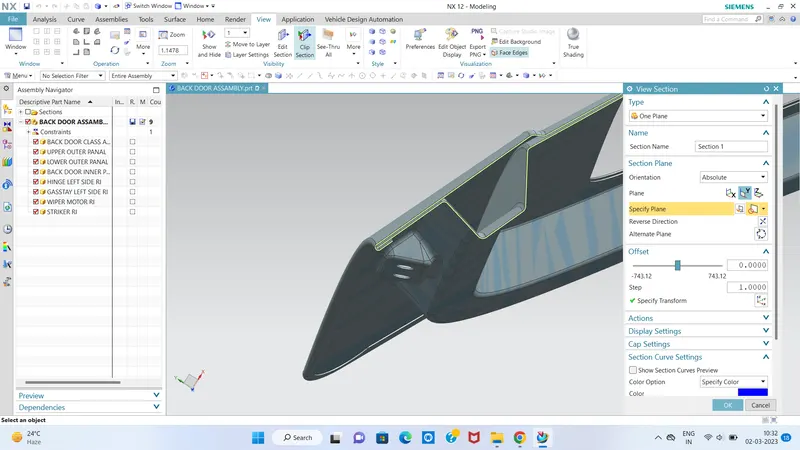
Design of Back door in NX CAD:
Door parts thickness is given below,
- Outer Panel - 0.75 mm
- Inner Panel - 0.75 mm
- Reinforcements - 1.5 mm
*********CLASS A SURFACE *********
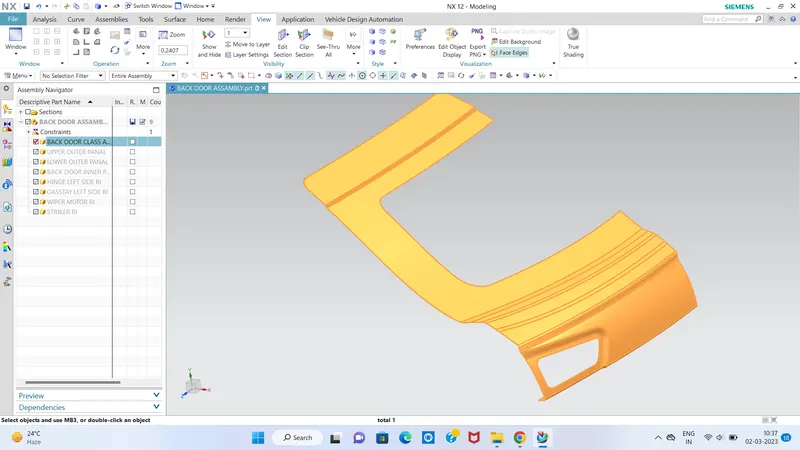
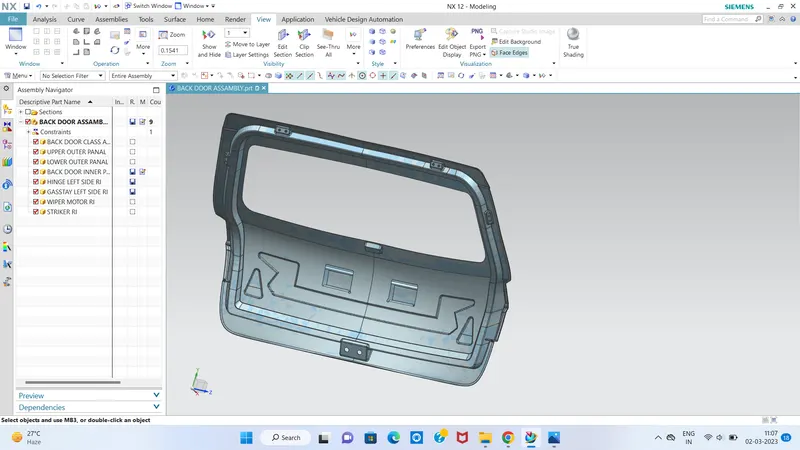
Parts Of the BackDoor
*Inner Panel
*Hinge Mounting Bracket ( LH & RH )
*Gas Stay Bracket ( LH & RH )
*Wiper Motor Support Bracket
*Latch
*Latch Reinforcement
*Hinge reinforcement ( LH & RH )
*Gas Stay Reinforcement ( LH & RH )
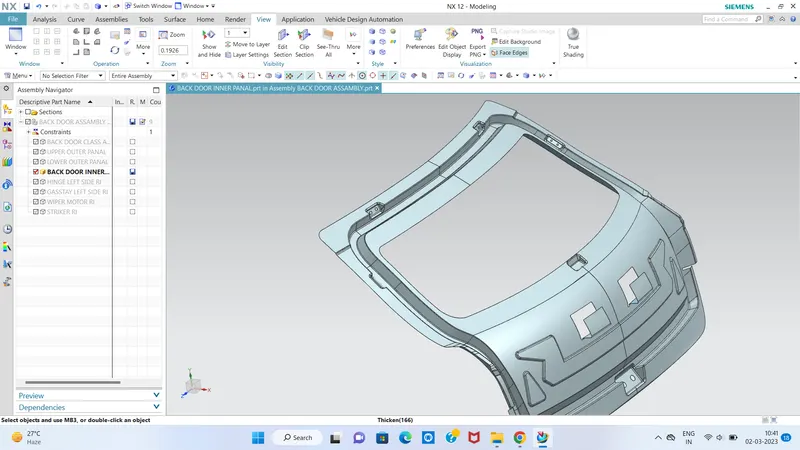
*Inner Panel
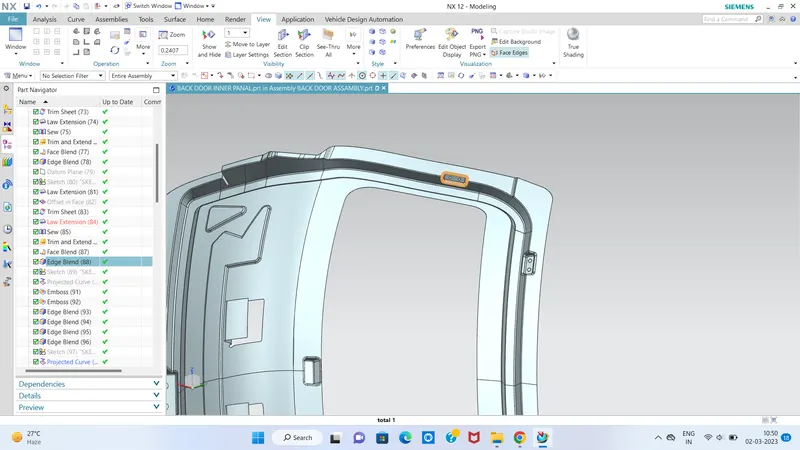
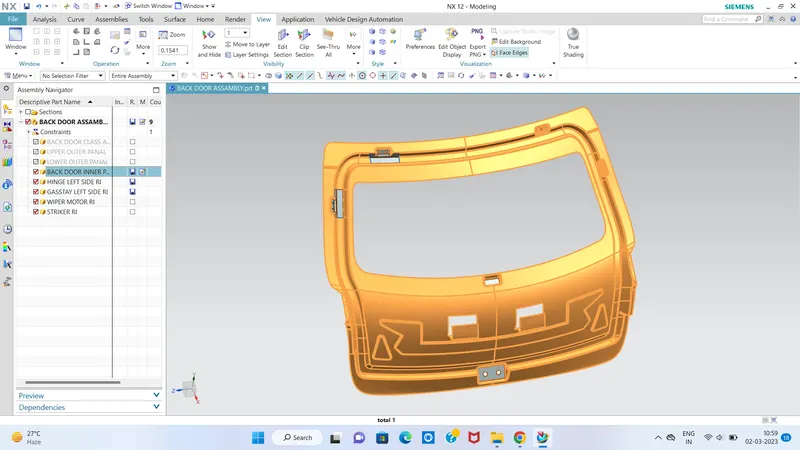
Inner door panel is a component which is use for strengthening the door assembly and it is one of the most important components on witch all accessories are mount like hinges, glass guide channel and gas stay.Back door inner panel is mounted with the the Roof.Inner is mounted with the outer panel with the help of hemming process.
- Materials used for the Inner panels are steels,Aluminum.
- For giving more strength to the inner panels by Adding extra reinforcements to strengthen the parts.
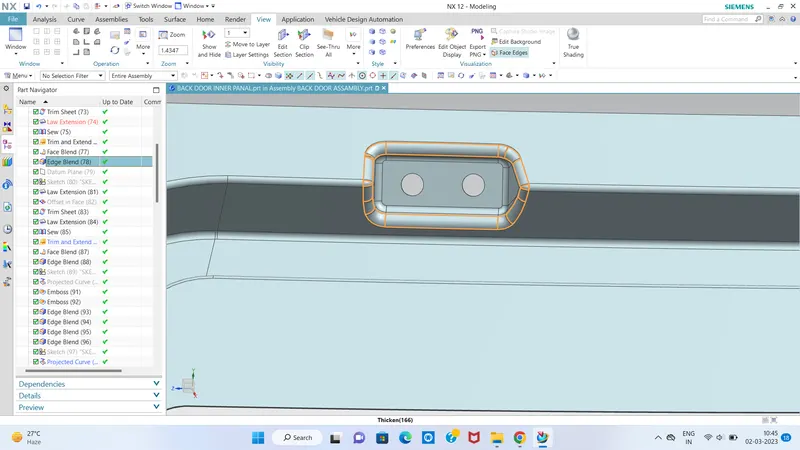
*Hinge
What is HINGE ?
* Hinges are simple mechanical bearing devices that are used to connect two parts and allow them to rotate relative to each other about a fixed axis. Depending on the type employed, the components can move (most commonly) within a limited arc or with 360° freedom.
Material Used for HINGE
*Due to the applications in which they are applied, hinges need to be able to withstand the stress of consistent opening and closing. To fulfill this requirement, many hinges are made of stainless steel as the strength of steel materials allows the hardware to bear heavy components, and the stainless characteristics prevent rust and corrosion. The latter is important because hinges used in external applications, especially near the ocean or salt lakes, can experience fatigue and failure much quicker due to exposure to moisture and salt in the environment.
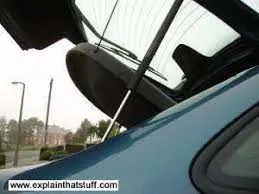
*Gas Stay Bracket ( LH & RH )
* A car tailgate held open by two gas springs ... The other mounting bracket stays in the same place throughout.
*Wiper Motor Support Bracket
What is Wiper Motor ?
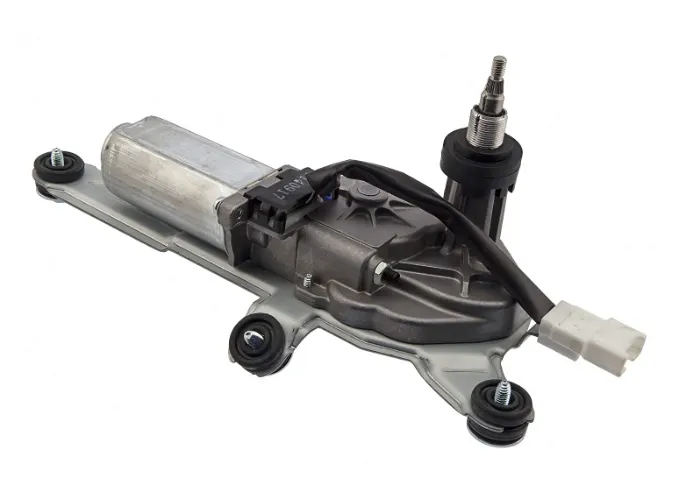
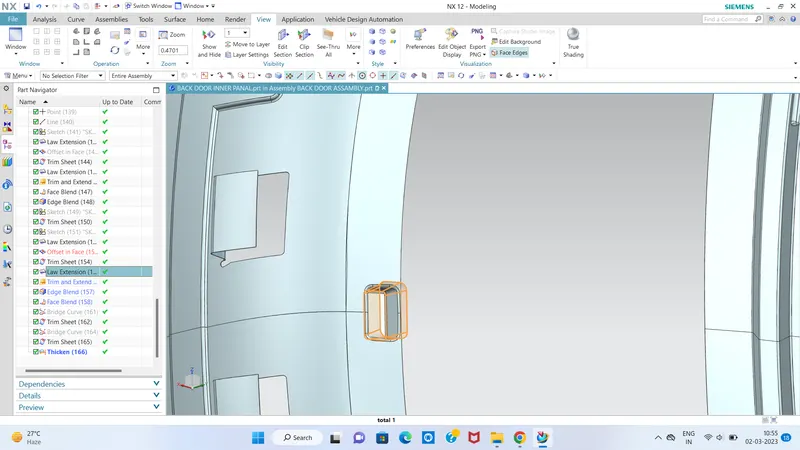
* Windshield wipers are powered by a small electric motor , usually mounted on the firewall or under the cowl (the area under the windshield's base). The motor activates linkage that moves the wiper arms back and forth. On vehicles with a rear window wiper, a separate motor powers the one in the rear
Reinforcement
Why we need Reinforcement ?
* Hinge rotates in the rotational axis in that it will loose some strength there,It means huge Back door opens with the help of small hinges only in this case hinge needs extra strength,For this we providing extra strength in the form of Reinforcement
*Hinge Reinforcement thickness be 1.2mm to 1.5mm.
RELIEF DATA:
Relief is provided onto the part or component in order to remove any stresses developed in a particular area i.e sharp corners that takes place during the hemming process is carried out. Thus corners are rounded or chamfered.
We leaving 2 mm from sheet metal for Roll hemming process.
DRAFT ANALYSIS:
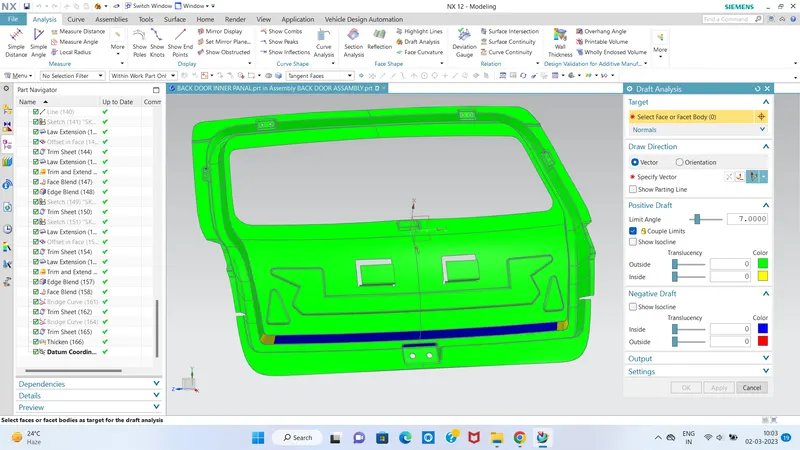
*Draft analysis of inner panel is carried out through the tooling direction only.Only the green areas are acceptable and i worst cases yellow regions are accepted but the blue and red regions are never accepted.
*The draft angle for aluminium casted panel is 2 to 3 degrees is enough but if it is steel then the angle is more than 7 degrees.
*In this project i considered it as steel and used 7 degrees as draft angle and direction is choosen as tooling direction which is the deep drawn direction.
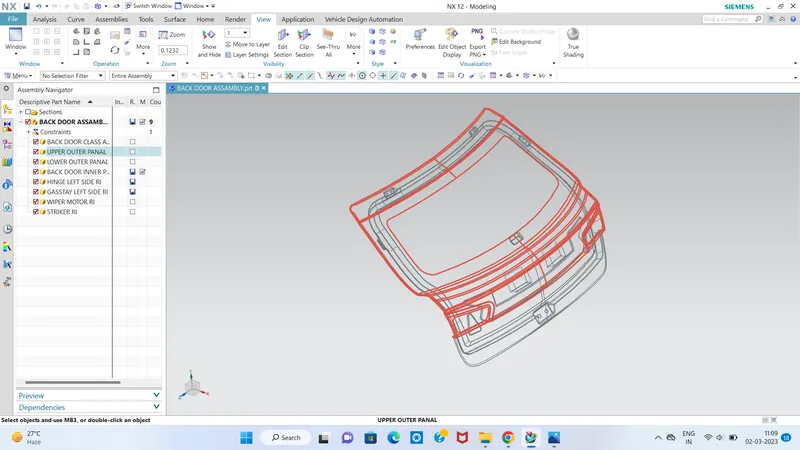
******MY BACKDOOR DESIGN IMAGES*