Section Modulus calculation and optimization
Section Modulus calculation and optimization
*Section modulus
* Section modulus is a geometric property for a given cross-section used in the design of beams or flexural members, it is also referred to as the Polar Modulus or the Torsional Sectional Modulus. Other geometric properties used in design include area for tension and shear, radius of gyration for compression, and moment of inertia and polar moment of inertia for stiffness. Any relationship between these properties is highly dependent on the shape in question. Equations for the section moduli of common shapes are given below. There are two types of section moduli, the elastic section modulus and the plastic section modulus.
S=I/Y
Here,
S = Section modulus
I= Moment of Inertia (Unit mm 4)
Y= Distance from Neutral axis to the extreme end (unit mm)
The Unit of a “section modulus” is (mm3)
| Cross-sectional shape | Figure | Equation | Comment |
|---|---|---|---|
| Rectangle |  |
Solid arrow represents neutral axis | |
| doubly symmetric I-section (major axis) | 
|
NA indicates neutral axis | |
| doubly symmetric I-section (minor axis) |  |
NA indicates neutral axis | |
| Circle |  |
Solid arrow represents neutral axis | |
| Circular hollow section |  |
Solid arrow represents neutral axis | |
| Rectangular hollow section |  |
NA indicates neutral axis | |
| Diamond |  |
NA indicates neutral axis | |
| C-channel | |
NA indicates neutral axis |
 ,
,
*Elastic section modulus
* The elastic section modulus is defined as S = I / y, where I is the second moment of area (or area moment of inertia, not to be confused with moment of inertia) and y is the distance from the neutral axis to any given fibre. It is often reported using y = c, where c is the distance from the neutral axis to the most extreme fibre, as seen in the table below. It is also often used to determine the yield moment (My) such that My = S × σy, where σy is the yield strength of the material.
*Plastic section modulus
*The plastic section modulus is used for materials where elastic yielding is acceptable and plastic behavior is assumed to be an acceptable limit. Designs generally strive to ultimately remain below the plastic limit to avoid permanent deformations, often comparing the plastic capacity against amplified forces or stresses.
*The plastic section modulus depends on the location of the plastic neutral axis (PNA). The PNA is defined as the axis that splits the cross section such that the compression force from the area in compression equals the tension force from the area in tension. So, for sections with constant yielding stress, the area above and below the PNA will be equal, but for composite sections, this is not necessarily the case.
* First Design Study
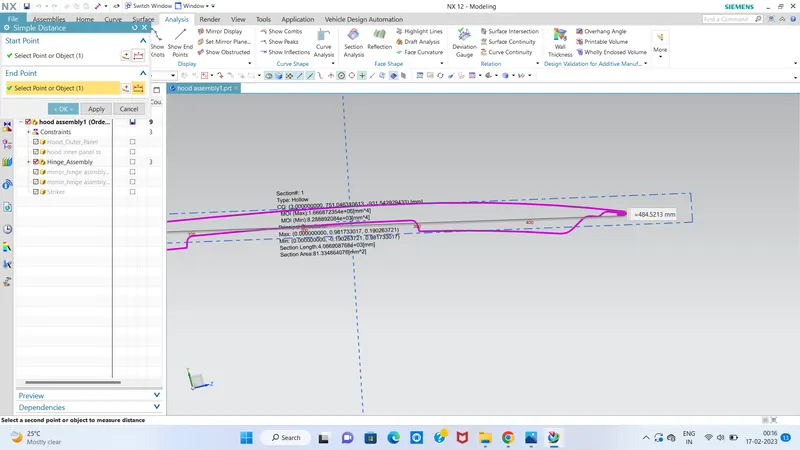
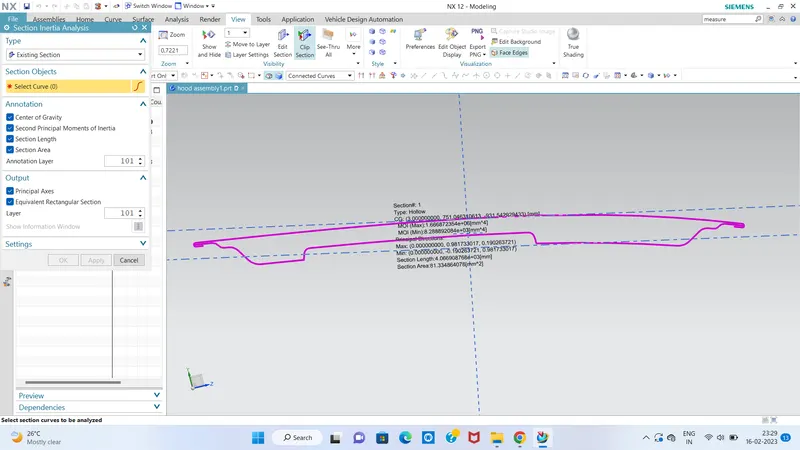
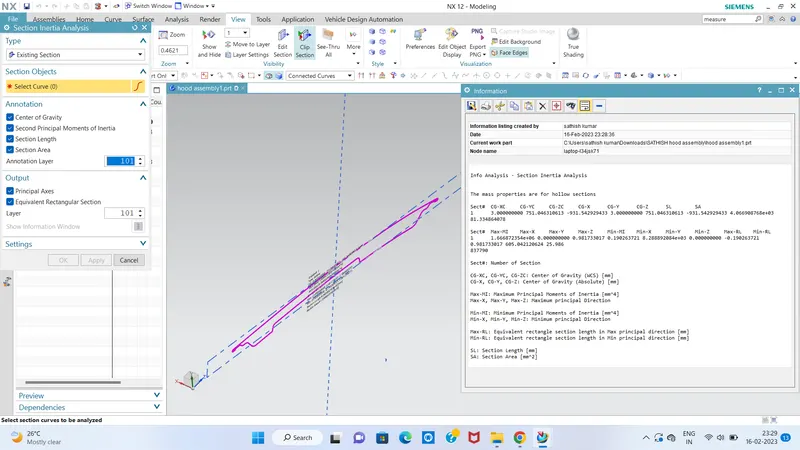
the moment of inertia was calculated by using the NX-software obtained values are ..
IMAX:-8.28889X105mm4
Imin:-1.66668x103mm4
Total length of 'Y' value was 484.52mm
So,at neutral axis we need 'Y' value:-Y/2=484.52/2=242.26mm
1)Section modulus(S):-I/Y=8.28889X105mm4/242.26mm
=3.421X103mm3(Maximum strength).
2) Section modulus(S):-I/Y=1.6668x103mm4/242.26mm
=0.016X103mm3(minimum strength).
strength of an hood varies from 0.016x103mm3to 3.421X103mm
now my hood innar panal offset in 1 mm
IMAX:-8.4462X105mm4
Imin:-3.61202x103mm4
Total length of 'Y' value was 484.52mm
So,at neutral axis we need 'Y' value:-Y/2=484.52/2=242.26mm
1)Section modulus(S):-I/Y=8.4462X105mm4/242.26mm
=3.486X103mm3(Maximum strength).
2) Section modulus(S):-I/Y=3.61202x103mm4/242.26mm
=0.014x103mm3(minimum strength).
strength of an hood varies from 0.014x103mm3to 3.486X103mm3.......