Challenge 4-Windshield Modeling
Windshield Design and Development
1.1 Windshield design features: The main functions of the windshield are: views, natural lights, air flow and preventing the impact of debris from the environment. The two important windshield design requirements are 1) Glass and 2) Gradient lines.
The gradient lines serve the aesthetic purpose as it hides the internal parts and provides a more visually pleasing transition from the black frit band.
1.2 Types of the windshield:
- Curved laminated glass: It is ideal for the front windshield as it is very strong. Two layers of glass are fused by a layer of plastic.
- Curved tempered glass: It is made up by heating the glass to a high temperature and then rapidly cooling it. It is stronger and safer than regular glass since it shatters into small round pieces.
1.3 Manufacturing process:
- The raw materials are carefully weighed in the appropriate amounts and mixed with a small amount of water to prevent segregation of the ingredients. Cullet (broken waste glass) is also used as a raw material.
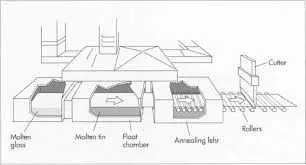
- Once the batch is made, it is fed to a large tank for melting using the float glass process. First, the batch is heated to a molten state, and then it is fed into a tank called the float chamber, which holds a bath of molten tin. The float chamber is very large—from about 13 feet to 26.25 feet (4 to 8 meters wide and up to almost 197 feet (60 meters) long; at its entrance, the temperature of the tin is about 1,835 degrees Fahrenheit (1,000 degrees Celsius), while at the exit the tin's temperature is slightly cooler—1,115 degrees Fahrenheit (600 degrees Celsius). In the float chamber, the glass doesn't submerge into the tin but floats on top of it, moving through the tank as though on a conveyor belt. The perfectly flat surface of the tin causes the molten glass also to become flat, while the high temperatures clean the glass of impurities. The decreased temperature at the exit of the chamber allows the glass to harden enough to move into the next chamber, a furnace.
- After the glass exits from the float chamber, rollers pick it up and feed it into a special furnace called a lehr. (If any solar coatings are desired, they are applied before the glass enters the lehr.) In this furnace, the glass is cooled gradually to about 395 degrees Fahrenheit (200 degrees Celsius); after the glass exits the lehr, it cools to room temperature. It is now very hard and strong and ready to be cut.
- The glass is cut into the desired dimensions using a diamond scribe—a tool with sharp metal points containing diamond dust. Diamond is used because it is harder than glass. The scribe marks a cut line into the glass, which is then broken or snapped at this line. This step is usually automated and is monitored by cameras and optoelectronic measuring systems. Next, the cut piece must be bent into shape. The sheet of glass is placed into a form or mould of metal or refractory material. The glass-filled mould is then heated in a furnace to the point where the glass sags to the shape of the mould.
- After this shaping step, the glass must be hardened in a heating step called tempering. First, the glass is quickly heated to about 1,565 degrees Fahrenheit (850 degrees Celsius), and then it is blasted with jets of cold air. Called quenching, this process toughens the glass by putting the outer surface into compression and the inside into tension. This allows the windshield, when damaged, to break into many small pieces of glass without sharp edges. The size of the pieces can also be changed by modifying the tempering procedure so that the windshield breaks into larger pieces, allowing good vision until the windshield can be replaced.
- After the glass is tempered and cleaned, it goes through a laminating process. In this process, two sheets of glass are bonded together with a layer of plastic (the plastic layer goes inside the two glass sheets). The lamination takes place in an autoclave, a special oven that uses both heat and pressure to form a single, strong unit that is resistant to tearing. The plastic interlayer is often tinted to act as an ultraviolet filter. When laminated glass is broken, the broken pieces of glass remain bound to the internal tear-resistant plastic layer, and the broken sheet remains transparent. Thus, visibility remains good. Unlike traditional safety glass, laminated glass can be further processed—cut, drilled, and edge-worked, as necessary. A typically laminated windshield is very thin: each glass layer is approximately .03 inches (.76 millimetres) thick, while the plastic interlayer is approximately .098 inches (2.5 millimetres) thick.
- After laminating, the windshield is ready to be assembled with plastic mouldings so it can be installed on the car. Known as glass encapsulation, this assembly process is usually done at the glass manufacturer. First, the peripheral section of the windshield is set in a predetermined position in a mould cavity. Next, molten plastic is injected into the mould; when it cools, it forms a plastic frame around the glass. The windshield assembly is then shipped to the car manufacturer, where it is installed in an automobile. The installation is done by direct glazing, a process that uses a polyurethane adhesive to bond the windshield and automobile body.