Challenge #3 - Week 1.3 - Flow over Aircraft Wing
Aim:
1) The Aim of this project is to determine the Drag force of an Aircraft wing's frontal area when travelling from Zero velocity to Take off velocity.
2) To Determine the Drag force of an Aircraft wing's frontal area for varying Co-Efficient of Drag keeping Velocity as constant.
Governing Equations: Drag Force=ρ.A.V^2.c_d / 2
Objective of the Project:
Below is the description of how to calculate the Drag force of an Aircraft's Wing (Airbus A380) from zero Velocity to Take off velocity while taxing on a runway. All inputs gathered here are taken from Internet.
1) When an Aircraft taxies towards the runway to take off it experiences the resisting forces such as Traction on wheels as well as Drag force which is nothing but Air resistance, Different areas of Aircraft experiences different resisting forces depending upon their frontal area. Here in the description below I have calculated the drag force experiences in the front area of one Aircraft wing as the Aircraft starts from Zero to its take off Velocity (0 to 87.5), Taking Drag Co-efficient as 0.0265.
2) Keeping Velocity as constant we are going to determine the drag force by varying Co-efficient of Drag (c_d).
Inputs:
Case 1:
1) Drag Co-efficient for Airbus A380 (As given by Airbus), Cd= 0.0265
2) Total Wingspan of the Aircraft= 80m
3) Wingspan of one wing= 40m
4) Frontal area of wing span (attack area) , A= 3.6 sq.m
5) Density of Air, rho= 1.2 kg/m^3
6) Static Velocity of Aircraft, V0= 0 m/s^2
7) Take off velocity of Aircraft, Vt= 87.5 m/s^2
8) Drag force is calculated by the equation, in N
F=rho*A*v^2*c_d/2
9) Plots of Velocity vs Drag Force are given as Outputs.
Case 2:
1) Varying Drag Co-efficient for Airbus A380 (As given by Airbus), Cd= 0.01 tp 0.05
2) Total Wingspan of the Aircraft= 80m
3) Wingspan of one wing= 40m
4) Frontal area of wing span (attack area) , A= 3.6 sq.m
5) Density of Air, rho= 1.2 kg/m^3
6)Velocity of Aircraft, V=40 m/s
7) Drag force is calculated by the equation, in N
F=rho*A*v^2*c_d/2
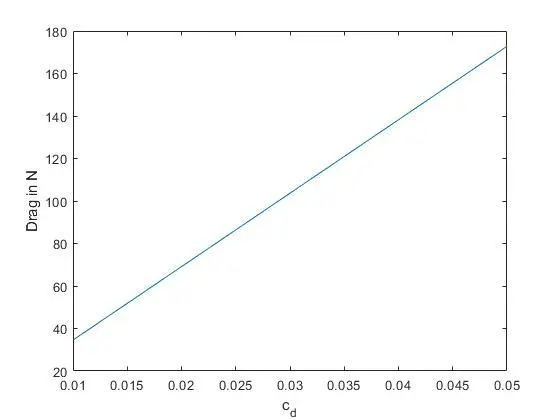
8) Plots of c_d vs Drag Force are given as Outputs.
---------------------------------------------------------------------------
For writing the program
Case 1:
%program to calculate drag force for a Frontal area of an Aeroplane wing
clear all
close all
clc
%inputs
%Drag Co-efficient for AirBus A380 (taken from Internet)
c_d=0.0265
%Frontal area in m^2
A=3.6
%Density in kg/m^3
rho=1.2
%velocity in m/s^2
v=[1:87.5]
%drag force of frontal area of one wing
drag_force=rho*A*v.^2*c_d*0.5
plot(v,drag_force)
xlabel('velocity')
ylabel('Drag')
--------------------------------------------------------------------------
Case 2:
Keeping Velocity as Constant:
%program to calculate drag force for a Frontal area of an Aeroplane wing
%keeping Velocity as constant
clear all
close all
clc
%inputs
%Drag Co-efficient for AirBus A380 (taken from Internet)
c_d=linspace(0.01,0.05,10);
%Frontal area in m^2
A=3.6
%Density in kg/m^3
rho=1.2
%velocity in m/s^2
v=40;
%drag force of frontal area of one wing
drag_force=rho*A*v^2*c_d*0.5;
plot(c_d,drag_force)
xlabel('c_d')
ylabel('Drag in N')
Conclusion:
Case 1: The Velocity vs Drag Force Curve is plotted as per the governing equation.
case 2: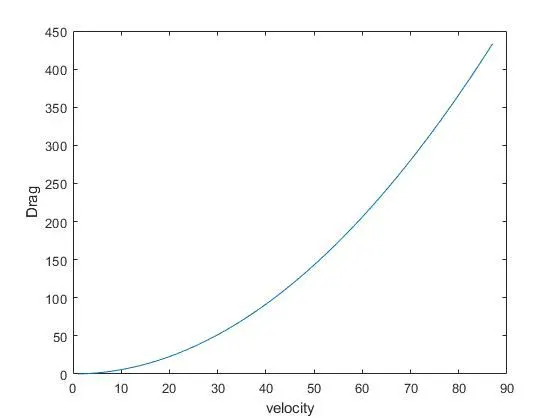 c_d vs Drag Force