Cell Balancing of multi cell battery pack.
Electric vehicles (EV), Single battery cells are serially and parallelly connected to make a battery stack to achieve higher voltage and capacity. However, the charging and discharging process need to stop as soon as any cell reaches its maximum limit or working threshold (below the absolute threshold). Due to this,
the capacity of the battery pack is limited by the imbalance in the cells of the pack. This reduces
the energy usage efficiencies and shortens the lifetime of the battery pack.
Weak cells (ones with lower capacity/ higher internal impedance) tend to exhibit higher voltage than the rest of the series cells at full charge termination. These cells are then weakened further by continous overcharge cycles. On the discharge side, the weak cells tend to have lower voltage than the other cells, due to either higher internal resistance, or a faster rate of discharge that the result from the lower capacity. If the cells are overheated or overcharged, they are prone to accelerated cell degradation. They can catch fire or even explode as a thermal runway condition can occur if a lithium ion cell voltage exceeds 4.2V by even a few hundred millivolts.
There are two popular ways of balancing, namely passive balancing and active balancing. The
conventional passive balancing method prevents the bleeding of excess energy from cells into
heat, while in active balancing there is a transfer of the excess energy into energy-depleted cells. With proper battery pack integration and improved thermal management, the battery pack
experiences lesser imbalance in a lifetime and the overall requirement of balancing is not very
extensive but a must-have feature. The passive balancing with the proper board-level thermal
management can handle all balancing requirements with cost-effective solutions.
Cell balancing is a very important thing when it comes to lithium-ion batteries. Nowadays, lithium-ion batteries are used in electric vehicles. Celling balancing means making the state of charge and the terminal voltage of all the lithium-ion cells equal by charging or discharging each cell.
The cell balancing is done by BMS(Battery Management System), which is a microcontroller used to maintain the lithium-ion batteries. The battery management system is required only for lithium-ion batteries. The purpose of the battery management system is celling balancing, protecting the battery from short circuits, measuring the state of charge, state of health, etc.
Proper cell balancing is required otherwise the life span of lithium-ion batteries decreases. Cell balancing is classified into two types, such as active cell balancing and passive cell balancing. Well, let’s see what is active cell balancing and what is passive cell balancing.
What causes cell unbalancing?
The cell becomes unbalance due to internal resistance and temperature. As the life span of the cell increases the internal resistance will also vary this causes the cell to unbalance. The cell may also become unbalanced due to the surrounding temperature.
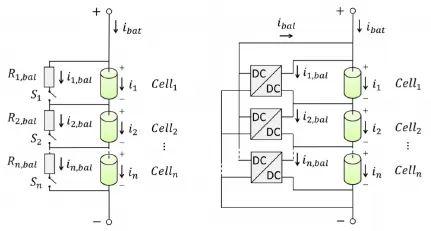
Passive Left and Active right, cell balancing topologies.
Active Cell Balancing
In an active cell balancing, the voltage across each cell is made equal without wasting any energy through a resistor. Suppose consider there are two cells of terminal voltage 4v and 6v. The 4v cell will be charged and the 6v cell will be discharged through the same methods, later the voltage across each cell will become 5v.
Let’s see one more example, Person ‘A’ has 20-liter water in the tank, Person ‘B’ has 10-liter, and Person ‘C’ has 30-liter, now to make equal water in all the three tanks, the person ‘C’ shares water of 10 liters to Person ‘B’, now the water in the tanks becomes equal. This is what active cell balancing does.
The active cell balancing makes the voltage of each cell equal without wasting any energy.
Passive Cell Balancing
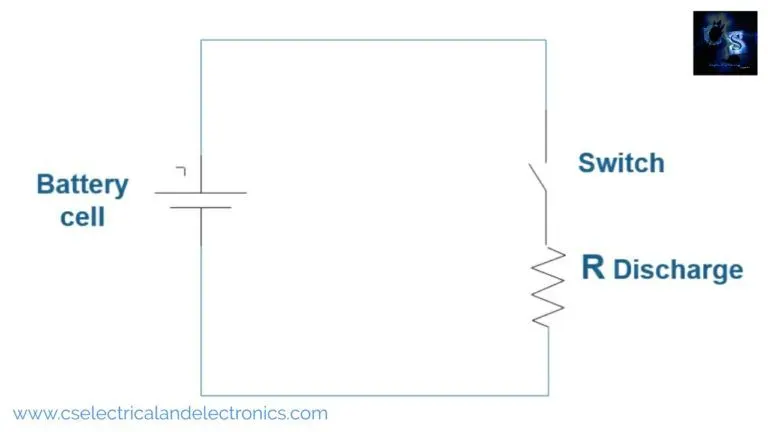
In a passive cell balancing, the voltage across each cell is made equal by wasting the energy through a resistor. Suppose, consider there are two cells having the terminal voltage of cell one 4 volts and the terminal voltage of the second cell 5v. The 1v of the 2nd cell is dropped through the resistor to make the voltages of each cell equal. Or else if the state of charge of cell 01 is 30% and the state of charge of cell 02 is 60%, then 30% of the state of charge in cell 02 is dissipated through a resistor, to make the cell's state of charge equal.
Well, let’s see one more example, Person ‘A’ has 40-liter water in a tank and Person ‘B’ has 50-liter water in a tank, to make water equal in both tanks, the person ‘B’ wastes 10-liter of water to make 40-liter. This is what passive cell balancing does.
Why Cell Balancing Is Required
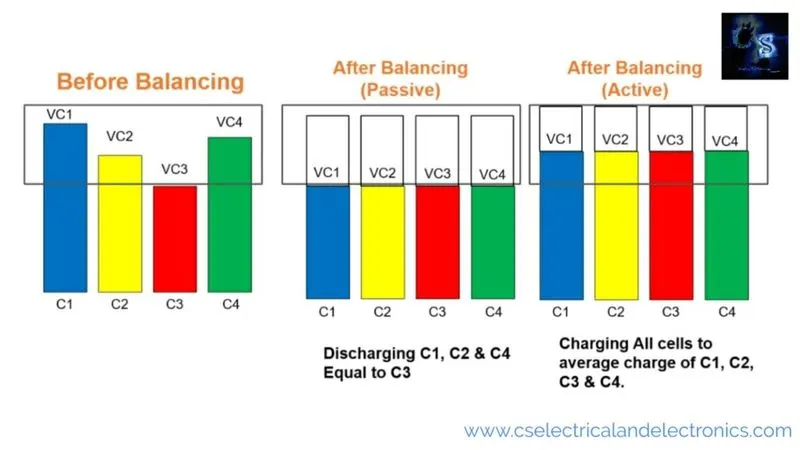
Cell balancing is required to increase the lifespan of the battery, to make the motor run efficiently, to increase the efficiency of lithium-ion batteries, etc.
References :