Bird Strike - Project - 2
Project Description-
Foreign object damage (FOD) is a big problem in aviation industry that reduces the level of safety for an aircraft. Foreign object damage (FOD) is a big problem in aviation maintenance industry that reduces the level of safety for an aircraft. This project is based on Foreign object damage in Aircraft engine.
In this project, a structural analysis of Fan in turbofan engine during bird strike is performed in LS-Dyna. A bird strike sometimes called bird ingestion (for an engine), bird hit, or bird aircraft strike hazard (BASH) is a collision between an airborne animal and a manmade vehicle, usually an aircraft.
Bird strikes are a significant threat to flight safety, and have caused a number of accidents with human casualties. There are over 13,000 bird strikes annually in the US alone. However, the number of major accidents involving civil aircraft is quite low and it has been estimated that there is only about 1 accident resulting in human death in one billion flying hours. The majority of bird strikes (65%) cause little damage to the aircraft. However, the collision is usually fatal to the bird involved.
LS-DYNA
LS-DYNA is an advanced general-purpose Multiphysics simulation software package developed by the former Livermore Software Technology Corporation (LSTC), which was acquired by Ansys in 2019. While the package continues to contain more and more possibilities for the calculation of many complex, real world problems, its origins and core-competency lie in highly nonlinear transient dynamic finite element analysis (FEA) using explicit time integration. LS-DYNA is used by the automobile, aerospace, civil engineering, military, manufacturing.
The term crash analysis was created in aerospace industries, it was first employed in structural analysis over fuselage and emphonage. Later, it has been used in other industries for testing safety and standards of products
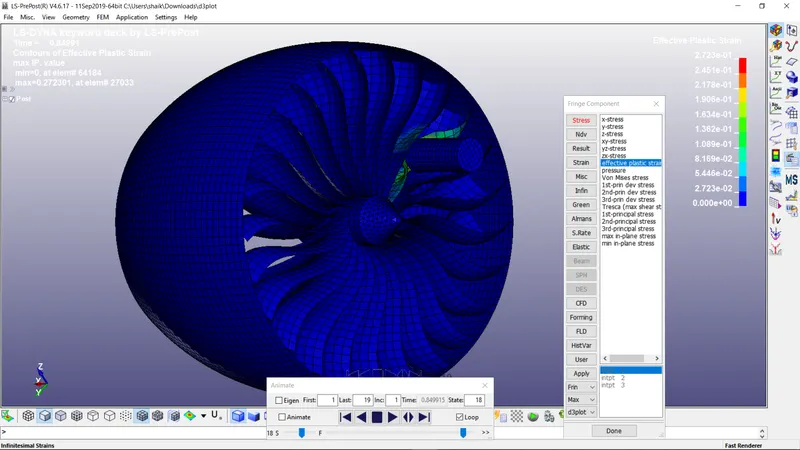
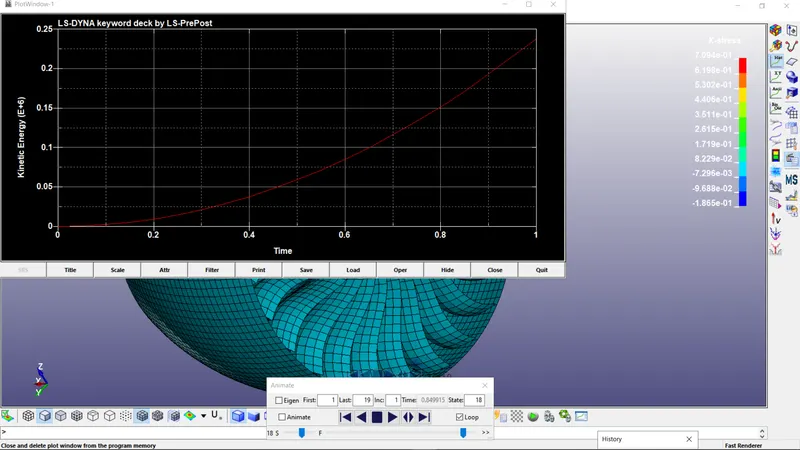
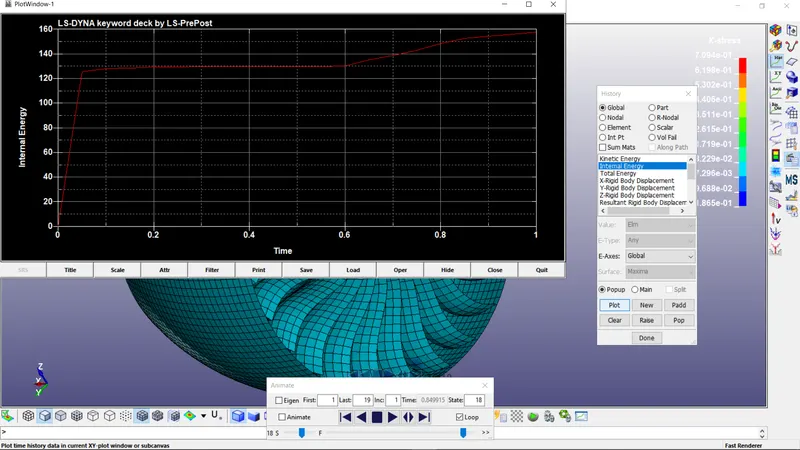
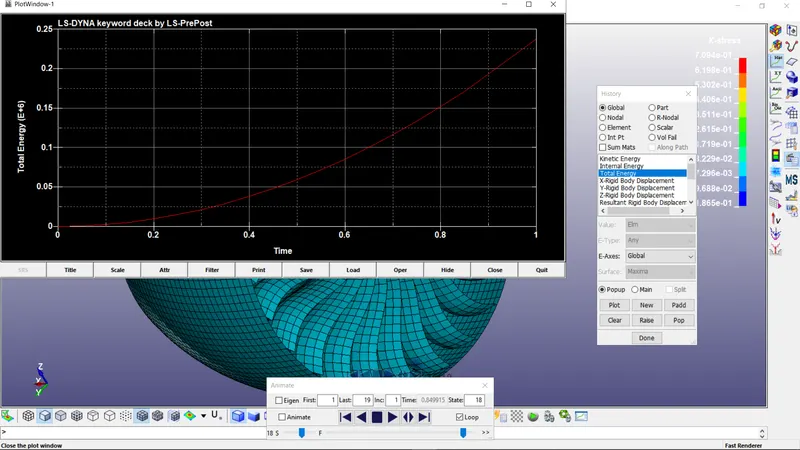
Finally a Bird strike over Fan is replicated in LS-DYNA and values of bodies will be employed to models in software and a detailed explanation of how analysis is done will be given continued by various structural variables (Stress, Strain) values and graphs.
Given-
Two files are given one containing all geometries of engine casing, bird and blades assembly, other file containing material properties for blades.
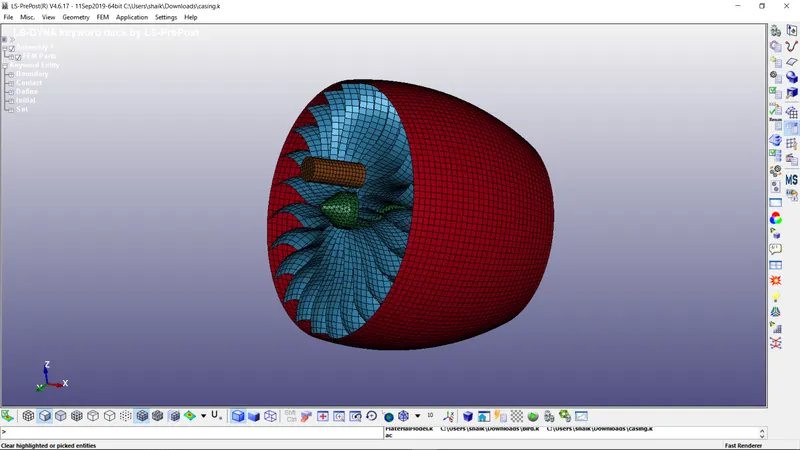
Process-
First each geometry is separated into single.k file
- both baldes and hub are tied using tied_Surface to Surface
-the properties file given will be assigned to Blades, a velocity is given by using BPM and a load curve has been made for movement of blades(rotational degrees of motion over x axis)
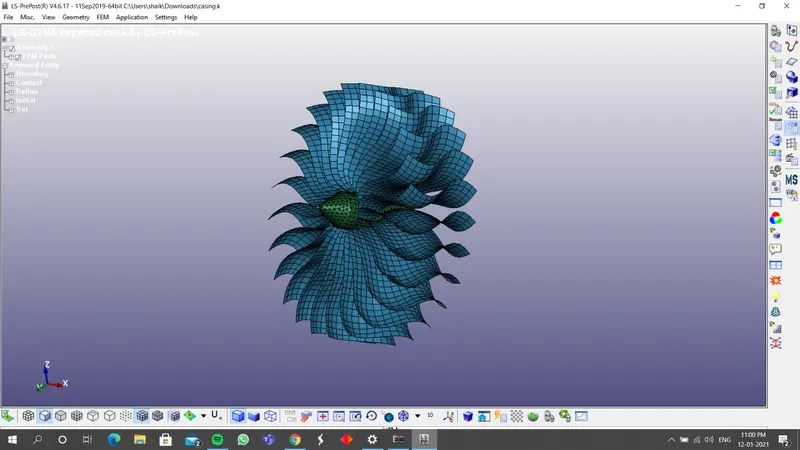
- for Hub,Section_solid is made and Section_shell for blades with thickness of 3 and saved
Engine casing-
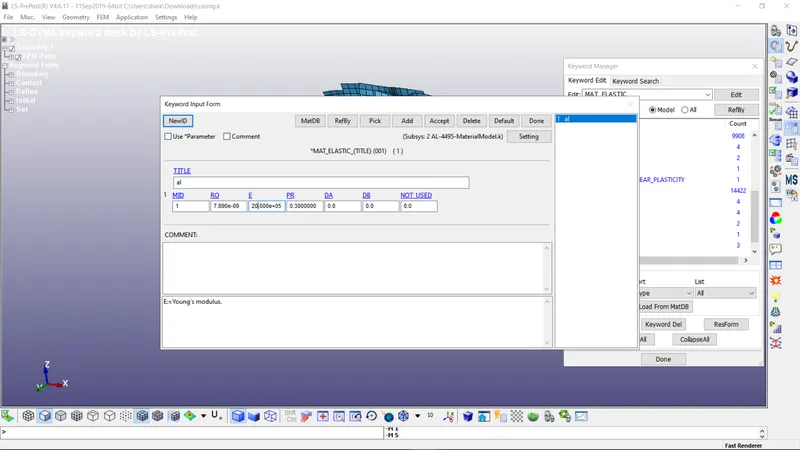
For engine casing, Material properties are assigned as shown in figure
-Section shell has been choosen for Engine casing and assigned into element card
Bird-
-Elastic material with 2000 gpa has been assigned to bird,Section shell is also assigned to bird in element keyword and all these .k files are merged and made into .dyn file.
- velocity has been given for Bird by BPM
Control termination, D3plot(DT) are assigned and solved in solver
Result