Benchmarking
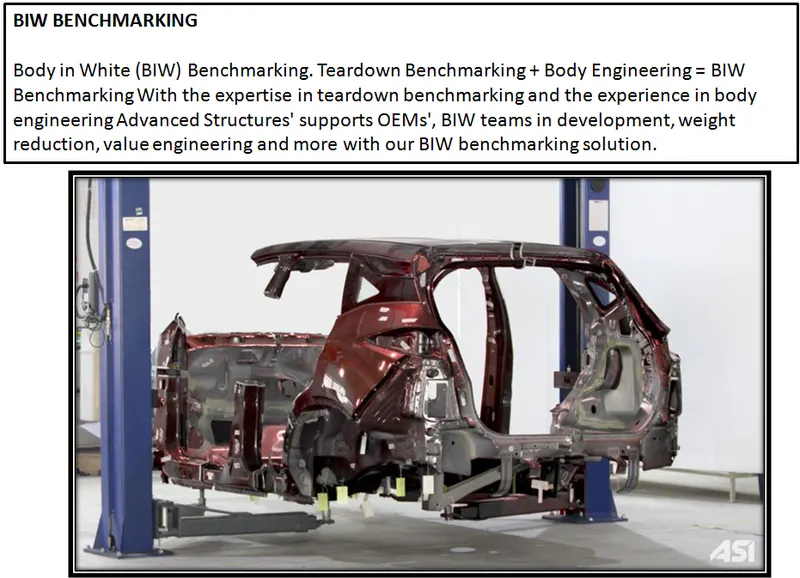
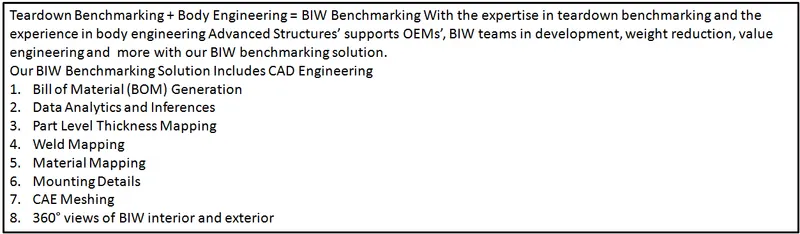
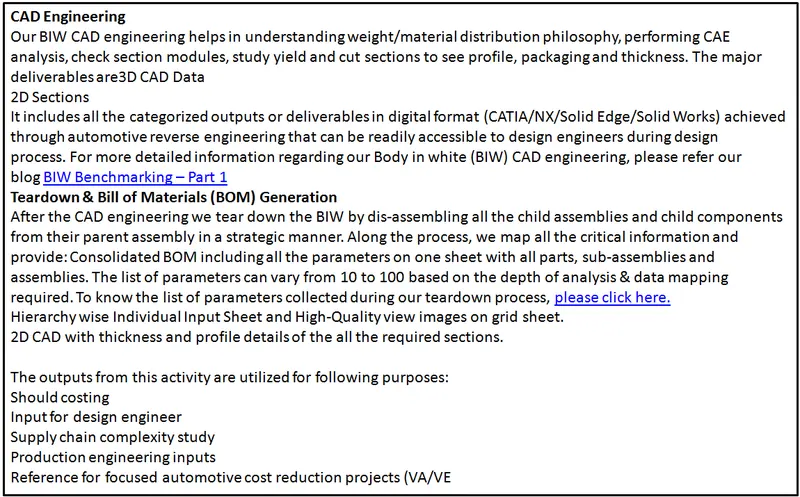
What all can be studied from the BiW of a competitor?
1. Energy management study
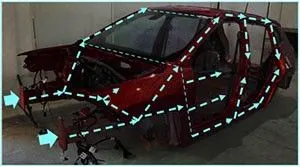
In order to study the load path for different load case scenarios (Frontal, Offset, Side Impact), an energy flow diagram on the BiW is created to identify the critical sections which are the key contributors for meeting crash norms. In the end of this activity, multiple flow diagrams for different load cases with critical sections (>120 areas) are identified for further detailed study.
2. Critical sections preparation
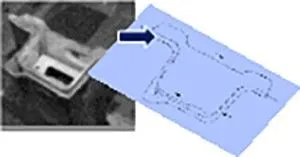
Based on the sections identified, 1:1 CAD files of the sections are prepared after physically cutting them from the BiW assembly. This data mapping exercise is required to reinforce the energy management study with additional key information such as profile shape, panel thickness, coating layer details & section modulus. On overlapping the flow diagram of the competition vehicle with the 2D sections in place the deviations and gaps can provide insights on the competitor philosophy of either transfer of energy or absorbing it at that zone.
3. Raw Material Analysis
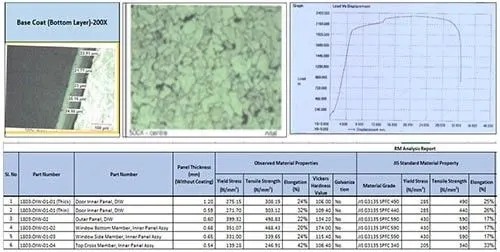
Raw material distribution along with physical properties (Tensile Strength, Vickers hardness, % elongation, and ultimate strength), chemical properties & thickness film analysis to understand the various layer of coating (paint, ED & Galvanisation). Based on the test lab results the data is triangulated with the standard material library to assess the exact grade of materials, in case of grades that are not matching with the existing grades are assigned specific special grades and material cards are generated. This data helps in understanding the strength of the regions/modules within the BiW, overall engineering philosophy & material library to benchmark.
4. Assembly sequence & process mapping
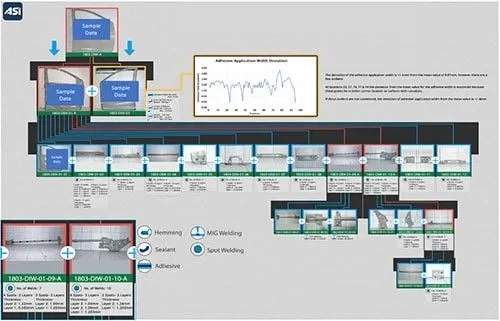
A disassembly map of all parts in a structured way is made to understand how parts are joined (sealant, adhesive, spot weld, arc weld, hemming, laser welding etc.). This map also helps in understanding the complexity of the overall assembly in terms of the total no of parts and joining method.
5. Sealant & Adhesive details
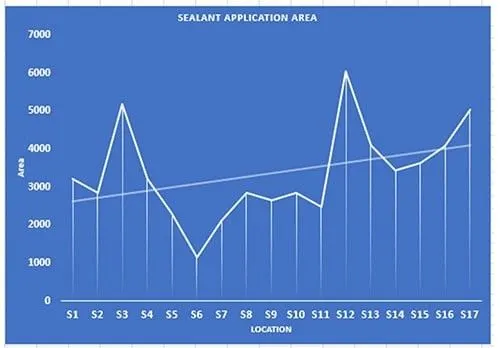
Considering the huge cost of sealants & adhesives, it is critical to study the application areas, quantity & type of adhesive or sealant used in BiW. It is also important that we study the reasons behind the usage of sealants & adhesives in order to understand the thought process of the OEM.
6. Welding information
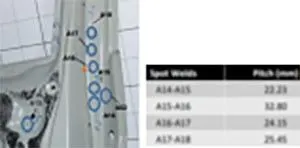
Strength of Body In White depends on how the panels are held together, in general, a BiW has approximately 3000 spot welds that hold 3 ply,2 ply, or 4 ply panels with nugget diameters of 6-8 mm with a pitch between 20-150 mm. The general information is good to know the facts but specific spot weld location, dia, ply thickness, & pitch is very critical from the strength perspective. The behavior of BiW undergoing torsion, bending or Frontal crash will entirely change if you change the position or size of the welds.
To deliver this information, a shell scan of the body in white is done and at all spots, weld locations spheres are created in 3D cad and shared with the client.
7. Bill of material
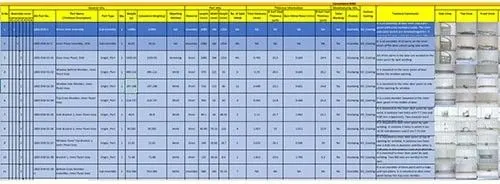
The bill of material contains >35 parameters mapped per part with hierarchy mapped as it is on the Body In White. These parameters mapped here help in understanding the weight distribution, quantity, purpose, coating types & thickness, part box size & joinery types, etc… Basically, all parameters that either impact cost or the function of the part is mapped and later utilized for VA-VE activity, directional costing & engineering inputs.
8. Thickness Map
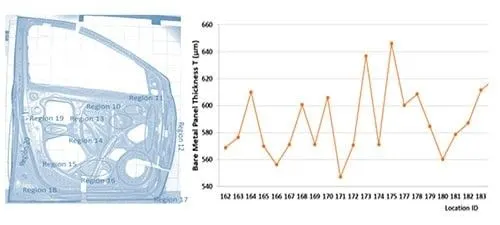
In order to understand the thinning percentage, thickness is mapped for all the parts that are formed during the stamping process. Thinning reduces the strength of the local region; hence it is critically planned while simulating the formability of steels. Parts should thin in the non-safety or non-strength critical areas only.
9. Full Reverse Engineering
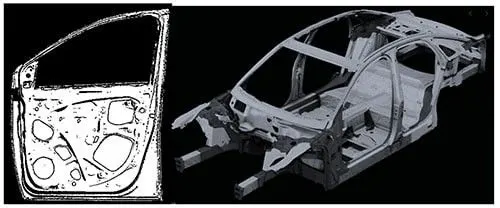
The competitor BiW & all 6 door closures are scanned and re-surface modeling is done for all A, B & C class surfaces. The entire CAD with all parts assembled and weld information mapped is created in 3D modeling software with BOM. This data is along with RM properties is used to simulate the model for the crash and other load cases and benchmark results for better design of Body In White.
10. Mounting Philosophy
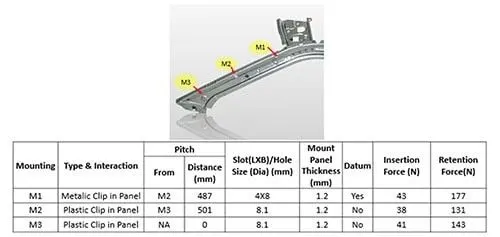
Around 20% of the parts in BiW are there to integrate other system parts onto the frame. The mounting philosophy report is generated for all the parts that are mounted on the BiW with fastener types, spacing, datum identification & packaging efficiency information. This information is used for VA-VE exercise reasoning or feasibility of the proposal generated while doing the idea generation workshop.
11. Directional Costing
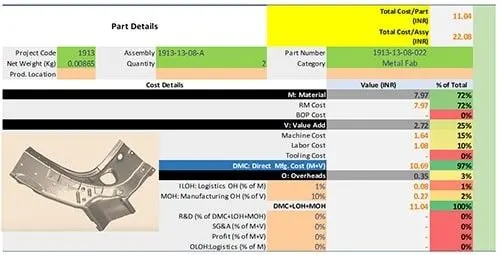
Without having cost estimates, it is difficult to quantify the worth of a VA-VE activity. With our xcPEP tool, we are able to estimate the cost of all the components with certain assumptions on the process, location, labor rates & tooling investment side. This assumptions sheet is configurable and flexible enough to update the calculations with a few clicks on the software.
12. Data Analytics
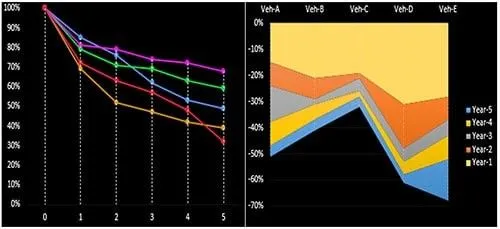
Once all the data is mapped, analysis is the next step. Based on the list of parameters that are mapped, analysis can be customized to answer questions specific to either cost-saving, weight saving, parts standardization, communication & others. Our xcPEP tool supports here in writing analysis algorithms quickly and executing them on the data mapped for the activity.
Few outputs of the data analytics activity are
- Weight analysis
- Material distribution analysis
- Manufacturing Process analysis
- Complexity analysis and more
Material Mapping
In our BIW benchmarking solution we also provide the details about material usage in the form of
- Material Distribution Sheet
- Chemical Composition
- Physical Properties
Part Mounting Details
We also provide details like the mounting method for parts mounted on Body In White, location, and complexity of mounts which can be used by design engineers for generating mounting method ideas and for space utilization and part integration philosophy
Apart from the above we also perform Part level Thickness Mapping and Weld mapping
For detailed information regarding our solutions Weld Mapping, Material Mapping etc please read our blog BIW Benchmarking – Weld & mounting.
Hyundai_VENUE_S_TURBO (SUV)

about engine
capcity
SUSPENSIONS AND BRAKING SYSTEM OF CAR
SAFETY OF CAR
LOCKING SYSTEM OF CAR
COMFORT OF THE CAR
PROS AND CONS OF CAR
TATA NEXAN XE (SUV)
ABOUT ENGINE
CAPACITY OF CAR
SUSPENSIONS AND BRAKING SYSTEM OF CAR
SAFETY OF THE CAR
BREAKING SYSTEM
FEATURES OF THE CAR
PROS AND CONS
HONDA WR-V (SUV)
ABOUT ENGINE
fuel-type
MAX. POWER
MILEAGE AND DRIVING RANGE
capacity
PROS AND CONS
MARUTI SUZUKI S CROSS SIGMA (SUV)
ABOUT ENGINE
MILEAGE OF CAR
FEATURERS OF CAR
SAFETY OF CAR
ENTERTAINMENT
PROS AND CONS
COMPARING FOUR CARs
ON-ROAD THIS VEHICLE COMES APPR.10 LAKHS
CONCLUSION
I will suggest HONDA WR-V for Mr. D.S. Pughazhyendhii
WHY HONDA WR-V
I WILL SUGGEST HONDA WR-V CAR FOR Mr. D.S. Pughazhyendhii, WHY BECAUSE OF GOOD MILEAGE, LOW MAINTENANCE COST THAN OTHER CARS, HONDA WR-V HAVING AUTOMATIC CLIMATE CONTROL, EPS MEANS ELECTRIC POWER STEERING WHICH PROVIDES BETTER FUEL ECONOMY, AND IT HAVING ELECTRIC SUNROOF, AND ITS [ACE] ADVANCED COMPATIBILITY ENGINEERING THAN OTHER CARS, HONDA WR-V HAVING MULTI VIEW REAR CAMERA AT FRONT MIRROR, INTELLIGENT PEDALS AND COMES WITH EASY HORN, BOOT SPACE IS HIGHER THAN 4 CARS, HONDA WR-V HAVING REMOTE FUEL LID OPENER, VANITY MIRROR AND ALSO TAILGATE AZAR IN IT.
HONDA WR-V COMES WITH GOOD MILEAGE, COMFORT FOR TRAVELING, ITS EASY TO TRAVEL 500 KM AND ALSO FOR DRIVING CITIES, EASY TO PARK AND ALSO IT COMES WITH GREAT FEATURES AND COMFORT,I WILL RECOMMEND THIS CAR TO MR PUGHAZHYENDHII.