Benchmarking
AIM :
1. Benchmark with presently available cars in the market for the following case.
Mr. D.S. Pughazhyendhii is a married man who lives in Bangalore which is a highly crowded city. His Family comprises five members including his wife, a five-year-old boy, his father, and his mother. He visits his native place Madurai which is 500kms away from Bangalore once a month. Also, he will be using his car to commute to his office. His budget falls between 8 to 10 lakhs on road. Please suggest to him options so that he will buy a good car for his family.
Note: Pughazhyendhii is fond of big cars.
BENCHMARKING: Benchmarking is a process of measuring the performance of a company's products, services, or processes against those of another business considered to be the best in the industry, aka “best in class.” The point of benchmarking is to identify internal opportunities for improvement.
In Automobile industry benchmarking is structured comparison between similar products, services or processes on some dimensions of performance of cars with features, specifications etc,. For example, it can be used to compare the availability delivery of features in a product and in this form often provides the basis of consumer tests and reviews. These look at products and services and provide recommendations based on which is best or some form of ranking amongst competitors. It is particularly useful when comparing not only performance but also practice.
Process benchmarking of this king can operate at several levels:
- Between similar processes in the same factory or service branch.
- Between different factories or service branches.
- Between different competing organizations.
- Between different competing manufacturers and marketplaces.
- Between different sectors using the same process.
There are four types of benchmarking,
1. Performance benchmarking involves gathering and comparing quantitative data (i.e., measures or key performance indicators). Performance benchmarking is usually the first step organizations take to identify performance gaps.
What you need: Standard measures and/or KPIs and a means of extracting, collecting, and analyzing that data.
What you get: Data that informs decision making. This form of benchmarking is usually the first step organizations take to identify performance gaps.
2. Practice benchmarking involves gathering and comparing qualitative information about how an activity is conducted through people, processes, and technology.
What you need: A standard approach to gather and compare qualitative information such as process mapping.
What you get: Insight into where and how performance gaps occur and best practices that the organization can apply to other areas.
3. Internal benchmarking compares metrics (performance benchmarking) and/or practices (practice benchmarking) from different units, product lines, departments, programs, geographies, etc., within the organization.
What you need: At least two areas within the organization that have shared metrics and/or practices.
What you get: Internal benchmarking is a good starting point to understand the current standard of business performance. Sustained internal benchmarking applies mainly to large organizations where certain areas of the business are more efficient than others.
4. External benchmarking compares metrics and/or practices of one organization to one or many others.
What you need: For custom benchmarking, you need one or more organizations to agree to participate. You may also need a third party to facilitate data collection. This approach can be highly valuable but often requires significant time and effort. That’s why organizations engage with groups like APQC, which offers more than 3,300 measures you can use to compare performance to organizations worldwide and in nearly every industry.
Let us sort out the requirements of Mr. D. S. Pughazhyendhii
- His family comprises five members including his wife, 5year old kid, his father & mother.
- He visits his native place Madurai which is 500 kms away from Bangalore once in a month
- He lives in Bangalore city which is highly crowded and commutes to his office daily
- Budget is between 8 to 10 lakhs on-road price.
- He is fond of big cars
which seems he required vehicle with following rules :
- 5-7 seater with comfortable seating
- Long range drive performance
- Speed and Efficient
- Enough Boot space for Luggage
- Enough Rear Leg room space
- As he commutes in Bangalore which is heavily crowded and roads with congested traffic Automatic Gear Transmission is best suited and also keeping in mind Fuel Economy is also key factor to save fuel costs. But Automatic Gear Transmission is expensive and Fuel consuming. But let us consider in requirements
- *As Indian roads are not that much good and vehicles with good ground clearance would be the best option and he is also fond of big cars Compact SUV's are best suited within his budget range currently available in market
If a person wants to buy a hatchback car, the available Hatchbacks in the market will be compared to features, specifications, comfort, mileage, engine power etc. in the available price range.
Similar way now we will compare 4 Compact SUV vehicles
Note: Below data is referenced from www.carwale.com
| MAKE | KIA | Hyundai | Tata | Renault | |
| MODEL VARIANT | Sonet HTK 1.2 | Venue S 1.2 | Nexon XE | Kiger RXT (O) AMT | |
| Fuel | Fuel type | Petrol | Petrol | Petrol | Petrol |
| ARAI Mileage (km/l) | 18.4 | 17.52 | 17.57 | 19.03 | |
| Fuel Tank capacity (litres) | 45 | 45 | 44 | 40 | |
| Engine | Engine size (cc) | 1197 | 1197 | 1199 | 999 |
| Drive Range (km) | 828 | 788 | 773 | 761 | |
| power (bhp) / RPM | 82 / 6000 | 82 / 6000 | 118 / 5500 | 71 / 6250 | |
| Engine | 4 cylinders inline, 4 valves/cyclinders, DOHC | 4 cylinders inline, 4 valves/cyclinders, DOHC | 3 cylinders inline, 2 valves/cyclinders, SOHC | 3 cylinders inline, 4 valves/cyclinders, DOHC | |
| Type | Smartstream G 1.2 | 1.2L KAPPA | 1.2L Turbocharged Revotron | 1.0L Energy | |
| Transmission | Transmission | Manual | Manual | Manual (sport mode) | Automatic (AMT) |
| No.of Gears | 5 | 5 | 6 | 5 | |
| Safety | Safety Rating | Not tested | Not tested | 5 star (Global NCAP) | 4 star (ASEAN NCAP) |
| No. of Air bags | 4 | 2 | 2 | 4 | |
| Dimensions | Ground Clearance (mm) | 205 | 195 | 209 | 205 |
| Length | 3995 | 3995 | 3993 | 3991 | |
| Width | 1790 | 1770 | 1811 | 1750 | |
| Height | 1625 | 1605 | 1606 | 1605 | |
| Boot Capacity (litres) | 392 | 350 | 350 | 405 | |
| No. of seats | 5 | 5 | 5 | 5 | |
| Price (in lacs) | OnRoad Price (Bangalore) | 9.8 | 9.65 | 9.22 | 9.77 |
KIA SONET HTK 1.2 :
The KIA Sonet comes with an exceptionally rich packagethat caters to everything from style to performance. It comes with Connected Car Technology powered by the latest evolution of KIA connect, it offers 58 smart was of staying connected, making it the brainiest of all SUV's.
Kia connect advanced technology includes AI Voice Command, Voice assisted Sunroof Control, OTA map updates, making driving experience safe, convenient and enjoyable.
The Electronic Stability Control(ESC), Hill Assist Control(HAC), Vehicle Stability Management(VSM), Break-Force Assist System(BFA) along with the Anti-Lock Break System(ABS) and Electronic Break-Force System(EBF) of Sonet ensure excellent breaking performance and maximised safety.
Kia sonet offers a large boot space of 392 litres, which is quite massive when compared to its competitors. It has a good amount of head and leg space.
Good things:
- Flamboyant styling - Great concoction of modern/youthful looks with a rugged stance
- Refined motors/gearboxes - Peppy/smooth performance, good refinement, frugal
- Easy to Drive - Compact size, steering that's light with reasonable feedback
- Good Quality - Quality and fit/finish are on par with segment expectations
Cons:
- Firm ride quality - Never feels settled, bounces at high speeds under full load
- Rear seat space - The rear bench is a squeeze for anything more than two adults
- Rear visibility - Is hampered by the chunky C-pillars and compact rear windscreen
| Technology | 2/3 structure made with HighStrenth Steel ensuring stong frame & safety |
| Parking sensors | 4 Airbags |
HYUNDAI VENUE S1.2
Hyundai venue is a subcompact crossover SUV. The Venue is powered by a 1.2-litre 4-cylinder naturally aspirated petrol engine that produces 82 bhp / 6000 RPM & 115 N-m torque.
It comes with sunroof, 60-40 rear split seats, good leg room & head room space. It has boot capacity of 350 ltrs.
Pros:
- Solid road presence - A strong shoulder line, flashy grille and the large wheels
- Feature loaded - Top trims get lots of modern equipment/extravagant music player
- Quality interiors - Good Quality with appreciable fir/finish, f avourable ergonomics
- Modern powertrains - the line-up consists of ultra-refined and efficient engines
Cons:
- Rear seat space - It isn't airy, seating three on the bench is a tight affair
- Firm ride quality - Road irregularities are noticeably felt, bounces at higher speed
- Costly top trims - For the money, one can opt for a lower variant on the creta
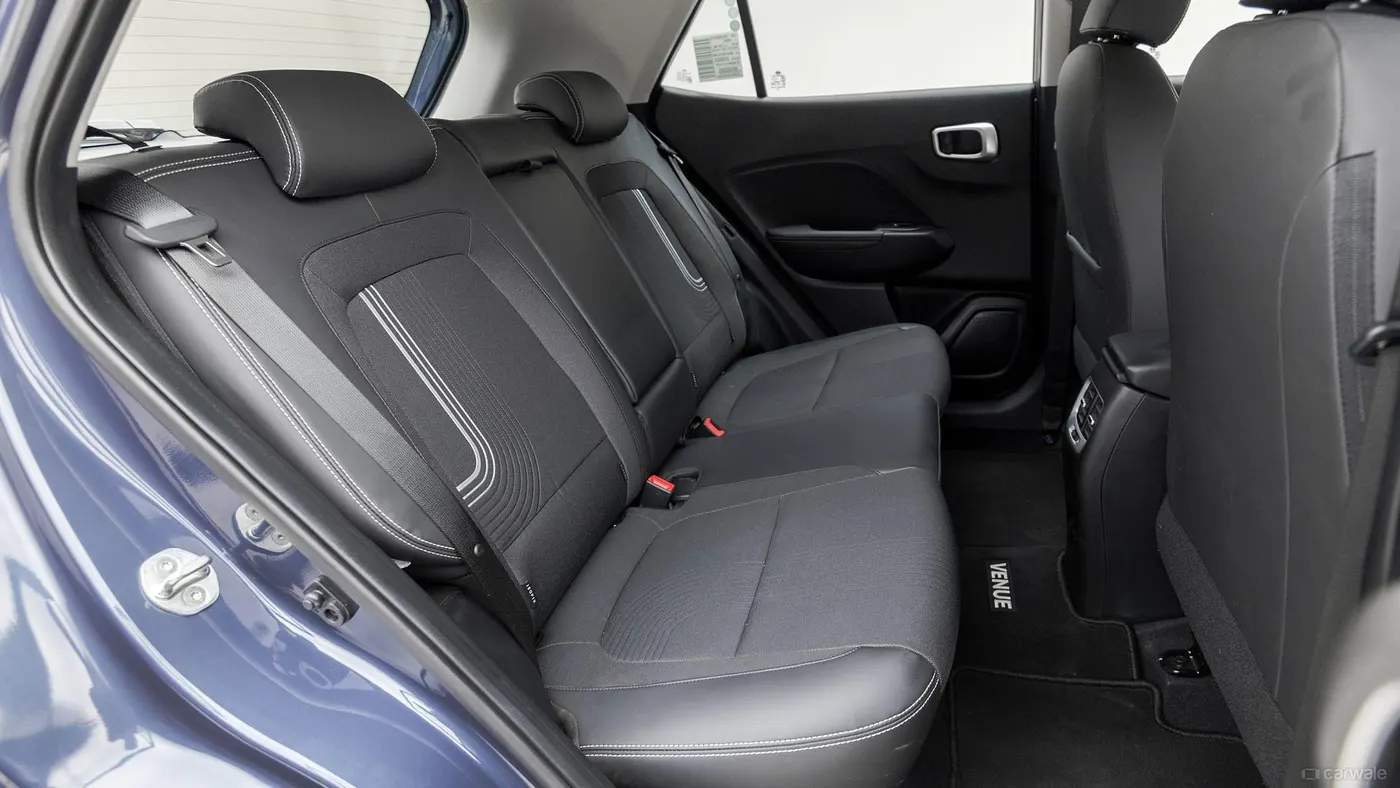
TATA NEXON XE
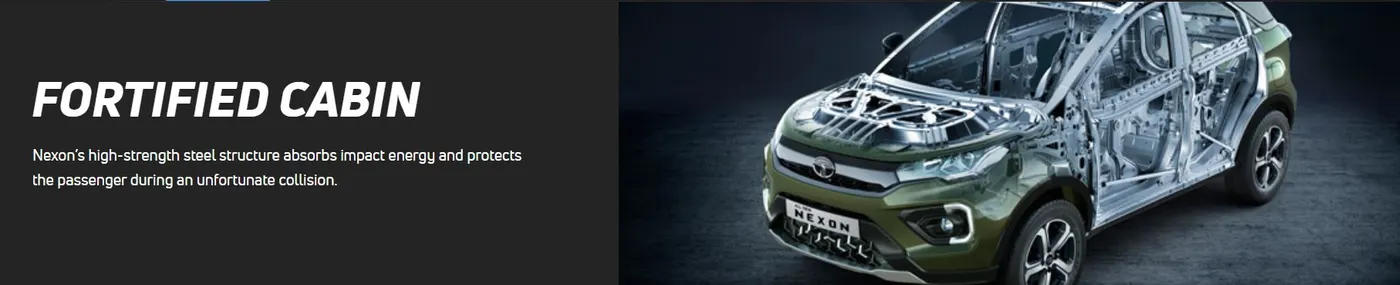
The trendsetter from the TATA stable, TATA Nexon is the first Indian car to score a 5-star Global NCAP safety rating. with its captivating appearance and one of the class-leading comforts, Tata Nexon is the only car in its segment to offer a turbocharged engine from its base variant onwards. Powering the Nexon is a 1.2L turbocharged petrol engine and 1.5L turbocharged diesel engine that transmit their power through either a 5-speed MT, 6-speed MT or AMT
Features:
LED DRLs, Multi Drive Models Eco/City/Sport, Dual airbags, LED tail lamps, front power windows, ABS with EBD, projector headlamps, Tilt steering
Rear parking sensors, Electronic Stability control, Digital Instrument Cluster, Traction Control, Flat-folding Rear Seat, Driver Seat Pretensioners with Load Limiters
Fixed Rear Headrests, ISOFIX, Luggage Hooks in Boot, Roll-over Mitigation, Hill Start Assist, Brake Disc Wiping
Pros:
- Upmarket looks, 5 star G-NCAP safety ranking
- Spacious cabin compared to rivals
- Easy to drive and live with
Cons:
- Interior Quality could be better
- Low-end grunt from motors
- Infotainment screen not good with competing models
- Mileage is backlag
|
Rear Row & Front Seats |
Sunroof |
|
|
Boot space |
Mode control | |
RENAULT KIGER RXT(O) AMT
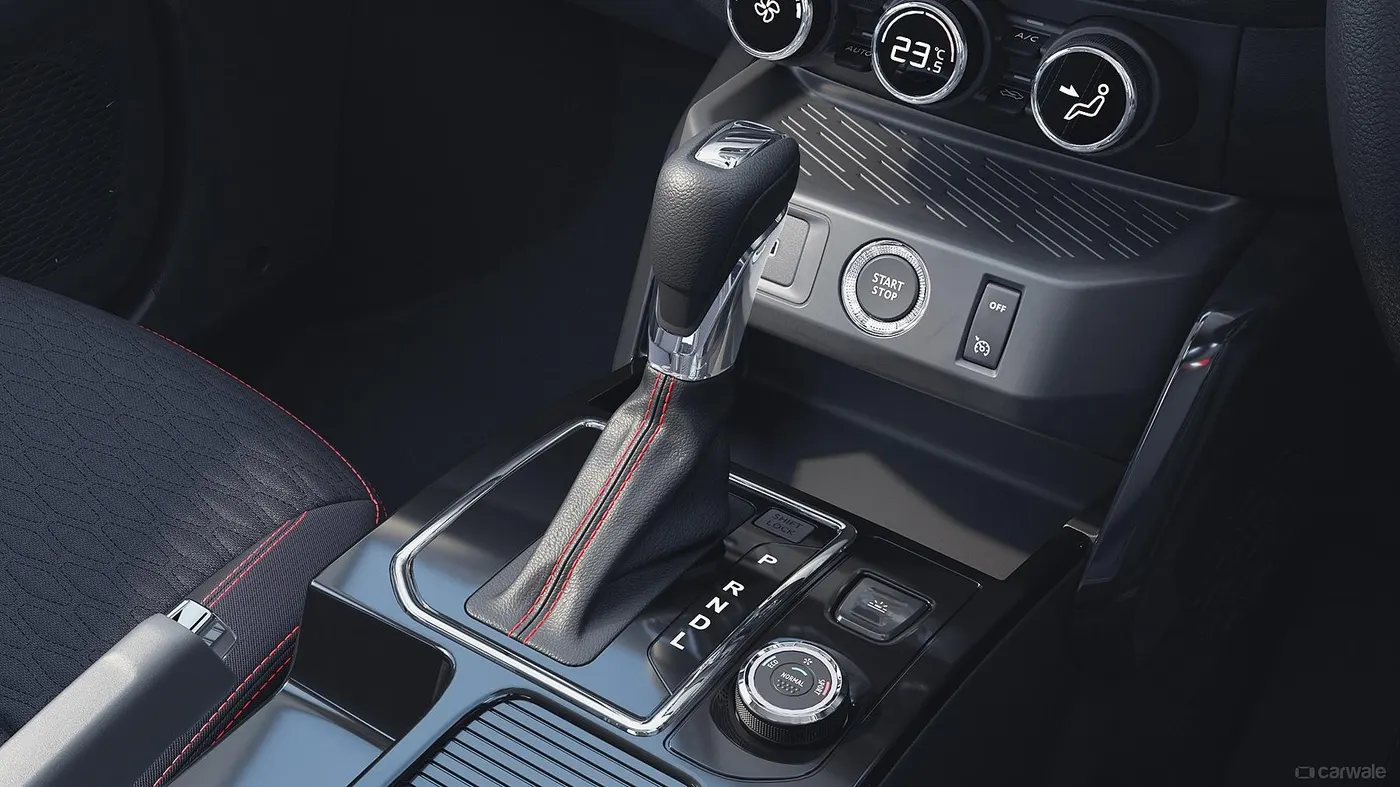
Renault Kiger RXT(O) AMT is a 5 seater Mid petrol variant with AMT transmission. Kiger RXT AMT has a 999 CC which produces a 71 bhp@6250 rpm power and 96 Nm@3500 rpm which is quite good enough for a family. It is available in 10 different colours.
Kiger RXT AMT has boot space of 405 ltrs which is large in this segment. It looks sporty and stylish. It is like a middle class luxury car. It is a NCEAP 4-star rated vehicle with 4 airbags.
With an automatic transmission it feels easy to drive in city traffic. It has touch screen display and connects android and apple car play.
Pros:
- Sprightly performance
- Feature-packed cabin
- Good-looking, affordable SUV
Cons:
- Tight for three adults in the second row
- Boot has a high loading lip
- Cost-cutting is evident
- Due to 3 cylindered engine some vibrations are there in cabin also
CONCLUSION:
From above studies & compared data TATA Nexon is the best in class vehicle compared to engine performance and safety rating with other competitive vehicles, but interior and infotainment system could be better & petrol variant lags of mileage. If Mr. D. S. Pughazhyendhii can increase his budget I would recommend TATA Nexon Diesel Variant priced 10.5 lacs on road which suits best.
But considering his budget & parameters like Safety, transmission and ARAI mileage the best suited vehicle for Mr. D. S. Pughazhyendhii and his family which comprises his wife, 5-year old kid, his father & his mother is KIGER RXT(O) AMT.