Basics of Probability and Statistics Week 1 Challenge
1.) Why there is a difference in the formula of variance for population and sample
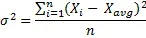
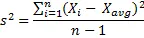
Ans:: Population variance refers to the value of variance that is calculated from population data, and sample variance is the variance calculated from sample data. Due to this value of denominator in the formula for variance in case of sample data is 'n-1', and it is 'n' for population data.
formula of variance for population is σ2=∑(xi−μx)2/N
formula of variance for sample is S2=∑(xi−μx)2/(N-1)
2.) Difference between stratified and clustered sampling
Ans:
| Stratified sampling | clustered sampling |
| cost reduction | enhanced precession |
| randomly selected clusters | randomly selected members |
| division naturally formed | depends on the researcher |
| more errors | reduced errors |
| homogeniety externally | homogeniety internally |
3.) How many different samples can be created out of population of size n
Ans :: if i cannot considering nullset the answer is 7 samples.
4.) What is the probability of drawing 2 jacks from a pack of card
Ans: 1/169
Total number of cards = 52
The probability of getting 1 jack = 4/52 (total jacks in a deck are 4 / total cards in a deck are 52) = 1/13 (for 1 jack it will be 1/13).
Hence, the probability of drawing two jacks is = (1/13).(1/13)
=1/169.
5.) What is the probability that both the numbers on dice are same while rolling 2 dice
Ans:: 1/36
The probability of one dice being a particular number is 1/6.
The probability of two dice being the same particular number is 1/6 x 1/6 = 1/36.
6.) Why standard deviation when variance can measure the dispersion in data
Ans:: the main reason is for units conversion. variance has a square, so the units are also in square form. so the units become wrong. to make it right we need to remove squares by applying square root on it. this method is called standard deviation. for removing sqaures we need standard deviation.
Variance is nothing but the average taken out of the squared deviations. Variance is expressed in Squared units. Standard deviation is expressed in the same units of the data available.