Basics of Probability and Statistics Week 1 Challenge
1) Why there is a difference in the formula of variance for population and sample
In most of the analysis we do not know the population mean and hence we estimate it with sample mean.But, sum of the deviation of the sample about the population mean is always greater than sum of its deviation about sample mean (Because sum of the deviations of a sample is always the minimum about its mean).Hence to compensate this we use (n-1) in the denominator when calculating variance using sample mean.
Using (n-1) we get variance greater than that calculated using (n), thus compensating the difference in deviation about population mean and sample mean
Example:
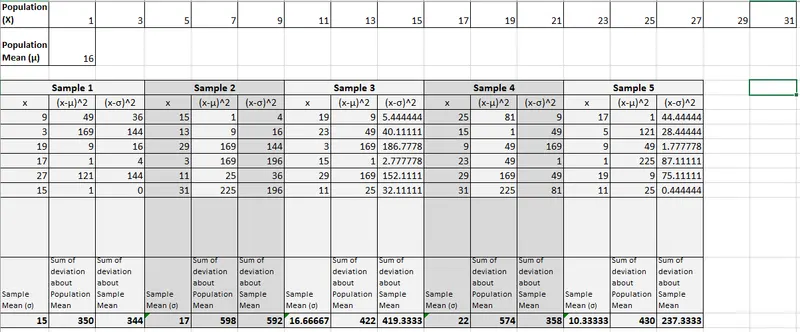
In the above example, we can find sum of the deviation of the sample about the population mean is greater than sum of its deviation about sample mean in all 5 samples. To compensate this difference we have (n-1) in denominator of sample variance formula.
2) Difference between stratified and clustered sampling
Stratified sampling technique is a probability sampling method where the population is divided to subgroups and members from each subgroups are radomly selected to form a sample.
Cluster sampling technique is also a probability sampling method where the population is divided into clusters and one of the cluster is randomly selected for sampling
The key difference between the two is in cluster sampling only one sample of subgroup (cluster) is chosen whereas in stratified sampling all the subgroups are selected for sampling.
3) How many different samples can be created out of population of size n
Number of sample of size 1 that can be formed from population of size n = `""^nC_1`
Number of sample of size 2 that can be formed from population of size n = `""^nC_2`
Number of sample of size 3 that can be formed from population of size n = `""^nC_3`
.
.
.
Number of sample of size n that can be formed from population of size n = `""^nC_n`
Number of sample of size 0 that can be formed from population of size n = `""^nC_0` (null set)
Total number of samples = `""^nC_0 + ""^nC_1 + ""^nC_2 + ""^nC_3 + ........ ""^nC_n`
By Binomial expansion,
`""^nC_0 + ""^nC_1 + ""^nC_2 + ""^nC_3 + ........ ""^nC_n = (1+1)^n = 2^n`
Hence, Number of different samples can be created out of population of size n = `2^n`
4) What is the probability of drawing 2 jacks from a pack of card
Number of cards in a pack = 52
Number of Jack in a pack = 4
With replacement:
Probability of drawing 2 jacks from a pack of card = `4/52 "x" 4/52 = 1/169`
Without replacement:
Probability of drawing 2 jacks from a pack of card = `4/52 "x" 3/51 = 1/221`
5) What is the probability that both the numbers on dice are same while rolling 2 dice
When two dice are rolled,
Probability that number on both dice is 1 = `1/6"x"1/6 = 1/36`
Probability that number on both dice is 2 = `1/6"x"1/6 = 1/36`
.
.
Probability that number on both dice is 6 = `1/6"x"1/6 = 1/36`
Probabilty that both the numbers on dice are same = `1/36+1/36+1/36+1/36+1/36+1/36=6/36=1/6`
6) Why standard deviation when variance can measure the dispersion in data
Standard deviation is calculated since it has the same unit as that of the original data and hence it provides better understading of the distribution of data while variance will have square of the original unit.
For example,
If original unit is in meter (m), variance will be in meter sq. (`m^2`) but standard deviation will be original unit meter (m)