Basics of Probability and Statistics Week 1 Challenge
Ans-1) Because the population is the whole and the sample is the part of the population.
Ans -2)
The main difference between stratified sampling and cluster sampling is that with cluster sampling , you have natural groups separating your population. For example, you might be able to divide your data into natural groupings like city blocks, voting districts or school districts. With stratified sampling , these breaks may not exist*, so you divide your target population into groups (more formally called "strata"). 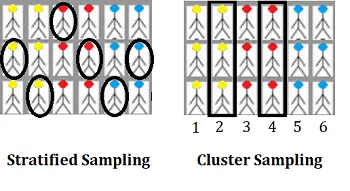
Ans -3) Simple random sampling (SRS) is a method of selection of a sample comprising of n number of
sampling units out of the population having N number of sampling units such that every sampling
unit has an equal chance of being chosen.
The samples can be drawn in two possible ways.
The sampling units are chosen without replacement in the sense that the units once are chosen
are not placed back in the population.
The sampling units are chosen with replacement in the sense that the chosen units are placed
back in the population.
1. Simple random sampling without replacement (SRSWOR):
SRSWOR is a method of selection of n units out of the N units one by one such that at any stage of
selection, any one of the remaining units have the same chance of being selected, i.e. 1/ . N
2. Simple random sampling with replacement (SRSWR):
SRSWR is a method of selection of n units out of the N units one by one such that at each stage of
selection, each unit has an equal chance of being selected, i.e., 1/ N
Ans -4)
The probability of drawing two cards of the same rank consecutively is:
the chance of drawing the first card X The chance of drawing the second card.
since the first card can be any of the 4 jacks, the chances of drawing one of them is 4(jacks) / 52(cards in deck).
the second card can be any of the remaining jacks, though there are now 51 cards in the deck so the chances of the second card also being a jack are 3(jacks)/51(cards in deck)
The chances of both happening are
(4*3)/(52*51) = 12/2652 = 1/221
So the chances of drawing the same rank in two consecutive cards is 1:221.
Ans 5) - 2/36
Ans 6) -The square root of standard deviation is known as variance.
Standard deviation is an absolute measure of dispersion. it is not suitable for comparison.