Basics of ML & AL Week 2 Challenge
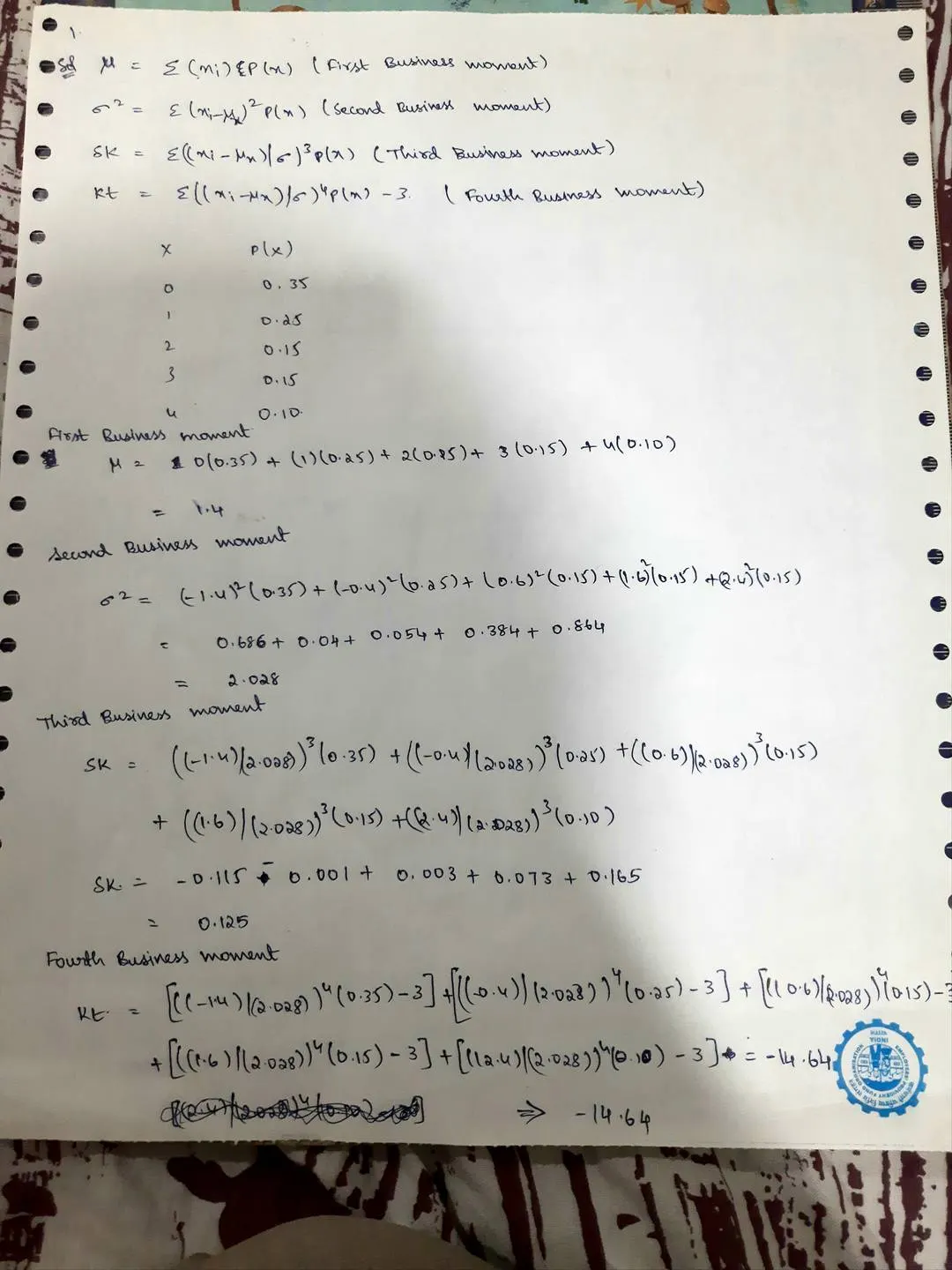
2.The expected value, when it exists, is almost surely the limit of the sample mean as the sample size grows to infinity. More informally, it can be interpreted as the long-run average of the results of many independent repetitions of an experiment (e.g. a dice roll). The value may not be expected in the ordinary sense—the “expected value” itself may be unlikely or even impossible (such as having 2.5 balls), as this is also the case with the simple mean.
3.Skewness:Skewness refers to distortion or asymmetry in a symmetrical bell curve, or normal distribution, in a set of data. If the curve is shifted to the left or to the right, it is said to be skewed. Having skewness in the curve is not a bad analysis,this skewness tells about wheather the curve is symmetric or not,and it also helps us to plot the different curves in the single one,where the median and mode will be the same for different curves and thus tells us wheather the curve is symmetric or not symmetric.
4.The probabilities for the given continous normal distribution are:
a.0.84
b.0.16
c.0.50
d.1
5.The above graph gives us more information,the above graph tells us that area under the curve for one(z=-34.1% to +34.1%),two(z=-13.6 to +13.6),three(z=-2.1 to +2.1) and four(z=-0.1 to +0.1) standard deviation from centre,the right side on the curve tells us that area under the right,we will use the values to find the area from z=0 to z=positive values,those values will be given under the Z-table.