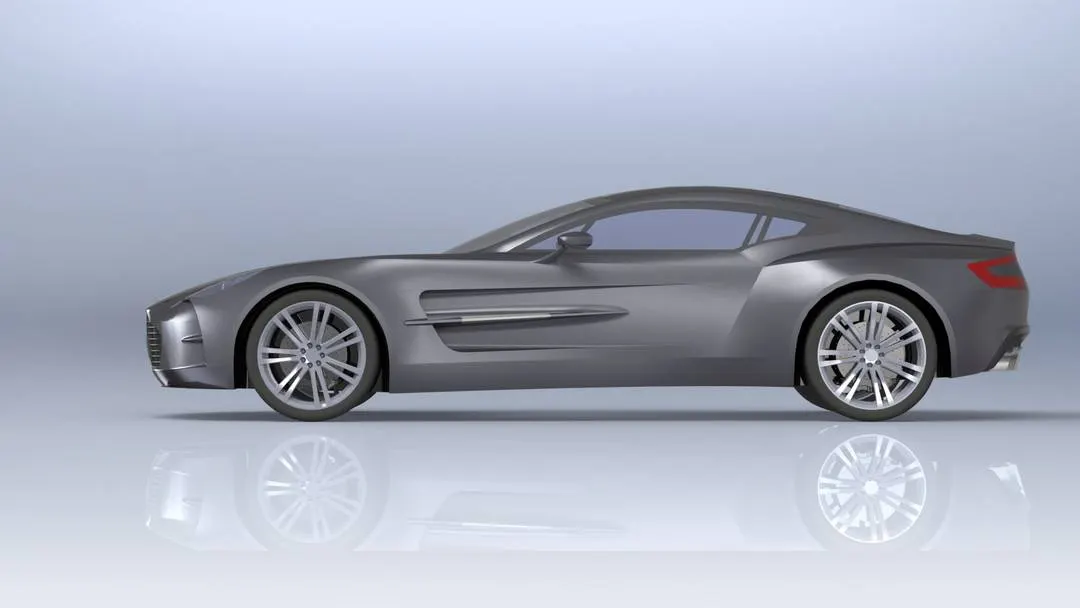
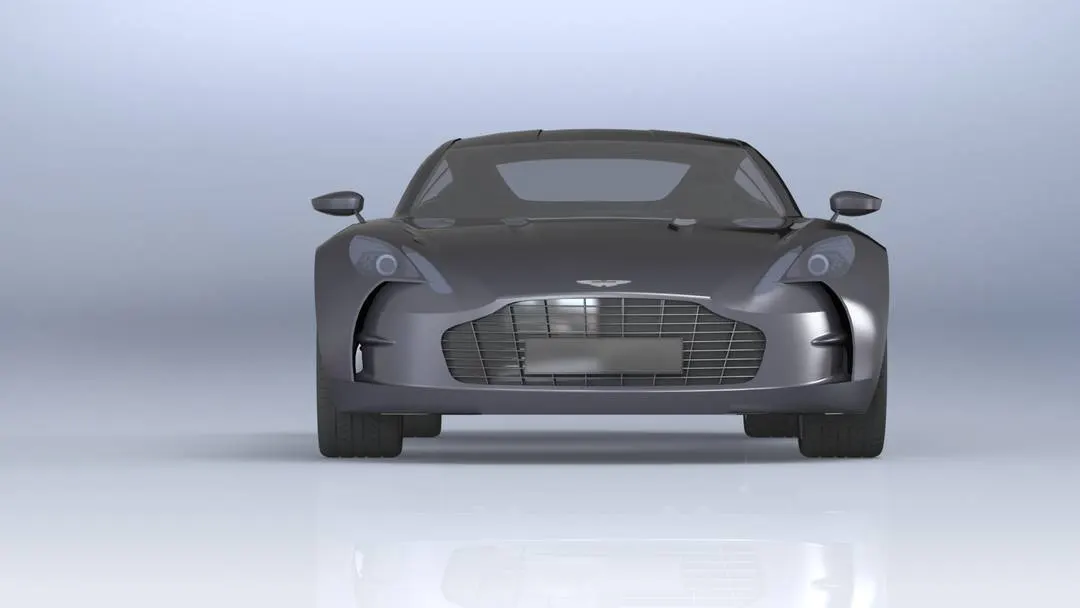
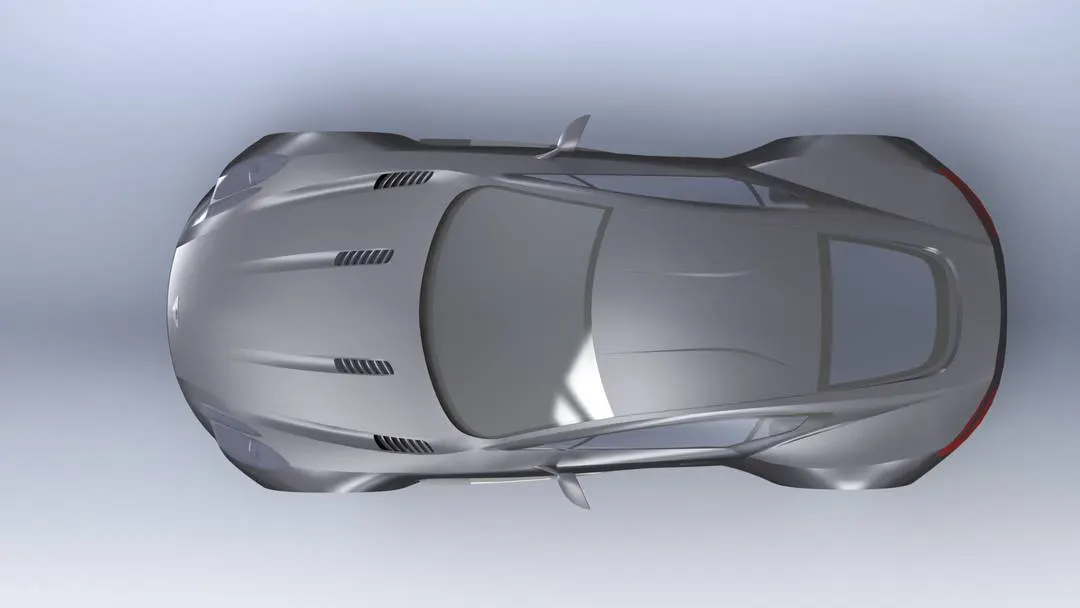
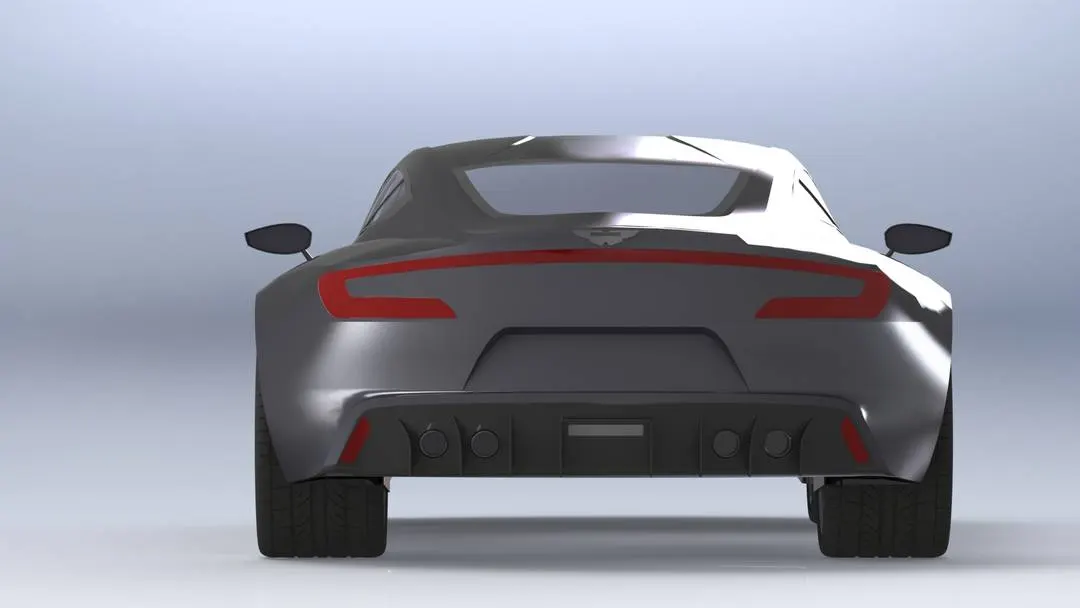
Aston Martin ONE-77 Challenge-11 (Project)
SURFACE MODELING OF 'ASTON MARTIN ONE-77' USING SOLIDWORKS
OBJECTIVE:
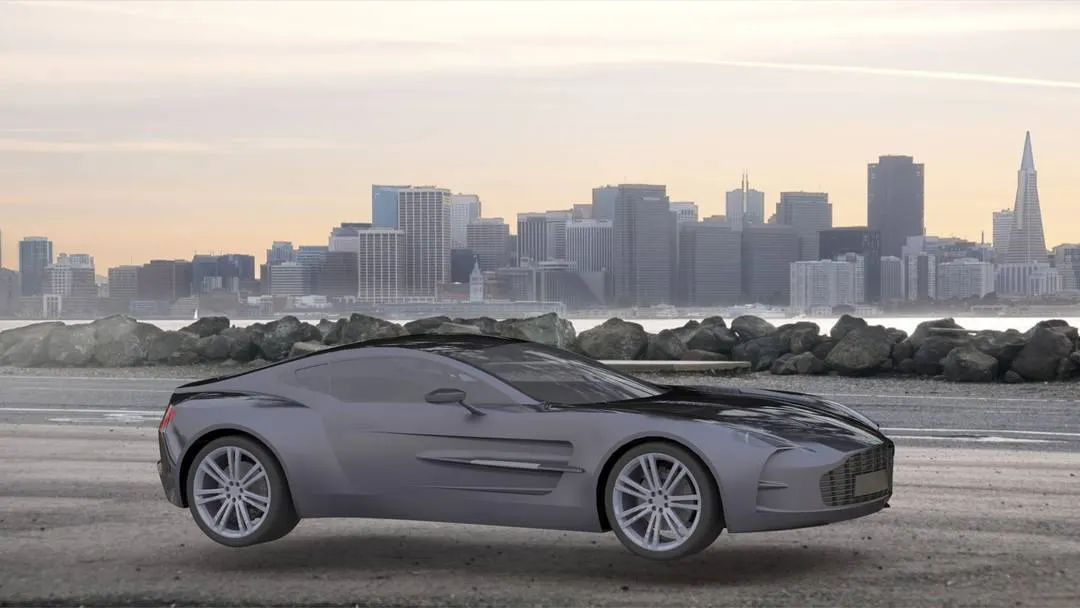
Apply surface modelling tools and features along with the application of solid modelling and assembly features in SolidWorks to Model the Aston Martin One-77.
INTRODUCTION:
SolidWorks is an amazing software to create 3D models of any components and products. Efficiently using its tools and features for advanced surface modelling helped in the creation of this stunning model of Aston Martin One-77. Having superior designing accuracy and using proper assembly methods, this model very closely resembles the actual car. Fully dimensioned sketches and curves are used to ensure the dimensional accuracy of the model. Some advanced features like pattern and mirror made the work even more efficient. Instead of making a complete model at once, the symmetry of the model favoured making only one side of the model and then mirroring it about its symmetry plane to almost half the work. Surface knitting tool and combining features bind the small elements of the model, giving its final state. Assigning suitable colours to different components give the model an aesthetic look.
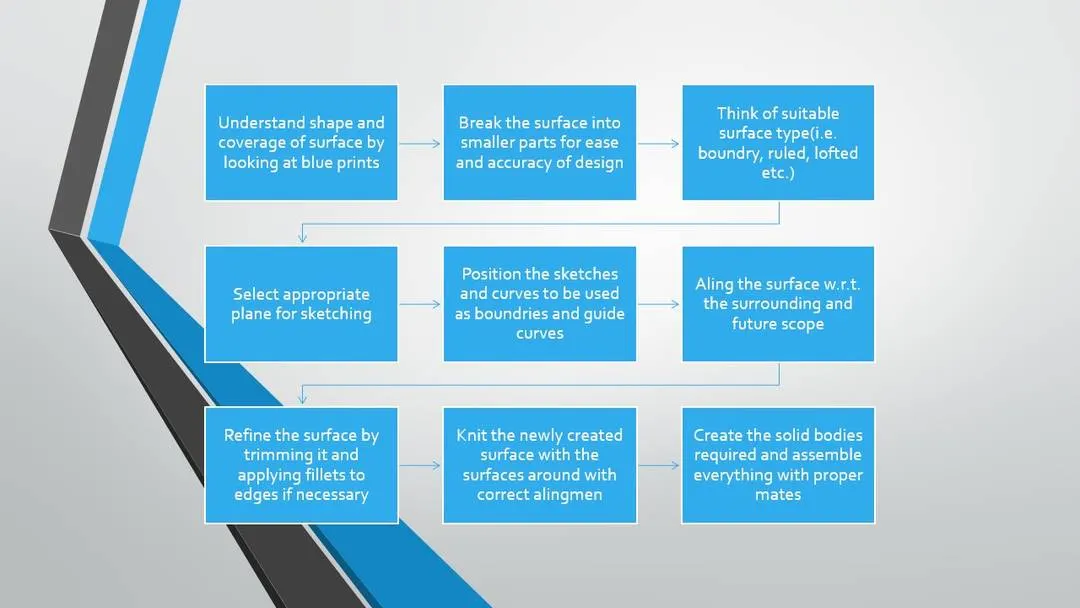
DESIGN METHODOLOGY:
DESIGNING TOOLS AND FEATURES:
- SKETCHING TOOLS
- 2D Sketches - as the name suggest this is drawn on a specific plane. For modelling of this car sketch entities like lines, splines and arcs were used the most.
- 3D Sketches - these are the sketches drawn all over the space. For this model, it is mostly used to join specific points in 3D space to be used as the boundary of a surface.
- Convert Entities - this tool lets us convert an already existing edge or sketch into new sketch entities of the same dimension on the plane on which new sketch is defined.
- Offset Entities - this tool works similarly to the Convert Entities tool with an exception that it creates the sketch of the selected entity at a specified distance from the original sketch.
- REFERENCE GEOMETRIES
- Point - a simple point is defined anywhere in the space of the desired location.
- Axis - an axis is positioned at the desired place for reference purpose.
- Plane - apart from the 3 base planes, a plane at the desired location is used to create sketches and for other reference purposes.
- CURVES
- Projected Curves - the most useful curve in this modelling is projected curves. It is generated by creating sketches on two different non-parallel planes and then projecting them on each other to create a curve in 3d space between these planes.
- Projection on Face - this type of curve uses only one sketch which is projected into the face of an already existing surface or solid.
- 3D splines - one of the simplest and efficient ways of creating a curve is drawing a spline in space using the 3D sketch tool.
- SURFACES
Generating a surface to create the model of the car is the sole purpose of this project. There are different types of planes and numerous ways to create them.
- Boundary Surface - most used type of surface for this model. This type of surface requires input in minimum 2 directions, it gives the most accurate result when a closed well-defined closed profile is given as boundary. Although there are ways where an open profile can be used and let SolidWorks guess and build the surface, this is not an accurate method. A surface can be trimmed by profile selected. We can also give special alignments like tangency or normal to its surroundings. Generally, a guide curve is also provided to get the desired shape.
- Lofted Surface - This tool creates a surface by joining different profiles with additional guide curves. All the alignments mentioned in the boundary surface are applicable in the lofted surface as well.
- Filled Surface - this the easiest way of creating a surface. This works a patchwork, edges of already existing surfaces are used to fill the gap between them by creating the desired surface. The accuracy of this type of surface is less and can not be controlled. Alignments with surroundings can be adjusted in these too.
- Ruled Surface - a sketch entity is transitioned for a specified length in the desired direction which again is given by another sketch.
- Surface Trim - the existing surface is trimmed with the help of a sketch or another surface.
- surface Knit - this tool knits the neighbouring surfaces converting them into a single surface body.
- Move/Copy Surface - this feature helps in relocating and making a copy of an existing surface.
- Mirror Surface - this is another useful feature with help of which a surface can be copied as a mirrored surface of the selected surface about the symmetry plane.
- SOLID MODELING
- Boss Extrude - a 2D profile is extruded to a specified given dimension to build a 3D solid.
- Extruded Cut - this is opposite of boss extrude, solid is removed from a 3D entity.
- Revolve Boss & Revolve cut- profile is revolved around an axis to create 3D geometry in the revolved boss feature. The reverse is valid for revolved cut, a profile is revolved around an axis to remove solid.
- Linear and Circular Pattern - a solid body or solid feature is repeated several times in a linear direction. A similar thing happens in a circular pattern in a circular direction instead of linear. The number of instances and distance between consecutive bodies can be controlled to get the desired result.
- Fillet - a curvature is given to solid edge to eliminate the sharp edges. The radius of the fillet can be kept constant or variable as per requirement.
- Chamfer - solid edge is cut using either distance and angle or distance to both sides of the edge.
- Split - the body is divided by using a profile and converted into two or more speared solid bodies.
- ASSEMBLY
Bodies are inserted in an assembly file and attached using different kinds of mates which is suitable according to the situation. The first body inserted is always fixed body other parts are mated with respect to the fixed body. The part whose motion is constrained fully is fixed part and the part which is free to translate or rotate in any direction is floating body.
CONCLUSION:
Using all the above tools and features this beautiful model of Aston Martin One-77 was created with utmost possible accuracy to match the original car. Below is the rendered images of the final model.