Assignment 5-RADIOSS Interfaces & Study of Effect of Notches Challenge
AIM:
1. To mesh the given bumper assembly.
2. To run the analysis of a crash box in radioss solver according to the given conditions.
PROCEDURE:
1. Meshing of bumper assembly:
- First the model is imported using the import option.
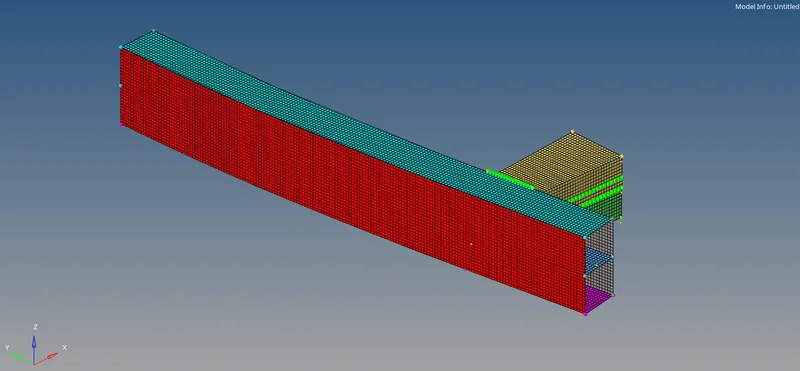
- Automesh command is opened (F12) and the target size is kept as 6mm.
- The surfaces are selected and the mesh is deployed.
- Changes are made by increasing or decreasing the number of nodes.
- Once the changes are finalized, the mesh is saved by clicking on return.
- This way, all the surfaces are meshed one by one.
2. Crash box analysis in Radioss:
Case 1:
In this case, the model is imported and run as it is without making any changes to the default settings & file parameters.
Case 2:
For this case, the model is imported. Then the ‘inacti’ parameter is changed to 6 from the default setting. The parameter ‘inacti’ is used to remove initial penetrations in the model during the analysis. With this setting, the analysis is started.
Case 3:
For case 3, a type 11 contact is created between 2 edges. The recommended parameters for type 11 contact are set and then the analysis is run.
Case 4:
For this case, the notches in the model are removed and the boundary conditions are also removed. This is done to see the effect of notches in the model. With this setup, the analysis is started.
Case 5:
For the 5th case, a new notch is created in the middle. Other notches are removed and then the analysis is run.
Case 6:
For the 6th case, the notch is created with the nodes from 2 opposite faces. Then the analysis is run.
RESULTS:
1. Meshing of bumper assembly:
Completed model:
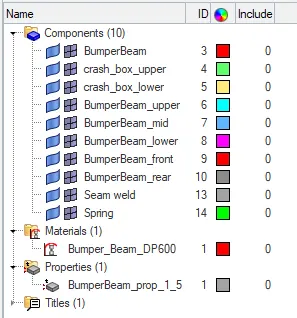
Component collectors:
2. Crash box analysis in Radioss:
Case 1:
TOTAL NUMBER OF CYCLES : 83496
ELAPSED TIME = 193.41 s
With the default settings, the number of cycles the simulation has run are high. As the number of cycles is high, the solver has taken more time to solve the given model. In contacts, we have the type 7 contact with default settings.
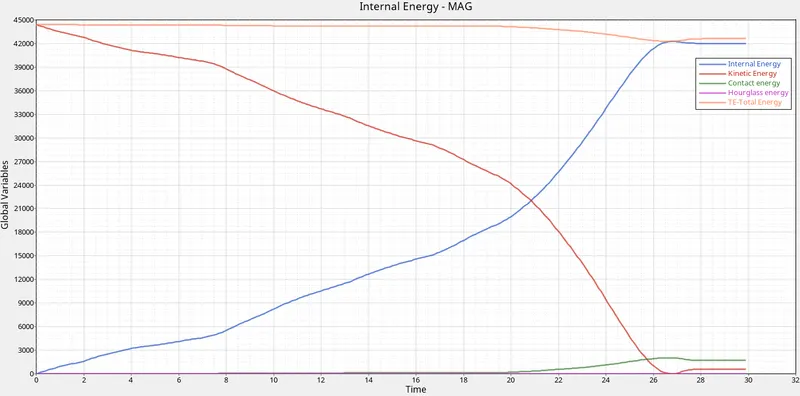
Von mises stress - 0.5867 `(kg)/(mm^3)`
Case 2:
TOTAL NUMBER OF CYCLES : 83496
ELAPSED TIME = 192.27 s
For this case we have changed the inacti parameter to 6. In this, the initial penetrations, if any, are removed by the solver. As a result, we can get a more accurate result. So the number of cycles is still the same but the time taken to solve is slightly reduced.
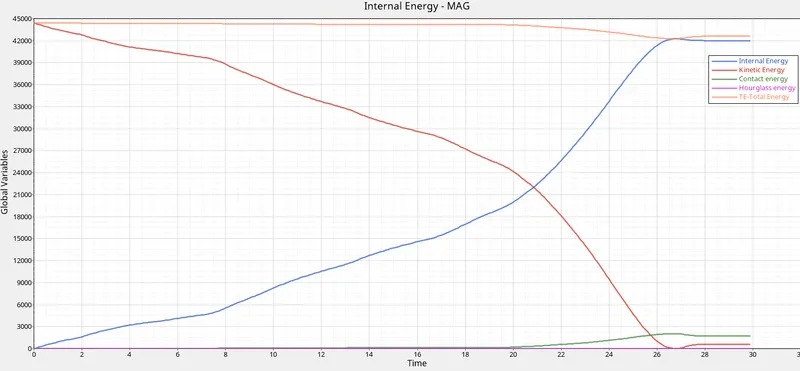
Von mises stress - 0.5867 `(kg)/(mm^3)`
Case 3:
TOTAL NUMBER OF CYCLES : 78519
ELAPSED TIME = 170.43 s
In this case, we created a type 11 contact which is between two edges. The slave & master are the same component. We can notice that the number of cycles has reduced as the contact type is changed from type 7 to type 11. This is because the type 7 contact takes more time and also needs more parameters to be given while defining the contact. We can also see that when the contact is properly defined with the right parameters set, the analysis takes lesser number of cycles and the time taken to solve is also lesser.
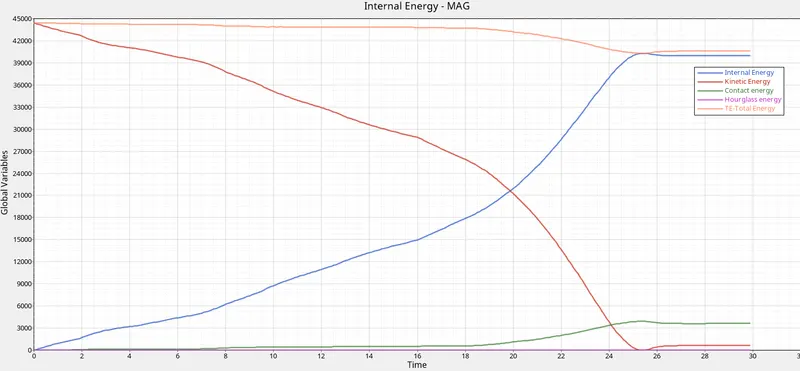
Von mises stress - 0.5718 `(kg)/(mm^3)`
Case 4:
TOTAL NUMBER OF CYCLES : 78675
ELAPSED TIME = 173.25 s
For this case, we have removed the notches and also the boundary conditions on the rigid body node. When the model is run, we can see that the number of cycles has increased compared to the previous case. When the notches are removed, the stiffness of the model is higher than before and the solver takes a little more time to solve the model than the before case.
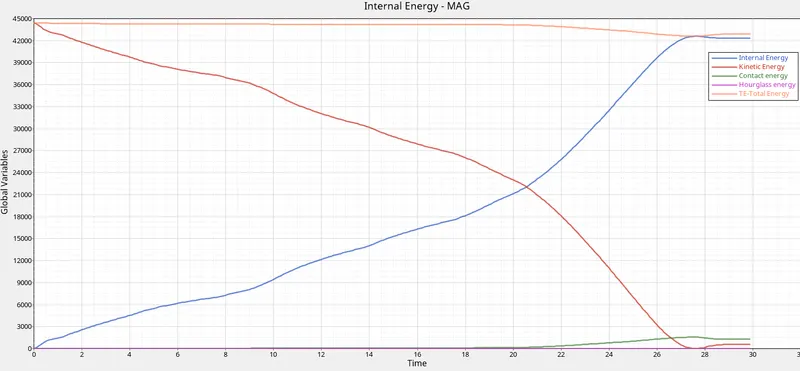
Von mises stress - 0.6203 `(kg)/(mm^3)`
Case 5:
TOTAL NUMBER OF CYCLES : 73480
ELAPSED TIME = 144.00 s
In this case, a notch was created in the between. Notches are used to direct the deformation in the model. Since we have a notch in the middle of the model, the deformation starts from the notch and it is spread over the whole crash box. In such a deformation, the model absorbs more energy from the crash during the deformation. It is to be noted that the number of cycles and the analysis time is significantly less from the previous cases.
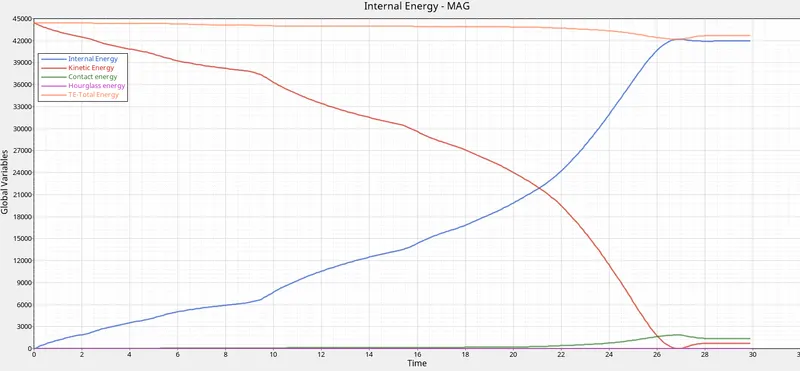
Von mises stress - 0.6132 `(kg)/(mm^3)`
Case 6:
TOTAL NUMBER OF CYCLES : 75430
ELAPSED TIME = 162.69 s
For this case, we have a notch only on the opposite faces. As compared to the previous case, the notch in this case is lesser. So we can see the deformation is lesser as compared to the previous case. As a result, we can see the number of cycles and time taken to solve being more in this case.
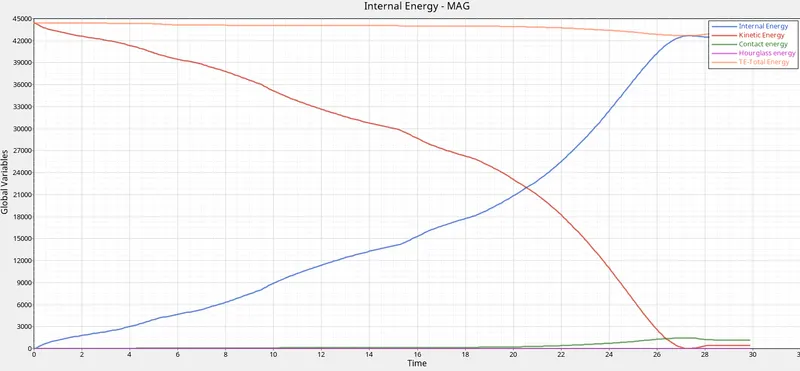
Von mises stress - 0.6031 `(kg)/(mm^3)`
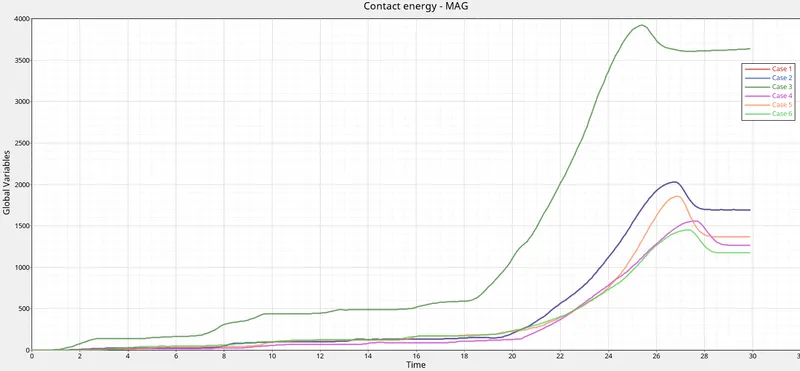
On comparing the contact energies of all the cases, we can see that the contact energy is highest in the third case. This is because of the type 11 contact. As we have the edge to edge contact, the contact is more than other types of contacts and the contact energy is also higher.
CONCLUSION:
From the analysis performed we can conclude that,
- In the energy plot, we are able to see that the kinetic energy from the maximum is decreasing till the end of the simulation. This kinetic energy is converted to internal energy. The total energy is constant upto 20 ms and slightly decreases after 20 ms.
- The criteria 'Inacti' is required to be defined as it removes any initial intersections in the model if they exist. It helps to obtain a more accurate result and also reduces the no. of cycles & time taken to solve.
- The type 11 contact is given between 2 edges and requires lesser parameters to be defined and also takes comparatively lesser time to be solved than a type 7 contact.
- Notches are an important part of the model which help in directing deformation when a load is applied.
- They help in making the component absorb maximum energy when a load is applied.