Studying model behavior after using different material laws and failure models in Radioss.
Aim: Study the behaviour of provided model using different material laws and failure models along with material laws and concluding which case be best for on-field scenario.
Procedure: Now, we already know from earlier project i.e. Assignment 3 what we need to access model in radioss and how to proceed with starter file and engine file to what can we conclude from energy error and mass error values.
So similarly, we will first open starter file using import option and selecting solver deck file. Then we will run this file for analysis using radioss solver. So, that we can access the graphs and animation file for same provided model.
Now, we will repeat the solving for different cases by changing the required values.
Cases to be studied:
1) Run the model as it is with the provided properties:
In this we were not asked to change any material property for model. What we need to notice is this that which type of law was used and is there failure model linked to it in this case and any other specific parameter that may decide failure parameter.
And during study we found that a failure Johnson card was linked to material card and also eps_p_max was defined which defines failure plastic strain.
Now it may seem very confusing from above statement what is this material card and failure card. This will be well understood by this article https://insider.altairhyperworks.com/accuracy-matters/
As we all know, today virtual testing is quickly reducing the need for physical product testing and is fast becoming a required component in the early stages of the design process. While simulation is having a great impact in improving product quality and time to market it also highlights the challenges related to accurately predicting and simulating model and material behaviour for dynamic loading events such as a vehicle crash or impact. Precisely modelling and simulating complex events such as material rupture, fatigue and crack propagation requires a rich simulation solution with extendable material and failure models.
So, material card here defines the properties for material. And failure card will help setting conditions for model to check its failure under different conditions.
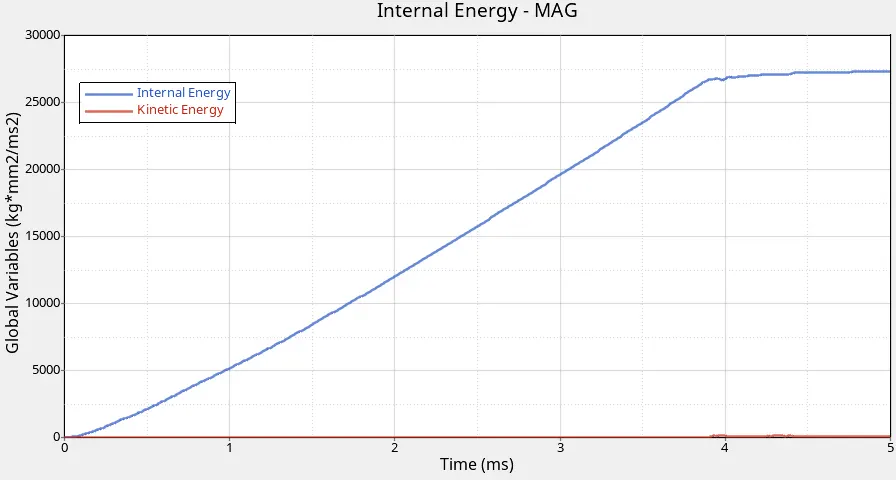
So, for this case it was noticed that Energy error was lying in between range of -0.6% to 1.3%. And mass error was found consistent to be 0. Runtime for same was 65.98 sec with 11 frames of animation.
Now after observing animation we noticed that, ball on falling the plate first cracked the plate and then passed tearing it off. Now we just don’t know that wheatear elements in plate are being deleted or cracked in total. So, to know this we need to check a value in failure model i.e. of Ixfem. If its value is 0 than we say element gets deleted, and if value is 1 than we say element gets cracked. In this case Ixfem was not allotted anything that means it will set it as default value i.e. 0 means elements are being deleted.
2) Run the model after making changes in Fail/ Johnson card as per specifications.
Values to be changed: Ixfem =1, Dadv = 1, Ifail_sh = 1.
Now, in this case we already know Ixfem = 1 so that means this time elements will be cracked instead of being deleted.
And other parameters keeping same as of earlier. Then we did run the solving for these values again and observed the parameters, graph and animation again.
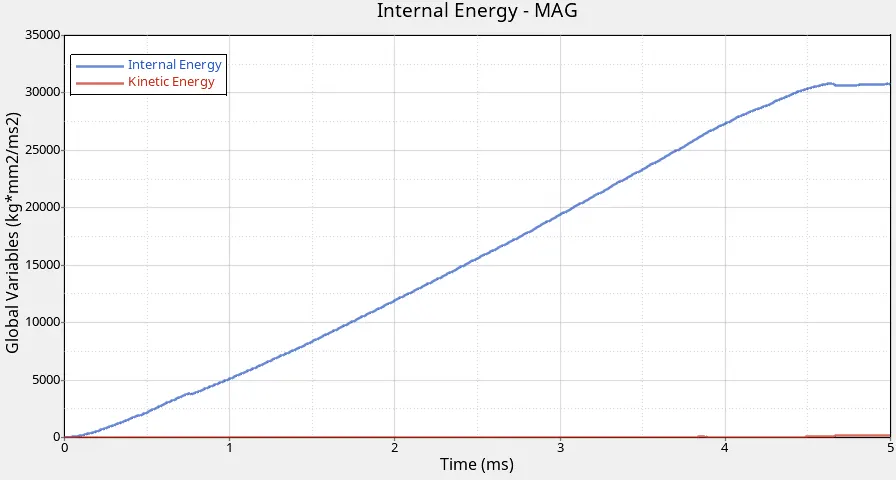
So, for this case it was noticed that Energy error was lying in between range of -0.6% to 4.5%. And mass error was found consistent to be 0. Runtime for same was 77.98 sec with 11 frames of animation.
This time also again plate was being first teared off and then later cracked and went through it. But this time elements were cracked instead of being deleted.
3) In this we just need to unlink Failure card with material card.
This is how first we will be unlinking failure card with material card like this:
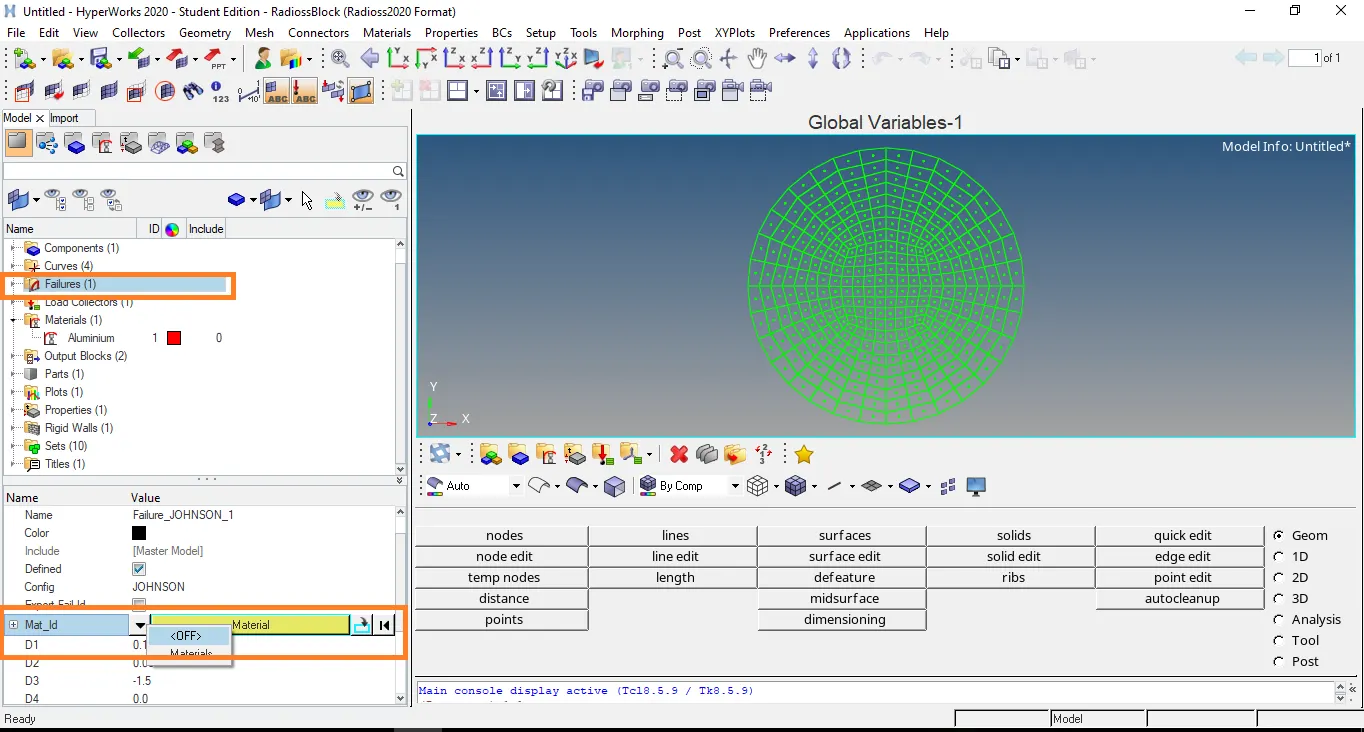
This way we can either off the linking or otherwise we can also delete the failure Johnson card completely. After this we again need to solve the model using radioss and then observe results. This time we found that Energy error was lying in between range of -0.6% to 1.0%. And mass error was found consistent to be 0. Runtime for same was 61.14 sec with 11 frames of animation.
This time as we don’t have parameter to control element deletion as Ixfem is not used to here in this case elements are being deleted.
4) Run the model after deletion of Eps_max value from earlier card model.
For this, we need to first remove the value allotted to Eps_max factor in material card of that model. We can make it zero. As told earlier, Eps_max is the factor which looks after failure plastic strain.
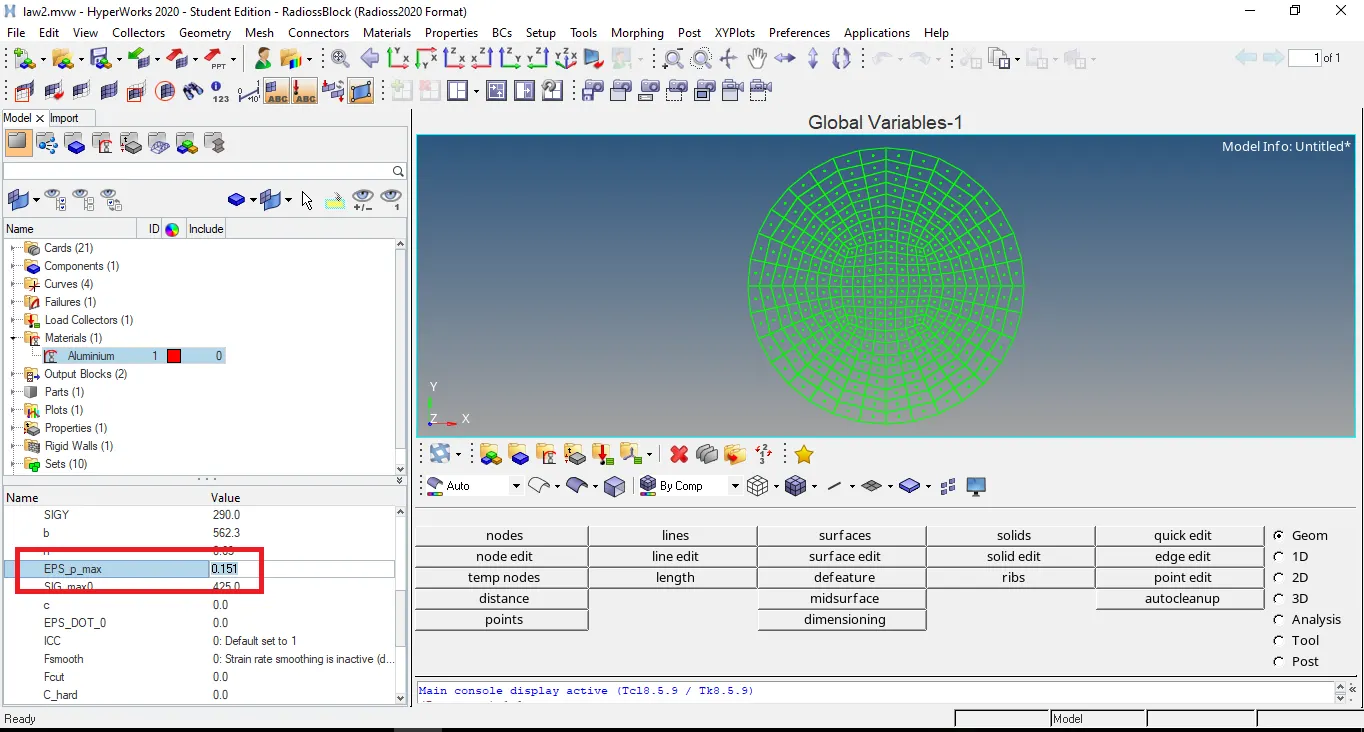
Now we will repeat process like before, we will first solve this by using radioss solver and later we will observe animation and graphs created while solving.
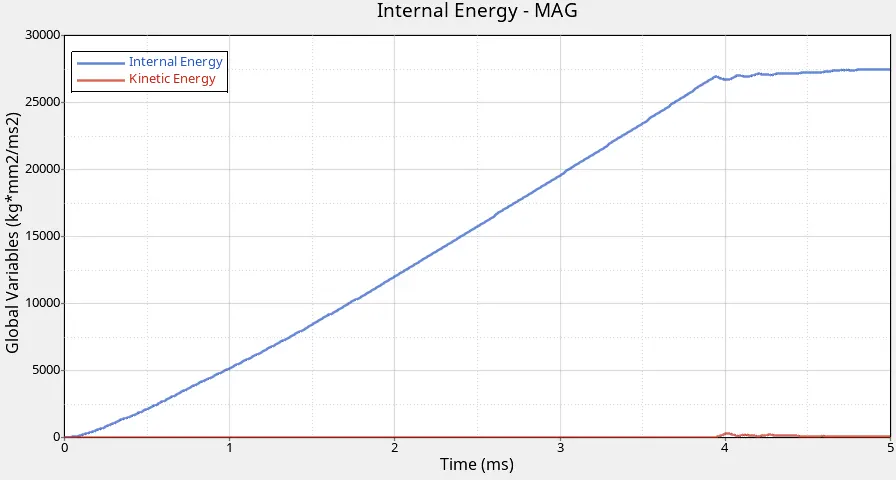
So, for this case it was noticed that Energy error was lying in between range of -0.6% to 1.3%. And mass error was found consistent to be 0. Runtime for same was 79.24 sec with 11 frames of animation.
This time also again plate was being first teared off and then later cracked and went through it. But this time elements were cracked instead of being deleted.
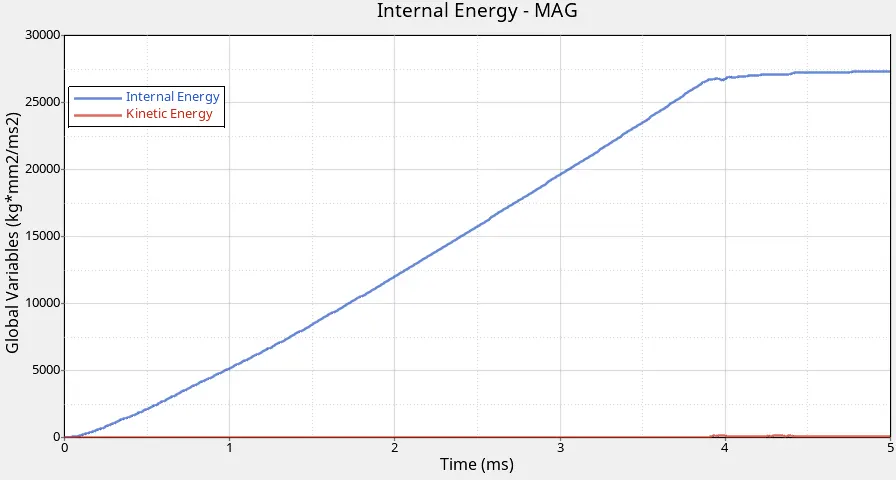
5) Run the provided model using LAW1 i.e. Elastic Material.
So, whatever analysis we did till now was done for Law2 i.e. for elasto-plastic material now it will be purely elastic material. So, this time we expect different results from earlier cases.
To do so we just need to change the Card image type the law which follows totally elastic behaviour i.e. Law1.
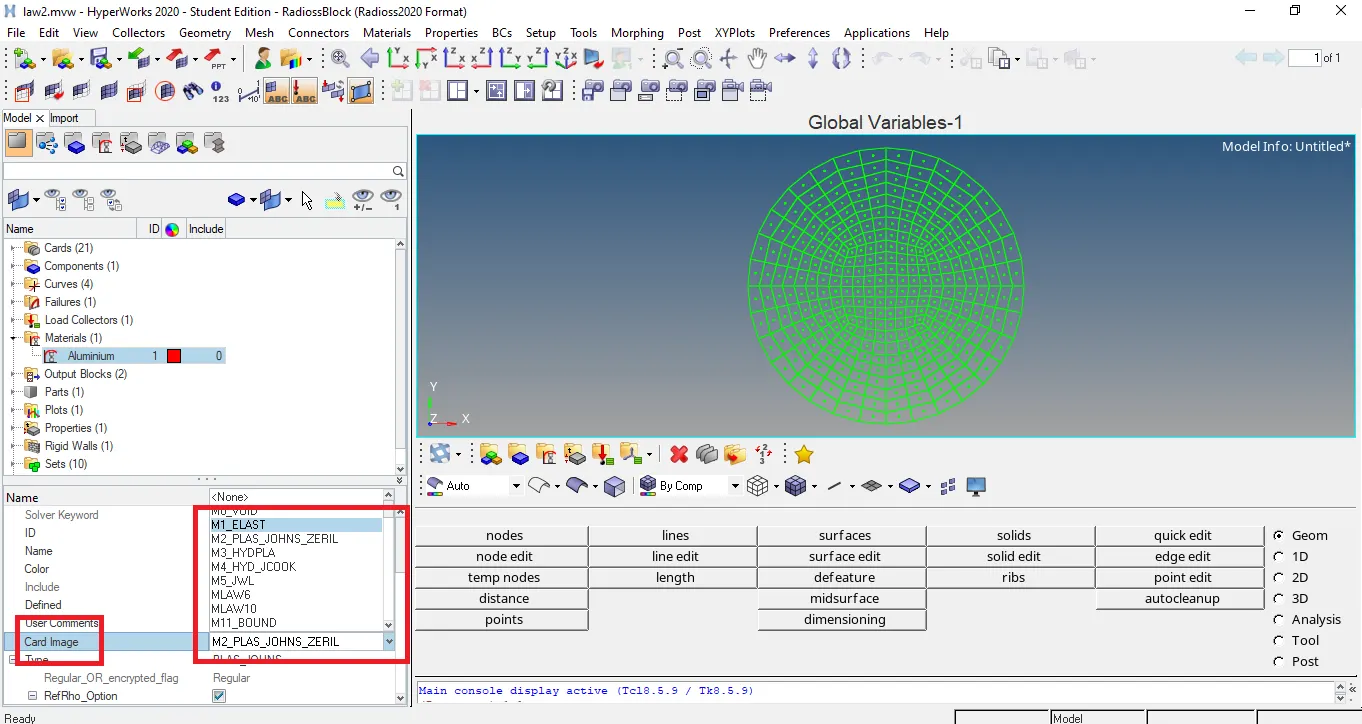
After making these changes we will again solve same using radioss solver and later analyse animation and graphs from the file created after solving.
So, for this case it was noticed that Energy error was lying in between range of -0.6% to 4.0%. And mass error was found consistent to be 0. Runtime for same was 59.36 sec with 11 frames of animation.
From, animation we will observe that neither plate teared off or cracked. Which means failure didn't happened element were intact with model itself
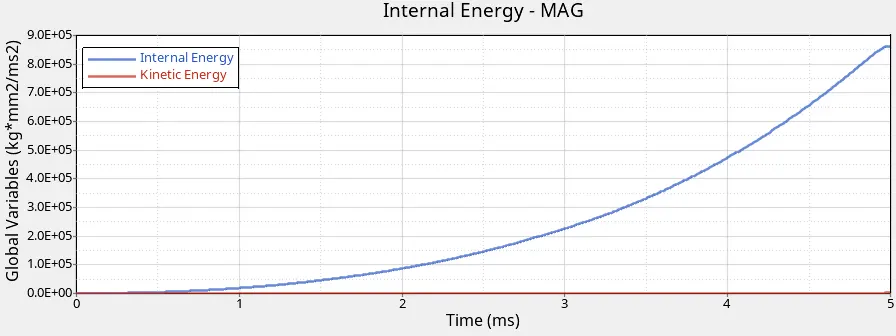
6) Run the provided model using LAW1 i.e. Elastic Material.
So, whatever analysis we did till now was done for Law2 and Law1 i.e. for elasto-plastic material and elastic material respectively. Now it will be purely brittle material. So, this time also we expect different results from earlier cases.
To do so we just need to change the Card image type the law which follows totally brittle behaviour i.e. Law27.
After making these changes we will again solve same using radioss solver and later analyse animation and graphs from the file created after solving.
So, for this case it was noticed that Energy error was lying in between range of -7.1% to 0.5%. And mass error was found consistent to be 0. Runtime for same was 73.76 sec with 11 frames of animation.
This time also again plate was being first teared off and then later cracked and went through it. But this time elements were cracked instead of being deleted.
Conclusion:
Based upon the above cases we can differentiate the activity of plate under different circumstances. Now before coming to conclusion we should know a lot more other than the above-mentioned text i.e. all link provided in references are helpful to better understand about materials and failure models. In referred links you will come to know about material compatibility with the type of model. Types of material card available and what all we can define in it to have better results which matched the physical testing almost. Similarly, it will be better to go through the link provided once to understand this task properly.
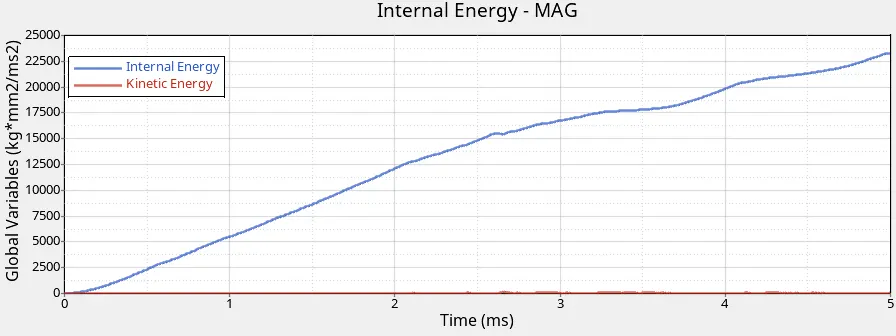
Talking about above cases we can read graphs by seeing animation and graphs simultaneously. Like after seeing i concluded that initiation of failure started when the graphs follows linear value after the slope we can see in every case. And the values in global variable defines how easily the plate breaks in that case reaching those values. Based upon which time was also decided for crack initiation.
Now to conclude we must select one of above cases which reflects best for on-filed scenario. So, for this we will always want that our plate should not break that means failure should not happen for that Law 1 follows the best as the energy error also remains in best possible limits. But if we need to select from Elasto-Plastic material than I will say Law 2 was best as crack initiation was late and also better control options were available.
Drive Link :
https://drive.google.com/drive/folders/1SE9sakAEwsl06-Y4YzLg1ZR171o0mAj2?usp=sharing
Refrences :
1. https://insider.altairhyperworks.com/accuracy-matters/
6. https://2020.help.altair.com/2020/hwsolvers/rad/topics/solvers/rad/failure_models_starter_r.htm
7. https://2020.help.altair.com/2020/hwsolvers/rad/topics/solvers/rad/fail_johnson_starter_r.htm