Assignment 4
AIM : Compare SI vs CI and list down differences, comment on parameters like BSFC, Exhaust Temperature, A/F ratios and change MFB 50 values and observe changes.
APPROACH : Open the tutorial files in GT-ISE and in engine performance choose for respective SI-final and CI-final engines from the file 01-1cylDIorSI
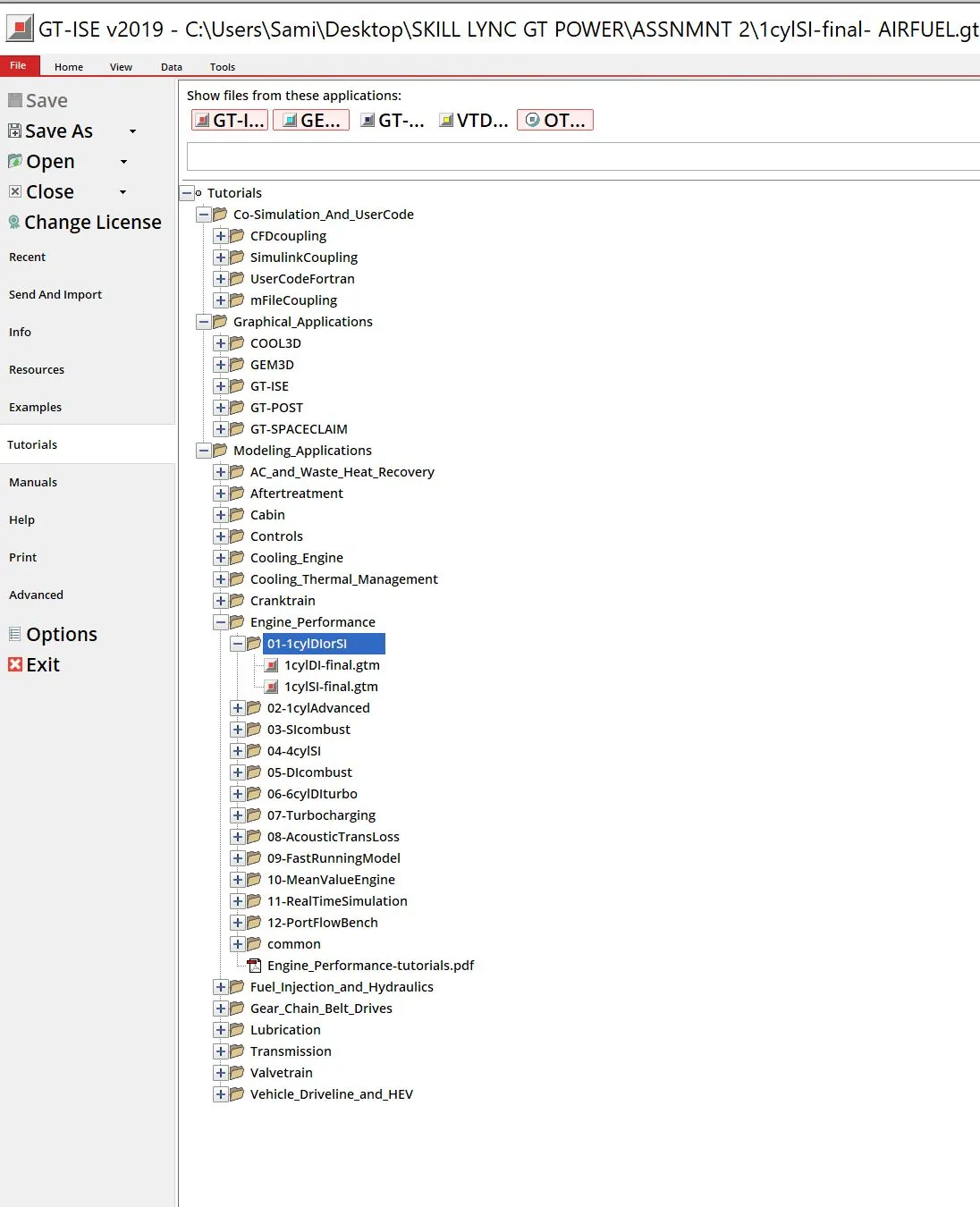
We will first run at max RPM's possible for SI and CI engines.
a. SI vs CI differences
i. Geometry differences:- CI engine (Left image) have large bore and stroke i.e. a larger cylinder than SI engines(Right image). This is due to the fact that it has high Compression ratios hence swept and clearance volume is higher and it has to have a larger cylinder size
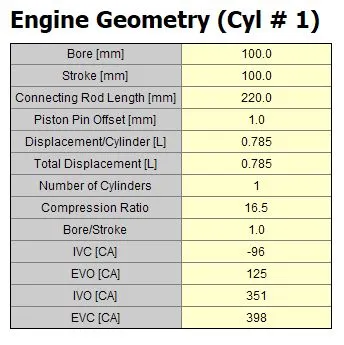
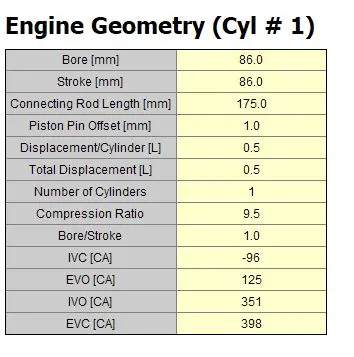
Fig.1 CI engine (left) vs SI engine (right)
ii. Compression ratio (CR):- From figure 1 we can see that compression ratio of SI engine is low and max can be taken upto 11:1 this limitation is to avoid knocking in SI engines. Whereas for CI engines CR can go upto 19:1. Hence, CR of CI engines is on high side compared to Si engines.
iii. RPM:- CI engines (left) have lower RPM due to higher inertia and have range between 1000-4000 RPM while SI engines (right) can be operated from 1000-8000 RPM.
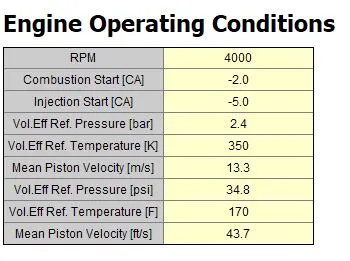
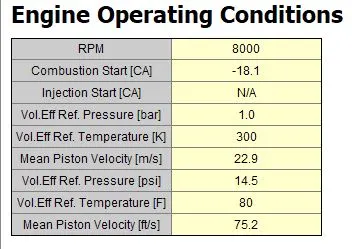
Fig.2 CI engine (left) vs SI engine (right)
iv. Power and Torque:- It is evident from the figure below that even after SI engine (right) operating @8000RPM has lower power and torque compared to CI engine (left) operating @4000RPM. The compression ratio of normal diesel engines is higher than that of its gasoline counterparts. It adds to the development of higher peak pressure inside the combustion chamber and, hence, on the crankshaft. Also Diesel fuel has lower calorific value and is denser than gasoline. Diesel also burns steadily and faster than gasoline. So, for a liter of fuel, you have more energy in diesel.
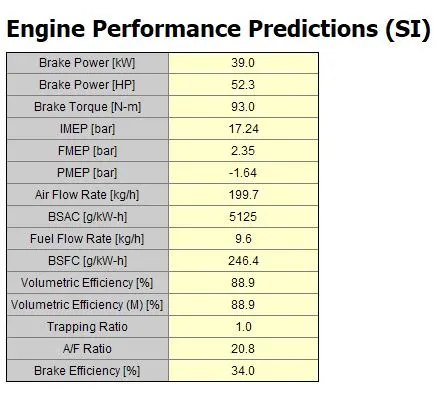
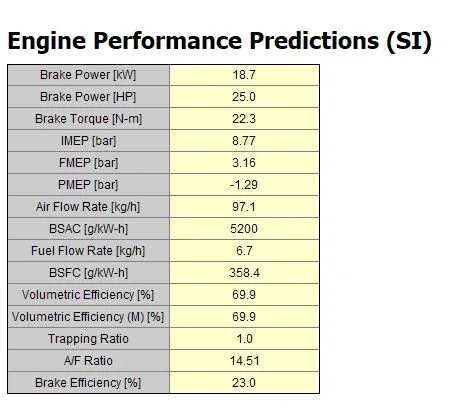
Fig.3 CI engine (left) vs SI engine (right)
v. Emissions:- For CI engines as it operates at leaner air/fuel mixture than SI engines i.e. it takes in more air than fuel. Hence, NOx produced is in high quantities. Also Soot (black particualte matter) is an extra emission from CI engine which SI engines doesn't produce. On the other-hand CO and HC( hydro-carbon) emissions are on lower side in CI engines.
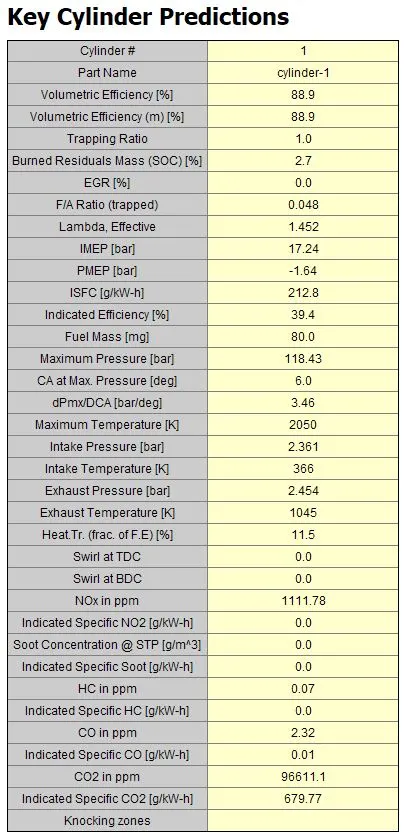
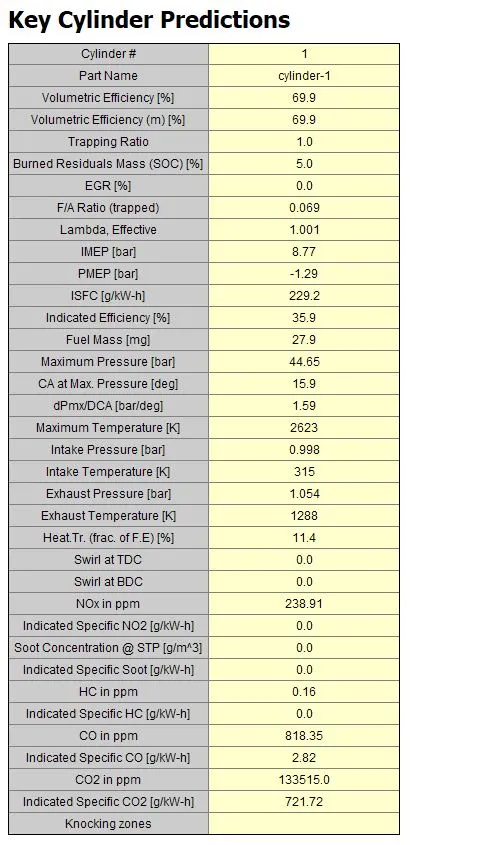
Fig.4 CI engine (left) vs SI engine (right)
vi. Other differences:-
- To control emissions SI engines SI-engines use 3-way catalytic converter whereas CI engine use DOC, DPF, SCR each.
- CI engine doesn't use spark plug due to self-ignite properties supported by high compression ratios.
- Abnormal combustion are common in both SI and CI engines with a slight difference. In SI engines knocking occurs at end of combustion, whereas detonation occurs in Ci engines at start of combustion.
- In SI engines introduction of air-fuel mixture is through tumble method (direct-port) and in CI engines fuel is introduced through helical port.
b. Parameters
- BSFC: Measure of fuel efficiency within a shaft reciprocating engine. It is the rate of fuel consumption divided by the power produced. From fig.3 for CI engine @4000 RPM it is observed as 246.4 g/KW-h and for SI engine @8000 RPM it is observed as 358.4 g/KW-h. Even at same RPM CI engines have less BSFC compared to SI engines.
- Exhaust Temperature: From figure 4 for CI engines @4000 RPM exhaust temperature is 1045 K and for SI engine @8000 RPM it is observed as 1288 K. Even at same RPM CI engines have less exhaust temperaturea compared to SI engines. This can be attributed to that fact that SI engines operate and richer A/F mixture and greater fuel burning results in rise of CO,HC emission and leads to higher exhaust temperature.
- A/F ratios: Diesel engines run on Lean mixture( air>fuel) it is because to self ignite automized diesel when injected. If run on rich mixtrure this will not atomize the fuel properly and hence there will be unburnt fuel. From fig.3 for CI engine @4000 RPM it is observed as 20.8:1 and for SI engine @8000 RPM it is observed as 14.5:1
c. Change MFB 50 and observe impact on performance
By changing the main duration as parameter performance impact is observed. Duration in crank-angle degrees of the main diffusion burn or the name of a dependency reference object. The duration should exclude the first 10% and the last 10% of the area under the main burn curve, i.e. the tails.
Three cases are noted as
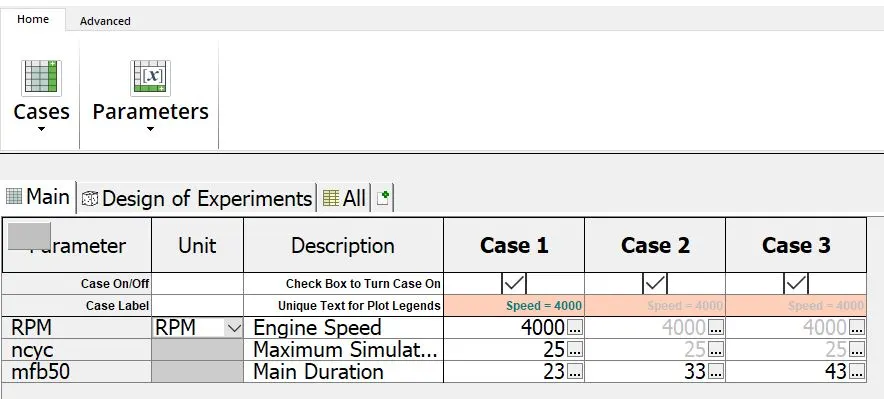
Following observation are noted:
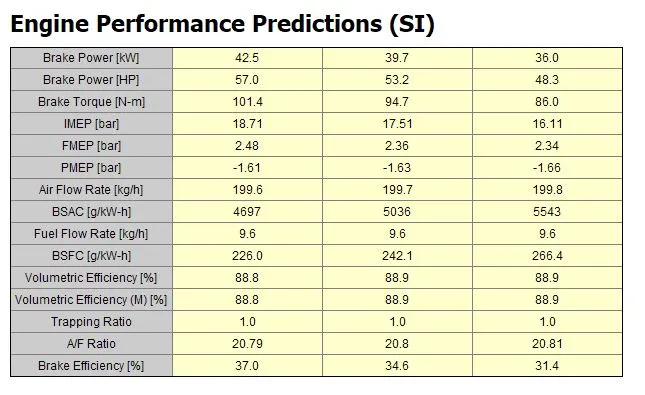
When duration in crank-angle degrees of the main diffusion burn is increased from 23 to 43 deg, Power and Torque both simultaneously decrease as is evident from above figure.
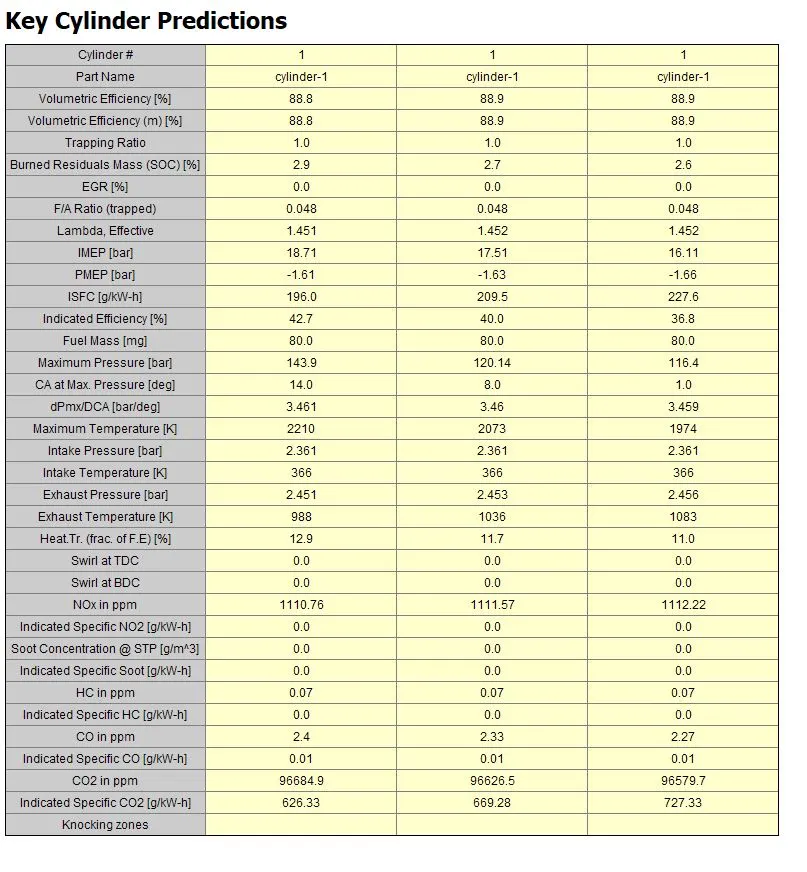
Further-more when duration in crank-angle degrees of the main diffusion burn is increased from 23 to 43 deg there is quite negligible impact on NOx, CO, HC emissions as seen in above fig.
Plots observation :
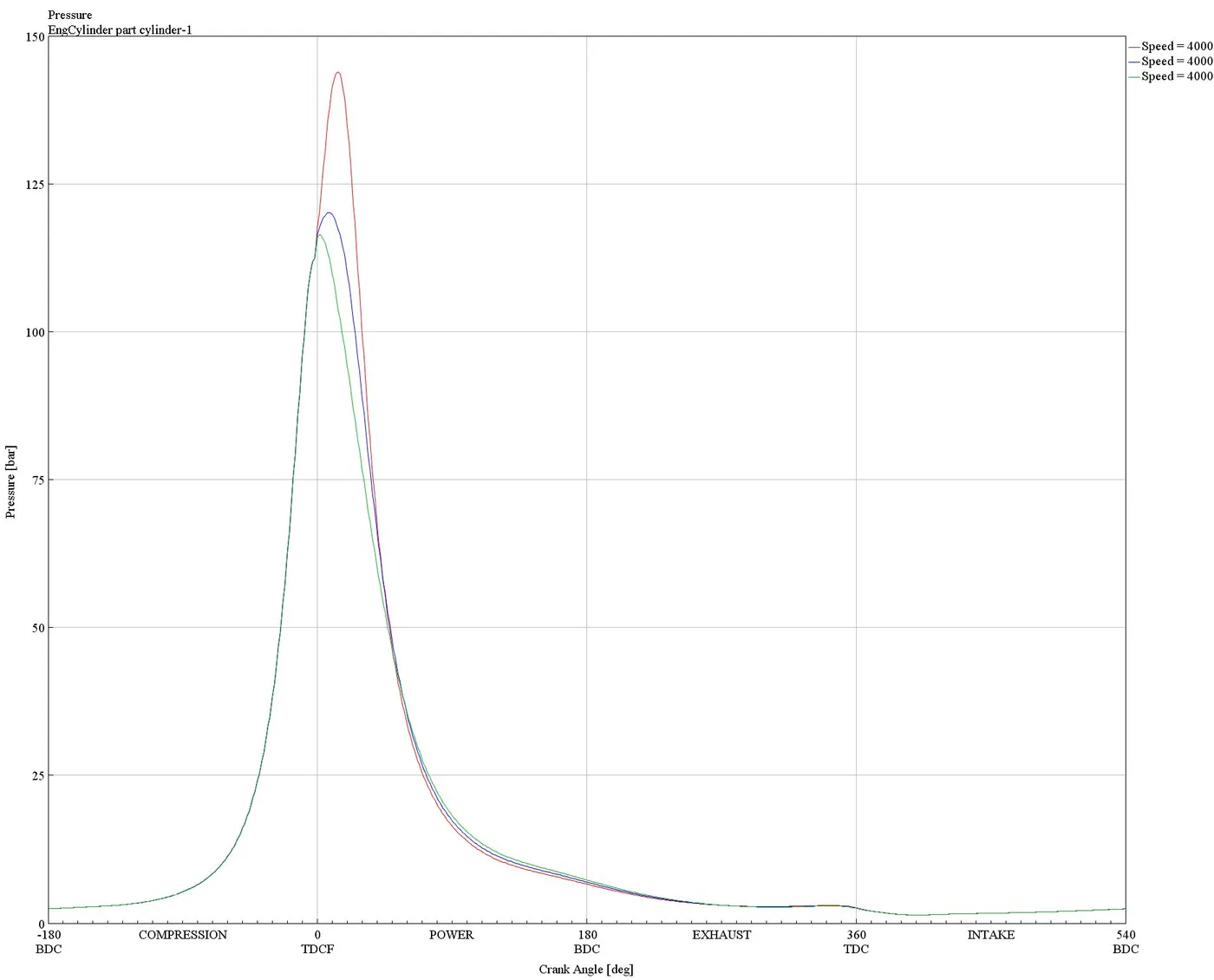
Pressure v/s Crank angle (Red-23 deg, blue-33 deg, green-43 deg)
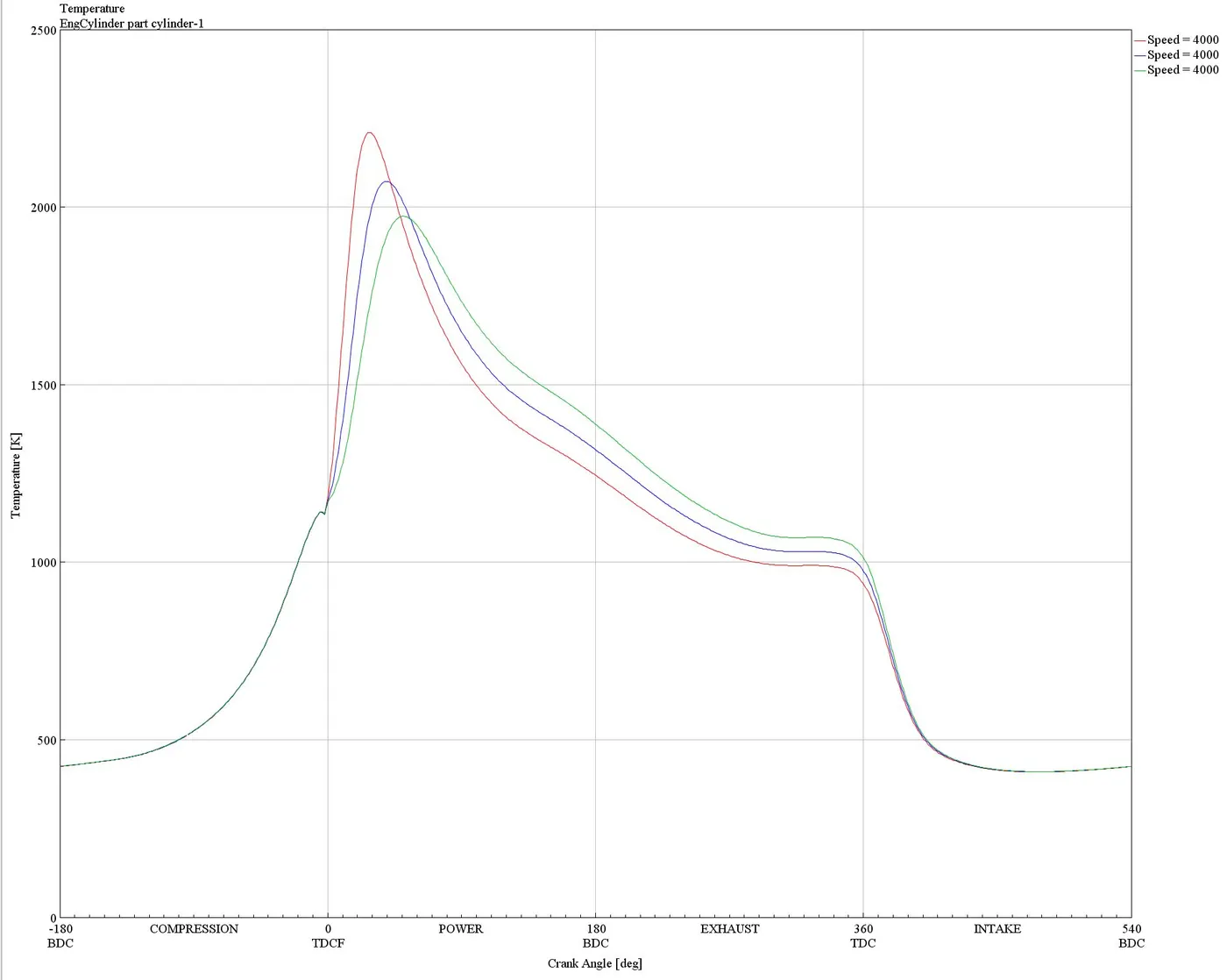
Temperature v/s Crank angle (Red-23 deg, blue-33 deg, green-43 deg)
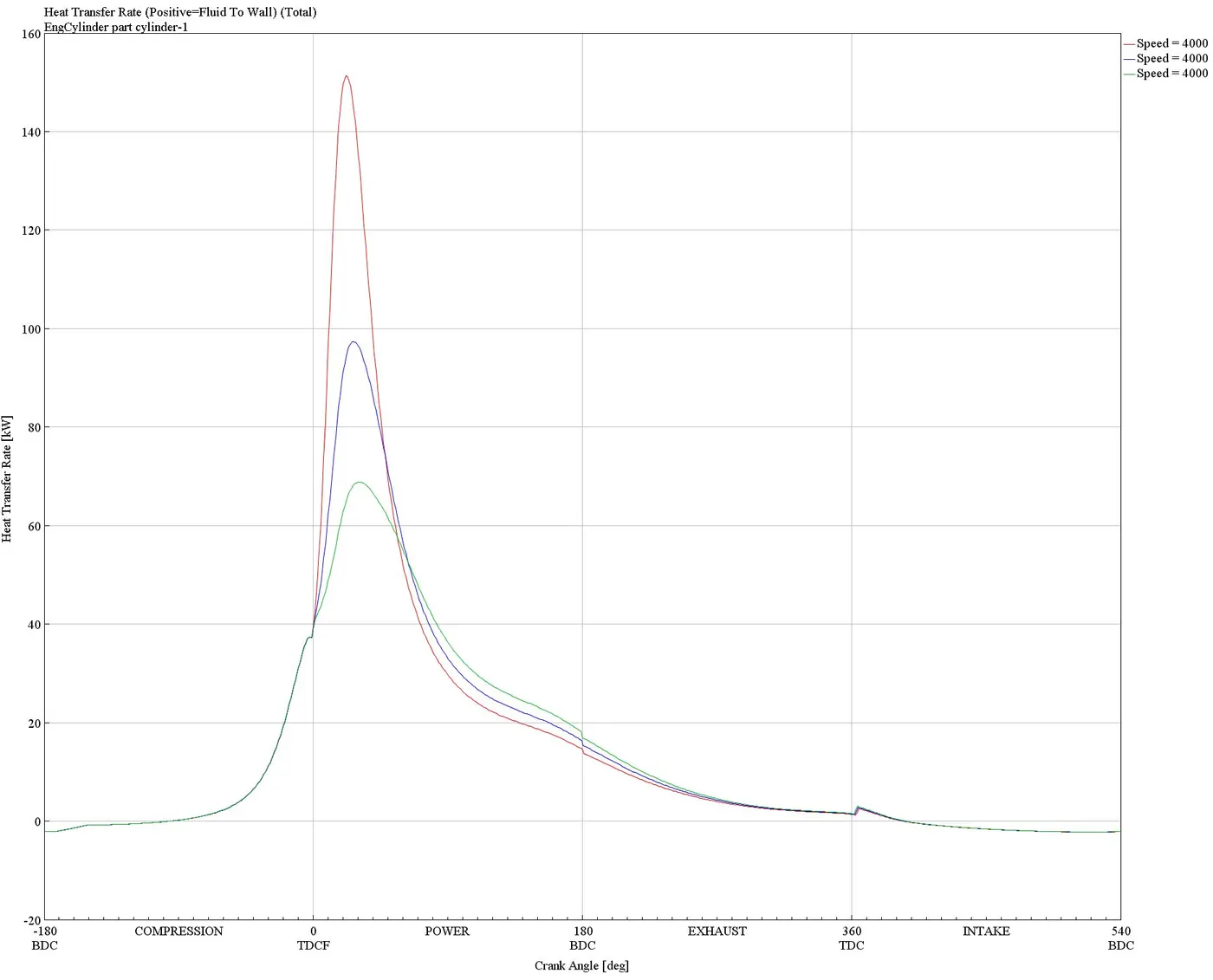
Heat transfer rate (Red-23 deg, blue-33 deg, green-43 deg)
It is evident from the above plots that as main duration is increased the maximum values of pressure, , temperature, heat transfer rate in cyinder is decreased. Also the pre-mixed combustion phase value rises to highest rate while slight change in mixed controlled phase.