Assignment 3-2D Element Formulation Challenge
Recommended properties:
| Parameters | Comment | |
|
Ishell =24 |
QEPH 4 nodes shells are best combination of cost and accuracy. | |
|
Ismstr=2 |
Full geometric nonlinearities (default)with possible small strain formulation activation in RADIOSS Engine. | |
|
Ish3n=2 |
Standard 3 noded shell (C0)with modification for large rotation(default) |
|
| N=5 | Number of integration points set to 5 for accuracy bending. | |
|
Ithick=1 |
Thickness change is taken into account for accuracy. |
|
|
Iplas=1 |
Iterative plasticity for good accuracy. |
Questions:
Comparison of results with base simulation and improved shell element properties
1.Using the crash beam file from the previous assignment, change the run time to 55 ms.
2. Change the number of animation steps during simulation to a minimum of 25 and maximum of 60.
3. Run the base simulation without any modification to element properties.
4. At the end of the simulation, do the energy error and mass error checks and determine whether results would be acceptable.
5. If acceptable, Plot rigid wall forces, internal energy, hourglass energy, contact energy, total energy of the simulations.
6. Change all the shell elements properties to recommended properties, save this as separate, rad files and run the simulation.
7. Follow steps 5 and 6.
8. Create a brief report comparing all the results from steps 5 and 6 for both simulations.
9. Comment whether there is any change in the results and why there is any change in the result.
ANSWER - :
AIM - : 2D element formulation challenge
Houeglass -: Hourglass is the deformation that is noticed in the deformation of elements due to applied load. but the strain energy due to deformation is not recorded for that element. it is also known as zero deformation modes.where an element is seen deformed.
it is usually seen in post - processing stage where elements can be seen in zig-zag formation.
Methods to the control hourglass -:
1) Perturbation method
2) Physical stabilization
PERTURBATION METHOD -:
1). In shell = 1,2,3,4 the hourglass deformation is detected with motion of the nodes.
2). if it is detected, an opposing force is applied on to the node to stabilize the deformation.
3). the amount of force inputted is based on the model's material applied like young modulus, yield stress and plastic tangent.
4) the opposing force produces an artificial energy called hourglass energy.
5) One disadvantages is that Q4 fail in case of large rotation and elastic loading - unloading cycles.
Physical Stabilization
1). In shell =24, shell elements control the hourglass from the material level.
2). Here, the hourglass loading stiffness and hourglass yield depends on that model's material properties like natural tangent modulus and naturul yield respectively.
3). By, this way, the hourglass is stabilized in QEPH elements.
4). Advantage over Q4 is that it works perfectly well at all kinds of loading - unloading cases.
Q4 element -:
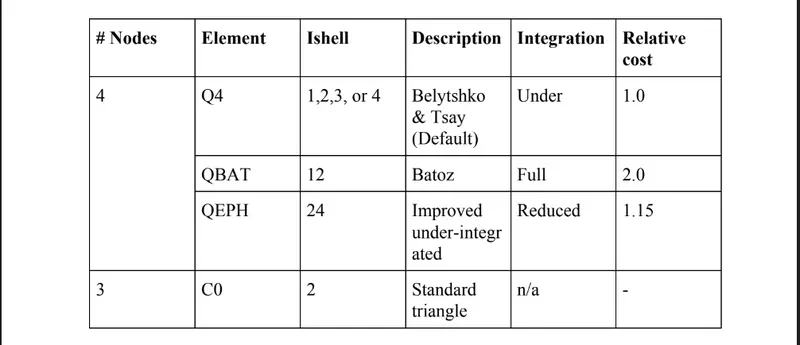
1). it is an under reduced - intergrated element.because it has only 1 integration point for an element.
2). it is represented in the radioss solver by an entity ' ishell (1,2,3,4)'.
3) usually ishell:1, ishell:4 elements are used , when no more velocities are to be found.
4). by, default, the solver takes as ishell:1.
5). as it has only 1 integration point, the time required to solve the problem with this type of element is relatively less.
6). the cost required to solve this type of element is relatively low.
7). but there will be no accuracy in the results.
QBAT element -:
1). it is a fully integrated element,which means it comprises 4 integrated points,each point is near to each node.
2). it is represented in the radioss solver by an entity named 'ishell:12'.
3). Because of these 4 gaussion integration points,there will be np hourglass deformation.
4). Using this element is not economical . but the achieved results are more accurate than the remaining ishell elements of quads.
QEPH element -:
1). it is an improved under integrated element with physical hourglass stabilization within itself.
2). it is represented in the radioss solver by an entity named 'ishell 24'.
3). this type of element is mostly used recently . because of its best compromise between the cost, quality& accuracy in results.
4). it is widely used in the automotive industry.
CO element -:
1). it is a standrad co- rotational tringale, with modification for large rotations.
2). usually, it helps in representing the tria elements with the entity named 'ish3n:2'.
3). it consists of 1 integration point.
4). no hourglass deformation.
5). low cpu cost.
6). results may be not accurate.
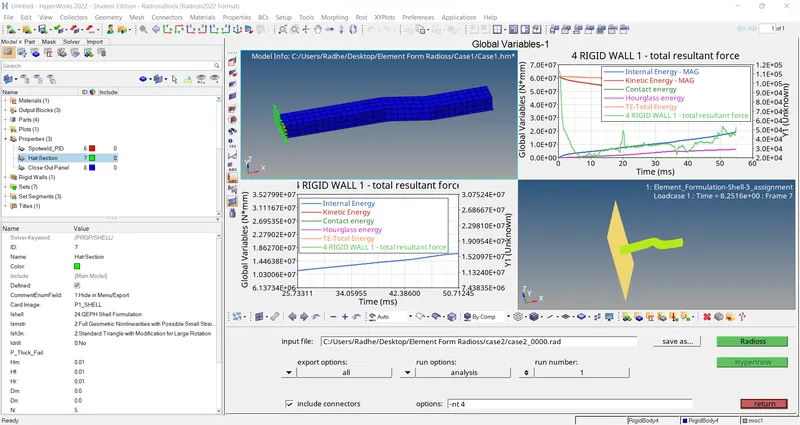
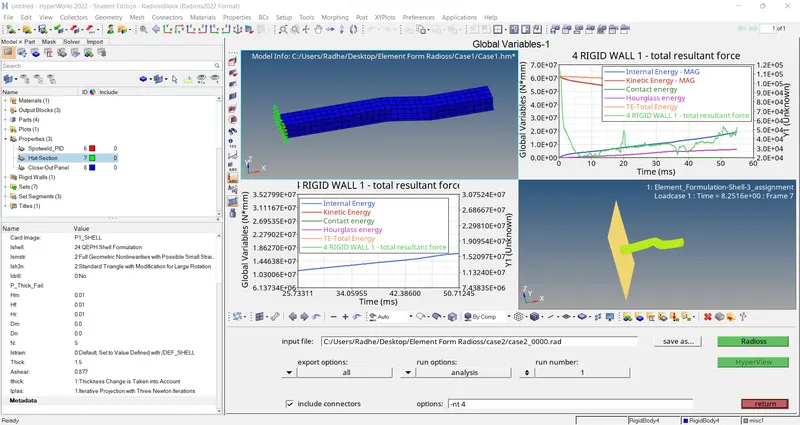
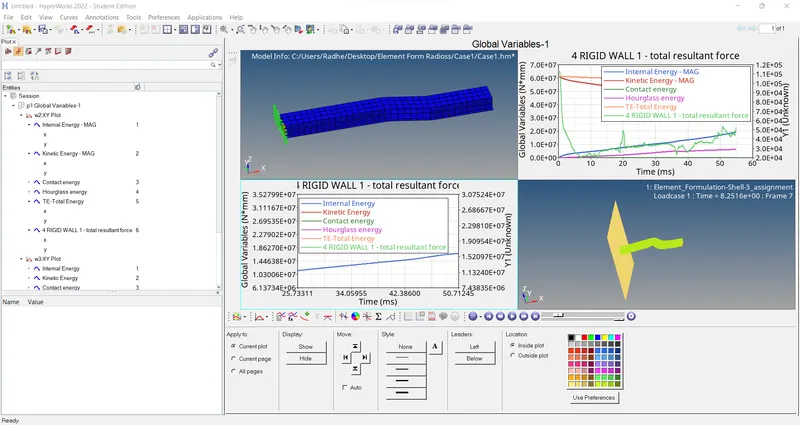
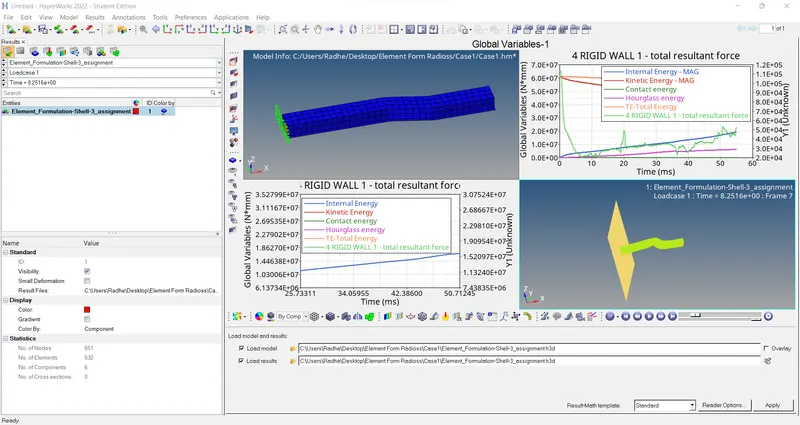
RESULTS -: case 2 is more accurate than case 1.