Assignment 3-2D Element Formulation Challenge
AIM:
To perform the simulation of a crash analysis of a beam with a rigid wall and know about the results.
OBJECTIVE:
The objective of the simulation is to get familiar with the Radioss solver and compare the results when the right properties are assigned in the property cards & when they are not assigned.
Hourglass energy:
- It is an effect on the elements which causes unrealistic or extreme deformation in the elements but the energy released due to deformation is not passed to the neighbouring elements. This effect is called the hourglass effect and the energy related to it is called the hourglass energy.
- This causes the elements to intersect within each other. This happens during the formulation of elements when there is only 1 integration point in the surface of the element. The result is calculated only about that point and then interpolated to the element.
PROCEDURE:
Case 1: Property cards not defined properly
First, the starter file is loaded in the Hyperworks application. Then the radioss solver is opened and the analysis is started. The analysis is done in the Analysis panel inside the Radioss command. The output file such as the animation file, output plot, etc. are saved in the required path. Once the analysis is completed, the results are viewed.
Case 2: Property cards defined properly
As in case 1, the starter file is imported. Then the following properties are assigned in the property cards.
| S.No | Parameter | Value |
| 1 | `I_(shell)` | 24 |
| 2 | `I_(smstr)` | 2 |
| 3 | `I_(sh3n)` | 2 |
| 4 | N | 5 |
| 5 | `I_(thick)` | 1 |
| 6 | `I_(plas)` | 1 |
Then the simulation is carried out in the same way as earlier.
RESULTS:
Case 1:
Output files (energy & mass error):
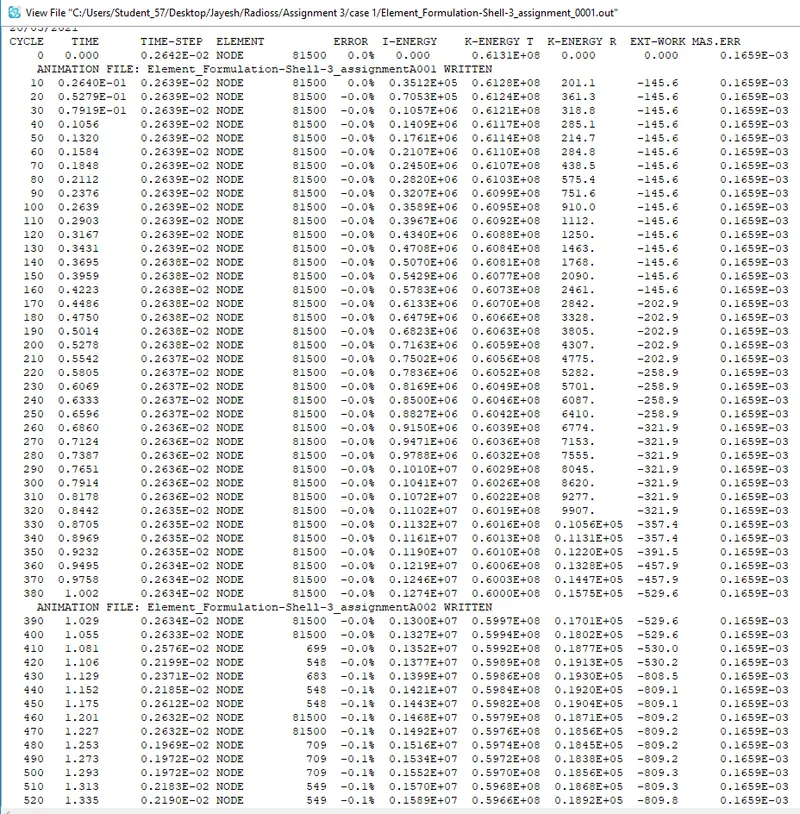
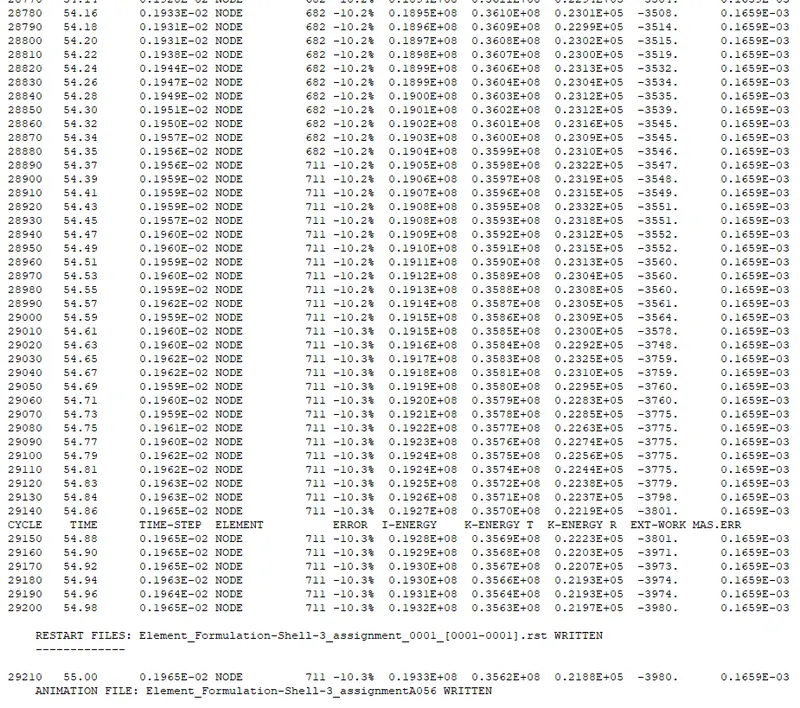
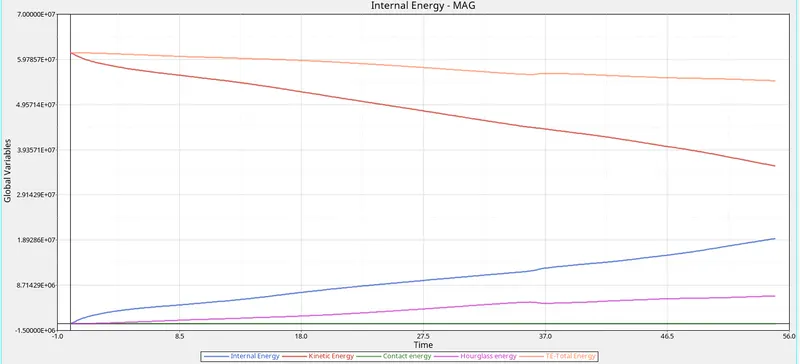
Output plots - Internal energy, hourglass energy, contact energy, total energy of the simulation
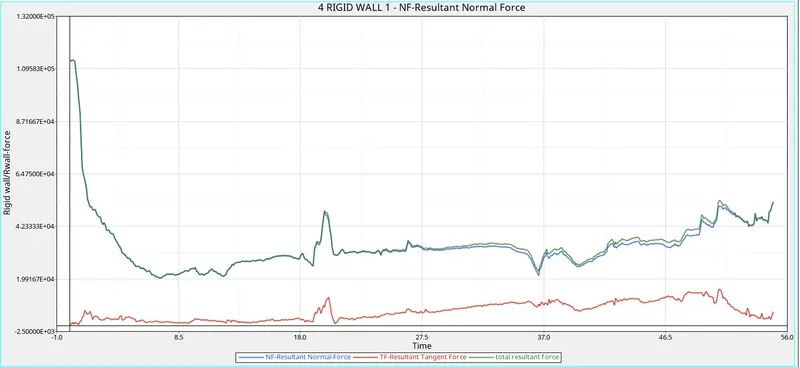
Output plots - Rigid wall forces
Analysis simulation
Case 2:
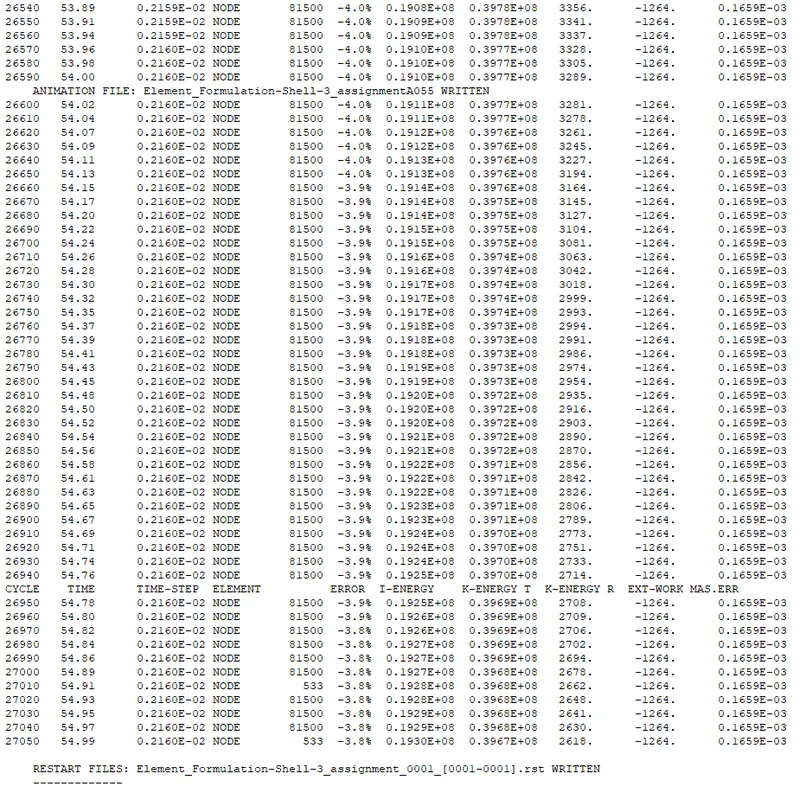
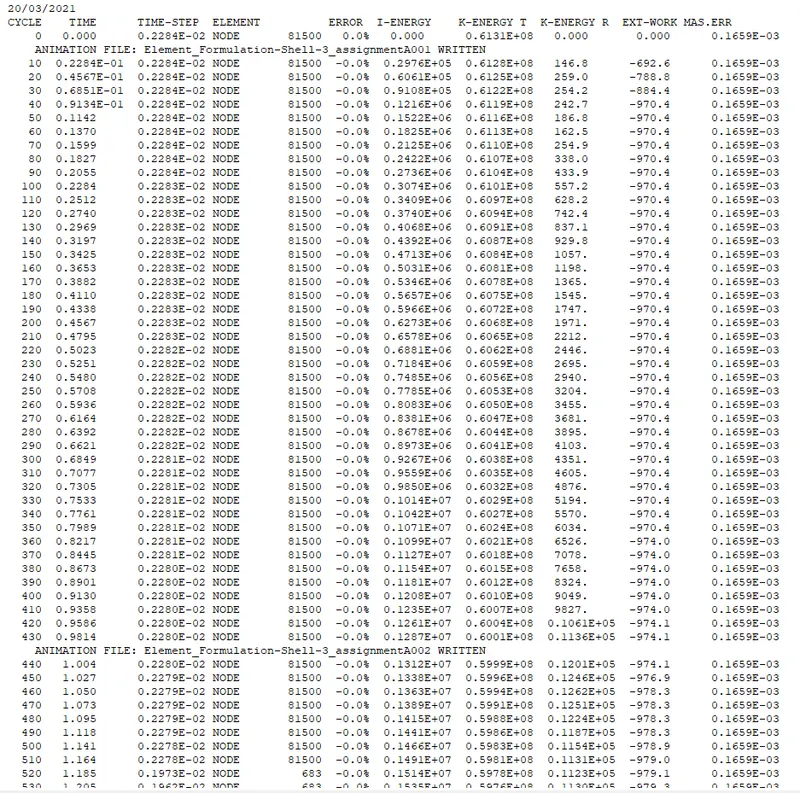
Output files (energy & mass error):
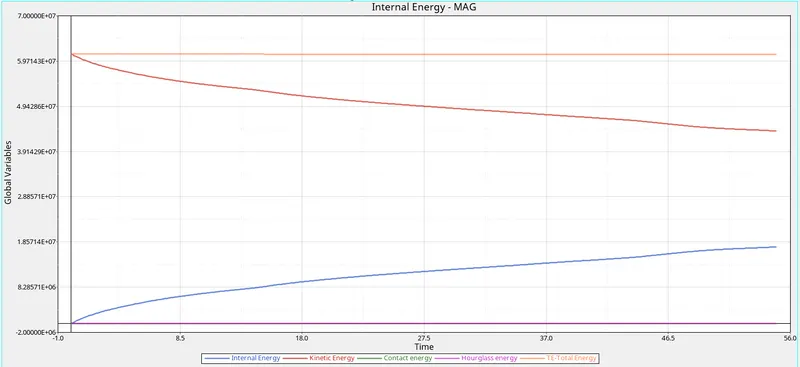
Output plots - Internal energy, hourglass energy, contact energy, total energy of the simulation
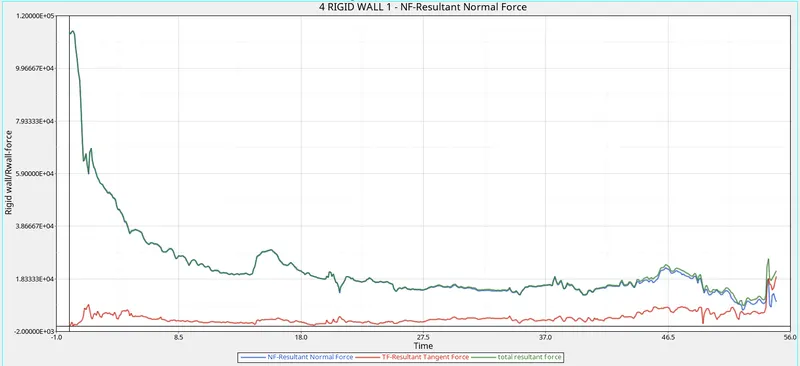
Output plots - Rigid wall forces
Analysis simulation:
Comparison:
- On comparing the two plots, we can right away say that in case 1 there is hourglass energy which is increasing as the analysis is carried out, whereas in case 2 it is completely zero throughout the simulation. This is one of the major differences.
- Hourglass energy is one quantity which is not desirable to be seen as it affects the result of the analysis. The difference can be clearly seen when the properties are assigned and when they are not.
- Also as the hourglass energy is zero in case 2, the total energy is higher than that in case 1. In case 1, the total energy falls as the analysis is carried out, whereas in case 2 it is almost the same.
- The internal energy sees a steeper increase in case 2 as compared to a less steeper increase in case 1. But in the end, the internal energy is highest in case 1.
- The kinetic energy falls very steep in case 1 as the analysis is carried out whereas it is less steeper in case 2. At the end of the analysis, the kinetic energy is higher in case 2 than that of case 1.
CONCLUSION:
From the output results, we can draw inference of the importance of the values in the property card, which make a difference in the result of the analysis. The major difference being in the prevalence of the hourglass energy, which is not desirable.