Advanced Sheet Metal Design Using NX Cad Challenge_2_Box Assembly
BOX ASSEMBLY
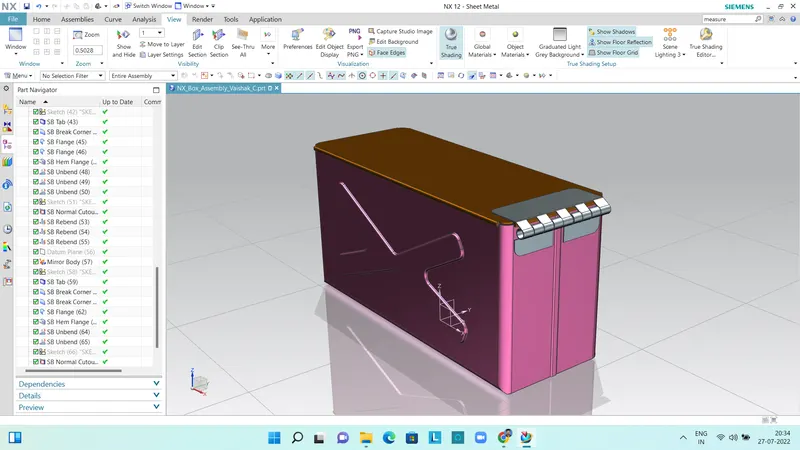
Aim: To design a Sheetmetal Box Assembly using Siemens NX Sheetmetal Application.
Introduction
Sheet metal is metal formed into thin, flat pieces, usually by an industrial process. Sheet metal is one of the fundamental forms used in metal working, and it can be cut and bent into a variety of shapes. The thicknesses can vary significantly; extremely thin sheets are considered foil or leaf, and pieces thicker than 6 mm are considered plate. Its thickness is quantified by a measure known as its gauge. The metal will be thin if the gauge number is larger. A wide range of products are manufactured with the use of sheet metal making it an essential part of the modern world. Sheet metal is used in automobile and truck bodies, major appliances, airplane fuselages and wings, tinplate for tin cans, roofing for buildings (architecture), and many other applications.
Design Methodology
Box base creation => Box walls creation => Joining walls by Hemming => Mirroring to form closed box => Feature creation => Lid creation => Hinge creation
Modelling Steps
1. First of all, the base of the box is created using tab command and then walls are created by flange command.
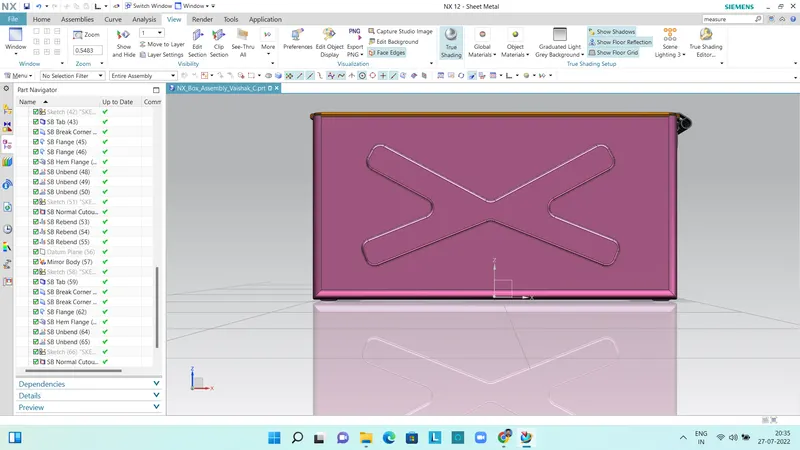
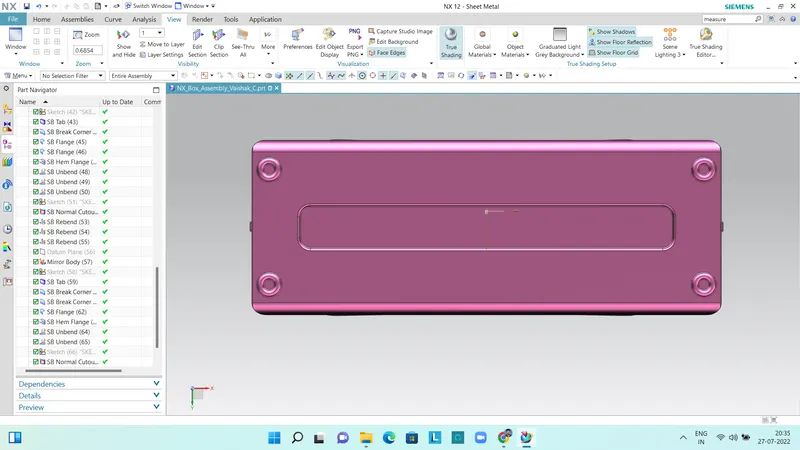
2. Then the side walls are joined by hemming and are locked. Then the created model is mirrored to form a closed box and then combined using unite command. After that features like dimples and beads are created.
3. After the creation of box, the lid is then created by defining a separate plane at a required height and created the sketch. Using tab option, top lid is created and is given with small side flanges.
4. Then for creating hinges, initially its base is created by tab command and then it is extended using flange command and at last open loop hem is created. After that cutouts are made after unbending the hinge and is then rebended.
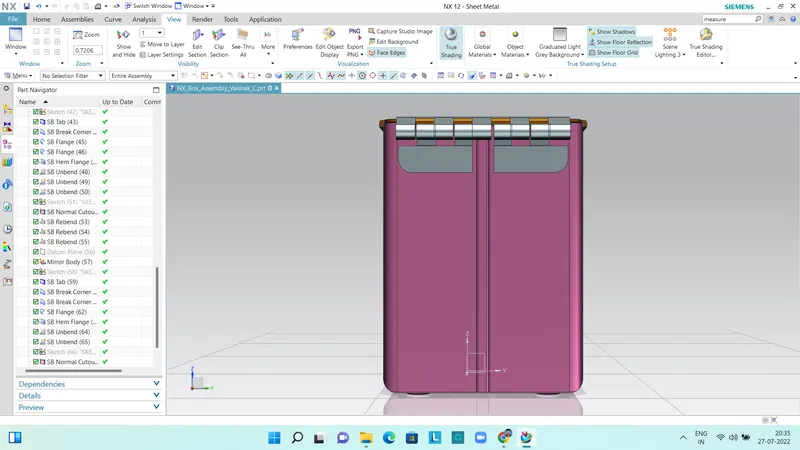
5. After creating hinge portion on the box, the other portion of hinge is created on the lid by the same method. And the final box assembly is created.
Final Model in Different views: