Flow over a Tesla Cybertruck
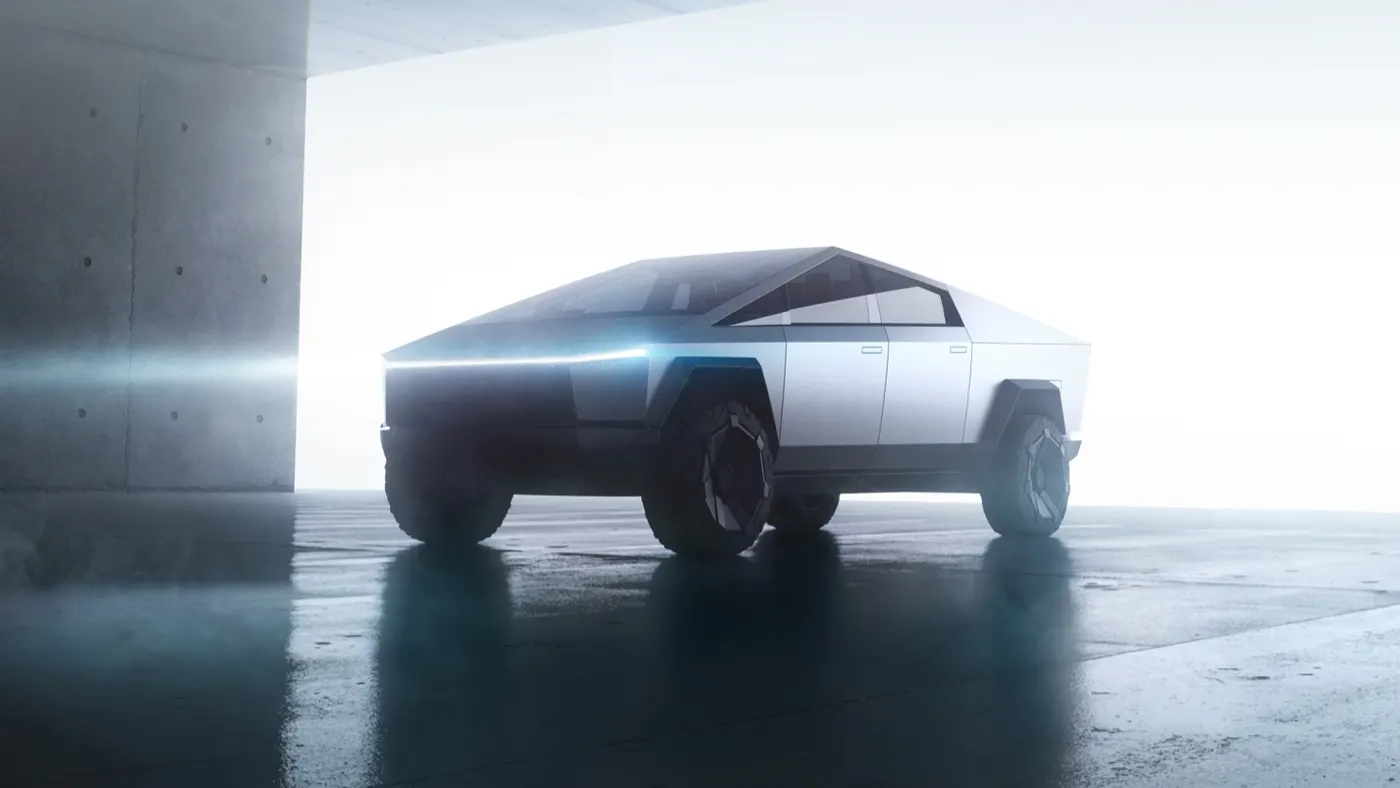
The Tesla Cybertruck seamlessly blends together something 4 year old me would draw and something out of a dystopian future. From the design, it looked like the team at Tesla decided to turn off the wind tunnel and forgot about the CFD options available while designing the car. The opposite approach was taken and an external aerodynamics simulation was run on the car.
Before we get into the aerodynamics of the car, let’s first take a small diversion and talk about drag and the production of drag. Assume a body in the path of a fluid or a stationary fluid where a body is moving. The property of fluids is such that is bends over the body. These are termed as streamlines. Each particle in the stream knows when it is about to impact a body and curves such that it moves over the body. After a point, the body stops impacting the flow and is termed as the freestream conditions. We are concerned with how the body affects the fluid and vice-versa in the case of aerodynamic study.
Here, we need to understand a few terms like separation, boundary layer reversal, wake and drag. Every body that comes into contact with a fluid produces a wake due to the separation of the flow from the body. The frictional forces cause the velocity near the body to go towards zero and may also cause negative velocity. This is termed as boundary layer reversal and we can see this as the recirculation zone behind bodies. When we have boundary layer reversal, we have flow separation and subsequently, we have a wake.
In the wake, we have a vacuum because there is no fluid in this region. This vaccum has a low pressure. In front of the body, we have the fluid coming to rest because of the body obstructing the flow. This is termed as the stagnation point and using Bernoulli’s theorem, we know that the pressure will be high. Now, we have high pressure in front of the body and low pressure behind the body. This net pressure difference imparts a force on the area in front of the body. This force is termed as the drag force. In order to have forward motion, we need to overcome drag. There is a lot of analysis that goes into making sure the vehicle produces as low a drag as possible in order to be as efficient as possible.
The production of lift also follows the same logic. Here, we use the pressure above and below the body to measure how much lift the body is able to produce. In order to produce lift, the force due to the weight needs to be overcome. In the case of downforce, this force adds on to the downforce. The vacuum behind the car can be taken advantage of for this purpose. The most common method is by implementing a spoiler. The spoiler serves the purpose of an inverted airfoil wherein it produces downforce by means of the pressure difference above and below the spoiler.
The major problem areas with the Tesla look to be the sharp edges and the slant at the back. The sharp edges are going to cause tip vortices and the slant is going to lead to separation. That is a problem if we are trying to reduce drag. Of course, an electric motor is going to have more torque and that is going to allow it to better overcome the drag, but drag is drag and drag is going to cause problems if the car is going to be marketed with a range of 500 miles. If most of the available power is going to be used to overcome drag, that range doesn’t sound possible. But that’s jsut speculation and speculation only goes so far. All said and done, a wind tunnel test would be the best possible measure of how the car affect the air stream. Unfortunately, we don’t have access to a wind tunnel or the model of the car.
That would have been a problem if not for CFD. We immediately got to work and setup the simulation. We post processed the results and things started to get interesting. While the car looked like an over-sized soapbox, it might just be aerodynamically efficient.
The steady state results are as follows:
Based on the design, since the car has a lot of sharp corners, it looked like the flow would immediately separate at the top of the car. However, from the above image, that doesn’t look to be the case. Flow doesn’t seem to separate at the top of the car and even better, the car produces a very small wake when the air stream finally decides to separate at the rear. Brilliant!
In order to better corroborate that theory, a few probes were placed after the top of the car and the streamwise velocity was studied. The best test of separation would be to see if the boundary layer reversed at the top of the car. This would show up as negative velocity as we go nearer to the wall. The line probes were places as follows:
6 line probes were used in total. 4 at the top of the car and 2 behind the car in the wake. Fantastically, there was no negative velocity. There was no separation at the top of the car.
The first 2 probes that were studied were the ones that were placed inside the recirculation region.
These 2 probes were selected such that they are completely inside the recirculation region. From the probes we can see that the velocity is least at the center of the recirculation region. The physics seem to be correctly captured.
The next 4 probes were placed sequentially at the top of the car from the top point where it looked like separation would occur towards the back of the car.
The 4 plots attached above empirically prove the theory that there is no separation at the top of the car. All 4 probes are from the top of the car and show no negative velocity and subsequently prove that there is no separation. This lack of separation can be explained by means of the Coanda effect which states that a stream of fluid will stay wholly attached to a body if the pressure above the body is sufficiently greater than the pressure below the fluid to push the fluid down onto the surface of the body. Better yet, when there is no separation and owing to the Coanda effect, the car is not going to produce lift either and is going to be much better stuck to the ground.
The Tesla cybertruck while at first glance looks to be aerodynamically inefficient but from this study, it looks otherwise. The car has a reported range of 500mi and it looks like the drag is not going to be as high a factor as previously thought in reducing the range of this car.