I have uploaded all the necessary files and I'm attaching a google drive link too.
https://drive.google.com/open?id=1Xx4DoXdSB4qKOJ8B9AjEz7nNEIdNUFM_
Drag force against a Cyclist
Problem Statement:
Write a Matlab program to calculate drag force against a cyclist
Write a program to plot
Velocity vs Drag force.
Drag Co-efficient vs Drag force
Theory:
Velocity:
It can be defined as the rate of change of an object’s position with respect to a frame of reference and time. It is a vector quantity as it consists of both magnitude and direction.
The SI unit of velocity is meter per second.
It is denoted by v = m/sec.
Drag Co-efficient:
The drag coefficient is a measure of the effectiveness of a streamline aerodynamic body shape in reducing the air resistance to the forward motion of a vehicle. It is a dimensionless quantity.
It is denoted by Cd.
Frontal area:
It can be defined as the area as projected right along the velocity vector. It is nothing but the frontal surface area of the object that gets into contact with the fluid while in motion.
It is denoted by A = m^2
Density:
Density is defined as the ratio between mass and volume.
The formula for density is d =M/V, where d is density, M is mass, and V is volume. Density is commonly expressed in units of kilograms per cubic metre.
In order to calculate the drag force over a cyclist we use the below formula
Fd = (1/2) (Cd) (d) (v2) (A).
Fd = The drag force acting on the cyclist (kg-m/sec^2)
Cd = drag coefficient
d = density (kg/m^3)
v = velocity (m/sec)
A = frontal surface area (m^2)
Programming for the calculation of drag force on a Cyclist
case(a): where the drag coefficient is constant for a given area and velocity isn’t.
�lculating the drag force against a cyclist where Cd is constant and
%velocity is varied and to plot grap against Velocity vs Fd
clc
clear all
close all
%Inorder to calculate we have to define the variable in the equation
%Here we assume a constant drag coefficient for a given area
cd = 0.8;
�nsity of air in kg/m^3
d = 1.225;
%Frontal area of a cyclist in m^2
a = 0.430;
%velocity at various instances in m/sec
v = 20:2:40;
%squaring velocity
y = v.^2;
�lculating the drag force
fd = y.*(0.5)*cd*d*a;
disp(v);
disp(fd);
%we are plotting a graph between velocity and drag force
plot(v,fd,'linewidth',3,'color','r');
xlabel('Velocity');
ylabel('Drag force');
grid on
Result:
20 22 24 26 28 30 32 34 36 38 40
Columns 1 through 10
84.2800 101.9788 121.3632 142.4332 165.1888 189.6300 215.7568 243.5692 273.0672 304.2508
Column 11
337.1200
Graphical result:
Conclusion:
From the above graph we have found that square of the velocity is directly proportional to Drag force.
Fd ∝ V2
Programming for the calculation of drag force on a Cyclist
case(b): where the velocity is constant for a given area but with variable drag coefficient.
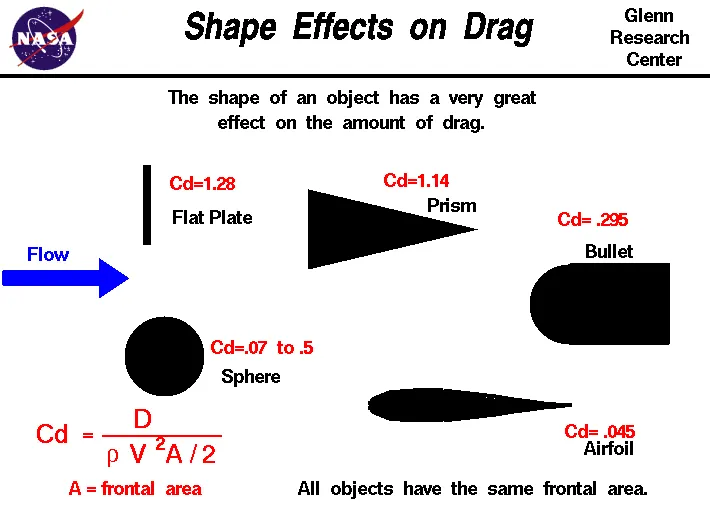
�lculating the drag force against a cyclist where velocity is constant and
� is varied at constant area and to plot grap against Cd vs Fd
clc
clear all
close all
%Inorder to calculate we have to define the variable in the equation
%Here we have various constant drag coefficient for a given area
� for flat plate is 1.28
� for a sphere is 0.5
� for a bullet is 0.295
� for a prism is 1.14
� for a airfoil is 0.045
cd = [0.045, 0.295 , 0.5 ,1.28 ,1.14];
�nsity of air in kg/m^3
d = 1.225;
%Frontal area of a cyclist in m^2
a = 0.430;
%velocity in m/sec
v = 45;
%squaring velocity
y = v.^2;
�lculating the drag force
fd = cd.*y*(0.5)*d*a;
disp(cd);
disp(fd);
%we are plotting a graph between drag coeff and drag force
plot(cd,fd,'linewidth',3,'color','r');
xlabel('Drag Coefficeient');
ylabel('Drag force');
grid on
Result:
0.0450 0.2950 0.5000 1.2800 1.1400
24.0000 157.3336 266.6672 682.6680 608.0012
Graphical Result:
Conclusion:
From the graph we can conclude that drag coefficient is directly proportional to drag force at
variable Cd when area, velocity, density are constant.
Cd ∝ Fd