 Free · 3 lessons · no payment
Introduction to ROS/GitHub/Linux: 3 free lessons
Three free lessons from Skill-Lync's Introduction to ROS/GitHub/Linux course. They introduce autonomous driving, the sensors used for perception (camera, lidar, radar, ultrasonic) and the idea of sensor fusion. They then cover the self-driving software stack, localization and path planning, the levels of autonomy, and what the Robot Operating System offers: messaging, tools such as RViz and RQT, and its drawbacks.
Last updated 16 Nov 2026 · 3 free lessons (1 h 20 min) · full course: 43 lessons (18 h 39 min), paid · ₹40,000
 Free lesson 1 · 22 minAutonomous Driving Basics: Perception, Control and Sensor Trade-Offs
What will you learn in the free Introduction to ROS/GitHub/Linux lessons?
- Perception versus control in self-driving cars
- Strengths and limits of camera, lidar and radar
- Localization, obstacle avoidance and path planning
- ROS messaging, TF, RViz and RQT tools
Free lessons you can watch now
- Lesson 1 · 22 minAutonomous Driving Basics: Perception, Control and Sensor Trade-OffsThe instructor splits autonomous driving into perception and control, using Waymo and Tesla as examples and the 2018 Uber and Tesla fatalities as limits of the technology. It compares camera, lidar, radar and ultrasonic sensors, explaining why sensor fusion is needed.
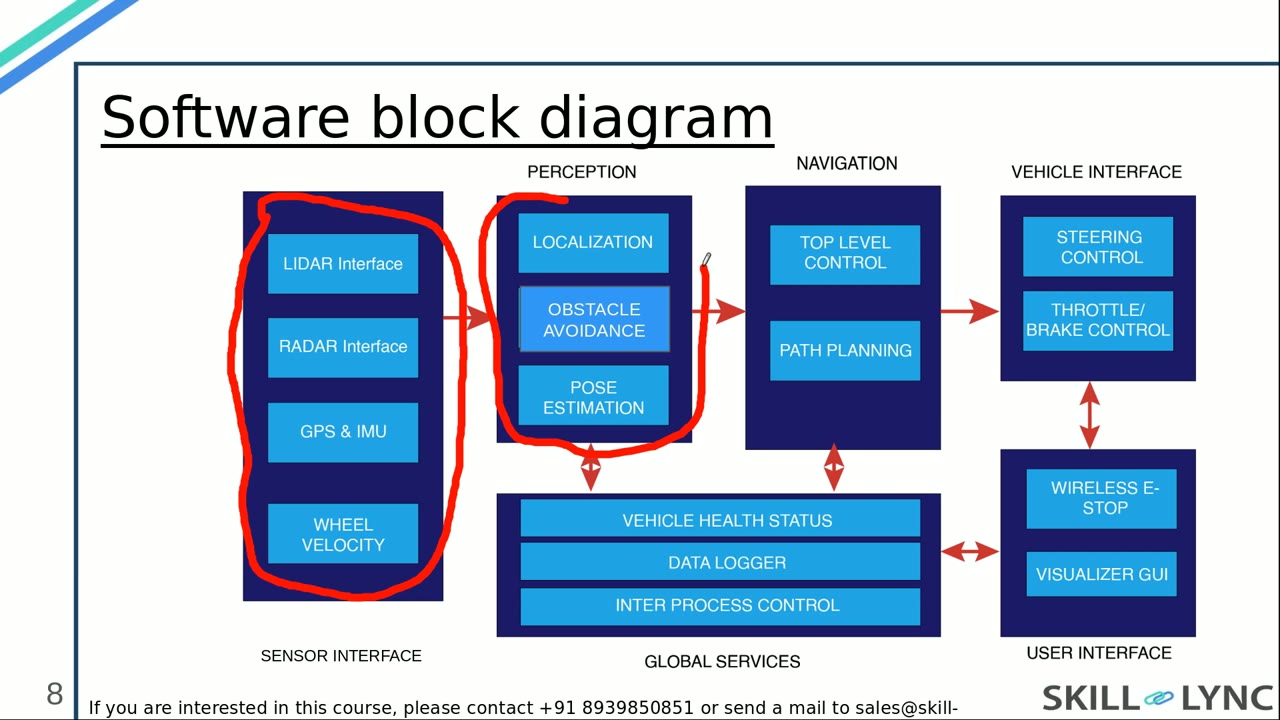 Lesson 2 · 36 minSelf-Driving Software Stack, Localization and Levels of AutonomyThe lesson outlines the software block diagram: perception, navigation and diagnostic stacks with an emergency stop. It explains lidar time of flight, radar, GPS, IMU and wheel encoders, then localization, obstacle avoidance, pose estimation and path planning, followed by safety eras and autonomy levels L0 to L5.
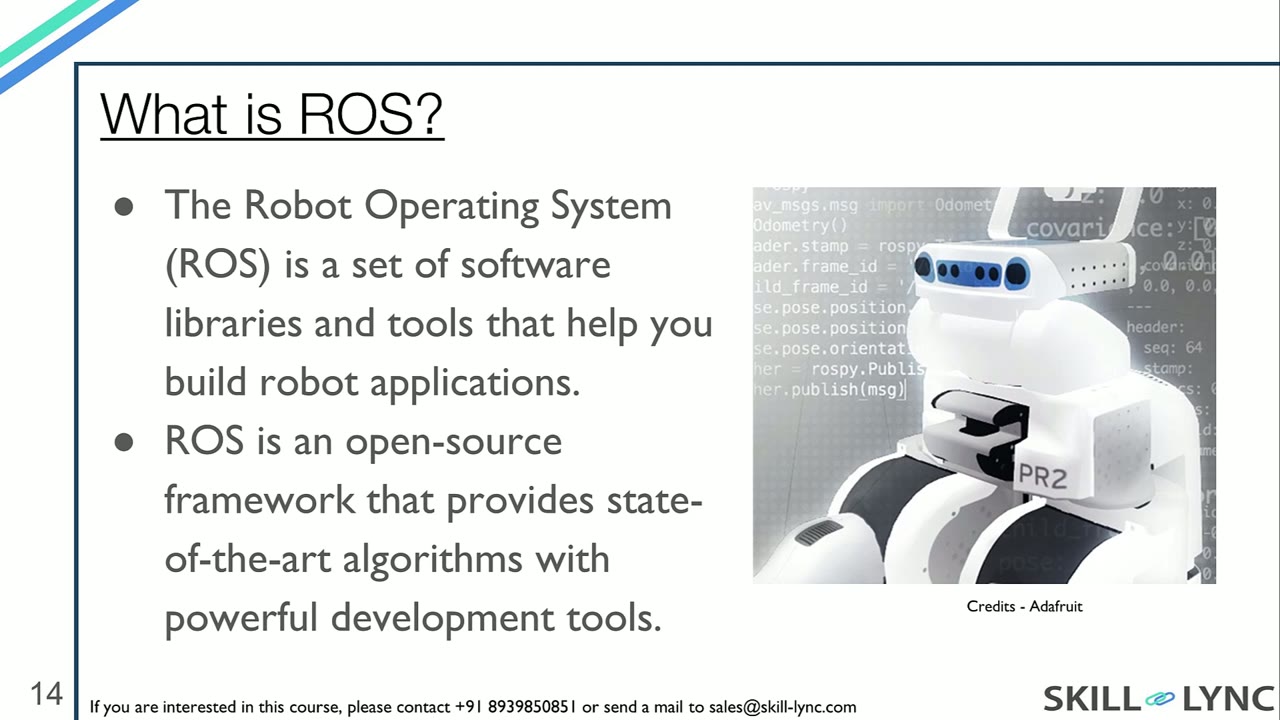 Lesson 3 · 23 minWhat ROS Is: Messaging, TF, Visualization Tools and DrawbacksThe instructor introduces the Robot Operating System as an open source framework created at Willow Garage in 2007. It covers publish-subscribe messaging, recording and playback, services, parameters, standard messages, the TF library, tools such as RViz and RQT, and drawbacks including dependence on a single component and open source risks.
Which lessons of Introduction to ROS/GitHub/Linux are free?
The first 3 lessons are free on Grow by Skill-Lync: 1 h 20 min of video from Skill-Lync's Introduction to ROS/GitHub/Linux course that you can watch here at no cost: leave your name and phone number once and they play (as of 16 Nov 2026). The full course is paid (₹40,000); its other 40 lessons are listed in the outline below so you can see what each one covers.
How long is the Introduction to ROS/GitHub/Linux course?
The full course has 43 lessons and 18 h 39 min of recorded video, plus the projects and assignments that come with enrolment. The free lessons alone take about 1 h 20 min, so you can finish them in an evening and decide whether to continue.
What comes after the free lessons?
Lesson 4 onwards is in the paid Introduction to ROS/GitHub/Linux course on Skill-Lync, with mentor support and a certificate. For a career in Automotive, the Post Graduate Program in Hybrid Electric Vehicle Design and Analysis goes further with industry projects and placement support.